 ProMapRanker
Best SOC Services for Cybersecurity in 2026


Mid-market teams wanting broad coverage · Pricing starts at: See website
Key takeaways
- Most managed SOC and MDR providers price by quote, not by a public rate, so compare the full scope of monitoring before comparing price.
- Tool-agnostic providers such as Expel and Red Canary layer over your existing tools, while platform providers such as CrowdStrike and Sophos go deepest with their own stack.
- Response authority matters: ask in writing whether the provider can isolate a host without waiting for your approval.
- Huntress is the clearest published-price benchmark for smaller teams, while Arctic Wolf and Rapid7 suit mid-market teams with broader log and cloud coverage.
- A managed SOC supports lawful, authorised security monitoring only, and it does not replace your own incident response plan or legal duties.
Quick comparison
| Pick | Great for | Pricing starts at | Free tier | |
|---|---|---|---|---|
| Arctic Wolf | Mid-market teams wanting broad coverage | See website | No | Visit |
 CrowdStrike Falcon Complete | Enterprises on the Falcon platform | See website | No | Visit |
 Rapid7 MDR | Teams pairing detection with risk data | See website | No | Visit |
 Expel | Teams keeping their existing tools | See website | No | Visit |
 Red Canary | Tool-agnostic detection and response | See website | No | Visit |
 Sophos MDR | Sophos shops wanting fast response | See website | No | Visit |
 Huntress | Small teams needing published pricing | $8.99 per endpoint per month | Free trial | Visit |
 SentinelOne Vigilance | SentinelOne customers wanting full response | See website | No | Visit |
 Microsoft Defender Experts | Microsoft 365 shops | $12 per user per month | No | Visit |
The best SOC services for cybersecurity
A security operations centre, or SOC, watches your systems around the clock, triages alerts, and responds when something looks wrong. The providers below sell that staffed service, usually called managed detection and response, rather than selling software alone. Note that only an independent auditor issues a SOC 2 report where relevant, and buying security software alone does not make an organisation compliant.
Arctic Wolf is a natural first call for mid-market organisations that lack a full overnight security team. Its concierge model pairs you with a named team, and its coverage reaches beyond endpoints into cloud and network telemetry, which matters because attacks rarely stay on one laptop. That breadth helps smaller IT teams that cannot stitch together five separate monitoring tools themselves.
The main friction is pricing transparency. Arctic Wolf prices by quote, so budgeting requires a sales conversation and a clear inventory of endpoints, servers, and log sources. Ask exactly which data sources are included, how long logs are retained, and what the provider can do without your approval during an incident, since those answers change the real value of any quote.
- Broad log and cloud coverage
- Concierge-style named team model
- Flexible tooling approach
- Quote-only pricing
- Response authority and scope need careful contract review
CrowdStrike Falcon Complete pairs the Falcon platform with a managed team that can act decisively, including isolating hosts and stopping malicious processes. For organisations already standardised on Falcon, that combination is hard to beat, because the analysts work with the same telemetry your own team sees, and containment does not wait for a tool handoff. Large enterprises with strict response-time needs tend to value that authority most.
The catch is commitment. Falcon Complete requires Falcon licensing on top of the managed service, so the total cost is higher than a quote for the service alone suggests. Smaller teams may find the platform requirement and the price hard to justify, while larger Falcon shops will see it as the most complete option here.
- Full containment authority
- Deep Falcon telemetry
- Large analyst team behind the service
- Requires CrowdStrike licensing
- Premium pricing that suits larger budgets
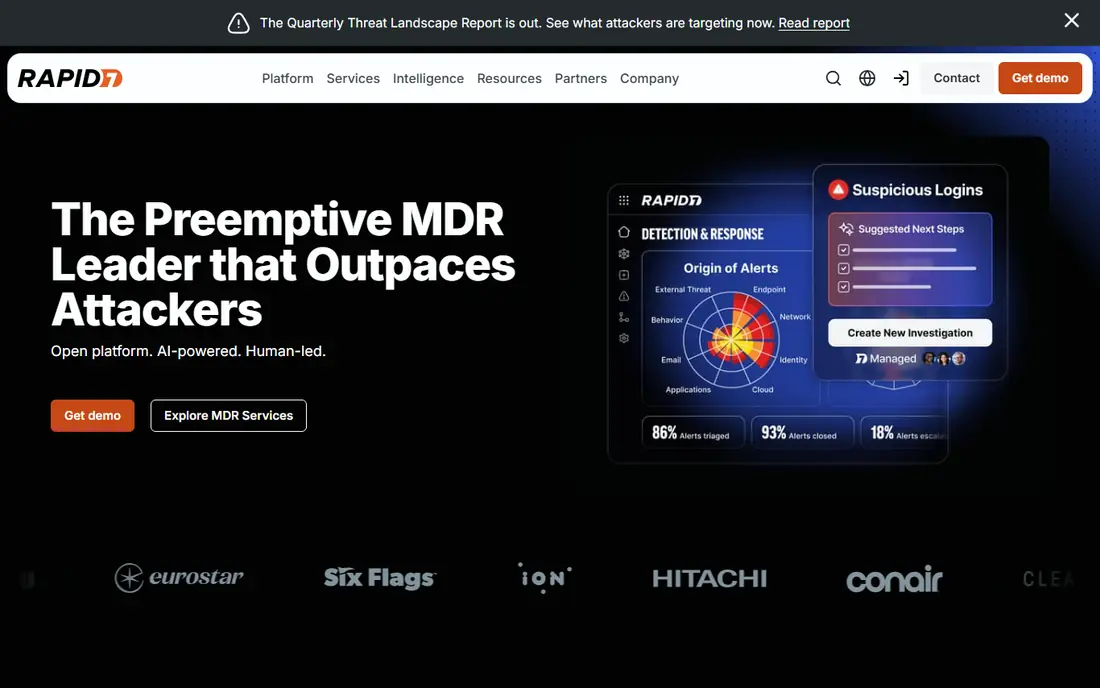
Rapid7 MDR suits teams that want detection connected to the rest of their risk picture. Its InsightIDR platform pulls endpoint, network, cloud, and identity signals together, and Rapid7's vulnerability management background adds context about which assets matter most when an alert fires. That context helps a small team prioritise the three alerts that matter over the three hundred that do not.
Buyers should still read the response terms closely. Rapid7's model leans more advisory in some configurations than the full containment authority offered by platform-native rivals, so confirm who acts first during an incident. Pricing is quote-based and varies with endpoints, servers, and log volume, so bring a clean asset count to the first call.
- InsightIDR platform
- Vulnerability and risk context alongside detection
- Flexible tooling
- Quote-only pricing
- Response authority is more advisory than full containment in some plans
Expel is built for organisations that like their current tools and do not want to rip them out. Its analysts connect to your existing endpoint, cloud, identity, and SaaS tools, automate much of the triage work, and present investigations with clear evidence rather than raw alert noise. That approach protects past tool investments and avoids a painful migration.
The trade-off is that Expel is not a tool bundle. If your current stack has gaps, especially in identity or cloud coverage, Expel can surface them but cannot fill them for free. Pricing is quote-based and shaped by integrations and data sources, so scope the conversation around the tools you already run.
- Works with your existing security stack
- Strong automation for triage
- Clear analyst investigations
- Quote-only pricing
- You must already own suitable detection tools
Red Canary has a strong reputation for detection quality, and its tool-agnostic model is the reason many mid-market and enterprise teams choose it. You keep your endpoint platform, Red Canary monitors it, and its analysts confirm real threats and guide response, with detailed reporting that helps your team learn from each incident. That model suits organisations with capable IT staff who want expert backup rather than a full handover.
Response style deserves a direct question before signing. Red Canary often works collaboratively, meaning your team approves some containment steps, which suits regulated environments but may feel slower than a fully autonomous service. Pricing is quote-based, so compare the full monitoring scope, not just the endpoint count.
- Strong detection engineering
- Works with many endpoint tools
- Detailed threat reporting
- Quote-only pricing
- Response is often collaborative rather than fully autonomous
Sophos MDR combines Sophos endpoint technology with a managed team that hunts threats and responds around the clock. For organisations already running Sophos Central, the integration is a genuine advantage, since analysts see the same console your administrators use, and response actions flow through familiar controls. Smaller teams often find the combined platform and service simpler to run than a multi-vendor stack.
The limit is the same as the strength. Sophos MDR shines brightest inside its own ecosystem, and teams with a mixed or rival stack may get less depth. Pricing is quote-based, so ask how the service is priced for your endpoint and server mix, and what response times the contract actually guarantees.
- Tight Sophos Central integration
- Fast response claims
- Good fit for smaller and mid-market teams
- Deepest value inside the Sophos stack
- Quote-only pricing
Huntress stands out in this list for a simple reason: it publishes a price. Managed EDR starts at $8.99 per endpoint per month at the 50 to 99 endpoint tier, with a 24/7 human-led SOC included, which gives smaller businesses and IT providers a benchmark that quote-only rivals do not. Its platform now covers managed EDR, identity threat detection, SIEM, and security awareness training, so a small team can consolidate several needs.
Huntress is not the deepest enterprise option for very large or complex cloud estates, and its coverage in some areas is still growing compared with premium providers. For small and mid-market teams that need real overnight coverage at a predictable price, though, it is the easiest provider here to evaluate and budget for.
- Published pricing
- Human-led 24/7 SOC included
- Managed EDR, identity, and SIEM options in one platform
- Growing rather than complete enterprise cloud coverage
- Smaller scope than premium rivals
SentinelOne Vigilance adds a managed analyst team on top of the SentinelOne platform, with authority to contain threats and hunt proactively rather than simply alerting your team. For organisations already running SentinelOne, that pairing removes the gap between detection and action, since the same agent that spots the threat can isolate the host. Teams without spare overnight analysts benefit most from that handover.
As with other platform-native services, the total cost includes the underlying licensing, and pricing for the managed layer is quote-based. Vigilance suits SentinelOne shops that want a complete service, and it suits them far better than it suits teams committed to a rival endpoint platform.
- Full response authority
- Deep SentinelOne telemetry
- Managed threat hunting included
- Requires SentinelOne licensing
- Quote-only pricing
Microsoft Defender Experts is the pragmatic choice for organisations already living in Microsoft 365. It layers managed hunting, triage, and response guidance onto Defender for Endpoint and related workloads, so alerts from endpoints, email, and identity flow to analysts who already understand the Microsoft signals. That integration avoids a separate console and a separate agent for many teams.
The scope limit is obvious: Defender Experts adds most value where Defender is already deployed, and it will not replace a multi-vendor SOC for a mixed stack. Pricing starts at $12 per user per month as an add-on to existing licenses, so confirm which Defender plans your organisation already holds before estimating the total.
- Deep Defender and Microsoft 365 integration
- Managed hunting and triage
- Simple add-on model
- Requires existing Defender licensing
- Less useful outside the Microsoft stack
How we picked these
We compared official service pages, published pricing where available, and independent MDR comparisons from 2026, and we kept only providers offering a staffed 24/7 SOC or MDR service in October 2026. We favoured a mix of tool-agnostic and platform-native models, and of small-team and enterprise options, so readers can match a provider to their existing stack. We did not claim hands-on testing, and where a provider prices by quote we say so rather than inventing a rate.
What to check before you sign
Start by listing what you actually need monitored: endpoints, servers, cloud workloads, identity, email, and network logs. A cheap endpoint-only quote looks attractive until an attacker moves through a cloud account or a stolen identity that nobody was watching. Bring that inventory to every vendor call, and ask which sources are included, which cost extra, and how long logs are kept.
Next, pin down response authority in the contract. Ask whether analysts can isolate a host, disable an account, or block a domain without waiting for your approval, and what happens overnight or on a public holiday. Also ask about onboarding time, named contacts, reporting, and how incidents are handed back to your team. A service that only sends alerts is not a SOC, no matter what the sales page calls it.
Finally, plan for the day after an incident. Your provider should deliver clear timelines, affected assets, and remediation steps, and your own team still owns business decisions such as customer notification and legal reporting. Remember that security tools and services support compliance work, but they do not by themselves make an organisation compliant, and only an independent auditor issues a SOC 2 report where one is required.
Frequently asked questions
What is the difference between a SOC service and an MDR service?
A SOC is the staffed team and process that monitors, triages, and responds to threats, while MDR is the common commercial name for buying that team as a managed service. In practice, most providers on this list sell a managed SOC under the MDR label, so compare coverage and response authority rather than the acronym.
How much does a managed SOC service cost?
Most providers price by quote based on endpoints, servers, log volume, and coverage breadth, which is why only Huntress and Microsoft publish clear starting rates here. Expect smaller teams to budget per endpoint per month, and larger estates to negotiate annual contracts with implementation fees.
Can a SOC service replace my internal security team?
It can replace overnight monitoring and much of the triage work, but it cannot replace your own decisions about risk, access, and incident communication. Most buyers keep a small internal team to own strategy, manage the provider, and handle business-side incident response.
Does a SOC service make us SOC 2 compliant?
No. A managed SOC can support the monitoring and incident response controls that auditors examine, but only an independent auditor issues a SOC 2 report, and compliance depends on your policies, access controls, and evidence across the whole organisation, not on one service alone.
Should we choose a tool-agnostic or platform-native provider?
Choose tool-agnostic providers such as Expel or Red Canary when you want to keep your current stack, and platform-native providers such as CrowdStrike or Sophos when you want the deepest integration and fastest containment. The right answer depends on how much you are willing to consolidate.
Are these services only for large enterprises?
No. Huntress and Sophos target smaller and mid-market teams directly, and Arctic Wolf and Rapid7 serve the mid-market well. The main barrier for small teams is usually quote-based pricing, so start with providers that publish rates and a clear scope.
Sources
See where you really rank - block by block
ProMapRanker scans Google Maps across a grid of your service area. Simple monthly plans from $19, white-label on every plan.
Start freeKeep reading
 worlds best local seo company
8 Worlds Best Local SEO Companies for Map Pack Growth in 2026
Compare the worlds best local seo company options for Google Business Profile work, citations, reviews, and multi-location rankings and reporting in 2026.
Read → world's best web hosting company
World's Best Web Hosting Company in 2026
Searching for the world's best web hosting company? We compared 10 hosts on price, renewal rates, speed, and support to help you choose well today in 2026.
Read → who's got the best nanny tax services
Who's Got the Best Nanny Tax Services in 2026
We answer who's got the best nanny tax services, comparing full filing, back taxes, software, and pricing so families can handle nanny taxes correctly.
Read →