 ProMapRanker
Best Small Company 401k Plans in 2026

Key takeaways
- Guideline and Human Interest suit employers who want administration handled online with clear monthly pricing.
- Fidelity, Vanguard, and Schwab suit employers who want low-cost funds and a large, established provider.
- ADP and Paychex suit employers who already run payroll with those providers and want one system for pay and retirement.
- Employee Fiduciary suits employers who want a flat, transparent fee structure and a dedicated contact.
- Compare total cost, not just the monthly base fee, because per-participant fees, fund expenses, and setup charges change the real price.
Quick comparison
| Pick | Great for | Pricing starts at | Free tier | |
|---|---|---|---|---|
 Guideline | Automated small business plans | See website | No | Visit |
 Human Interest | Affordable automated administration | $120 per month | No | Visit |
 Fidelity | Low-cost funds and no-fee setup | See website | No | Visit |
 Vanguard | Low-cost index funds | See website | No | Visit |
 Charles Schwab | Self-directed small business plans | See website | No | Visit |
 ADP | Payroll and retirement in one system | See website | No | Visit |
 Paychex | Payroll-linked retirement plans | See website | No | Visit |
 Employee Fiduciary | Transparent flat-fee plans | See website | No | Visit |
The best small company 401k plans
This is general information only, not financial advice. Fees, fund choices, and eligibility vary by provider and plan design, so confirm current terms before you sign up. We compared official pricing pages, plan features, payroll links, and support options for small employers.
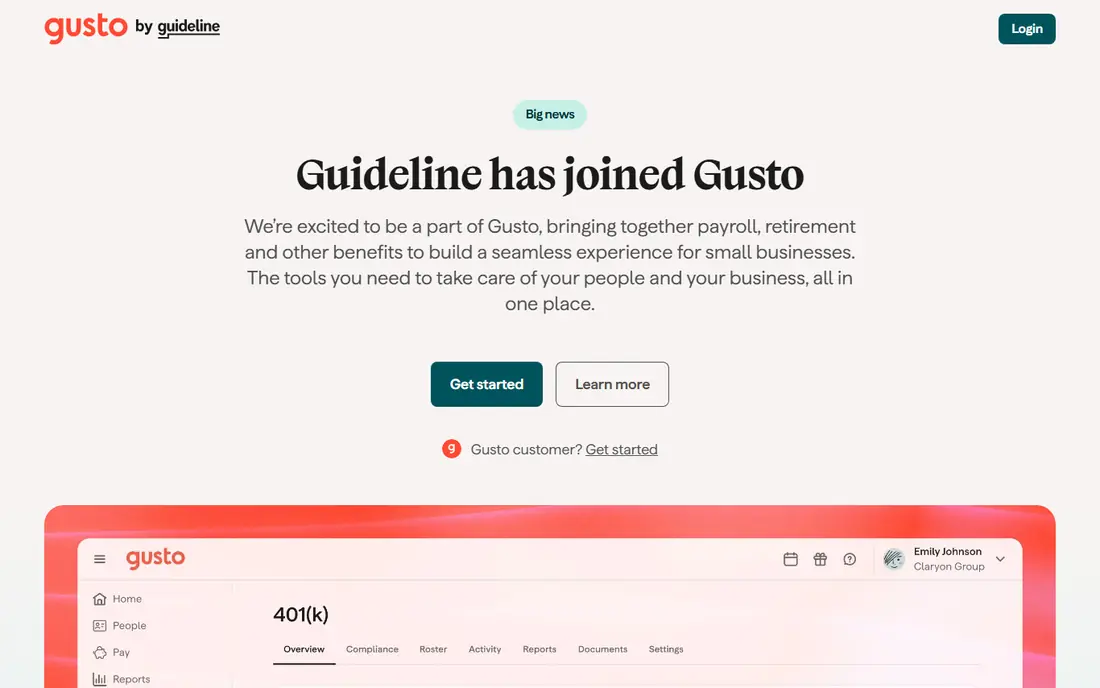
Guideline builds its plans around automation. The platform handles much of the recordkeeping, compliance testing, and employee notices that take up time for a small owner. That focus makes it a sensible pick for a company with no in-house benefits staff and a wish to keep paperwork off a busy schedule. Payroll links help contributions move from pay runs to accounts without manual files.
The trade-off is control. Employers who want a wide-open fund menu or a highly custom plan design may find Guideline more structured than they prefer. Staff who want to build their own portfolios from many fund families will also have less room to do so. For most small teams, the guided approach is a fair exchange for less admin work, but it is worth checking the fund list before committing.
- Automated administration and compliance tasks
- Payroll links with many providers
- Clear online dashboards for employers and staff
- Investment choice is more guided than fully open
- Pricing rises with headcount, so larger teams should model total cost
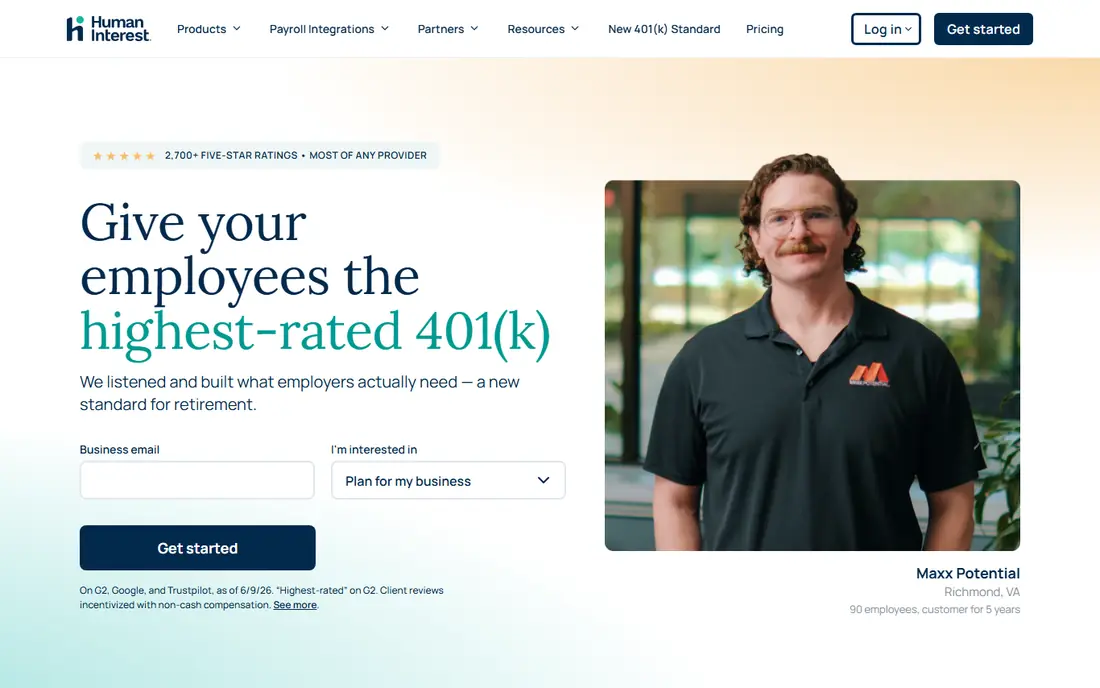
Human Interest is a strong match for a small employer watching the monthly bill. Its Essentials tier starts at 120 dollars per month plus a per-employee charge, and it covers automated administration, recordkeeping, and payroll links. That combination keeps the core work handled while the price stays in reach for a team of ten or twenty people. Higher tiers add services such as plan administration support and a dedicated account manager.
The catch is that the headline base fee is only part of the bill. Add the per-employee charge for every eligible worker, then check fund expenses and any setup fee. Employers who grow quickly should price the plan at their expected headcount in a year, not just today. Even with that caution, Human Interest remains one of the clearest low-cost routes into a proper company plan.
- Low starting base fee for an automated plan
- Payroll links with many providers
- Tiered plans that add fiduciary and account support
- Per-employee fees add up as headcount grows
- Higher tiers are needed for the fullest level of hands-on service
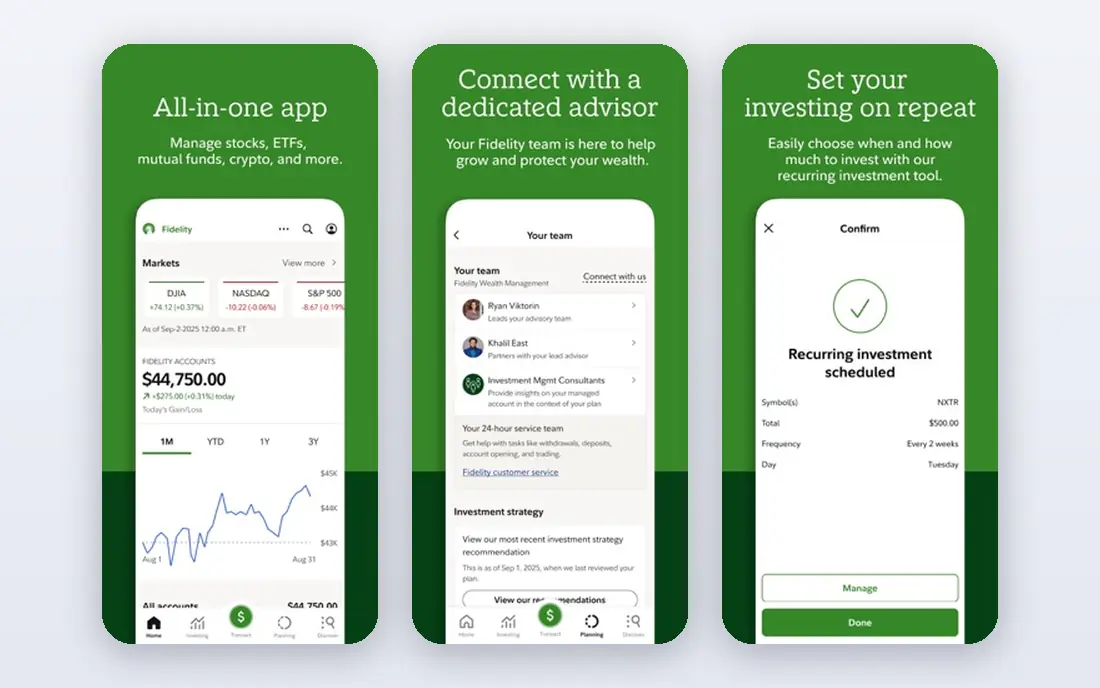
Fidelity suits an owner who is comfortable making choices and wants low fund costs above all. Its small business retirement plans cover solo 401k plans and plans for companies with staff, with a broad range of investments and no commission on many trades. The online tools for enrollment, contributions, and reporting are well developed, and staff can manage accounts from one place.
The downside is that Fidelity is less of a done-for-you service than Guideline or Human Interest. Plan design, compliance checks, and payroll links still need attention, and an employer may need an adviser or extra help for testing and filings. For a cost-conscious owner who already uses Fidelity or who wants fund flexibility, that trade is often worth it.
- Wide fund choice including low-cost index options
- No setup or ongoing fee listed for its small business plans
- Strong online tools
- Employers must handle more plan decisions themselves
- Support can feel less hands-on than a fully managed provider
Vanguard appeals to employers who believe fund costs matter more than extra features. Its plans offer pre-tax and Roth options, and its own index funds keep expenses low for staff who stay invested for years. That simple structure works well for a small company that wants a solid plan without a long list of add-ons.
The weaker point is ease of setup. Vanguard is a large provider, and a small employer may find the onboarding process slower or less guided than a provider built only for small businesses. Employers who want a single contact to walk them through every step should ask about support before choosing. If low fund cost is the priority, Vanguard still deserves a place on the shortlist.
- Low-cost in-house funds
- Pre-tax and Roth contribution options
- A long record in retirement saving
- Plan setup and administration can feel less streamlined for very small teams
- Fund menu leans toward Vanguard funds
Schwab is a good fit for owners who want choice and a known brand. Its small business plans include traditional and Roth options, and staff can pick from a wide range of investments rather than a short guided list. The absence of a setup or maintenance fee on its published terms is a clear plus for a company keeping fixed costs down.
The honest catch is administration. Schwab does not package the same level of automated compliance and payroll handling as providers built for small employers. An owner with an adviser or a payroll provider that handles retirement files will manage fine. An owner who wants everything handled in one dashboard may prefer Guideline or Human Interest instead.
- No setup or maintenance fee listed for its small business plans
- Traditional and Roth 401k options
- Broad investment choice
- Less automated administration than newer small business providers
- Employers carry more of the setup work
ADP makes sense when payroll is already with ADP or when a company wants one vendor for pay, HR, and retirement. Contributions can flow from payroll, and plan types cover traditional, Roth, safe harbor, solo, SIMPLE IRA, and SEP IRA options. That breadth helps a company whose needs change as it hires, because the same provider can adjust the plan rather than forcing a move.
The main drawback is price transparency. ADP quotes pricing rather than publishing a simple monthly rate, so an employer must go through a sales process to compare it fairly. Companies that only need a retirement plan, with no interest in wider HR tools, may also find the platform larger than necessary. For payroll customers, though, the single-system benefit is real.
- Retirement plans sit beside payroll, time, and HR tools
- Plan types include traditional, Roth, safe harbor, and solo options
- Large support network
- Pricing is quoted, so comparison takes a sales call
- Smaller employers may pay for a broader platform than they need
Paychex is a natural pick for a small business already running payroll through Paychex. Linking retirement contributions to payroll cuts manual work and reduces the chance of missed deposits. Its retirement range covers traditional 401k plans, solo plans, SIMPLE IRAs, employer plans, owner-only plans, and Roth options, so a growing company can stay with one provider.
As with ADP, the price is not published as a flat monthly figure, so comparison requires a quote. Employers should also ask who their day-to-day contact will be, since a large provider can feel different depending on the team assigned. When payroll and retirement already live together, Paychex is a practical, low-friction choice.
- Strong payroll link for contributions
- Plan options include traditional, solo, SIMPLE IRA, and Roth types
- Service for businesses of many sizes
- Pricing is quoted rather than published
- Service quality can vary by local team
Employee Fiduciary targets employers who dislike fee surprises. Its published model charges a flat annual amount for a plan up to a set headcount, with setup, administration, a dedicated relationship manager, and compliance and non-discrimination testing included. That clarity helps an owner compare total cost against per-employee pricing models that grow with every hire.
The trade-off is the starting annual figure, which can feel steep for a company with only two or three staff. It also positions itself as a full-service provider, so owners who want the cheapest possible bare-bones plan may find a simpler option elsewhere. For a team of ten to thirty people that wants clear fees and a named contact, it is a strong contender.
- Flat-fee structure that is easy to understand
- Full-service setup, administration, and compliance testing
- Dedicated relationship manager
- Annual fee can look high for a very small team
- Fund menu and service model suit employers who want guidance, not a bare-bones plan
How we picked these
We compared official pricing pages, plan types, payroll links, fund choice, and support models for providers that serve small US employers. We kept only providers with a live small business 401k offering and a clear way for an employer to set up and run a plan. We left out providers whose pricing or plan details could not be confirmed from public sources, and we favored a mix of automated platforms, large fund providers, and payroll-linked services so different kinds of small employers can find a fit.
What to check before you choose a plan
Start with total cost at your real headcount. A low base fee can turn into a high bill once per-participant charges, fund expenses, and setup fees are added. Ask each provider for a written estimate at your current staff count and at the count you expect in twelve months. That single step avoids the most common surprise in small business retirement plans.
Next, check the payroll link. If contributions must be entered by hand each pay period, the plan will take more time and carry more error risk. A direct link to your payroll system, or a clear file process your payroll provider supports, is worth paying a little more for in many cases. Also confirm who handles compliance testing, annual filings, and employee notices, and whether fiduciary services are included or cost extra.
Then look at the fund menu from the staff point of view. Low-cost diversified funds, a default investment for staff who do not choose, and Roth and pre-tax options cover most needs. A long list of funds is not better if staff find it confusing. Finally, test support before you sign. Call or message with a real question about eligibility or vesting, and note how fast and how clearly the provider answers. The quality of that answer is a fair preview of life after setup.
Plan types worth knowing
A traditional 401k lets staff save pre-tax, while a Roth 401k uses after-tax money with tax-free qualified withdrawals later. A safe harbor plan can simplify compliance testing in exchange for required employer contributions. A solo 401k fits an owner with no staff other than a spouse. Matching the plan type to your hiring plans matters more than picking the cheapest provider first.
Questions to ask every provider
Ask for the full fee schedule, including fund expenses and any charge for loans, distributions, or plan changes. Ask who signs filings and who acts as plan administrator. Ask how long setup takes and what happens if you change payroll providers later. Written answers to those questions make providers much easier to compare side by side.
Frequently asked questions
What is the cheapest small company 401k plan?
There is no single cheapest plan for every company, because cost depends on headcount, fund expenses, and plan type. Human Interest and Guideline often look low for small teams on base fees, while Fidelity and Schwab can look low on fund costs. Price each provider at your actual headcount and compare the full yearly total, not just the monthly base fee.
How much does a small business 401k cost per month?
Costs vary widely. Some automated providers start around 120 dollars per month plus a per-employee charge, while large fund providers may charge no setup or maintenance fee and earn from fund expenses. Payroll-linked providers usually quote pricing after a short review of your team size and payroll setup.
Can a company with one employee offer a 401k?
Yes. A solo 401k is made for an owner with no staff other than a spouse, and several providers on this list offer it. If you plan to hire soon, a standard small business plan may be simpler than starting solo and switching later.
Do small company 401k plans include Roth options?
Many do. Fidelity, Schwab, Vanguard, ADP, and Paychex all list Roth options among their plan types, and automated providers commonly offer Roth contributions too. Confirm Roth availability for the exact plan design you choose, since features can vary by tier.
What is a safe harbor 401k?
A safe harbor plan requires the employer to make set contributions, and in return it can avoid some annual compliance testing. It suits companies that want to let highly paid staff contribute more without failing tests. Ask a provider or adviser whether safe harbor fits your pay mix and budget.
Should a small employer use a payroll provider for its 401k?
It helps when contributions move straight from payroll, since that cuts manual work and missed deposits. If your payroll provider is ADP or Paychex, its retirement service is a natural fit. If you use another payroll system, check which retirement providers link to it before you decide.
Sources
See where you really rank - block by block
ProMapRanker scans Google Maps across a grid of your service area. Simple monthly plans from $19, white-label on every plan.
Start freeKeep reading
 zoro.to alternatives
Best Zoro.to Alternatives in 2026
We compare the best zoro.to alternatives in 2026, listing only legal licensed anime streaming services, from Crunchyroll to free options for fans today.
Read → zip alternatives
Best Zip Alternatives in 2026
We compare the best zip alternatives for buy now, pay later in 2026, covering pay-in-4 plans, fees, spending limits, and credit reporting options today.
Read → yesware alternatives
Best Yesware Alternatives in 2026
Compare the best yesware alternatives for sales email tracking, templates, and sequences, with current pricing and honest tradeoffs for small sales teams.
Read →