 ProMapRanker
Best Service Mesh Tools in 2026

Key takeaways
- Istio offers the deepest traffic and security controls, while Linkerd offers the simplest operating model for Kubernetes teams.
- A service mesh adds traffic management, mutual TLS, and observability between services, but it also adds operational work.
- Sidecar and sidecarless designs differ in performance and complexity, so check how each mesh runs its data plane.
- Most open source meshes are free to use, while managed and enterprise distributions charge for support, governance, and multi-cluster control.
Quick comparison
| Pick | Great for | Pricing starts at | Free tier | |
|---|---|---|---|---|
 Istio | Feature-rich Kubernetes mesh | Free | Yes | Visit |
 Linkerd | Lightweight and simple Kubernetes mesh | Free | Yes | Visit |
 Consul | Hybrid Kubernetes and virtual machine environments | Free | Yes | Visit |
 Kuma | Multi-zone and multi-cluster mesh | Free | Yes | Visit |
 Cilium | High-performance eBPF-based mesh | Free | Yes | Visit |
 Traefik Mesh | Simple non-invasive Kubernetes mesh | Free | Yes | Visit |
 Gloo Mesh | Multi-cluster Istio management | See website | No | Visit |
 OpenShift Service Mesh | Red Hat OpenShift environments | See website | No | Visit |
The best service mesh tools
A service mesh manages traffic between microservices. It handles routing, retries, timeouts, load balancing, mutual TLS encryption, identity, and telemetry, so application code does not have to. Most meshes run on Kubernetes, and the choice usually comes down to how much control you need, how much operational complexity your team can carry, and whether your services also run on virtual machines or multiple clouds.
Istio is the most feature-rich service mesh, and the default choice for large Kubernetes platforms. It offers fine-grained traffic routing, including canary releases and fault injection, plus mutual TLS, authorisation policies, and detailed telemetry through Prometheus, Grafana, and tracing tools. Its newer ambient mode moves much of the data plane out of per-pod sidecars, which can lower resource use for larger deployments.
That power comes with operational cost. Istio needs skilled platform engineers, careful upgrade planning, and attention to control plane sizing. Smaller teams may find it more than they need. If you run many services, multiple clusters, or strict security policies, Istio depth is worth the complexity, and enterprise distributions add support on top of the same open source base.
- Deepest traffic management and security policy controls
- Ambient mode for a lighter data plane option
- Large ecosystem and documentation
- Most complex to operate in this list
- Resource use is higher than lightweight meshes
Linkerd is the mesh to pick when you want security and observability without a large platform project. Its data plane proxies are written in Rust and use far less memory and CPU than many rivals, and mutual TLS is automatic once Linkerd is installed. Dashboards show live traffic, success rates, and latencies per service, which makes troubleshooting faster for small teams.
Linkerd deliberately offers fewer knobs than Istio. Advanced routing and policy features exist, but they are narrower in scope. If your main needs are encrypted service traffic, clear observability, and a mesh your team can actually run, Linkerd is the best starting point, and many teams never outgrow it.
- Very light resource use
- Automatic mutual TLS
- Simple install and clear dashboards
- Fewer advanced traffic features than Istio
- Kubernetes-focused, with no virtual machine story
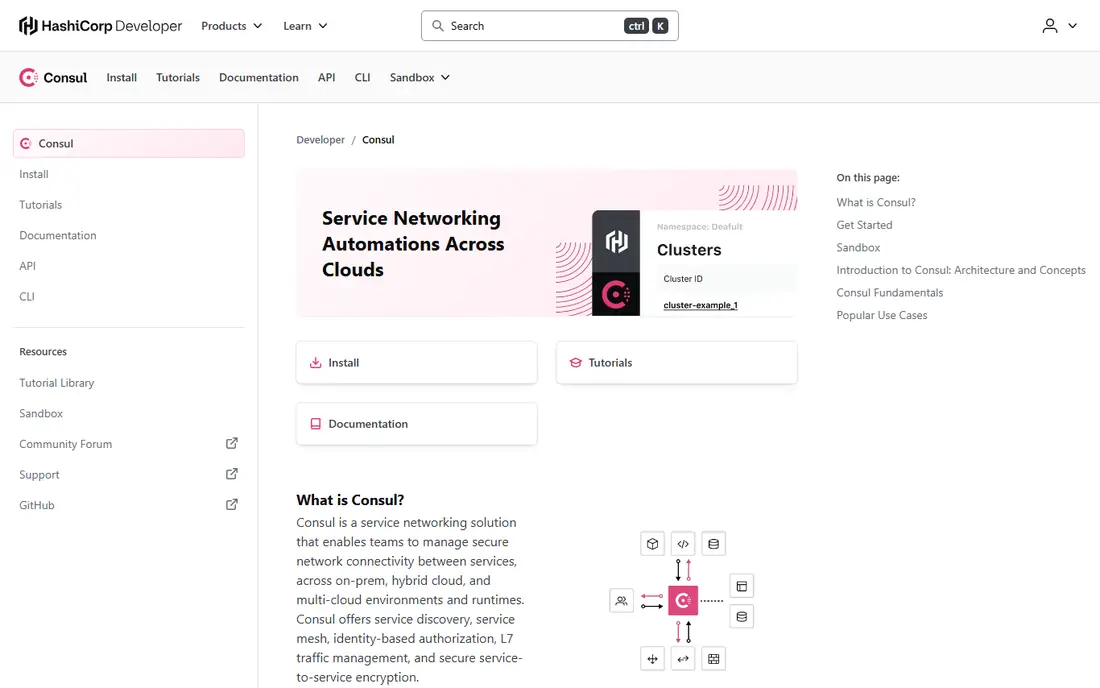
Consul, from HashiCorp, pairs service discovery with service mesh features, which makes it the strongest pick for hybrid environments. Services on Kubernetes, virtual machines, and bare metal can all register, discover each other, and communicate over mutual TLS with identity-based policies. That breadth suits organisations migrating to Kubernetes in stages, rather than all at once.
For a pure Kubernetes shop, Consul mesh features are less deep than Istio, and its broader scope adds learning time. Consul also integrates well with other HashiCorp tools, which is a plus for teams already using them. If your estate spans containers and virtual machines, Consul is the most practical mesh in this list.
- Service discovery plus mesh in one system
- Works across Kubernetes, virtual machines, and multiple clouds
- Identity-based security
- Broader scope means more concepts to learn
- Mesh features are less deep than Istio for pure Kubernetes use
Kuma is built for multi-zone and multi-cluster deployments from the start. A global control plane manages policies across zones, while zone control planes handle local traffic, which suits teams running services in several regions or clouds. It runs on Kubernetes and virtual machines, uses Envoy as its data plane, and supports mutual TLS, traffic policies, and observability out of the box.
The community is smaller than Istio or Linkerd, so examples and third-party guides are thinner. Commercial support and extra governance features are available through a paid distribution. For a platform team that needs one mesh policy across many clusters, Kuma design is cleaner than stitching several single-cluster meshes together.
- Multi-zone and multi-mesh support built in
- Works on Kubernetes and virtual machines
- Envoy-based data plane
- Smaller community than Istio or Linkerd
- Enterprise features sit in a commercial distribution
Cilium takes a different approach by using eBPF in the Linux kernel for networking, security, and observability. Its service mesh can run without per-pod sidecars, which lowers latency and resource use, while still offering mutual TLS, traffic management, and detailed flow visibility. That kernel-level view also gives strong network policy enforcement and troubleshooting data.
The requirement is a modern kernel with eBPF support, and the networking depth rewards operators who understand Linux networking. Cilium also serves as a container networking interface, so teams often adopt it for networking first and add mesh features later. If performance and kernel-level visibility matter most, Cilium is the most modern mesh design here.
- EBPF-based data plane with low overhead
- Sidecarless option
- Strong network policy and observability
- Needs a modern Linux kernel and eBPF support
- Networking depth needs skilled operators
Traefik Mesh, formerly Maesh, aims for the simplest possible mesh install. It uses a node-based design rather than injecting a sidecar into every pod, which makes adoption less invasive for an existing cluster. Configuration follows Traefik patterns, so teams already using Traefik for ingress will find the model familiar, with traffic management, mutual TLS, and basic observability included.
Feature depth is the trade-off. Traefik Mesh does not match Istio for policy and routing options, and its ecosystem is smaller. For a small Kubernetes deployment that wants mesh basics without reworking every workload, Traefik Mesh is a low-friction option. For complex multi-cluster policy, look at Istio, Kuma, or Gloo Mesh instead.
- Non-invasive install with no sidecar injection changes for many setups
- Simple configuration
- Good fit with Traefik ingress
- Fewer advanced features than Istio
- Smaller ecosystem for mesh-specific tooling
Gloo Mesh, from Solo.io, is a management plane for Istio across multiple clusters and clouds. It centralises traffic, security, and observability policies, federates services across clusters, and integrates with API gateways, so platform teams can govern many meshes from one place. That governance focus suits large organisations with several teams and clusters under central platform rules.
Gloo Mesh is a commercial product priced by quote, and it builds on Istio rather than replacing it, so you still carry Istio operational knowledge. Smaller teams with one cluster do not need it. For an enterprise standardising on Istio at scale, Gloo Mesh turns a set of separate meshes into one managed platform.
- Central management for multiple Istio clusters
- Federation and gateway integration
- Enterprise support and governance
- Commercial pricing by quote
- Adds a management layer on top of Istio complexity
OpenShift Service Mesh is Red Hat supported distribution of Istio for OpenShift clusters. It integrates with OpenShift routing, monitoring, and identity, and it follows Red Hat lifecycle and support policies, which matters for organisations that already standardise on OpenShift. Teams get Istio traffic, security, and observability features with a vendor-supported install and upgrade path.
The limit is platform lock-in. OpenShift Service Mesh is designed for OpenShift, so it is not the pick for a plain Kubernetes estate. Pricing follows Red Hat subscription models, so get a quote for your cluster size. If your organisation already runs OpenShift, its service mesh is the natural, supported way to add mesh features without running upstream Istio yourself.
- Tightly integrated with OpenShift
- Supported Istio-based distribution
- Red Hat support and lifecycle management
- Tied to OpenShift
- Commercial subscription pricing
How we picked these
We compared meshes that are live and maintained in October 2026, using vendor documentation, project pages, and independent comparison guides. We kept a mix of open source meshes and commercial distributions, and we excluded tools with an announced end-of-support date in 2026, since starting a new project on a retiring mesh would be poor advice. We weighted traffic and security features, data plane design, multi-cluster and hybrid support, operational complexity, and community or vendor support.
What to check before you choose a service mesh
Start with a real problem, not a feature list. A mesh earns its place when you have many services, need consistent mutual TLS, struggle to trace requests across services, or need controlled rollouts. A small application with a handful of services usually does not need a mesh, and a well-configured ingress plus good logging may be enough.
Next, test the data plane on your cluster. Measure latency and resource use with your real traffic shape, check kernel or node requirements for eBPF-based options, and confirm upgrade paths and rollback steps. A mesh that is easy to install but hard to upgrade will cost more over two years than a mesh with a steeper install and a clean upgrade story.
Finally, plan who owns the mesh. Platform teams need time for control plane operations, policy design, certificate management, and incident response when mesh behaviour changes traffic. If no team owns those jobs, even the simplest mesh will drift into a support burden. Pick the mesh your team can run well, not only the mesh with the longest feature list.
Frequently asked questions
Which service mesh software is best?
For most Kubernetes teams, Istio offers the most features and Linkerd offers the simplest operation. Consul suits hybrid Kubernetes and virtual machine estates, Kuma suits multi-cluster setups, and Cilium suits teams that want eBPF performance. The best pick depends on your cluster count, team size, and security needs.
Do I need a service mesh for Kubernetes?
Not always. A mesh helps when you run many microservices and need consistent traffic control, mutual TLS, and cross-service observability. Small applications, monoliths, or a handful of services usually do fine with ingress, network policies, and application logging alone.
What is the difference between Istio and Linkerd?
Istio offers deeper traffic routing, security policy, and multi-cluster features, at the cost of higher complexity and resource use. Linkerd offers automatic mutual TLS, clear dashboards, and very low resource use, with a narrower feature set. Choose Istio for depth, Linkerd for simplicity.
Is a service mesh free?
Open source meshes such as Istio, Linkerd, Consul, Kuma, Cilium, and Traefik Mesh are free to use under their open source licences. Costs come from the engineering time to run them, plus commercial support or management distributions such as Gloo Mesh and OpenShift Service Mesh, which are priced by quote or subscription.
What is ambient mode in Istio?
Ambient mode is an Istio data plane design that moves much of the proxy work out of per-pod sidecars into shared node-level components, with a waypoint proxy per namespace for richer policy where needed. It aims to lower resource use and simplify adoption for larger deployments, while keeping mutual TLS and policy controls.
Sources
See where you really rank - block by block
ProMapRanker scans Google Maps across a grid of your service area. Simple monthly plans from $19, white-label on every plan.
Start freeKeep reading
 zscaler alternatives
Best Zscaler Alternatives in 2026
Looking for zscaler alternatives? We compare 9 SASE and zero trust platforms on architecture, data protection, pricing, and fit for your network and team.
Read → zapier alternatives free
Best Zapier Alternatives Free in 2026
Nine automation tools for zapier alternatives free in 2026, all with genuinely free tiers, plus free plan limits, starting prices and upgrade paths explained.
Read → which platform is best for online reputation
Which Platform Is Best for Online Reputation in 2026
Wondering which platform is best for online reputation? We compare 8 review, listing, and response tools for small and multi-location businesses and agencies.
Read →