 ProMapRanker
Best Services for High API Traffic Frontend Cloud in 2026

Key takeaways
- This article covers cloud, CDN and edge services that handle high API traffic for frontends, not general web hosting alone.
- Cloudflare is our pick for most frontends, thanks to its global network, free entry tier and edge tools in one account.
- Fastly suits teams that need instant cache purging and fine control over API responses at the edge.
- Amazon CloudFront and Google Cloud CDN suit teams already built on AWS or Google Cloud, where integration saves setup time.
- Price API traffic by requests and egress together. A cheap per-gigabyte rate can still cost more if request fees or origin load are high.
Quick comparison
| Pick | Great for | Pricing starts at | Free tier | |
|---|---|---|---|---|
 Cloudflare | Most frontends and APIs | Free | Yes | Visit |
 Amazon CloudFront | AWS-based frontends | See website | Free trial | Visit |
 Fastly | Instant purge and edge control | See website | Free trial | Visit |
 Akamai | Large-scale global delivery | See website | No | Visit |
 Vercel | Frontend teams on modern frameworks | See website | Yes | Visit |
 Netlify | Jamstack frontends and APIs | See website | Yes | Visit |
 Microsoft Azure Front Door | Azure-based global frontends | See website | No | Visit |
 Google Cloud CDN | Google Cloud frontends | See website | Free trial | Visit |
 Bunny.net | Low-cost high-volume delivery | See website | Free trial | Visit |
The best services for high API traffic frontend cloud
A frontend that calls APIs heavily needs more than fast static hosting. It needs caching, edge logic, rate limiting and protection against traffic spikes, all close to users. We compared official pricing pages, feature pages and documentation for services live in October 2026, focusing on how each handles API traffic, not just files.
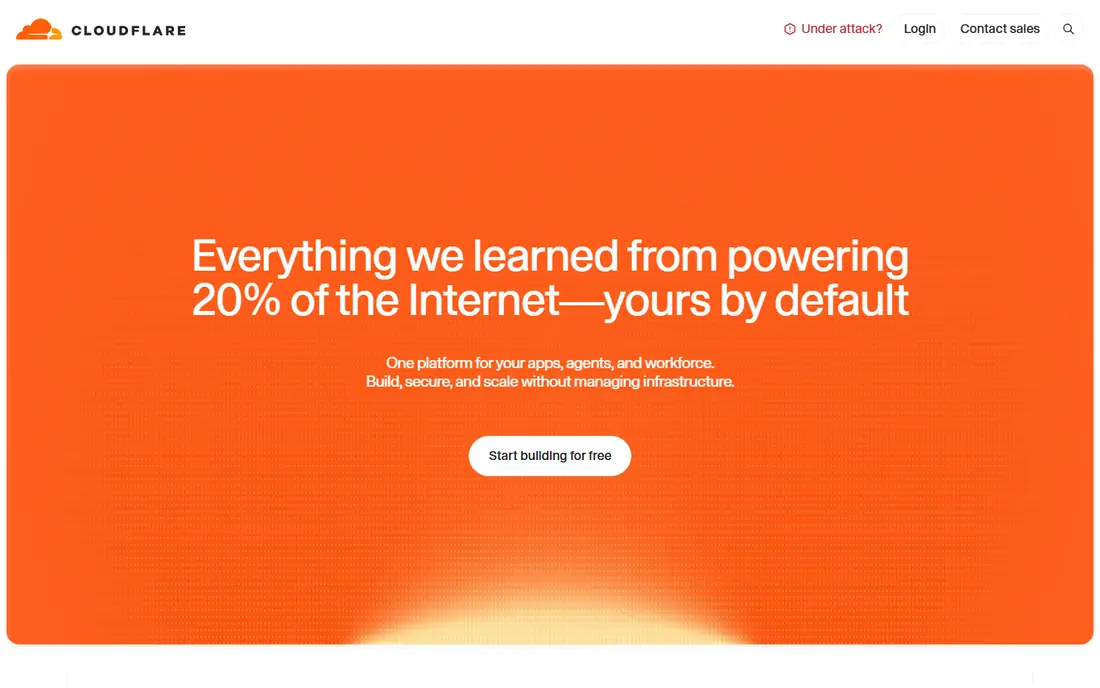
Cloudflare puts a global anycast network in front of your frontend and APIs, with caching, DDoS protection and Workers for running code at the edge. That combination handles traffic spikes well, since cached responses and edge logic reduce origin load. The free tier lets small frontends start without a bill, and paid plans add more control and support.
Advanced API protection, such as API Shield features and deeper rate limiting, sits in higher plans, and Workers, KV and R2 are billed separately from the base plan. For most frontends with heavy API use, Cloudflare is our pick, but price the full stack, not just the base plan.
- Huge global network
- Free tier for small sites
- Workers for edge API logic
- Advanced API protection sits in higher plans
- Workers billing is separate
- Support varies by plan
CloudFront is the natural CDN for frontends already on AWS. It works closely with S3, API Gateway, Lambda and load balancers, and Origin Shield reduces repeated origin requests for popular content. For API-heavy frontends, pairing CloudFront with API Gateway gives caching, throttling and usage plans in one AWS setup.
Pricing is tiered by region and volume, with request fees on top of bandwidth, so a high-request API can cost more than the bandwidth figure suggests. Setup also takes more AWS knowledge than a simpler CDN. If your stack is AWS-based, CloudFront is the sensible default.
- Deep AWS integration
- Origin shield cuts origin load
- Global edge network
- Pricing tiers need careful reading
- Setup is more involved
- Request fees add up
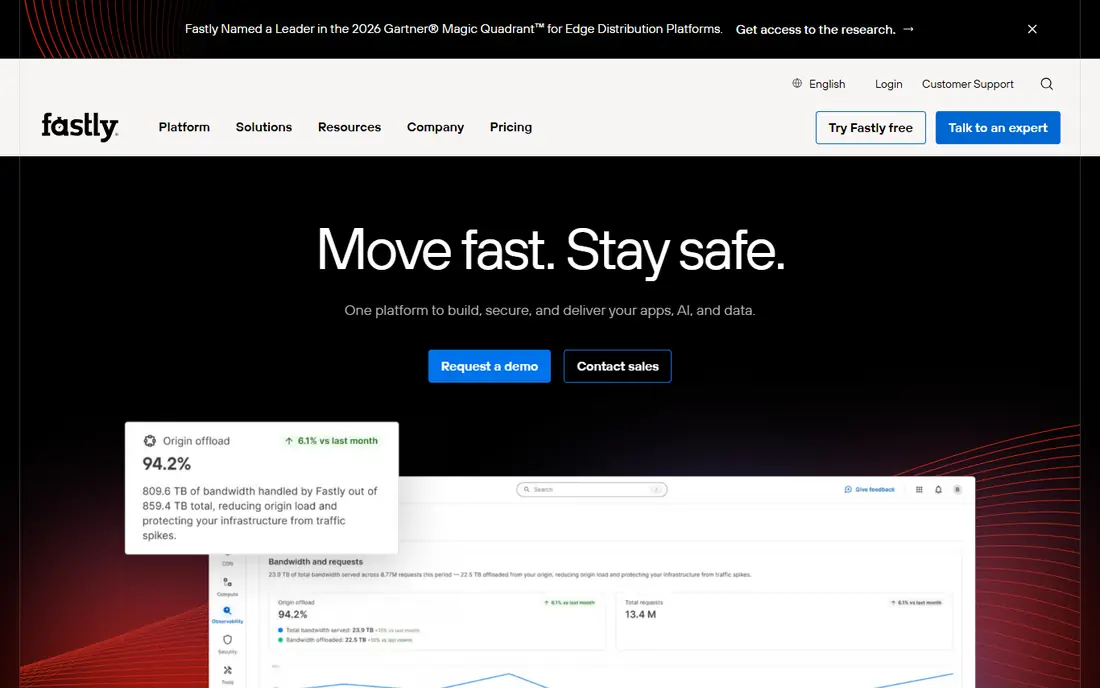
Fastly is built for teams that need precise control over caching and API responses. Its purge is near-instant across the network, which matters when API data changes often and stale responses would confuse users. Compute lets teams run logic at the edge, from auth checks to response shaping, without a round trip to origin.
The trade-off is complexity and pricing. Fastly often prices through packages and commits, so small teams should confirm minimums before committing. Developers who value control and freshness will find Fastly worth that effort, especially for API-heavy frontends.
- Near-instant cache purging
- Powerful VCL and Compute edge logic
- Strong API caching
- Pricing is often negotiated
- Learning curve for edge logic
- Minimums can suit larger teams
Akamai operates one of the largest delivery networks in the world, with deep ISP reach and strong controls for large enterprises. For a frontend serving millions of users across regions, with strict performance and compliance needs, Akamai's scale and support are genuine advantages. Its API and edge tools cover acceleration, security and delivery in one platform.
Smaller teams will find contract pricing and enterprise onboarding heavy. Akamai suits large-scale frontends where tail latency and global reach justify a negotiated deal. Small and mid-size frontends usually get better value from Cloudflare or Fastly.
- Very large global footprint
- Strong enterprise controls
- Proven at huge scale
- Contract-only pricing
- Setup is enterprise-heavy
- Overkill for small frontends
Vercel is a frontend cloud built for modern frameworks, especially Next.js. It deploys frontends to a global edge network, runs serverless and edge functions for API routes, and handles previews for every pull request. For a team shipping a React or Next.js frontend with API routes, that workflow saves a lot of glue work.
High API traffic needs pricing care, since function invocations, bandwidth and edge requests all count. Teams with very high or spiky API use should model costs before scaling. For frontend-first teams, Vercel is our pick for developer speed.
- Fast frontend deploys
- Edge network and functions
- Great Next.js integration
- Costs can grow with traffic and functions
- Less control than a pure CDN
- Vendor focus
Netlify suits Jamstack frontends that mix static pages with API calls through edge and serverless functions. Deploys from Git, preview links and simple configuration make it easy for small teams to ship fast. Its edge network handles global delivery, while functions cover form handling, auth checks and API proxies.
Very high API traffic can push function and bandwidth costs up, so model usage before relying on it for a heavy API frontend. For content-driven frontends with moderate API use, Netlify is simple and effective.
- Simple deploys from Git
- Edge functions for APIs
- Good free tier
- High traffic costs can rise
- Function limits shape design
- Less suited to huge monoliths
Azure Front Door gives Azure-based frontends global entry, load balancing, caching and security in one service. It routes users to the nearest healthy backend, which helps API-heavy frontends spread across regions. Higher tiers add Web Application Firewall protection and private link support for sensitive backends.
The fit is Azure-first. Teams outside Azure gain less from its integration, and tier choice changes which security features you get. For an Azure frontend serving users worldwide, Front Door is the natural front door, in the literal sense.
- Global load balancing for Azure apps
- WAF included in higher tiers
- Azure integration
- Azure focus narrows fit
- Tier differences matter
- Pricing is usage based
Google Cloud CDN runs on Google's backbone and pairs with Cloud Load Balancing to serve frontends and API responses close to users. For teams already on Google Cloud, with backends in Compute Engine, GKE or Cloud Run, integration is smooth and cache controls are solid. It handles both static assets and cacheable API responses well.
Pricing varies by region, volume and cache egress, so high API traffic needs a cost model, not a guess. Teams outside Google Cloud will find less reason to choose it over Cloudflare or Fastly. For Google-based frontends, it is a strong, well-integrated choice.
- Google backbone network
- Cloud Load Balancing integration
- Cache controls
- Google Cloud focus
- Pricing by region and volume
- Setup needs Cloud knowledge
Bunny.net appeals to teams where delivery cost dominates the bill. Its per-gigabyte prices are low, setup is simple, and it covers CDN delivery, edge storage and image optimization. For a frontend with high static and cacheable API volume, Bunny can cut delivery costs sharply compared with hyperscaler CDNs.
Its edge logic and API protection features are thinner than Cloudflare or Fastly, so teams needing deep API controls should pair it with another layer or choose a richer platform. For cost-first delivery at volume, Bunny.net is worth a trial.
- Low per-gigabyte prices
- Simple setup
- Edge storage and optimization options
- Smaller feature set than Cloudflare
- API edge logic is thinner
- Support varies by plan
How we picked these
We compared official pricing pages, feature pages and documentation for cloud, CDN and edge services live in October 2026. We kept services that can sit in front of a frontend, cache or accelerate API traffic, and handle spikes without origin collapse. Where pricing is tiered, negotiated or usage based, we wrote See website rather than a single rate that would mislead. We did not claim hands-on testing.
What to check before you choose
Start by separating cacheable API responses from live ones. Many API calls can be cached briefly at the edge, which cuts origin load more than any bandwidth discount. For live calls, focus on rate limiting, auth at the edge and origin protection, since those decide whether a spike becomes an outage.
Next, model total cost. Add bandwidth, request fees, function invocations, WAF charges and origin egress together for a realistic month of traffic. A low bandwidth rate with high request fees can cost more for an API-heavy frontend than a higher bandwidth rate with bundled requests.
Test with real traffic patterns
Run a load test that mirrors your real API mix, including cache misses, auth calls and error paths. Measure latency from your main user regions, not just from your office. A CDN that is fast for static files can still be slow for uncached API calls if origin routing is poor.
Plan for failure and abuse
Set rate limits, timeouts and circuit breakers before launch, and confirm how each service handles DDoS and bot traffic. Check purge speed, cache invalidation and rollback steps, since a bad deploy cached at the edge can affect users worldwide until purged.
Frequently asked questions
What is the best service for high API traffic frontend cloud work?
Cloudflare is our pick for most frontends, thanks to its network, free tier and edge tools. Fastly suits teams needing instant purge and edge control, while CloudFront, Azure Front Door and Google Cloud CDN suit teams already on those clouds.
Should I cache API responses at the edge?
Yes, where data allows it. Even short cache times, such as seconds or minutes, cut origin load sharply for popular calls. Keep user-specific and sensitive responses uncached, and use cache tags or purge tools to clear stale data fast.
How do I control costs for high API traffic?
Model bandwidth plus request fees, function calls and WAF charges together. Use caching, compression and sensible timeouts, and set alerts for traffic spikes. A cheap bandwidth rate alone does not guarantee a cheap bill.
Is a CDN enough for API protection?
No, a CDN helps with delivery and basic protection, but API security also needs auth, rate limiting, input checks and monitoring at your backend. Use the CDN as one layer, not as the whole security plan.
When should I pick Vercel or Netlify over a pure CDN?
Pick them when your team ships a modern frontend from Git and wants deploys, previews and API functions in one workflow. Pick a pure CDN such as Cloudflare or Fastly when you need deeper cache control, multi-origin routing or lower delivery cost at very high volume.
What is the difference between a CDN and an edge platform?
A CDN mainly delivers and caches content close to users. An edge platform adds code execution, auth and response logic at the edge, so API calls can be shaped, checked or answered without reaching origin. Many modern services, such as Cloudflare and Fastly, do both.
Sources
See where you really rank - block by block
ProMapRanker scans Google Maps across a grid of your service area. Simple monthly plans from $19, white-label on every plan.
Start freeKeep reading
 zoro.to alternatives
Best Zoro.to Alternatives in 2026
We compare the best zoro.to alternatives in 2026, listing only legal licensed anime streaming services, from Crunchyroll to free options for fans today.
Read → zip alternatives
Best Zip Alternatives in 2026
We compare the best zip alternatives for buy now, pay later in 2026, covering pay-in-4 plans, fees, spending limits, and credit reporting options today.
Read → yesware alternatives
Best Yesware Alternatives in 2026
Compare the best yesware alternatives for sales email tracking, templates, and sequences, with current pricing and honest tradeoffs for small sales teams.
Read →