 ProMapRanker
Best Service Dog Registration Resources in 2026

Key takeaways
- In the US there is no official federal service dog registry and no federal certification requirement under the ADA, so no paid registry can make a dog official.
- A service dog under the ADA is a dog individually trained to do work or perform tasks for a person with a disability, not a dog with a purchased certificate.
- Paid certificates, ID cards and registry listings sold online do not convey rights under the ADA and are not recognized by the Department of Justice as proof.
- Vests, ID cards and patches are optional practical tools, not legal requirements, and a business may ask only two questions about a service dog.
- The trusted options below are official guidance, training organizations and identification suppliers, listed with that caveat stated plainly.
Quick comparison
| Pick | Great for | Pricing starts at | Free tier | |
|---|---|---|---|---|
 ADA.gov | Official ADA service animal guidance | Free | Yes | Visit |
 ADA National Network | Plain-language ADA information and referrals | Free | Yes | Visit |
 Assistance Dogs International | Accredited member programs and standards | See website | No | Visit |
 Canine Companions | Placed assistance dogs and training programs | See website | No | Visit |
 NEADS | Service dogs for deaf and disabled handlers | See website | No | Visit |
 Paws With A Cause | Custom-trained assistance dogs | See website | No | Visit |
 Service Dogs Inc | Service dogs and training support in Texas | See website | No | Visit |
 4 Paws for Ability | Service dogs for children and veterans | See website | No | Visit |
 International Association of Assistance Dog Partners | Handler community and identification guidance | See website | No | Visit |
The best service dog registration resources
Read this first: there is no official federal service dog registry in the United States, and the ADA does not require registration or certification. The entries below are therefore not a list of official registries, since no such registry exists. They are official information sources, accredited training organizations and identification options that handlers use in practice, and none of them can grant legal status to a dog. We compared official government guidance, accredited program listings and training organization pages to build this list.
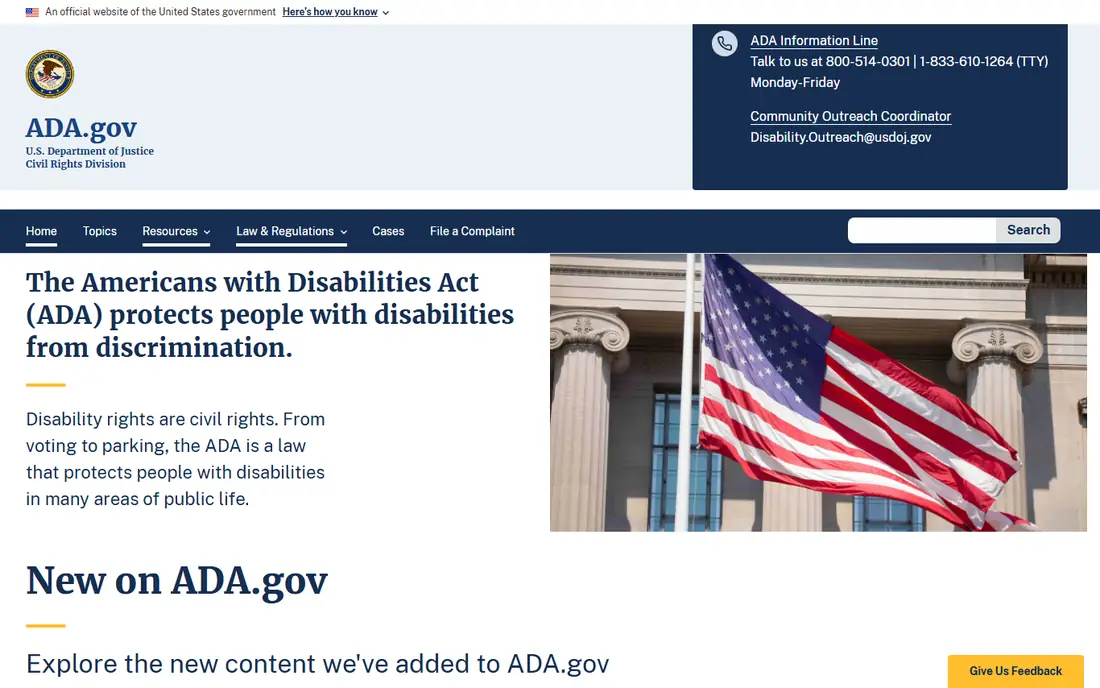
ADA.gov, run by the US Department of Justice, is the first place to check before you pay for anything related to service dog paperwork. Its service animal pages explain that a service animal is a dog trained to do work or tasks for a person with a disability, and that businesses may ask only two questions: whether the dog is required because of a disability, and what work or task it has been trained to perform. It also states that documentation, such as proof of certification or training, cannot be required as a condition of entry.
The limit is that ADA.gov is guidance, not a service. It will not train your dog, match you with a program or sell you an ID, and that is the point. Use it to judge every other offer on this list, and treat any seller that claims ADA approval or official registration as a warning sign, since no such approval exists.
- The official US government source
- Clear service animal requirements
- Free guidance and complaint information
- It does not place dogs or provide training
- Legal detail can be dense for first-time readers
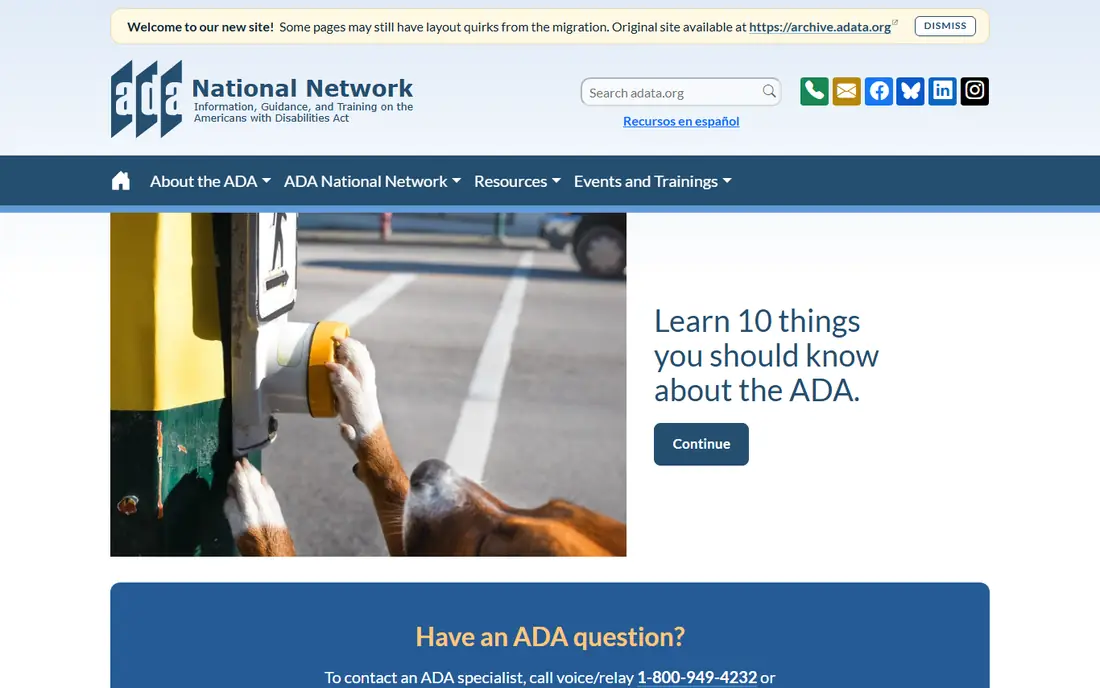
The ADA National Network provides free information, referrals and training on the ADA through regional centers. Its service animal fact sheets explain the difference between service animals, emotional support animals and therapy animals in plain terms, which helps handlers answer questions from employers, landlords and businesses. Regional centers can also point you to local resources and complaint routes.
The honest catch is scope. The network explains rights and refers you onward, but it does not place dogs or issue any credential. That makes it a strong second check after ADA.gov, especially if you need help in your state or want to talk through a specific access problem with a knowledgeable source.
- Free information by phone and online
- Regional centers across the US
- Plain-language fact sheets
- It does not register or certify dogs
- Local rules on housing and transport may need separate checks
Assistance Dogs International
Great for: Accredited member programs and standards
Assistance Dogs International, known as ADI, is a coalition of nonprofit assistance dog organizations that meet shared standards for training, dog welfare and client support. Its member directory helps handlers find established programs rather than relying on a paid online registry. ADI accreditation is a quality signal for a program, not a federal certification for an individual dog.
The limit for readers is that ADI does not hand you a registration. You still apply to a member program, meet its criteria and wait for placement or training support. Use ADI to shortlist programs, then check each program directly for eligibility, wait times and costs in your area.
- A global body for assistance dog programs
- Member programs meet published standards
- A useful directory for finding programs
- Membership is for programs, not individual handlers
- Wait times and costs vary by member program
Canine Companions is a nonprofit that breeds, trains and places assistance dogs with adults, children and veterans with disabilities, at no charge to recipients for the dog itself in its standard program model. Its dogs are trained for tasks such as retrieving items, opening doors, pulling wheelchairs and alerting to sounds. The organization also runs puppy raising and volunteer programs that support its training pipeline.
The trade-off is time and fit. Placement is not instant, and applicants must meet program criteria and be able to care for and work with a dog. Check the official site for current application steps and regional centers, and do not confuse a placement program with a registry, since the dog's status comes from its training, not from a listing.
- A large, established nonprofit
- Dogs trained for mobility, hearing and other tasks
- Regional training centers
- Placement involves an application and wait
- Eligibility and task needs must match the program
NEADS, also known as Dogs for Deaf and Disabled Americans, trains and places service dogs for people who are deaf or have a physical disability. Its dogs learn tasks matched to the handler, such as alerting to sounds, retrieving items and providing mobility support. The organization provides follow-up support after placement, which matters as handler needs change over time.
The limit is capacity. Like other nonprofits, NEADS cannot place a dog with every applicant at once, and eligibility depends on disability-related task needs. Use its official application page for current criteria, and plan for a wait rather than expecting a fast placement.
- A long-running nonprofit for service and hearing dogs
- Training matched to handler needs
- Support after placement
- Placement is limited by capacity and eligibility
- The program is based in the US Northeast, with national applicants
Paws With A Cause trains assistance dogs matched to each client's needs, including mobility support, hearing alert and seizure response work. Its program covers the full path from puppy raising through advanced training and placement, with follow-up support for the working team. The custom approach suits handlers whose task needs do not fit a standard program template.
The honest catch is the wait and the process. Custom training takes time, and the organization sets eligibility and support criteria that not every applicant will meet. Check the official site for application details and current wait information, and keep your own training records as you go, since task training is what defines a service dog under the ADA.
- Custom training for individual handler needs
- A long nonprofit history
- Dogs for mobility, hearing and seizure response tasks
- Wait times can be long
- Applicants must meet program and fundraising criteria
Service Dogs Inc, based in Texas, trains service dogs, many from rescue backgrounds, for veterans and civilians with disabilities. Its programs include placement and handler training, so the handler learns to work with the dog as a team rather than simply receiving an animal. That training focus is useful, since a service dog must be under the handler's control in public.
The limit is geography and capacity. In-person programs center on Texas, though the organization provides information that helps handlers elsewhere understand the training path. As with other entries here, it does not offer an official registration, and any ID it provides is a practical tool, not a legal credential.
- A Texas nonprofit with rescue-based training
- Programs for veterans and civilians
- Handler training beside placement
- Geographic focus limits in-person access
- Placement depends on dog availability and handler fit
4 Paws for Ability places service dogs with children with disabilities, veterans and other handlers, with task training tailored to conditions such as autism support, mobility needs and seizure response. Its program includes handler education, so families and veterans learn how to maintain training and manage public access. The organization is well known in the service dog field, which helps when checking references.
The trade-off is demand. Popular programs for children and veterans attract many applicants, so waits are common and fundraising may form part of the process. Read the official eligibility and application pages carefully, and be wary of any third party that promises to speed placement for a fee.
- A focus on children and veterans
- Task training matched to the handler
- A large placement history
- Demand is high and waits are common
- Fundraising and eligibility steps apply
International Association of Assistance Dog Partners
Great for: Handler community and identification guidance
The International Association of Assistance Dog Partners, or IAADP, is a handler-led organization that provides peer support, public access guidance and optional identification materials for assistance dog teams. Its guidance helps handlers understand their rights and prepare for access questions, and its community can be a useful source of practical tips from people who work with service dogs daily.
The key caveat applies here most clearly. IAADP membership or an ID card from any source does not create legal status, and businesses cannot require such a card. Treat its materials as practical help for daily life, not as proof of status, and keep ADA.gov guidance as your legal reference.
- A handler-led community
- Guidance on public access and identification
- Peer support from experienced handlers
- It is not a government body and cannot grant legal status
- Membership is optional and practical, not legal
How we picked these
We started from official government guidance, then added accredited programs and established nonprofits with public placement and training records. We deliberately left out paid online registries and certificate sellers, since their products do not convey rights under the ADA and presenting them as official would mislead readers. We did not test placements or training ourselves, and we judged programs on published standards, history and transparency.
How to handle service dog paperwork honestly
Start with training, not paperwork. A service dog must be individually trained to perform tasks tied to a disability, and that training, whether through a program or owner training allowed under the ADA, is the legal basis for public access. Keep simple records of tasks trained, training sessions and veterinary care, since those records help you and any program you work with, even though businesses cannot demand them.
Next, decide on practical identification. A vest, patch or ID card can reduce questions from the public, but none is required, and none proves legal status. If you buy identification, buy it as a convenience item from a clear supplier, not as an official credential, and ignore any seller that uses words such as official, federal or ADA certified in its marketing.
Finally, know the two questions and your local rules. Staff may ask whether the dog is required because of a disability and what task it performs, but they may not ask for documentation, demand a demonstration or ask about your disability in detail. Housing, air travel and employment have separate rules from public access, so check those rules separately before you travel, move or start a job with a service dog.
Frequently asked questions
Is there a best service dog certification that is official?
No. There is no official federal service dog certification in the US under the ADA, and no certificate seller can grant official status. What matters is that the dog is individually trained to perform tasks for a person with a disability.
Do I need to register my service dog?
No federal registration is required, and there is no official federal registry to join. Paid online registries sell listings and cards that do not convey rights under the ADA, so spending money on one is not needed for public access.
What is the difference between a service dog and an emotional support animal?
A service dog is trained to perform specific tasks tied to a disability, while an emotional support animal provides comfort by presence. Emotional support animals do not have the same public access rights as service dogs under the ADA, though housing rules differ.
Can a business ask for my service dog papers?
No. Under the ADA, staff may ask only whether the dog is required because of a disability and what work or task it has been trained to perform. They may not require documentation, certification, registration or a demonstration of tasks as a condition of entry.
Should I get a vest or ID card for my service dog?
A vest or ID card is optional and can reduce everyday questions, but it is not legally required and does not prove status. If you use one, treat it as a practical aid, and do not rely on it as legal proof in a dispute.
Sources
- https://www.ada.gov
- https://adata.org
- https://assistancedogsinternational.org
- https://canine.org
- https://www.neads.org
- https://www.pawswithacause.org
- https://www.servicedogs.org
- https://www.4pawsforability.org
- https://www.iaadp.org
- https://nwadacenter.org/factsheets/service-animals-frequently-asked-questions/
See where you really rank - block by block
ProMapRanker scans Google Maps across a grid of your service area. Simple monthly plans from $19, white-label on every plan.
Start freeKeep reading
 zscaler alternatives
Best Zscaler Alternatives in 2026
Looking for zscaler alternatives? We compare 9 SASE and zero trust platforms on architecture, data protection, pricing, and fit for your network and team.
Read → zapier alternatives free
Best Zapier Alternatives Free in 2026
Nine automation tools for zapier alternatives free in 2026, all with genuinely free tiers, plus free plan limits, starting prices and upgrade paths explained.
Read → which platform is best for online reputation
Which Platform Is Best for Online Reputation in 2026
Wondering which platform is best for online reputation? We compare 8 review, listing, and response tools for small and multi-location businesses and agencies.
Read →