 ProMapRanker
Best Self Serve CTV Advertising Platforms in 2026

Key takeaways
- Vibe.co has the lowest published entry point in this group, at $50 per day, with no annual contract stated on its site.
- Publisher tools from Roku, Disney and Paramount give direct access to one media family, while DSPs such as StackAdapt and Simpli.fi buy across many apps.
- MNTN and Tatari put more weight on performance measurement, including site visits and sales outcomes, rather than reach alone.
- A TV-ready 15 or 30 second video is still required, so budget for creative before you judge a platform on media cost alone.
Quick comparison
| Pick | Great for | Pricing starts at | Free tier | |
|---|---|---|---|---|
 Vibe.co | Small budgets testing streaming TV | $50 per day | No | Visit |
 MNTN | Performance TV for direct brands | $5,000 per month | No | Visit |
 Roku Ads Manager | Roku household reach | See website | No | Visit |
 Disney Campaign Manager | Hulu and Disney+ inventory | $500 per campaign | No | Visit |
 Paramount Ads Manager | Sports, news and entertainment | $500 per campaign | No | Visit |
 Tatari | TV measured as performance media | $350 per week | No | Visit |
 StackAdapt | Multi-channel programmatic buying | See website | No | Visit |
 Simpli.fi | Local and hyperlocal CTV | See website | No | Visit |
The best self serve ctv advertising platforms
Self serve CTV tools let a small team set a budget, pick an audience, upload a video and launch without hiring an agency. The eight platforms below differ mainly in inventory, minimum spend and how they report results.
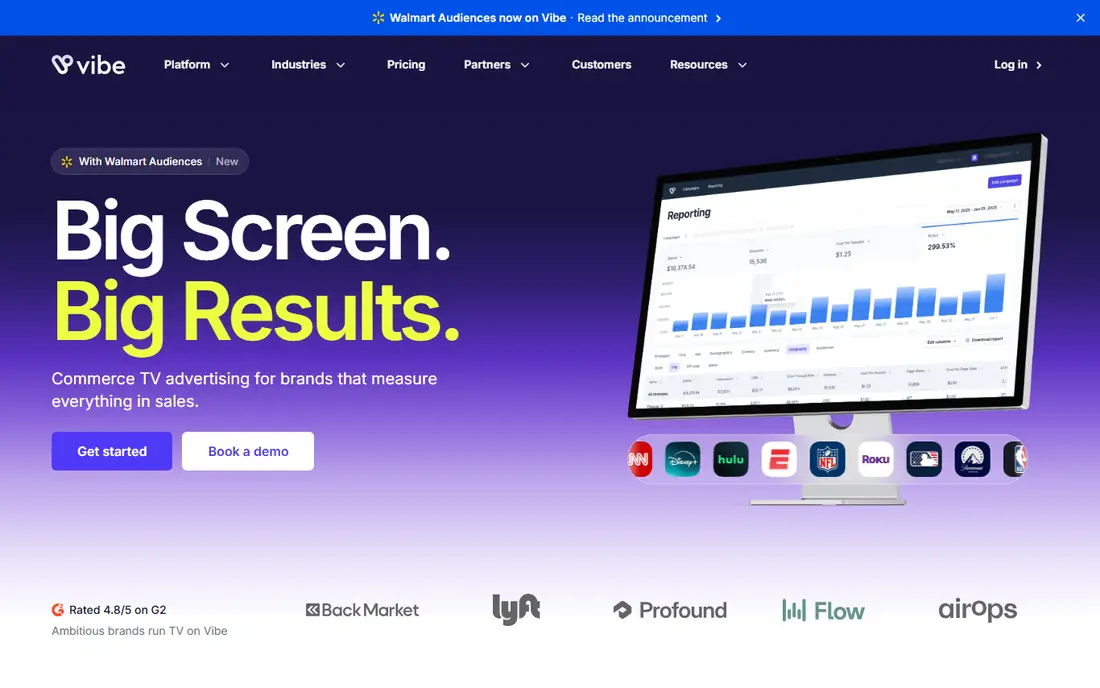
Vibe.co is our pick for a first CTV test because the entry point is clear and low. You set a daily budget from $50, define an audience from your customer list, behaviour or location, and upload a 15 or 30 second spot. The platform states that it uses direct premium inventory across many streaming apps, rather than only open exchange supply. That point matters for small advertisers, since direct supply tends to be easier to explain in a report than a long chain of resellers.
The trade off is scale and control. Vibe is built for US campaigns, so teams that need wide international reach will need another route. CPMs also move with targeting, so a narrow audience will cost more per thousand impressions than a broad one. Still, for a contained test with a clear landing page or store, Vibe gives a small team a fast way to learn whether TV creative drives action.
- Low daily minimum
- Direct premium streaming inventory
- Same-day launch for ready creative
- US focused
- Media cost varies by targeting
- No free plan
MNTN frames TV as a performance channel, not only a brand channel. Its platform links household exposure to site visits and purchases, which helps a direct brand judge CTV next to search and social. It also offers creative support, including tools that turn existing assets into TV-ready video. That is useful when a team has product photos and short clips but no finished commercial.
The catch is the $5,000 monthly minimum budget reported for the platform. That puts MNTN a step above a casual test and into a planned monthly channel. Teams with a proven offer and a site that can convert visits will get more from it than a brand that is still working out its message. Check the current minimum and included services before signing, since bundled creative and reporting can change the total cost.
- Performance reporting tied to visits and sales
- Creative help available
- Audience matching from customer data
- Higher monthly minimum
- Less suited to a one-off tiny test
- Pricing varies by plan
Roku Ads Manager buys inside the Roku system, including The Roku Channel and other apps on Roku devices. That direct position gives it first party viewing data, such as genres and shows a household watches, which a third party buyer cannot copy exactly. For a brand whose buyers skew toward Roku households, that focus can be a strength rather than a limit.
The limit is obvious: you are buying one platform family, not the whole streaming market. Roku does not publish a single fixed minimum on the pages we reviewed, and third party guides often cite $500 per campaign as a practical floor. Treat that figure as a planning guide, not a vendor promise, and confirm the current terms in the account setup flow. Creative must also meet Roku specs, so leave time for encoding and review.
- Direct Roku inventory and viewing data
- Self serve campaign control
- Action ad formats for shopping
- Limited to Roku inventory
- No published minimum on its own pages in our check
- Creative specs must be met exactly
Disney Campaign Manager gives smaller advertisers direct access to Hulu and Disney+ through a self serve tool, without going through a large agency buy. That matters because both services carry well known shows and films, and advertisers often want that context for a brand message. Targeting covers location, demographics and genre, and reporting sits in one dashboard.
The $500 per campaign starting point is modest for premium TV, but premium inventory still tends to price above broad exchange supply. A local business with a very tight budget may get more impressions elsewhere, even if the context is less premium. Disney is the better choice when the show or service itself is part of the pitch, such as family, entertainment or sports-adjacent products.
- Premium Hulu and Disney+ inventory
- Self serve buying
- Demographic and genre targeting
- Campaign minimum applies
- Premium inventory can cost more
- Smaller reach than a cross-app DSP
Paramount Ads Manager covers Paramount+, Pluto TV, CBS and Paramount cable networks from one account. That mix is useful for sports, news and entertainment campaigns, since live and news viewing still draws large audiences. The tool also includes a creative builder that can make a simple ad from a website address, which lowers the barrier for a team without a video editor.
As with Disney, the trade off is breadth. You are buying Paramount properties, not every streaming app. CPMs vary with targeting, season and placement, so the $500 campaign minimum is a floor, not a full cost estimate. Test with a narrow geography first if your product is local, then widen the buy only after the first results are in.
- Paramount+, Pluto TV and CBS in one account
- Creative tool for building an ad
- Zip level targeting
- Campaign minimum applies
- CPM varies by targeting
- Inventory is tied to Paramount properties
Tatari stands out for measurement. It was built to treat TV like a performance channel, with reporting that connects exposure to site and store outcomes. Its self serve retargeting offer, reported from $350 per week, gives smaller brands a way to reach people who already visited their site. Prospecting to new audiences costs more, with reports citing $5,000 per week, so the two campaign types should not be confused in a budget plan.
The honest catch is complexity. Tatari rewards a team that can read attribution reports and act on them, and it is less of a one-click test than Vibe. If your site traffic is small, retargeting pools will also be small, which limits reach. Tatari fits best when you already have site traffic and want TV to work as a retargeting and prospecting layer on top of it.
- Self serve retargeting from $350 per week
- Linear and streaming in one view
- Measurement built for outcomes
- Prospecting costs more than retargeting
- Setup takes more care
- Minimums differ by campaign type
StackAdapt is a DSP with a self serve interface, so CTV sits beside display, video and native in one campaign. That suits agencies and in-house teams that already run programmatic media and want TV to share an audience, budget and report with other channels. You can target by audience, context and geography, and adjust the buy as results come in.
The downside is that custom pricing and a steeper learning curve make it a weaker first step for a beginner. StackAdapt assumes you know how programmatic auctions work and how to read frequency, reach and CPM together. A small team that only wants TV may find a single-purpose CTV platform simpler. Choose StackAdapt when CTV is one part of a larger programmatic plan.
- CTV inside a wider programmatic buy
- Self serve interface
- Audience and contextual targeting
- Custom pricing
- Assumes more trading skill
- Minimums are set by quote
Simpli.fi is built for local advertisers and agencies that need precise geography. It can target by zip code, neighbourhood and location behaviour, which suits car dealers, clinics, restaurants and service firms with a defined trade area. CTV can run beside display and other local formats, so a local campaign can stay in one system.
Pricing is custom, so you will need a quote to compare it fairly with Vibe or Roku. That is a real friction point for a small team that wants a published price before a sales call. Simpli.fi also buys programmatically rather than selling its own premium shows, so it will not match Disney or Paramount on single-publisher context. Its strength is local precision, and that is where it should be judged.
- Strong local and zip level targeting
- Agency and local advertiser focus
- No single published campaign minimum in our check
- Custom pricing
- Reporting depth varies by partner
- Less premium publisher direct access than a publisher tool
How we picked these
We compared official product pages, pricing pages and help material, plus independent comparisons of CTV platforms published in 2026. We kept only platforms that offer a self serve route, meaning an advertiser can build and launch a campaign in a dashboard without a mandatory agency buy. We favoured platforms with a stated minimum or a clear self serve tool, and we marked pricing as See website where the vendor does not publish a fixed rate. We did not claim hands-on testing, and we did not invent CPMs, audience sizes or results.
What to check before you launch
Start with the creative, not the platform. A 15 second spot needs a clear offer, a readable brand name and a simple next step, such as a short web address or a QR code on screen. Test the video on a TV screen, not only on a laptop, since small text that looks fine on a phone can be unreadable from a sofa.
Next, match the platform to your geography and goal. Use a publisher tool when one service matches your buyers, use Vibe or Tatari for a contained performance test, and use a DSP when TV must share audiences with other programmatic channels. Set a test budget you can afford to lose, run it for at least two weeks, and judge it on visits, leads or sales, not only on impressions or completion rate.
Finally, check measurement before launch. Confirm that your site analytics, pixel or post-visit tracking is in place, and ask how the platform handles households that saw the ad on TV and converted on a phone. A platform that cannot explain its attribution in plain terms is a weak choice, even if its CPM looks low.
Frequently asked questions
How much do I need to start CTV advertising?
Vibe.co starts at $50 per day, while Disney and Paramount start at $500 per campaign in the reports we reviewed. MNTN and Tatari prospecting need larger monthly or weekly budgets. Plan for creative costs on top of media, since a poor ad will waste even a well targeted buy.
Do I need an agency to run self serve CTV?
No. Each platform in this list offers a dashboard where you can set budget, audience and creative yourself. An agency can still help with creative and measurement, but it is not a requirement to launch on these tools.
What video format works best for CTV?
Most platforms accept 15 and 30 second spots in a wide screen format. Keep the message to one offer, show the brand early, and end with a clear next step. Check each platform spec sheet, since length, file size and safe areas differ.
How is CTV different from linear TV?
Linear TV buys scheduled slots on broadcast or cable channels, often through a sales team. CTV buys impressions inside streaming apps, targeted by household, location or behaviour, and reported in a dashboard. That targeting and reporting is the main reason small teams can now test TV.
Can I target a local area with CTV?
Yes. Simpli.fi, Paramount and other tools in this list offer zip level or local targeting. Local targeting narrows reach and can raise CPM, so start with your true trade area and widen only if the pool is too small to spend the budget.
How do I measure CTV results?
Use site visits, leads, store visits where offered, and sales matched to exposed households. Ask each vendor how it defines a visit or conversion, and whether it offers a holdout test. Without that detail, a high reported return may reflect correlation rather than a proven effect.
Sources
See where you really rank - block by block
ProMapRanker scans Google Maps across a grid of your service area. Simple monthly plans from $19, white-label on every plan.
Start freeKeep reading
 zoro.to alternatives
Best Zoro.to Alternatives in 2026
We compare the best zoro.to alternatives in 2026, listing only legal licensed anime streaming services, from Crunchyroll to free options for fans today.
Read → zip alternatives
Best Zip Alternatives in 2026
We compare the best zip alternatives for buy now, pay later in 2026, covering pay-in-4 plans, fees, spending limits, and credit reporting options today.
Read → yesware alternatives
Best Yesware Alternatives in 2026
Compare the best yesware alternatives for sales email tracking, templates, and sequences, with current pricing and honest tradeoffs for small sales teams.
Read →