 ProMapRanker
Best Scribe Company in 2026

Key takeaways
- AI scribe companies suit clinicians who want fast drafts, while human scribe companies suit complex visits that need human judgment.
- EHR fit matters more than a feature list, so check whether notes sync directly, use a browser tool or require copy and paste.
- Privacy, audio retention and business associate agreement terms should be confirmed before any clinical use.
- Clinicians remain responsible for reviewing, editing and signing every note, even when a scribe drafts it.
- This guide is general information only and is not medical advice; pilot a scribe on your hardest visit types before committing.
Quick comparison
| Pick | Great for | Pricing starts at | Free tier | |
|---|---|---|---|---|
 Abridge | Hospital and enterprise scribing | See website | No | Visit |
 Suki | Multi-EHR ambient scribing | See website | No | Visit |
 DeepScribe | Specialty and complex visits | See website | No | Visit |
 Ambience Healthcare | Documentation plus coding support | See website | No | Visit |
 Freed | Solo and small practice scribing | From $39 per month | Free trial | Visit |
 Heidi Health | Low cost entry with free tier | Free | Yes | Visit |
 Nabla | Multilingual and telehealth scribing | See website | Free trial | Visit |
 Microsoft Dragon Copilot | Enterprise Epic workflows | See website | No | Visit |
 ScribeAmerica | Human scribe services | See website | No | Visit |
 Commure Scribe | Broad EHR sync for groups | See website | Free trial | Visit |
The best scribe companies
We compared scribe companies that serve clinicians and health organizations, covering AI ambient scribes, dictation tools and human scribe services. Each company below fits a different practice size, specialty and workflow, so start with your EHR and visit type.

Abridge suits hospitals and large health systems that want ambient scribing at scale. Its tools capture visit conversations and draft structured notes, with workflows designed around major EHR systems. That enterprise focus helps large organizations standardize documentation across many clinicians and sites.
The catch is access. Abridge is sold mainly through enterprise agreements, with implementation and training timelines that suit large buyers better than solo clinicians. Smaller practices should ask about group pricing and onboarding support before assuming it fits their budget and timeline.
- Strong hospital and health system adoption
- Ambient note drafting
- EHR focused workflows
- Enterprise pricing and onboarding
- No self-service trial for most buyers
Suki fits health systems and multi-specialty groups that work across more than one EHR. Its ambient scribe drafts notes from conversations, and its voice tools also support dictation and commands inside clinical workflows. That combination helps clinicians who switch between systems or who want both ambient and dictation options.
Implementation is the main limit. Multi-EHR setups need IT coordination, and pricing is handled through sales rather than a public self-service plan. Groups should budget time for integration testing and clinician training, and pilot with a small team first.
- Ambient scribing plus voice dictation
- Broad EHR integrations
- Enterprise scale experience
- Enterprise pricing
- Implementation may need IT support
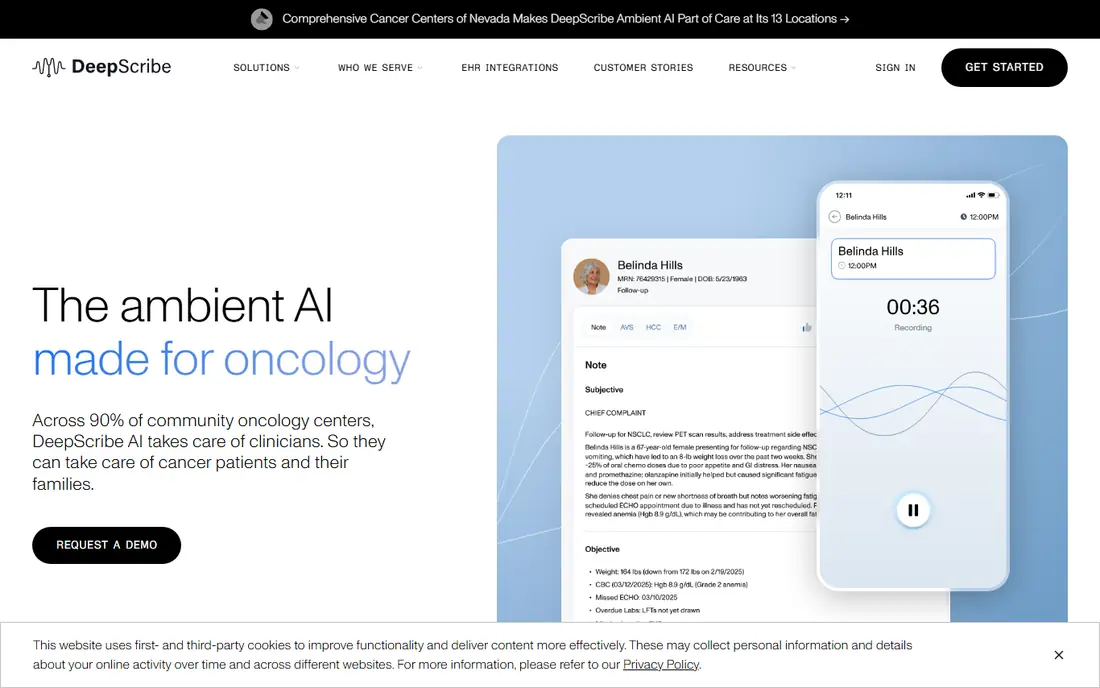
DeepScribe suits specialty practices and clinicians with complex, multi-problem visits. Its ambient scribe is designed to handle detailed clinical conversations and produce structured notes, with integrations for major EHR systems. Oncology, cardiology and other high-acuity specialties are often cited as strong fits.
The trade-off is that pricing and onboarding are geared to larger buyers, so solo clinicians may find access harder. Ask about specialty coverage, note turnaround and editing workflows during a demo, and test it on your most complex visit types before deciding.
- Focus on complex specialty visits
- EHR integrations
- Coding related suggestions on some plans
- Pricing through sales
- Onboarding suits larger practices and systems
Ambience Healthcare suits large health systems, emergency departments and inpatient teams that want documentation plus coding support. Its tools aim to draft notes and surface coding related information during or after the visit, which can help downstream billing and review. That breadth suits complex care settings.
Smaller practices will likely find the enterprise model a barrier, because pricing and implementation are handled through sales. Groups should ask about specialty coverage, EHR workflow and training needs, and compare it with more accessible tools if they need a quick start.
- Documentation with real-time coding support
- Focus on large systems and emergency care
- EHR focused design
- Enterprise sales model
- Less accessible for solo clinicians
Freed is our pick for solo clinicians and small practices that want a fast start. Its starter plan is priced from $39 per month, with a trial available, and setup takes minutes rather than weeks. That accessibility makes it easy to test AI scribing without an enterprise contract.
The honest catch is workflow. Depending on the plan, notes may move to the EHR through a browser tool or copy and paste rather than a deep native integration. That is workable for many small practices, but clinicians should test the handoff with their own EHR before committing to a higher plan.
- Simple self-service start
- Clear starter pricing
- Popular with solo clinicians
- EHR handoff may rely on browser tools on some plans
- Note editing still needed
Heidi Health suits clinicians who want to try AI scribing with minimal upfront cost. Its free tier offers transcription and basic drafting, while paid plans add more advanced features, templates and integrations. Same-day signup makes it a low-risk first test for many practices.
Free does not mean unlimited. Advanced features on the free tier have limits, and paid plans are needed for fuller workflows. Clinicians should check which features they actually use during the trial, then choose the paid tier that covers those features, rather than paying for extras they do not need.
- Free tier available
- Fast signup
- Template control and EHR partner options
- Advanced features need paid plans
- Free tier has usage limits on advanced features
Nabla, known for Nabla Copilot, suits virtual, hybrid and multilingual practices. Its tools support live transcription and note drafting across languages, which helps clinicians serving diverse patient populations. Telehealth workflows and EHR integrations are central to its design.
Pricing clarity is the main limit. Some plans are public and others are handled through sales, so clinicians should confirm the plan that fits their practice size and EHR. Test language support and telehealth audio quality during a trial, because those factors vary by setup.
- Multilingual support
- Telehealth friendly workflows
- Broad EHR integrations on enterprise plans
- Full pricing is not fully public
- Enterprise integrations may need IT help
Microsoft Dragon Copilot, formerly known as DAX, suits large health systems already using Epic and Microsoft tools. Its ambient and dictation workflows are designed for enterprise governance, security and EHR embedding, which helps large organizations manage documentation at scale. That depth is its main advantage.
Solo and small practices will likely find it out of reach, because pricing and onboarding are enterprise focused. Groups already invested in Microsoft and Epic should compare it closely with Abridge and Suki, while smaller practices should look at Freed, Heidi Health or Nabla first.
- Deep enterprise and Epic workflows
- Microsoft and Nuance heritage
- Compliance focused design
- Enterprise pricing and long onboarding
- Not built for solo self-service signup
ScribeAmerica suits clinicians and organizations that prefer human scribes over AI drafting. Human scribes can handle complex visits, adapt to clinician style and manage real-time documentation, which some clinicians prefer for high-acuity or nuanced encounters. Its staffing and training model supports hospitals and practices that need in-person or remote scribe coverage.
Cost and availability are the limits. Human scribe services usually cost more than AI tools, and staffing depends on location, specialty and shift needs. Organizations should compare total cost, coverage hours and training quality against AI options before choosing.
- Human scribes for real-time documentation
- Training and staffing model
- Suits complex visits
- Human staffing costs more than AI tools
- Availability depends on location and specialty
Commure Scribe suits groups that want broad EHR synchronization and coding support in one tool. Its scribe covers many EHR systems, with one-click sync on group plans and coding support for common code sets. That breadth helps multi-site groups that use different systems.
Pricing and setup vary by plan, so groups should confirm the exact EHR sync method, coding coverage and trial terms before committing. Pilot with clinicians across sites, because EHR workflows can differ even within one organization.
- Broad EHR sync options
- Coding support on some plans
- Trial available for groups
- Pricing details vary by plan
- Group setup may need coordination
How we picked these
We compared scribe companies with current US service, published product and security pages, and coverage across AI ambient scribing, dictation and human scribe services. We used recent pricing checks for Freed and Heidi Health, and we used See website where pricing is handled through sales or varies by plan. We did not claim hands-on clinical testing, and we focused on EHR fit, privacy terms, practice size and workflow rather than accuracy scores, which vendors measure differently.
How to choose a scribe company safely
Start with your EHR and visit type. Check whether the scribe syncs natively, uses a browser tool or requires copy and paste, and test that handoff with your own record system. A tool that drafts well but moves notes poorly will cost time on every visit.
Next, check privacy and compliance in writing. Ask about audio retention, data handling, security certifications and whether a business associate agreement is included. Confirm who can access recordings and notes, and how long audio is kept, before using the tool with real patients.
Finally, pilot on hard visits and measure edit time. Use the scribe for multi-problem visits, complex medication lists and specialty cases, not only simple follow-ups. Note how long edits take, how often key details are missed and how clinicians feel about the notes, then decide based on that pilot rather than a sales demo.
Frequently asked questions
What is the best scribe company?
The best scribe depends on practice size and workflow. Large systems suit Abridge, Suki and Dragon Copilot, solo clinicians suit Freed and Heidi Health, and organizations that want human scribes suit ScribeAmerica.
What are the best scribe companies for small practices?
Freed, Heidi Health and Nabla are strong for small practices, because they offer self-service signup, trials or free tiers. Check EHR handoff and pricing for your exact plan before committing.
Do AI scribes replace human scribes?
AI scribes draft notes quickly, while human scribes offer judgment and real-time adaptation. Many organizations use AI for routine visits and human support for complex cases, and clinicians must review every note in either model.
Is patient audio kept by AI scribe companies?
Audio retention varies by vendor and plan, so check the privacy policy and business associate agreement before use. Ask how long audio is stored, who can access it and whether you can delete it.
Can a scribe company work with my EHR?
Many scribes support major EHR systems, but the depth of integration varies. Confirm whether notes sync directly, use a browser extension or require copy and paste, and test the workflow during a trial.
Sources
See where you really rank - block by block
ProMapRanker scans Google Maps across a grid of your service area. Simple monthly plans from $19, white-label on every plan.
Start freeKeep reading
 zscaler alternatives
Best Zscaler Alternatives in 2026
Looking for zscaler alternatives? We compare 9 SASE and zero trust platforms on architecture, data protection, pricing, and fit for your network and team.
Read → zapier alternatives free
Best Zapier Alternatives Free in 2026
Nine automation tools for zapier alternatives free in 2026, all with genuinely free tiers, plus free plan limits, starting prices and upgrade paths explained.
Read → which platform is best for online reputation
Which Platform Is Best for Online Reputation in 2026
Wondering which platform is best for online reputation? We compare 8 review, listing, and response tools for small and multi-location businesses and agencies.
Read →