 ProMapRanker
Best SBOM Tools in 2026: 9 Tools Compared

Key takeaways
- Syft and Trivy are the free starting points for SBOM generation in CI.
- FOSSA leads for licence-linked management, while Cybeats leads for lifecycle monitoring.
- Most serious tools support both SPDX and CycloneDX formats.
- VEX statements matter, because they show which vulnerabilities actually affect a product.
Quick comparison
| Pick | Great for | Pricing starts at | Free tier | |
|---|---|---|---|---|
 Syft | free SBOM generation in CI | Free | Yes | Visit |
 FOSSA | licence and SBOM management | See website | Yes | Visit |
 Snyk | developer-led fixing with SBOM output | See website | Yes | Visit |
 Sonatype Lifecycle | policy-driven component management | See website | Free trial | Visit |
 JFrog Xray | artifact-native SBOM and security gates | See website | No | Visit |
 Trivy | free scanning plus SBOM generation | Free | Yes | Visit |
 Anchore Enterprise | container SBOM policy and enforcement | See website | No | Visit |
 Cybeats | lifecycle monitoring of SBOMs | See website | No | Visit |
 Manifest | supplier SBOM ingestion and consumption | See website | No | Visit |
Best SBOM Tools
A software bill of materials, or SBOM, lists the components in a piece of software, much like an ingredients list. Customers, regulators and security teams use SBOMs to find vulnerable components, check licences and respond faster when a new flaw appears. The best SBOM software depends on if your job is to generate, manage, monitor or consume SBOMs.
This list covers all four jobs. Free generators suit teams starting in CI. Management platforms suit licence and policy work. Monitoring tools suit long-lived products. Buyer tools suit teams receiving SBOMs from suppliers. Pick by obligation, not by feature count.
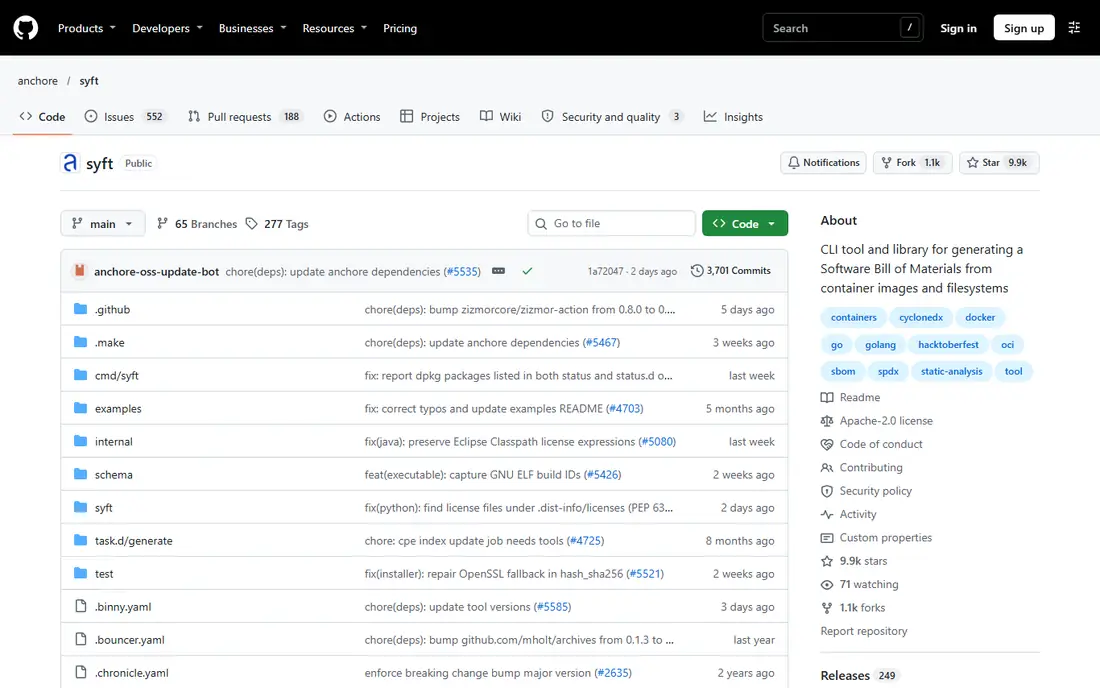
Syft, from Anchore, is the free starting point for most SBOM work. It generates software bills of materials in SPDX and CycloneDX formats from container images, filesystems and directories, and it fits naturally into CI pipelines. Teams can start producing SBOMs this week at no licence cost.
Syft generates, but it does not manage a portfolio, monitor new vulnerabilities or handle supplier SBOMs on its own. Pair it with a scanner like Grype for vulnerability data, or with a management platform when SBOMs must be tracked across many products.
- Generates SPDX and CycloneDX SBOMs from containers and filesystems
- Fast CI integration
- Open source
- Generation only, so management and monitoring need other tools
FOSSA suits teams whose SBOM obligation is as much legal as security. It manages SBOMs alongside licence compliance, so legal teams can review obligations, policies and third-party components in one place. That licence link is stronger here than in pure security scanners.
The platform is broader than generation alone, so pricing is tiered and smaller teams may pay for features they do not use. It works best when licence risk, open source policy and SBOM delivery are all part of the same obligation.
- Licence compliance plus SBOM management
- Policy controls
- CI and legal workflows
- Full platform pricing is tiered
- Smaller teams may need only part of the suite
Snyk is a developer platform first, with SBOM export as part of a wider security workflow. It finds vulnerabilities in code, dependencies and containers, then gives developers fix guidance such as upgrades. Teams already using Snyk can often meet basic SBOM requests without a separate tool.
The limit is SBOM depth. Dedicated SBOM platforms offer stronger lifecycle monitoring, supplier ingestion and VEX handling. Snyk fits teams whose main need is fixing code, with SBOMs as a useful output, not the core obligation.
- Finds vulnerabilities in code and dependencies
- SBOM export
- Developer fix guidance
- SBOM management depth is lower than dedicated SBOM platforms
- Pricing is per developer
Sonatype Lifecycle focuses on policy: which components are allowed, which need review, and which must be replaced. It ingests SBOMs, monitors components over time and links to Nexus repositories, which helps teams enforce open source policy consistently across projects.
That governance strength comes with enterprise pricing and setup effort. Small teams with a single SBOM request will find Syft faster. Sonatype fits organisations where component policy, licence risk and security risk must be managed together.
- Component policy and governance
- SBOM ingestion and monitoring
- Nexus repository links
- Enterprise pricing and setup
- Best value with Sonatype repository use
JFrog Xray suits teams already using Artifactory, because it applies SBOM generation, scanning and policy gates where artifacts are stored. A build that fails policy can be blocked before it reaches production, which turns SBOMs from documents into controls.
Outside Artifactory, that advantage fades. Teams without JFrog may find a standalone SBOM platform simpler. Judge Xray on total JFrog platform cost and on whether artifact-level gating matches your release process.
- SBOM generation and scanning at the artifact level
- Policy gates in Artifactory
- Vulnerability data
- Best value inside JFrog Artifactory
- Standalone use is less natural
Trivy, from Aqua, is the other free floor for SBOM work. It scans containers, filesystems and repositories for vulnerabilities and can output SBOMs, making it a strong CI companion to Syft. Many teams run both: Syft for generation, Trivy for scanning, or Trivy alone for both jobs.
Trivy is a scanner, not a portfolio manager. It does not provide long-term SBOM monitoring, supplier workflows or legal review on its own. Use it to generate and check SBOMs in CI, then add a management tool when SBOMs must be tracked across customers and releases.
- Open source scanner with SBOM output
- Container, filesystem and repository scanning
- Fast CI use
- Scanning focus, so portfolio management needs another tool
Anchore Enterprise builds on Syft for teams that need policy enforcement on container SBOMs. It generates SBOMs, checks them against vulnerability and policy rules, and can gate builds or deployments that fail those rules. Container-first teams get a coherent workflow from generation to gate.
The scope is container-focused, so teams with mixed artifacts, libraries and firmware will need complementary tools. Pricing is quote-based, so small teams should start with open source Syft and only move to Enterprise when policy gating becomes a real need.
- Container SBOM generation with policy enforcement
- CI integration
- Syft-native workflow
- Container focus limits non-container coverage
- Enterprise pricing is quote-based
Cybeats focuses on what happens after an SBOM is generated: monitoring it over time, handling VEX statements, and tracking SBOMs across products and suppliers. That lifecycle view matters when a new vulnerability appears months after release and teams must know which products are affected.
The trade-off is that Cybeats is a monitoring and management purchase, not a free generator. Teams should already generate SBOMs reliably before buying lifecycle monitoring, or they will monitor an incomplete set of bills.
- SBOM lifecycle monitoring
- VEX handling
- Supplier and product SBOM tracking
- Tiered pricing
- Setup effort for full lifecycle use
Manifest suits organisations on the buying side of SBOMs: teams that receive SBOMs from suppliers and must check, track and act on them. It ingests supplier bills, handles VEX statements and helps buyers understand risk across a supplier portfolio, rather than generating SBOMs for their own code.
That buyer focus is also its limit. Teams that mainly need to generate SBOMs for their own products should start with Syft or Trivy. Manifest earns its place when supplier SBOM volume, not generation, is the bottleneck.
- Ingests supplier SBOMs
- VEX and risk tracking
- Consumption workflows for buyers
- Tiered pricing
- Best for buyers managing many supplier SBOMs
How we picked these
We compared official vendor pages and feature descriptions, and we cross-checked recent SBOM roundups for consistency. We favoured tools clearly operating in October 2026 that generate, manage, monitor or consume SBOMs as a core function. Where pricing was tiered or quote-based, we wrote See website rather than inventing a figure.
We also separated generation from management and monitoring, because a good generator can be a poor portfolio tool. That split shaped the list and the advice below.
How to choose SBOM tools for your obligation
Generate first, then buy management
Add Syft or Trivy to CI this week and start emitting SBOMs for every release. That free step future-proofs builds and reveals gaps in component data. Only then buy management or monitoring for the obligation you actually face: legal, portfolio, firmware or supplier work.
Support both formats and VEX
Serious tools support SPDX and CycloneDX, because customers ask for different formats. VEX handling also matters: without exploitability statements, every ingested SBOM looks alarming. Check format support and VEX import before committing to a management platform.
Plan for retention and response
An SBOM is only useful if it can be found later. Decide where SBOMs are stored, how long they are kept, and who responds when a new vulnerability matches a shipped product. A tool without a retention and response process is a document generator, not a security control.
Frequently asked questions
What is the best SBOM software?
Syft ranks first for free generation, FOSSA for licence-linked management, and Cybeats for lifecycle monitoring. The best SBOM tools choice depends on if your job is to generate, manage, monitor or consume SBOMs.
What is the difference between SPDX and CycloneDX?
SPDX, from the Linux Foundation, has strong licence heritage, while CycloneDX, from OWASP, leads for security use cases and VEX. Most serious tools support both, so format choice matters less than consistent, complete generation.
Are there free SBOM tools?
Yes. Syft and Trivy are open source and free, and several paid platforms offer free tiers or trials. Free generators cover generation and basic scanning, while management, monitoring and supplier workflows usually require paid platforms.
What is VEX and why does it matter?
VEX, or Vulnerability Exploitability eXchange, states whether a vulnerability in a component actually affects a product. Without VEX, teams must triage every match. With VEX, teams can focus on vulnerabilities that truly affect shipped software.
Do I need an SBOM tool if I already use a scanner?
Scanners find vulnerabilities, but SBOM tools produce, store and share component lists for customers and regulators. Many teams use both: a scanner for fixing, and an SBOM tool for generation, delivery and long-term tracking.
Sources
See where you really rank - block by block
ProMapRanker scans Google Maps across a grid of your service area. Simple monthly plans from $19, white-label on every plan.
Start freeKeep reading
 zscaler alternatives
Best Zscaler Alternatives in 2026
Looking for zscaler alternatives? We compare 9 SASE and zero trust platforms on architecture, data protection, pricing, and fit for your network and team.
Read → zapier alternatives free
Best Zapier Alternatives Free in 2026
Nine automation tools for zapier alternatives free in 2026, all with genuinely free tiers, plus free plan limits, starting prices and upgrade paths explained.
Read → which platform is best for online reputation
Which Platform Is Best for Online Reputation in 2026
Wondering which platform is best for online reputation? We compare 8 review, listing, and response tools for small and multi-location businesses and agencies.
Read →