 ProMapRanker
Best Sales Tax Software for Startups in 2026


Larger startups with many integrations · Pricing starts at: $69 per month
Key takeaways
- Start with nexus monitoring and calculation, then add filing only in states where you actually owe tax, because filing fees add up fast.
- TaxJar and TaxCloud suit small online sellers best, while Anrok and Avalara suit software and larger multi-state sellers.
- Per-filing pricing looks cheap at two states and expensive at twenty, so model your cost at your expected state count, not at launch.
- This article is general information only, not tax advice, and rates and rules vary by jurisdiction, so confirm registration and filing duties with a tax professional.
Quick comparison
| Pick | Great for | Pricing starts at | Free tier | |
|---|---|---|---|---|
| Avalara | Larger startups with many integrations | $69 per month | No | Visit |
 TaxJar | Small online sellers on Stripe or Shopify | $39 per month | Free trial | Visit |
 Anrok | Software startups selling in many markets | $100 per market per month | No | Visit |
 Numeral | Small sellers who want pay-per-filing pricing | Free | Yes | Visit |
 Kintsugi | Startups that want a free monitoring tier | Free | Yes | Visit |
 TaxCloud | Budget sellers in Streamlined Sales Tax states | $199 per year | Yes | Visit |
 Stripe Tax | Businesses already taking payments through Stripe | 0.5% per transaction | No | Visit |
 Vertex | Startups with complex product tax rules | See website | No | Visit |
 Sovos | Startups planning global tax compliance | See website | No | Visit |
The best sales tax software for startups
We compared calculation, nexus tracking, registration help, filing, and published pricing, and we kept only tools that still serve small and growing US sellers in October 2026.

Avalara is the broadest tool on this list, and that breadth is the reason larger startups pick it. Its AvaTax engine calculates tax at checkout, tracks nexus across states, and connects to major commerce, accounting, and ERP systems, so a growing company does not need to rebuild its tax stack when it adds a channel. The Core Compliance plus Streamlined Sales Tax plan starts at $69 per state per month for qualifying sellers, which can lower costs in participating states.
The catch is complexity and total cost. Entry pricing is per state, returns and exemption management sit in related modules, and implementation can take real staff time. A startup selling in two states may pay more here than with a simpler tool, and it should get a written quote that covers calculation, filing, and any implementation fees before signing.
- Wide integration library
- Automatic rate updates
- Managed returns option
- Quote-based costs above entry tiers
- Setup can feel heavy for a tiny team
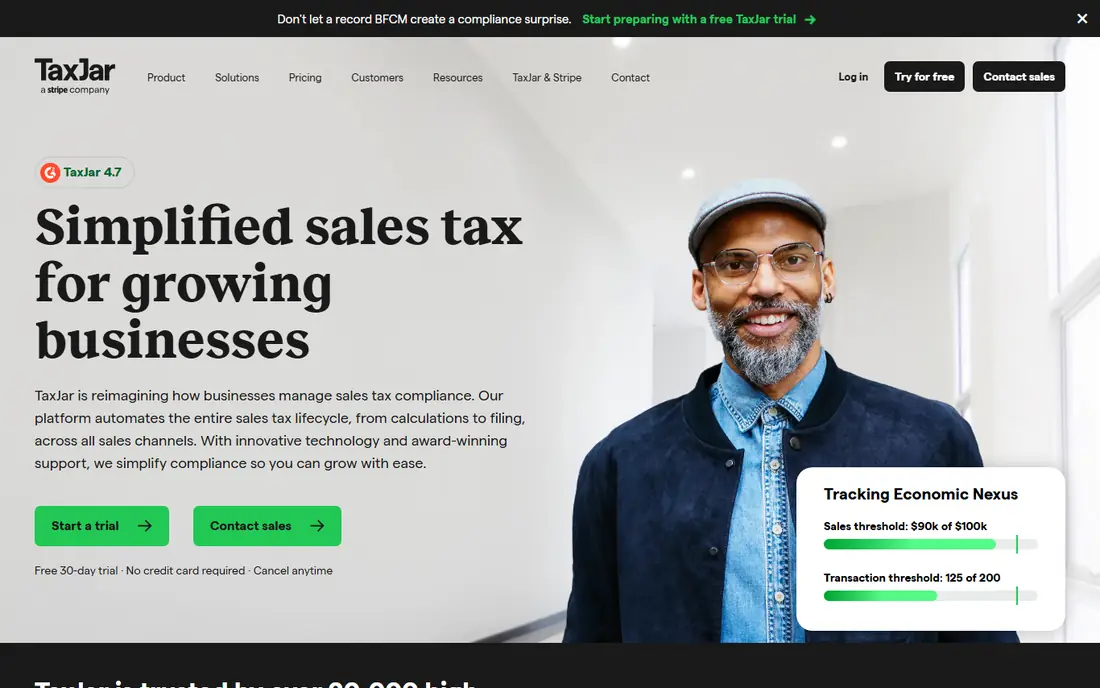
TaxJar, now part of Stripe, remains one of the easiest starting points for a small online store. It connects to Shopify, WooCommerce, Amazon, and other common channels, calculates tax in real time, watches for nexus, and files returns through AutoFile in states covered by your plan. Starter starts at $39 per month for up to 200 orders per month, with two AutoFile credits per year.
The limit to watch is filing volume. A seller filing quarterly in five states needs twenty filings a year, far above the included credits, and each extra filing adds cost. TaxJar also stays focused on US sales tax, so a startup that adds meaningful sales in Canada or Europe will still need a second process for VAT or GST.
- Simple setup for US sellers
- AutoFile in covered states
- Clear order-volume tiers
- US-focused scope
- Extra filings cost $50 to $55 each on entry plans
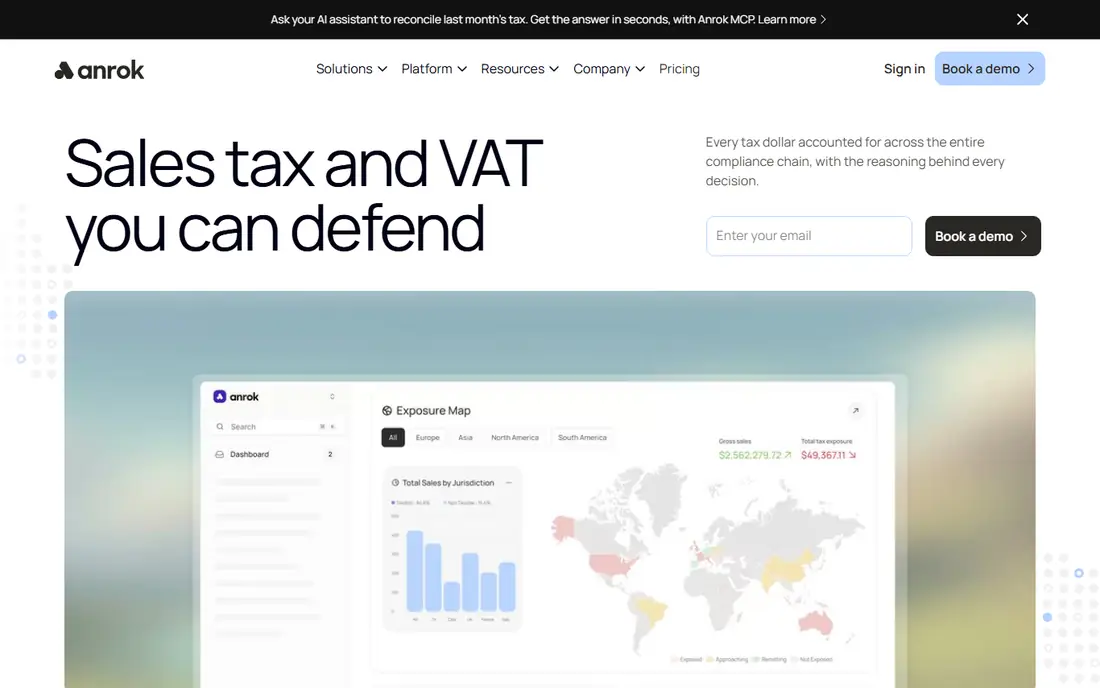
Anrok was built for software companies, and that focus shows in how it handles subscriptions, billing systems, and multi-state exposure. Starter costs $100 per market per month and includes global exposure monitoring, real-time calculation, filing and remittance, exemption certificate management, and physical nexus tracking. For a SaaS startup, the appeal is one system from first sale through filing, without buying filing as a separate add-on for each state.
The trade-off is that every new market adds the same monthly fee, so a startup expanding from three markets to fifteen should model that jump in advance. Anrok also fits subscription billing better than a single-location retail shop, and teams with mostly physical goods may find a commerce-first tool more natural.
- Built for SaaS and subscriptions
- Filing and remittance included
- Physical nexus tracking
- Per-market pricing grows with each new state
- No free tier on the current Starter plan
Numeral keeps pricing unusually plain: a free monitoring plan, then $75 per filing and $150 per registration on its standard plan. That structure suits a startup filing in only a few states, because it pays nothing in months when it has no new filing and avoids a large monthly subscription for a small footprint. It also covers nexus monitoring across US states and connects to Shopify, Amazon, QuickBooks Online, and similar tools.
The weakness appears as the footprint grows. Ten monthly state filings at $75 each cost $750 a month, which can exceed a subscription plan that bundles filings. Numeral also does not advertise hands-on audit defence, so a startup facing a complex audit should keep its own adviser in the loop and check what support its plan actually includes.
- Free nexus monitoring tier
- Flat $75 per filing
- Simple per-state math
- Costs rise steeply across many states
- No advertised hands-on audit defence
Kintsugi starts free for monitoring, which makes it a low-risk way for a very early startup to learn where it may owe tax before it pays for filing. Its paid growth pricing is reported at around $100 per filing interaction with a state, with a custom premium tier for larger sellers, and it offers AI-assisted product categorisation plus integrations with Shopify, Stripe, Chargebee, and other billing tools. That combination suits a startup that wants to watch exposure first and file only where needed.
The honest limit is scale. Per-filing pricing, like Numeral, gets expensive once a startup files in many states every month, and some public reviews have raised filing reliability concerns. A startup should test support response and filing reports in its first two states before trusting it across twenty.
- Free starter tier for monitoring
- AI-assisted product categorisation
- Many integrations
- Per-filing costs add up across many states
- Newer vendor with less documentation depth
TaxCloud is the budget pick for many small sellers, with a Starter plan reported at $199 per year and a Premium plan at $799 per year. As a Streamlined Sales Tax certified service provider, it can offer free filing in participating SST states for qualifying sellers, which is a genuine saving that competitors without SST access cannot match. It also offers filing subscriptions that cap the price at $39 per return, with volume discounts available.
The catch is volume and scope. Entry tiers limit annual orders, so a fast-growing store may need Premium sooner than expected, and filing outside SST terms still adds per-return cost. TaxCloud suits a small seller that wants steady, low-cost compliance more than a startup needing deep ERP or global VAT work.
- Low annual starter price
- Streamlined Sales Tax certified service provider status
- Filing subscriptions capped at $39 per return
- Order limits on entry tiers
- Filing still costs extra outside included terms
Stripe Tax makes sense when Stripe already handles payments, because tax calculation sits inside checkout, billing, and invoicing without a separate integration project. Tax Basic charges 0.5% per transaction for no-code integrations, or $0.50 per API transaction where the seller is registered, and it monitors thresholds and calculates tax for many product types. Tax Complete starts at $90 per month on a one-year contract and adds registration and filing.
The limit is dependence on Stripe. A startup selling mainly through other channels will get less value, and Tax Basic alone does not file returns, so the full compliance cost is higher than the headline transaction fee. Teams should price Basic plus Complete together, not Basic alone, when they compare it with TaxJar or Avalara.
- Native Stripe checkout integration
- Monitoring and calculation in many countries
- Tax Complete adds registration and filing
- Filing needs Tax Complete from $90 per month
- Not a standalone tool outside Stripe
Vertex is the enterprise-grade option on this list, and it earns its place for startups whose products have tricky taxability rules or who plan to pair tax with a full ERP system. Its tax engine draws on detailed jurisdiction content, supports complex product classification, and integrates with major ERP platforms, which matters when a startup sells bundles, digital goods, and physical goods side by side. That depth helps a finance team defend calculations in an audit.
The drawback for a startup is cost and effort. Pricing is quote-based, implementation usually needs more planning than a plug-in tax tool, and a two-person team may not use most of what Vertex offers. It is a strong pick for a funded startup with complex needs, and a poor first pick for a shop filing in two states.
- Deep tax content and rate accuracy
- Strong ERP and enterprise integrations
- Global scope
- Quote-only pricing
- Heavier implementation than small-seller tools
Sovos covers more than US sales tax, with VAT, GST, e-invoicing, and information reporting alongside US filing. That breadth suits a startup that expects to sell into Europe and other regions soon and wants one vendor for several tax regimes, rather than stitching together a US tool and a separate VAT tool. Its managed services team can also prepare and file returns, which helps a small finance team that lacks tax staff.
The trade-off is scale and price transparency. Sovos pricing is custom and quote-based, onboarding is more involved than a self-serve tool, and a US-only startup will pay for scope it does not yet need. Choose Sovos when global coverage is a near-term plan, not a distant possibility.
- Global sales tax, VAT, and e-invoicing coverage
- Managed filing services
- Regulated-industry experience
- Quote-only pricing
- Complex onboarding
- Built for larger operations
How we picked these
We compared official pricing pages, product documentation, and public reviews for calculation, nexus monitoring, registration, filing, and integrations, and we favoured tools that still publish clear starting prices or a clear quote path in October 2026. We excluded tools that had shut down or that no longer serve US small sellers, and we kept the focus on products a startup can actually buy and run without a large tax department.
What to check before you buy
Start by listing every state where you have customers, every channel you sell through, and how often each state requires filing, because those three facts drive most of the price difference. Then ask each vendor for a total first-year quote that includes subscription, per-filing fees, registration fees, and implementation, and ask who handles a state notice if one arrives. Check whether the tool calculates tax inside your checkout or only after the sale, whether it stores exemption certificates, and whether you can export a full transaction history for your accountant. Finally, confirm the cancellation and data export terms, because switching tax vendors mid-year is painful if your history stays locked inside the old system.
Frequently asked questions
Is sales tax software tax advice?
No. These tools calculate, track, and file based on the rules and data you provide, but they do not replace a tax professional. Rates and rules vary by jurisdiction, and a startup should confirm nexus, registration, and product taxability with a qualified adviser, especially before entering a new state.
When does a startup need to register for sales tax?
Registration is generally needed once a startup has nexus in a state, through physical presence or by passing that state's economic threshold for sales or transactions. Thresholds differ by state, so a startup should monitor sales by ship-to state rather than guessing from total revenue alone.
What is the difference between calculation and filing?
Calculation works out the correct tax amount at checkout, while filing prepares and submits the return and pays the state. Some tools do both, some only calculate, and some charge filing as a separate per-return fee, so compare the combined cost, not the subscription alone.
Does marketplace sales tax change what a startup needs?
Marketplace facilitator laws mean a marketplace often collects tax on sales made through that marketplace, but a startup usually still owes tax on its own website and other direct channels. A tool should separate marketplace sales from direct sales so the startup does not double-file or miss its own obligations.
Can a startup start free and upgrade later?
Yes, several tools offer a free monitoring tier or trial, including Numeral, Kintsugi, and TaxCloud. Free monitoring helps a startup learn where it may owe tax, but filing, registration, and audit support usually sit on paid plans, so budget for those before the first filing deadline.
How often should a startup review its sales tax setup?
At least once a quarter, and again after any change in sales channels, product lines, or hiring in a new state. Nexus can appear quickly during a growth spurt, and a quarterly review catches new obligations before penalties and interest build up.
Sources
See where you really rank - block by block
ProMapRanker scans Google Maps across a grid of your service area. Simple monthly plans from $19, white-label on every plan.
Start freeKeep reading
 what’s the best risk software for enterprises
What Is the Best Risk Software for Enterprises in 2026
We compared what’s the best risk software for enterprises on risk registers, controls, third-party risk, and reporting, with pricing notes for large teams.
Read → what's the best pam software for enterprises
What is the Best PAM Software for Enterprises in 2026
Find what's the best pam software for enterprises, with vaulting, session recording, just in time access and pricing compared for large enterprise IT teams.
Read → what’s the best grc software
What Is the Best GRC Software in 2026
We compared what’s the best grc software on risk, compliance, audit and vendor risk, so teams can pick a platform that fits their frameworks and budget.
Read →