 ProMapRanker
Best RPC Services in 2026

Key takeaways
- Free tiers in this list are permanent plans, not trials, and every one of them carries a rate limit that will shape what you can build.
- Alchemy and Infura suit teams that want extra APIs and wallet-adjacent tooling, while dRPC and Dwellir suit teams that want simpler per-request maths.
- No free tier in this list promises a production uptime guarantee, so a second provider or a paid plan is the sensible step before launch.
- Method weighting matters more than the headline allowance, because a log-heavy workload can cost far more than a simple balance check.
Quick comparison
| Pick | Great for | Pricing starts at | Free tier | |
|---|---|---|---|---|
 Alchemy | Enhanced APIs and webhooks | Free | Yes | Visit |
 Infura | MetaMask and ConsenSys projects | Free | Yes | Visit |
 Chainstack | Simple request-unit pricing | Free | Yes | Visit |
 dRPC | Flat-rate multi-provider routing | Free | Yes | Visit |
 Dwellir | One credit per response | Free | Yes | Visit |
 Ankr | Broad multi-chain coverage | Free | Yes | Visit |
 GetBlock | Shared and dedicated nodes | Free | Yes | Visit |
 Helius | Solana-focused development | Free | Yes | Visit |
The best rpc services
An RPC service gives your app a managed connection to a blockchain, so you do not run and maintain your own node. The services below all offer a permanent free tier, and we have left out providers whose free offer is only a short trial. Read the rate limit and the support terms before you commit, because those details matter more than a large headline allowance.
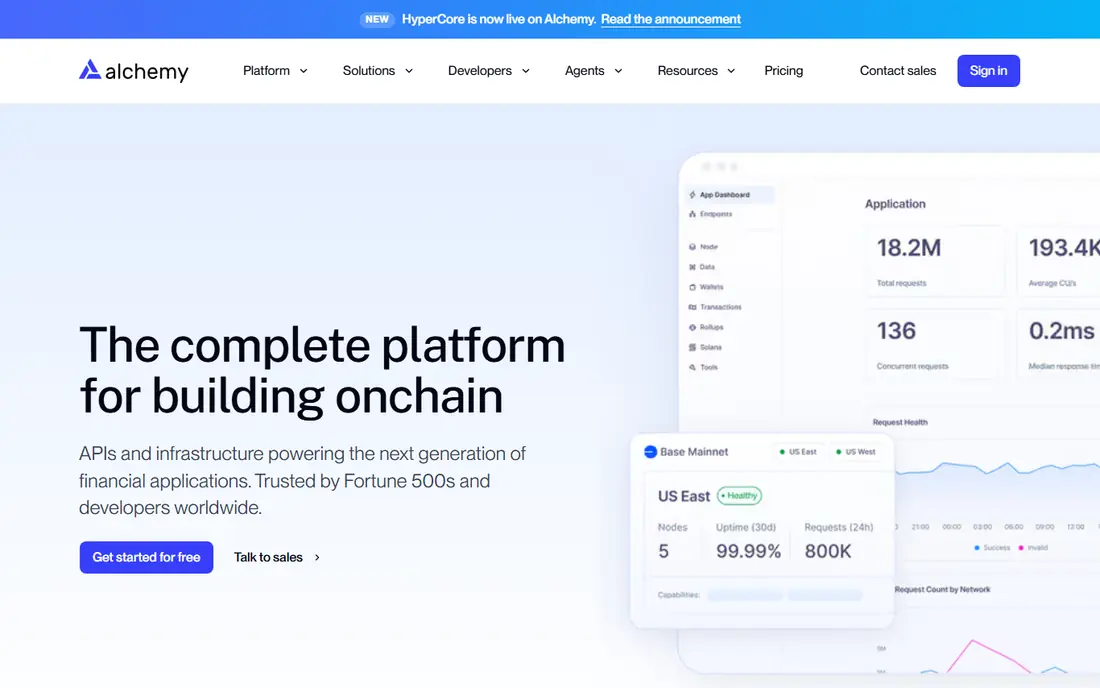
Alchemy is the pick we would point most general app teams toward first, because its extra APIs cover work that a plain RPC endpoint does not. Token data, transfer history, webhooks, and transaction simulation can save a small team from building several side services. The platform covers a wide range of networks, which helps when a product starts on one chain and later adds another. Its dashboard also makes usage patterns visible, so you can see which methods are eating your allowance.
The catch is the billing unit. Alchemy charges in compute units, and a method such as eth_getLogs costs several times more than a basic block number call. That means two apps with the same request count can face very different costs, and a log-heavy indexer needs careful modelling before it relies on the free tier. The free plan gives 30 million compute units a month at a modest throughput, which suits prototypes and small apps. For production traffic, expect to move to pay as you go, where pricing is published per million compute units, and to keep a second endpoint ready for outages.
- Broad chain coverage
- Useful enhanced APIs and webhooks
- Clear dashboard for usage and errors
- Compute-unit pricing is hard to forecast
- Free tier has no SLA
- Heavy methods cost far more than light ones
Infura has been part of Ethereum tooling for years, and it remains the natural choice for teams already building around MetaMask. The free Core tier gives 3 million credits a day, which resets daily rather than pooling across a month. That structure suits apps with steady traffic, since you can watch one day at a time, but it punishes a single busy day because unused credits from a quiet day do not carry over. Archive data is included, which is a real help for apps that need history as well as current state.
The pricing model needs the same care as Alchemy. Credits are weighted by method, so eth_getLogs and trace calls consume far more than a simple call. Paid plans start at 50 dollars a month for a larger daily credit pool, with a higher tier at 225 dollars a month for teams that need many keys and much higher throughput. If your app already uses ConsenSys tooling, the integration value may outweigh the credit maths. If it does not, compare the effective cost per call on your own method mix before choosing.
- Deep MetaMask and ConsenSys integration
- Archive data included
- Daily quota is easy to track
- Daily credits do not roll over
- Log and trace methods are expensive
- No SLA on the free tier
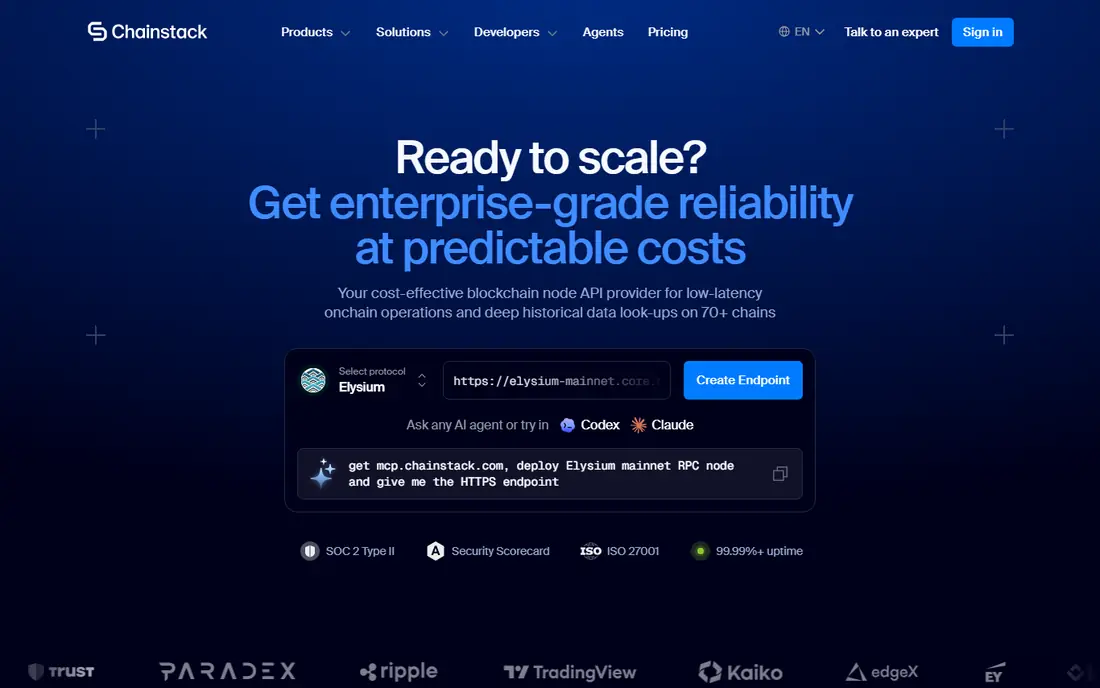
Chainstack appeals to teams that want billing they can explain without a spreadsheet. A recent-state call costs one request unit, while archive and debug or trace calls cost two, which is far simpler than a long table of method weights. The free Developer tier gives 3 million request units a month at 25 requests per second, which is enough for development, testing, and a small live app. Paid plans start at 49 dollars a month and raise both the allowance and the throughput in clear steps.
The honest limit is that the free tier is a development tier, not a production promise. There is no SLA on it, and 25 requests per second will not carry a busy app. Dedicated nodes are available on higher plans for teams that need isolation and steadier performance. Chainstack fits best when you value predictable unit maths and a clean upgrade path over extra developer APIs, and when you are willing to pay once traffic grows past the free allowance.
- Request units are easy to understand
- Dedicated nodes available on higher plans
- Broad chain support
- Free tier throughput is modest
- Archive and debug calls cost double
- No SLA on the free tier
dRPC takes a different route from single-vendor node operators. It routes requests across a network of independent providers, which can improve availability when one upstream provider has trouble. Its paid pricing is flat at 6 dollars per million requests, with every method costing the same, so a trace-heavy workload does not suddenly cost many times more than a read-heavy one. That predictability is the main reason to consider it for analytics and indexing work.
The free tier is generous in raw size, at 210 million compute units a month, which works out to roughly 10.5 million requests at the flat method cost. The limits are in features rather than volume, since the free tier covers public nodes only and excludes archive, trace, and WebSocket access. Teams that need those features must move to a paid plan. dRPC suits builders who want redundancy and flat pricing, and who can accept that the free tier is for testing and lighter workloads rather than full production use.
- Flat rate per request regardless of method
- Routing across many providers
- Generous free allowance
- Free tier uses public nodes only
- No archive, trace, or WebSocket on free
- No published formal SLA
Dwellir is the simplest pricing story in this list, because one response costs one credit whatever the method. That removes the method-weight surprise that complicates several rivals, and it makes cost forecasting a matter of counting responses. The free tier gives 100,000 responses a day at 20 requests per second, which is a workable allowance for a prototype or a small internal tool. Paid plans start at 49 dollars a month and scale throughput in large steps.
The free tier has clear feature limits, since it excludes eth_getLogs as well as trace and debug methods. That rules it out as a free home for indexers, even though the paid plans handle those methods at the same one-credit rate. Dwellir also covers a wide set of networks, which helps teams that work across ecosystems. Pick it when simple billing matters most and your free-tier workload is mostly current-state reads, and plan a paid step before you need history or traces.
- One credit per response for every method
- Archive on paid plans
- Clear per-response pricing
- Free tier excludes eth_getLogs and trace or debug
- 20 requests per second on free
- No SLA stated for free
Ankr suits teams that need many chains under one account, since its coverage spans a large number of networks. The free tier gives 200 million credits a month, which sounds huge until you apply the method weight, since a standard call costs 200 credits and therefore works out to roughly one million calls. That is still a useful allowance for development and small apps, and public endpoints allow quick testing without an account for some chains. Paid access is usage based, which keeps entry flexible.
The weakness is feature gating. WebSocket access and some premium capabilities sit behind paid plans, so a real-time app cannot stay on the free tier for long. The credit model also means you must model your own method mix, just as with Alchemy and Infura. Ankr is a strong fit when chain breadth matters more than a single-chain deep toolset, and when you are happy to pay for premium features once the app needs live subscriptions.
- Very broad chain coverage
- Large free credit allowance
- Public endpoints for quick testing
- Credits are weighted by method
- Premium features such as WebSocket are paid
- No SLA on the free tier
GetBlock gives teams a path from a free shared endpoint to a dedicated node without changing vendors. The free tier gives 50,000 compute units a day at 20 requests per second, which is a modest allowance suited to learning, testing, and very small apps. Shared paid plans start at 49 dollars a month with a much larger compute-unit pool and higher throughput, and dedicated nodes are available for teams that need isolation. The network list is broad, which helps multi-chain projects.
The trade-off is that the free tier will not carry much real traffic, and compute-unit weighting means a basic call and a heavier call do not cost the same. Trace and debug access is also fuller on higher plans, so an analytics workload should check the plan details before building on the free tier. GetBlock fits best when you want one vendor that can grow from shared to dedicated infrastructure, and when you accept that the free tier is a starting point rather than a launch plan.
- Shared and dedicated options
- Broad network list
- Dashboard control over endpoints
- Small free daily allowance
- Compute-unit weighting
- Trace and debug need higher plans for full use
Helius is a specialist rather than a generalist, and that focus is its strength for Solana teams. Its APIs cover token balances, NFT data, and transaction history in ways that a generic RPC endpoint does not, which can cut a lot of plumbing work from a Solana app. The free tier gives a starting credit allowance at low throughput, which is enough to prototype and to learn the API surface. Paid plans raise the allowance and throughput for live apps.
The limit is obvious and should decide the choice on its own. If your app needs Ethereum, a layer 2, or any non-Solana chain, Helius cannot be your only provider. Even Solana teams should check whether the free tier covers their method mix, since enhanced APIs can consume credits faster than plain reads. Pick Helius when Solana is the whole product, and pair it with a general provider if you later add another chain.
- Solana-specific APIs for tokens and NFTs
- Useful for Solana app teams
- Free tier for starting out
- Solana only, so no help for other chains
- Free tier throughput is low
- No SLA on the free tier
How we picked these
We compared official pricing pages, plan limits, and product documentation, plus public comparisons that quoted those pages in October 2026. We kept only services with a permanent free tier, and we left out any provider whose free offer was a one-month trial, including QuickNode, because a trial is not a free tier. We also checked that each service was still operating and that its homepage matched the product named. Prices change often, so check the vendor page before you sign up.
What to check before you rely on a free tier
A free tier is a development tool, not a production guarantee. Start by confirming the rate limit in requests per second and the daily or monthly allowance, then test your app against both, since a burst can hit the rate limit long before the monthly allowance runs out. Next, check which methods are excluded on free, because archive, trace, and WebSocket gaps can break an indexer or a live feed without warning. Also confirm whether unused allowance rolls over, since some providers reset daily and others reset monthly.
Support and uptime terms deserve the same attention. Free tiers in this list do not carry a production SLA, so a paid plan or a second provider is the practical answer for a live app. Set up alerts for usage, add a fallback endpoint, and keep your code provider-agnostic where you can, so switching does not mean rewriting every call. Finally, model cost on your real method mix rather than the headline allowance, because a log-heavy app and a balance-check app can differ several times over on the same plan.
Frequently asked questions
What is an RPC service?
An RPC service runs blockchain nodes for you and gives your app an endpoint to read chain data and submit transactions. It saves you from running, syncing, and monitoring your own node. You still need to handle keys, signing, and app security yourself.
Are free RPC tiers safe for a live app?
They can work for a small live app with modest traffic, but they carry rate limits and no production SLA. A traffic spike or a provider outage can interrupt your app without compensation. For anything users depend on, use a paid plan, a fallback provider, or both.
Why do two providers quote very different costs for the same traffic?
They bill in different units and weight methods differently. One provider may charge the same for every method, while another charges far more for log and trace calls. Always convert the headline allowance into your own method mix before comparing prices.
What is the difference between a free tier and a free trial?
A free tier is a permanent plan with a fixed allowance and limits. A free trial is a time-limited offer that ends after a set period, even if you have not used the allowance. QuickNode is an example of a trial-only free offer, which is why it is not listed here.
Do I need archive access?
You need archive access if your app reads historical state, such as old balances or past contract storage. Current-state reads do not need it. Check whether archive access is included on your plan, since some free tiers exclude it or charge double for it.
Should I run my own node instead?
Running your own node gives you full control and no per-request bill, but it adds hardware, storage, syncing, and monitoring work. Most small teams start with a managed provider and only self-host when traffic, privacy, or control needs justify the effort.
Sources
See where you really rank - block by block
ProMapRanker scans Google Maps across a grid of your service area. Simple monthly plans from $19, white-label on every plan.
Start freeKeep reading
 worlds best local seo company
8 Worlds Best Local SEO Companies for Map Pack Growth in 2026
Compare the worlds best local seo company options for Google Business Profile work, citations, reviews, and multi-location rankings and reporting in 2026.
Read → world's best web hosting company
World's Best Web Hosting Company in 2026
Searching for the world's best web hosting company? We compared 10 hosts on price, renewal rates, speed, and support to help you choose well today in 2026.
Read → who's got the best nanny tax services
Who's Got the Best Nanny Tax Services in 2026
We answer who's got the best nanny tax services, comparing full filing, back taxes, software, and pricing so families can handle nanny taxes correctly.
Read →