 ProMapRanker
Best RPC Providers for Blockchain Apps in 2026

Key takeaways
- Alchemy and Infura suit teams that want rich APIs and deep Ethereum tooling, while Chainstack and Dwellir suit teams that want simpler request-based pricing.
- Free tiers differ more than headlines suggest, because credits and compute units weight calls differently, so test with your real method mix before you choose.
- Archive access, WebSocket support and rate limits matter more in production than a low headline price, especially for wallets, explorers and indexers.
- Multi-chain apps should pick one provider that covers most of their chains, then keep a second provider as a fallback for outages.
Quick comparison
| Pick | Great for | Pricing starts at | Free tier | |
|---|---|---|---|---|
 Alchemy | Enhanced APIs and Ethereum apps | Free | Yes | Visit |
 Infura | Ethereum and MetaMask ecosystem apps | Free | Yes | Visit |
 QuickNode | Broad chains and developer tooling | See website | Free trial | Visit |
 Chainstack | Simple request pricing | Free | Yes | Visit |
 Ankr | Multi-chain public and premium endpoints | Free | Yes | Visit |
 GetBlock | Shared and dedicated nodes | Free | Yes | Visit |
 dRPC | Decentralised node routing | Free | Yes | Visit |
 Blast | Fast multi-chain APIs | Free | Yes | Visit |
 NOWNodes | Wide chain coverage | See website | Yes | Visit |
 Dwellir | Transparent per-response pricing | Free | Yes | Visit |
The best rpc providers for blockchain apps
This guide is general information only, not financial advice, and it covers infrastructure for apps that read and write blockchain data, not investment choices. An RPC provider runs nodes that your app queries for balances, blocks, transactions and contract data, so reliability and pricing shape user experience directly. We compared free tiers, paid entry points, archive and WebSocket support, chain coverage and developer tools, using vendor pricing pages and recent provider comparisons as a starting point. Confirm current limits on the vendor site before launch, because credit weights and plan names change often.
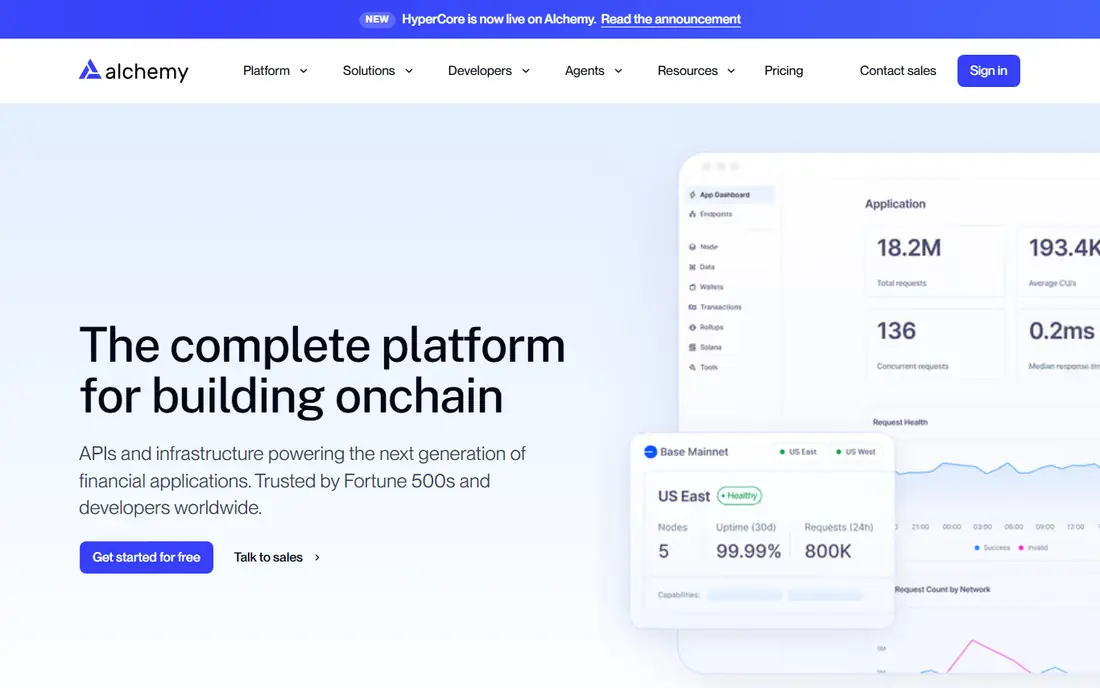
Alchemy is a strong pick for teams building wallets, NFT apps or token tools that need more than basic node calls. Its enhanced APIs cover token balances, transfers and transaction simulation, and webhooks can notify your app when on-chain events happen. That saves engineering time compared with building indexers from raw node data alone.
The catch is pricing in compute units, where a simple call and a heavy trace call do not cost the same. A free tier of 30 million compute units per month is generous for a prototype, but a production app should model its real method mix. If your app leans on logs and traces, test those calls early and set usage alerts before traffic grows.
- Rich enhanced APIs and webhooks
- Broad chain support
- Strong documentation and dashboard tools
- Compute-unit pricing can be hard to forecast
- Heavier calls cost more units
- Advanced features sit on paid plans
Infura suits teams already working in the Ethereum ecosystem, especially apps that connect through MetaMask or other ConsenSys tools. Its free tier gives 3 million credits per day, with paid tiers raising that daily allowance, and its dashboard makes key management and usage tracking straightforward. For a standard Ethereum app with steady traffic, that daily reset can be easier to reason about than a monthly pool.
The trade-off is that credits are not equal to requests: a logs query can cost far more credits than a simple block query. Plan your allowance around your heaviest methods, not an average call. Teams with spiky traffic should also check rate limits and archive availability on their chosen tier before relying on Infura alone.
- Long-running Ethereum infrastructure
- Daily credit allowance
- Close fit with MetaMask and ConsenSys tooling
- Credit weights vary by method
- Daily allowance does not roll over
- Some chains and features need paid tiers
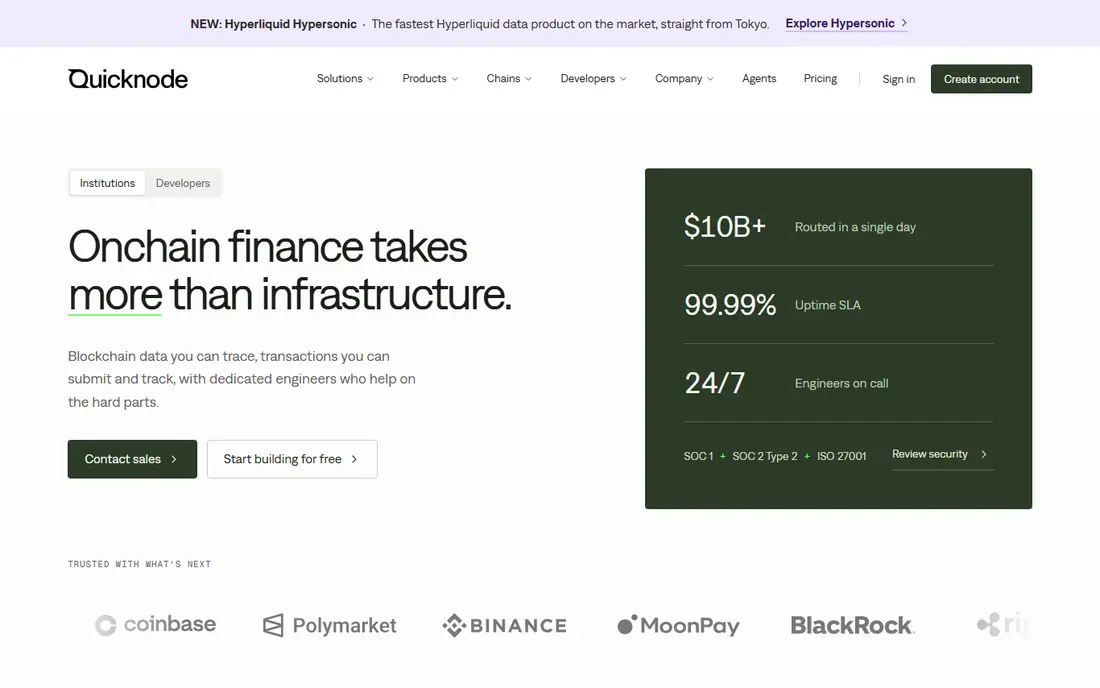
QuickNode is a good fit for a multi-chain app that wants one dashboard, many networks and extra tooling such as streams, functions and marketplace add-ons. Its chain list covers major Ethereum-compatible networks, Solana and other ecosystems, which helps when a product roadmap adds a new chain without adding a new vendor. The dashboard and documentation make onboarding a small team fairly quick.
Pricing needs care, because credits weight methods differently and the free option is a trial period. Check the current entry plan, credit allowance and rate limit on the QuickNode pricing page, then load test with your own traffic pattern. If you need archive data or high throughput, confirm those limits on the plan you will actually buy.
- Wide chain coverage
- Add-ons and marketplace tools
- Global endpoints for lower latency
- Credit-based pricing needs careful modelling
- Free access is a trial, not a permanent free tier
- Trace and debug calls cost more
Chainstack appeals to teams that want predictable bills. Its model counts most calls as one request unit, with archive and debug calls costing more, which is simpler to model than a long list of per-method weights. A free tier of 3 million request units per month suits prototypes and small apps, and paid plans start at a level that covers many early production workloads.
The limits to watch are throughput and archive costs. If your app reads large historical ranges often, those double-unit calls add up, so cache results where you can. Dedicated nodes are available for teams that outgrow shared endpoints, but they change the cost picture, so compare shared and dedicated pricing before you scale.
- Request-unit pricing is easier to forecast
- Free tier with millions of units
- Managed and dedicated node options
- Archive reads cost extra units
- Top shared rate limits are lower than some rivals
- Enterprise features need higher tiers
Ankr is useful when your app spans many chains, including smaller networks that larger providers cover less well. Public endpoints let a developer test a new chain quickly, and premium plans raise limits and add features for production use. Its decentralised heritage also appeals to teams that want node diversity rather than a single central operator.
The catch is uneven coverage: archive, WebSocket and premium support are not identical on every chain. Check the specific chain pages for the networks you need, and do not assume a feature available on Ethereum is available everywhere. For a core chain, keep Ankr as part of a multi-provider setup rather than the only path.
- Very broad chain coverage
- Public endpoints for quick tests
- Premium tiers with higher limits
- Premium features vary by chain
- Credit multipliers apply
- Support and SLAs differ by plan
GetBlock suits teams that want to start on shared nodes and move to dedicated nodes on the same platform as they grow. Its chain coverage is broad, and its plans range from small shared allowances to large dedicated deployments. That path is handy for an app that starts as a side project and later needs stable throughput for a single busy chain.
Pricing needs translation, because compute units are weighted by chain and method, so a headline allowance does not equal the same number of basic calls. Work out your effective cost per basic call for each chain you use, and test trace calls separately. If you need dedicated nodes, ask for a quote early, since those plans sit well above shared pricing.
- Wide chain list
- Shared and dedicated node choices
- Flexible plans for different traffic levels
- Compute-unit pricing varies by chain tier
- Headline unit counts overstate basic calls
- Dedicated nodes cost much more
dRPC takes a different approach by routing requests across a network of independent node providers, which can reduce dependence on one operator. Its free tier offers a large compute allowance, and paid plans aim at production apps that want failover built into the routing layer. For teams worried about a single provider outage, that design is a real selling point.
The practical check is still your method mix and tier limits. Free access excludes some advanced features, and paid plans set the rate limits for archive, trace and WebSocket use. Test failover behaviour under load, not just in a demo, and keep your own fallback endpoint for critical paths such as wallet balances and transaction submission.
- Routes across many independent node providers
- Generous free compute allowance
- Supports many chains
- Compute-unit model still needs modelling
- Archive and WebSocket access vary by tier
- Newer brand than the largest rivals
Blast, from Bware Labs, is a practical choice for a team that wants one API key across many chains without managing nodes. It supports a wide set of networks, offers public endpoints for testing, and provides dedicated plans for apps that need higher throughput. That simplicity helps small teams ship a multi-chain feature without a large infrastructure budget.
As with other credit-based providers, check the plan details for the chains you actually use, since limits and archive support are not uniform. Load test the chains that matter most to your users, and watch latency from your users regions, because a provider that is fast for one chain may not be fast for another.
- Multi-chain API access from one key
- Public endpoints for many networks
- Dedicated options for heavy use
- Pricing and limits vary by plan and chain
- Documentation depth varies by network
- Smaller community than the largest providers
NOWNodes stands out for chain breadth, including networks such as Bitcoin, Monero and Dogecoin alongside Ethereum-compatible chains. That makes it useful for wallets and explorers that need non-EVM data, or for apps that support a long tail of assets. Dedicated nodes add region choice and priority support for teams that outgrow shared limits.
The free tier is modest, so it suits testing and small apps rather than production traffic. Confirm the current entry price and request allowance on the vendor site, since published comparisons show different figures for different periods. For a core high-traffic chain, compare NOWNodes with a larger provider on latency and archive support before committing.
- Covers many chains, including less common networks
- Dedicated nodes available
- Blockbook and explorer-style interfaces on some chains
- Entry paid pricing is in euros on some pages
- Free tier is limited
- Feature depth varies by chain
Dwellir is worth a close look if unpredictable compute-unit bills have frustrated you before. Its model charges one credit per response for most methods, which makes forecasting as simple as counting responses. A free tier of 100,000 responses per day suits development and small apps, and paid plans scale by response volume and throughput.
The trade-off is scale and breadth. Dwellir covers many chains, but not every network a wallet might need, and its highest shared throughput sits on its top tiers. Check your chains, test trace and debug calls, and compare the effective cost per million calls for your real mix, not just the headline plan price. For a focused app, the clarity can outweigh the smaller brand.
- One credit per response on most methods
- Clear free daily allowance
- Strong focus on trace and debug pricing
- Smaller brand than Alchemy or Infura
- Chain coverage is narrower than the widest rivals
- Top throughput needs higher tiers
How we picked these
We compared vendor pricing pages, chain lists and documentation, plus recent independent provider comparisons that modelled the same method mix across providers. We kept only providers with a live public API, a documented free or trial tier, and production endpoints in October 2026, and we favoured providers that publish archive, WebSocket and rate limit details. Where published comparisons disagreed on a plan price, we used See website in the product block, because vendor pages change faster than secondary roundups. This is general information only, not financial advice, and RPC choice does not make any token or chain a sound investment.
What to check before you commit
Start by logging your real traffic for a week: which chains, which methods, how many logs and trace calls, and what peak rate you hit. Then price that exact mix on two or three providers, including overage rates, rather than comparing headline allowances. A provider that looks cheap for simple calls can become costly for an indexer that reads logs all day, while a provider that looks pricey for basic calls can be cheaper for trace-heavy work.
Next, test reliability in the way your users will feel it. Measure latency from your main user regions, test WebSocket stability for subscriptions, and check archive depth for the oldest block your app needs. Set up a second provider as a fallback, with health checks that switch endpoints when errors or latency cross a threshold. Finally, review key security, allowed origins, rate limit alerts and support response times, because a fast endpoint with weak key controls can become a cost and security problem.
Frequently asked questions
What is an RPC provider in simple terms?
An RPC provider runs blockchain nodes and gives your app an endpoint to ask for data, such as a balance, a block or a transaction receipt. Your app sends a request, the node answers from chain data, and your app shows the result to the user. Without a provider, you would need to run and maintain your own nodes for every chain you support.
Do I need a paid RPC plan for a small app?
Many small apps run fine on a free tier, especially during development and early launch, provided they cache results and avoid heavy logs queries. Once daily users grow, or you need archive data, higher rate limits or support guarantees, a paid plan becomes necessary. Monitor usage early so a traffic spike does not exhaust the free allowance.
Why do free tiers look so different across providers?
Providers count usage in different units, such as requests, credits or compute units, and they weight methods differently. A free tier of 30 million compute units is not the same as 30 million requests, because a heavy call may use many units. Always convert a free tier into your expected number of real calls before comparing providers.
Should I use one RPC provider or two?
For a hobby project, one provider is fine. For a production wallet, exchange or explorer, two providers with automatic failover reduce outage risk and give you a comparison point for latency and cost. Keep the fallback endpoint tested and warm, so switching does not fail at the moment you need it most.
Does an RPC provider affect the security of user funds?
An RPC provider does not hold user private keys in a normal setup, but it can see request patterns and, if misconfigured, it can become a cost risk through exposed keys. Use restricted API keys, rotate keys, limit allowed methods where possible, and never send a private key to an RPC endpoint. Review the provider privacy and security pages before launch.
Sources
See where you really rank - block by block
ProMapRanker scans Google Maps across a grid of your service area. Simple monthly plans from $19, white-label on every plan.
Start freeKeep reading
 zoro.to alternatives
Best Zoro.to Alternatives in 2026
We compare the best zoro.to alternatives in 2026, listing only legal licensed anime streaming services, from Crunchyroll to free options for fans today.
Read → zip alternatives
Best Zip Alternatives in 2026
We compare the best zip alternatives for buy now, pay later in 2026, covering pay-in-4 plans, fees, spending limits, and credit reporting options today.
Read → yesware alternatives
Best Yesware Alternatives in 2026
Compare the best yesware alternatives for sales email tracking, templates, and sequences, with current pricing and honest tradeoffs for small sales teams.
Read →