 ProMapRanker
Best Roadmap Tool in 2026: 9 Tools Compared


Strategy-to-delivery planning · Pricing starts at: $59 per user per month
Key takeaways
- Aha Roadmaps leads for strategy-to-delivery planning, while Productboard leads for feedback-driven prioritization.
- ProductPlan and Roadmunk suit teams that mainly need clear, shareable timeline views for stakeholders.
- Jira Product Discovery is the best low-cost start for teams already working in Jira.
- Per-editor pricing means viewers are usually free, so count editors carefully before comparing headline prices.
- A roadmap tool fails when plans go stale, so pick the tool your product managers will update weekly.
Quick comparison
| Pick | Great for | Pricing starts at | Free tier | |
|---|---|---|---|---|
| Aha Roadmaps | Strategy-to-delivery planning | $59 per user per month | Free trial | Visit |
 Productboard | Feedback-driven prioritization | $19 per maker per month | Free trial | Visit |
 ProductPlan | Visual, shareable timelines | $39 per editor per month | Free trial | Visit |
 Roadmunk | Stakeholder-ready roadmap views | $19 per user per month | Free trial | Visit |
 airfocus | Prioritization-first roadmapping | $19 per editor per month | Free trial | Visit |
 Craft.io | Product planning with feedback | See website | Free trial | Visit |
 ProdPad | Now, Next, Later planning | See website | Free trial | Visit |
 Jira Product Discovery | Jira-native idea roadmapping | Free | Yes | Visit |
 Canny | Public roadmaps with voting | See website | Free trial | Visit |
The best roadmap tool
We compared official product and pricing pages for tools that plan, prioritize and communicate product direction. These nine cover dedicated roadmapping suites, feedback-led platforms and a low-cost Jira-native option.
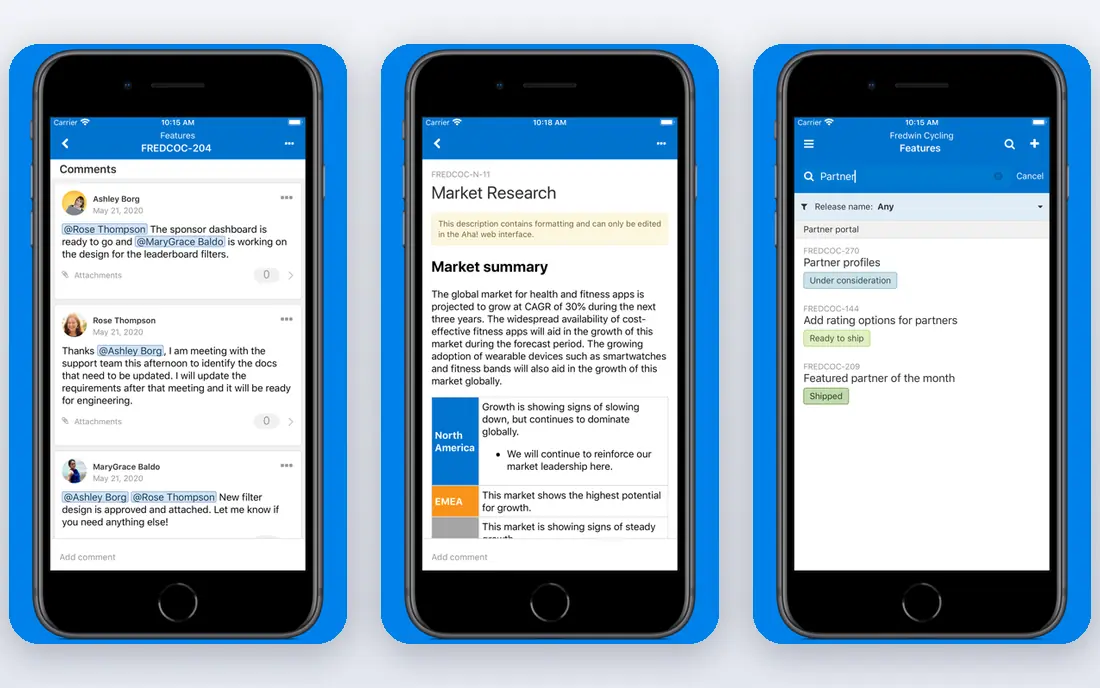
Aha Roadmaps is the most complete planning suite on this list. Teams connect goals and initiatives to features, plan releases, and publish roadmaps in many views, from timelines to portfolio boards. That depth suits product organizations with several products, many stakeholders and a need to show how daily work links to strategy.
The price and setup reflect that depth. Entry pricing starts at $59 per user per month, and small teams may find the configuration heavier than they need. For a single product with one product manager, a simpler tool will move faster. For a growing product org, Aha gives structure that simpler tools cannot match.
- Full strategy, goals and release planning
- Many roadmap views
- Strong reporting
- Highest entry price here
- Setup takes time for small teams
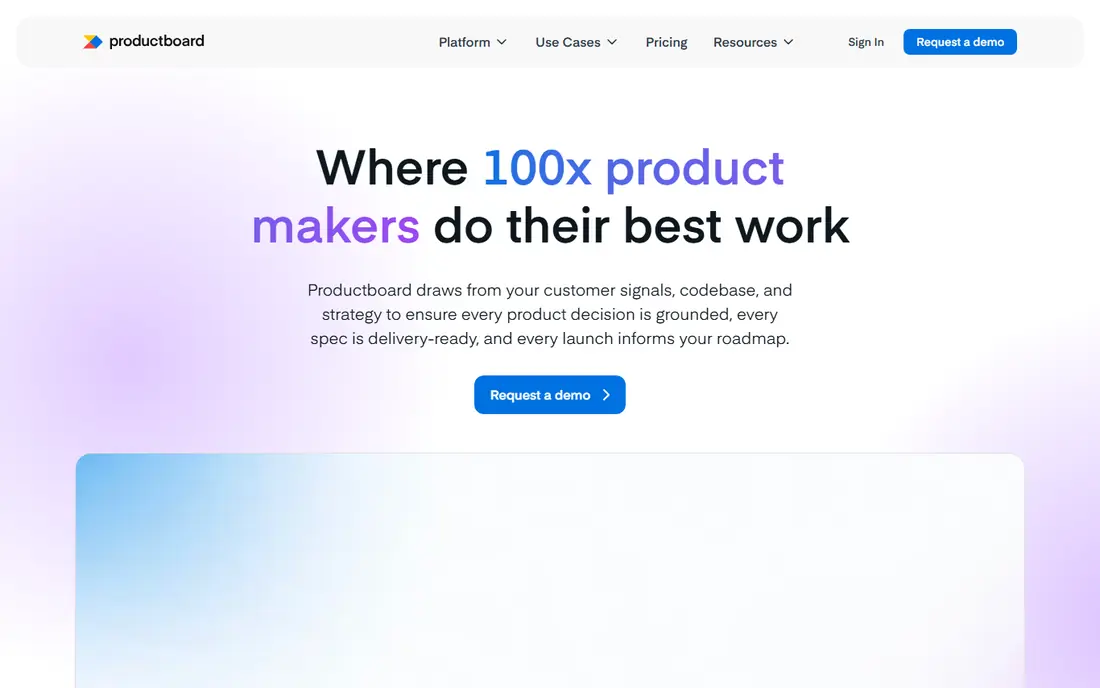
Productboard starts from customer feedback rather than a blank timeline. Teams collect feature requests, link them to insights, score them against strategy, and build roadmaps that show the evidence behind each item. That trail helps product managers defend priorities in front of sales, support and leadership.
Pricing starts at $19 per maker per month, with viewers typically free, so the cost depends on how many people edit and prioritize. The tool only pays off if feedback actually flows in, so teams need a habit of logging requests from support, sales and research. Without that input, it becomes an expensive timeline.
- Central feedback hub with scoring
- Roadmaps tied to customer evidence
- Customer portal
- Maker-based pricing needs careful role planning
- Full value needs steady feedback input
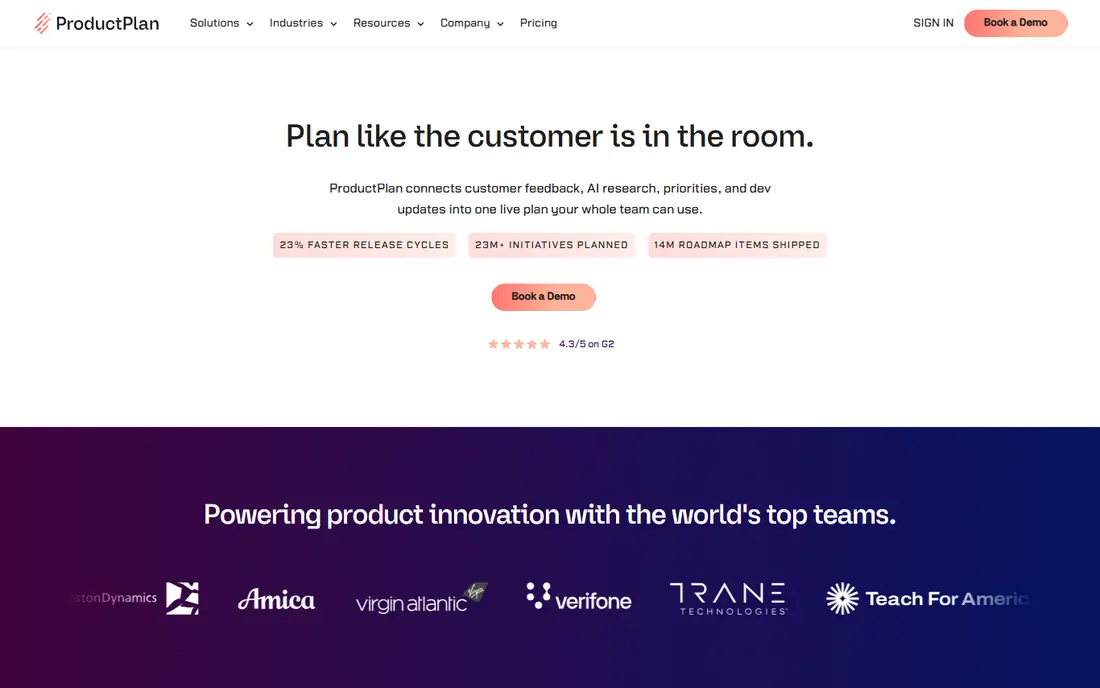
ProductPlan does one job well: it turns a product plan into a timeline that stakeholders can read at a glance. Bars, milestones and swimlanes are easy to arrange, and sharing with executives or customers takes little setup. Entry pricing starts at $39 per editor per month, with unlimited viewers, which suits teams that present often.
It is thinner on feedback collection and prioritization scoring than Productboard or airfocus. Teams that need to weigh hundreds of requests should pair it with a feedback tool or choose a feedback-led platform. Teams that mainly need a clear, credible timeline will find ProductPlan fast and easy to keep current.
- Clean drag-and-drop timelines
- Easy sharing with stakeholders
- Unlimited viewers on paid plans
- Less feedback depth than Productboard
- Pricing is per editor
Roadmunk, now part of Tempo, focuses on roadmap views for different audiences. A team can publish one view for executives, another for engineering and another for customers, without rebuilding the plan each time. Timeline and swimlane views look polished in presentations, and Jira integration keeps roadmap items linked to delivery work.
Feedback collection is not its strongest area, so teams that prioritize mainly from customer votes may prefer Productboard or Canny. Roadmunk suits teams whose main problem is communication: one plan, many audiences, and a need to keep each view current without manual slide updates.
- Multiple audience-specific roadmap views
- Clean timeline presentations
- Jira integration
- Feedback features are thinner than rivals
- Pricing varies by plan and billing
airfocus puts prioritization first. Teams score features with frameworks such as value versus effort, run Priority Poker sessions to reach agreement, and turn ranked items into roadmaps. That structure helps teams that argue about priorities without a shared method, since the score and the reasoning stay visible.
The tool needs that method to work. A team that has not agreed on scoring criteria will still argue, just inside a nicer interface. Start with one framework, score a small backlog together, and only expand the criteria once the team trusts the process.
- Scoring frameworks and Priority Poker
- Flexible roadmap views
- Good for distributed prioritization
- Needs a clear scoring method to pay off
- Smaller ecosystem than Aha or Productboard
Craft.io combines feedback capture, prioritization, roadmapping and capacity planning in one platform. Product teams can collect ideas, score them, plan releases against team capacity and publish roadmaps without stitching several tools together. That breadth suits mid-size product teams that want one system for the full planning cycle.
Pricing is less transparent than the per-editor tools here, so request a quote at your editor count and confirm which modules are included. Trial it with a real release plan, including capacity limits, since that feature is where Craft.io differs most from simpler timeline tools.
- Feedback, planning and roadmaps in one product
- Multiple roadmap views
- Capacity planning
- Pricing is quote-based for many plans
- Learning curve for full feature set
ProdPad is built around the Now, Next, Later format, which suits teams that want to communicate direction without promising exact dates. Ideas, feedback and roadmaps sit together, so a roadmap item can be traced back to the customer request that inspired it. That format reduces the pressure to defend a date that was never firm.
Teams that must commit to dated releases for enterprise customers may find Now, Next, Later too loose, though ProdPad also supports timeline views. Check pricing by module during a trial, since ideas, feedback and roadmaps have historically been sold in combinations that change the total.
- Now, Next, Later format avoids false date precision
- Ideas and feedback tools
- Clean roadmaps
- Teams that need dated timelines may find it too loose
- Pricing varies by module
Jira Product Discovery is the lowest-cost serious option for teams already in Jira. A free tier covers up to 10 users, and ideas, prioritization and roadmaps live next to the delivery tickets they become. That closeness removes the usual gap between a roadmap slide and the work engineers actually pick up.
Outside Jira, its value drops sharply. Teams on other delivery tools will get more from a standalone platform. For Jira teams, start here before paying for a dedicated suite, and upgrade only when feedback volume or portfolio reporting outgrows it.
- Free for up to 10 users
- Ideas and roadmaps live beside Jira delivery work
- Low setup for Jira teams
- Best only inside the Atlassian ecosystem
- Advanced features need paid tiers
Canny suits SaaS teams whose roadmap is a customer-facing promise as much as an internal plan. Customers vote on feature requests, follow a public roadmap and read changelogs when features ship. That loop builds trust and gives product teams a steady stream of prioritization evidence.
It is thinner for internal portfolio planning across many products and teams. If the audience is mainly customers and the goal is votes plus a public roadmap, Canny is a strong, focused pick. If the audience is mainly executives and delivery teams, Aha or ProductPlan will serve better.
- Public roadmap boards with customer voting
- Feedback and changelog in one tool
- Simple setup
- Less suited to internal portfolio planning
- Pricing varies by tracked users and plan
How we picked these
We compared official product and pricing pages, roadmap views and prioritization features for tools current in October 2026. To qualify, a product had to create and share product roadmaps, support prioritization or planning beyond a simple task board, and be available for product teams today. We kept prices as See website where vendors quote or price by module, rather than printing a figure we could not verify.
How to choose a roadmap tool
Start with the audience. Executives need a high-level timeline, engineering needs a link to delivery work, and customers need a public board with votes. A tool that serves the wrong audience will be ignored, no matter how good its features look in a demo.
Planning style and pricing
Decide whether dates or priorities drive the plan. Dated timelines suit ProductPlan, Roadmunk and Aha, while Now, Next, Later suits ProdPad and feedback-led ranking suits Productboard and airfocus. Count editors, not total staff, since viewers are often free, and check whether feedback, portals or capacity planning cost extra.
Keeping the roadmap current
Assign one owner per product area and a weekly update habit. Link roadmap items to feedback and to delivery tickets where possible, so a shipped feature updates the roadmap without a manual rewrite. Review the roadmap with stakeholders on a fixed cycle, and retire items that no longer fit strategy instead of letting them linger.
Frequently asked questions
What is the best roadmap tool?
Aha Roadmaps leads for full strategy planning, while Productboard leads for feedback-driven teams. ProductPlan and Roadmunk lead for clear stakeholder timelines. The best pick depends on team size, audience and whether feedback or dates drive decisions.
What is the best roadmap software for product teams?
Productboard and Aha are the strongest dedicated choices for product teams, with Craft.io as a broad alternative. Jira Product Discovery is the best low-cost start for Jira teams. Trial two options on the same backlog before committing.
What is the best free roadmap tool?
Jira Product Discovery offers a free tier for up to 10 users, which is the most capable free option here for small teams. Spreadsheet and board tools can also work for free, but they lack feedback scoring, roadmap views and delivery links. For a dedicated roadmap tool, Jira Product Discovery is the best free starting point.
What is the best product roadmap tool for stakeholders?
ProductPlan and Roadmunk lead for stakeholder communication, thanks to clean timelines and audience-specific views. Aha adds portfolio views for larger organizations. Pick the tool whose default view stakeholders can read without training.
How much does roadmap software cost?
Entry pricing here runs from free to $59 per user per month, with most dedicated tools priced per editor or maker. Viewers are often free, so the real cost depends on editor count and add-on modules. Budget for onboarding time as well as the subscription.
Sources
- https://www.aha.io/roadmaps/pricing
- https://www.productboard.com/pricing/
- https://www.productplan.com/pricing
- https://www.roadmunk.com/pricing
- https://airfocus.com/pricing/
- https://craft.io/pricing
- https://www.prodpad.com/pricing
- https://www.atlassian.com/software/jira/product-discovery/pricing
- https://canny.io/pricing
See where you really rank - block by block
ProMapRanker scans Google Maps across a grid of your service area. Simple monthly plans from $19, white-label on every plan.
Start freeKeep reading
 who has the best home internet service
Who Has the Best Home Internet Service in 2026
Who has the best home internet service in 2026? Compare fiber, cable, and 5G providers on speed, price, data caps, and availability at your address today.
Read → visio alternatives
Best Visio Alternatives in 2026
Compare 9 Visio alternatives for flowcharts, org charts, and network diagrams, with free plans, pricing, and the best pick for teams and solo users in 2026.
Read → top 10 logistics software
Top 10 Logistics Software in 2026
We compared the top 10 logistics software tools for transport, warehousing, visibility and shipping, for shippers, carriers and 3PL teams in 2026 today.
Read →