 ProMapRanker
Best Revenue Cycle Companies in 2026

Key takeaways
- Revenue cycle companies range from software for in-house billing teams to full outsourcing for hospitals and health systems.
- Waystar suits in-house teams that want claims and denial tools, while R1 RCM and Ensemble suit systems that want end-to-end outsourcing.
- athenahealth and CareCloud suit smaller practices that want billing joined to practice management.
- Pricing is almost always quoted, so compare scope, implementation time and support, not just a headline fee.
- This guide is general information only, not financial advice, and results depend on payer mix, coding and local contracts.
Quick comparison
| Pick | Great for | Pricing starts at | Free tier | |
|---|---|---|---|---|
 Waystar | Claims and denial prevention | See website | No | Visit |
 R1 RCM | Full-service hospital outsourcing | See website | No | Visit |
 athenahealth | Ambulatory practices | See website | No | Visit |
 Optum | Large systems and coding | See website | No | Visit |
 Ensemble Health Partners | End-to-end hospital partnerships | See website | No | Visit |
 FinThrive | Mid-to-large hospital networks | See website | No | Visit |
 Experian Health | Patient access and eligibility | See website | No | Visit |
 CareCloud | Small to mid-size practices | See website | No | Visit |
 Availity | Payer-provider data exchange | See website | No | Visit |
The best revenue cycle companies
We compared revenue cycle companies on service model, claims handling, patient access, coding support and fit for different organisation sizes, using vendor pages and published guides.

Waystar provides a cloud platform for claims, eligibility, patient payments and denial management, used by hospitals, health systems and practices. Its strength for in-house billing teams is a single place to submit claims, check eligibility, track denials and work patient balances. Published 2026 benchmarking material also rated Waystar highly for support and production reliability among surveyed revenue cycle leaders.
The trade-off is scope and setup. Pricing is quoted, and connecting EHR systems, payers and clearinghouse workflows takes planning. Smaller practices with simple billing may find a practice management system with billing built in easier. For in-house teams that want claims control at scale, Waystar is a leading option.
- Cloud claims platform for many provider types
- Eligibility and denial tools
- Analytics for billing teams
- Enterprise pricing is quoted
- Implementation needs EHR and payer setup
- Smaller practices may need simpler tools
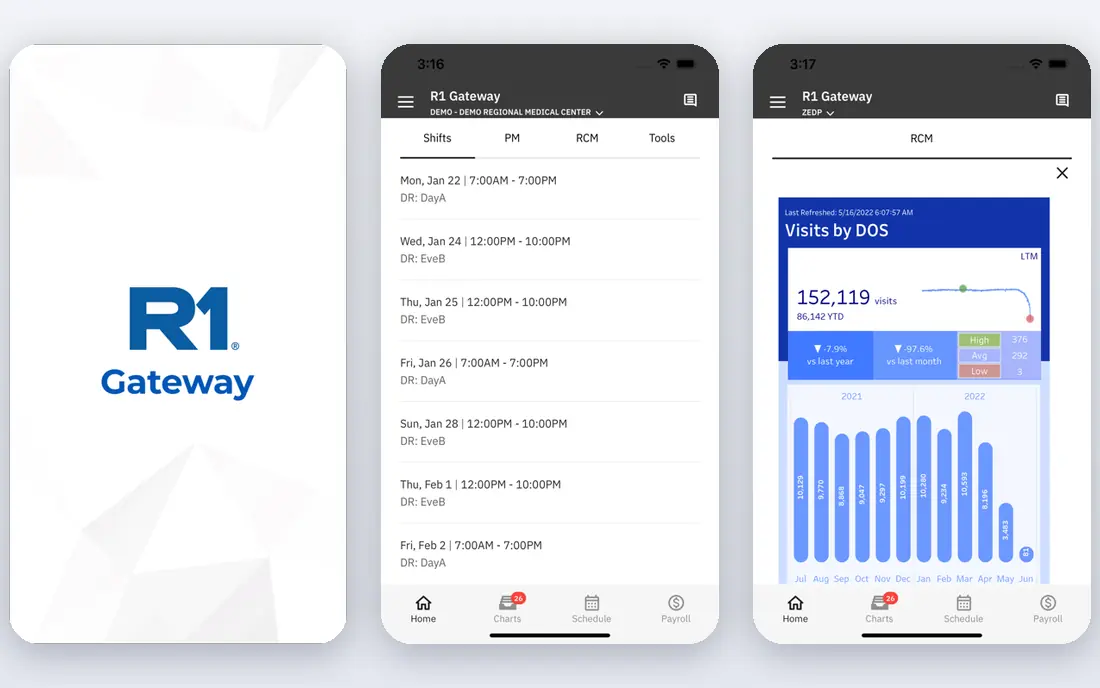
R1 RCM takes over the full revenue cycle for hospitals and health systems, from patient access and coding to claims, collections and analytics. That model suits large systems that want a single partner accountable for performance, rather than staffing each step in-house. Its automation work across the cycle is a central part of its pitch.
Outsourcing also means handing over control and data flows, so governance matters. Check service levels, reporting, staff transition plans and exit terms before signing. A long contract with unclear performance measures can be costly to unwind. For large systems seeking full outsourcing, R1 RCM is a major contender.
- End-to-end revenue cycle outsourcing
- Large hospital experience
- Automation across the cycle
- Outsourcing means less day-to-day control
- Contracts are long and complex
- Transition takes time
athenahealth combines electronic health records, practice management and billing for ambulatory practices and physician groups. That joined-up model helps smaller practices avoid separate billing software and manual handoffs between clinical and billing teams. Claims, eligibility and patient payments sit inside the same workflow.
Large inpatient hospitals usually need a different system, and switching EHR platforms is a major decision beyond billing alone. Pricing is quoted by practice size and services. For outpatient practices that want one system for care and billing, athenahealth is a strong fit.
- EHR, practice management and billing in one system
- Strong for outpatient practices
- Payer and claims workflows built in
- Less suited to large inpatient hospitals
- Pricing is quoted
- Switching EHR systems is a large project
Optum offers revenue cycle services, coding support, claims data and advisory work for large hospitals and health systems. Its coding intelligence and claims data are useful where complex cases, payer contracts and denial patterns need detailed review. Large systems can also pair revenue cycle work with wider Optum services.
Breadth can mean complexity. Scoping, pricing and implementation need a clear statement of work, and smaller practices may not need the full range. Ask which services are included, who owns each step and how performance is reported. For large systems with complex coding and payer work, Optum is a credible partner.
- Wide service range for large systems
- Coding and claims data depth
- Analytics and advisory options
- Large-vendor complexity
- Pricing and scope need careful scoping
- Smaller practices may find it too broad
Ensemble Health Partners works as an end-to-end revenue cycle partner for hospitals and health systems, handling patient access, coding, billing and collections. Its model suits systems that want a partner invested in results rather than a software licence alone. Published guides often place Ensemble among the stronger end-to-end partners for hospitals.
A partnership model still needs strong governance. Check performance targets, reporting cadence, staffing plans and termination terms. Transition from an in-house team or another vendor takes time and clear communication. For hospitals seeking a long-term partner, Ensemble is worth a detailed proposal.
- End-to-end partnership model for hospitals
- Focus on performance and client service
- Hospital experience
- Partnership contracts are long-term
- Transition needs close management
- Pricing is quoted
FinThrive provides revenue cycle software and services for mid-to-large hospital networks, covering claims, patient payments, analytics and contract management. Its tools help billing teams track payer performance, denials and underpayments, which matter when contracts are complex. Networks with several hospitals can use one platform across sites.
Pricing and implementation scope are quoted, so compare the modules included and the time needed to connect EHR and payer systems. Smaller practices may find the platform broader than they need. For hospital networks that want a unified revenue cycle platform, FinThrive is a solid option.
- Revenue cycle platform for hospitals and networks
- Claims, payments and analytics
- Payer contract tools
- Pricing is quoted
- Implementation scope varies
- Smaller practices may prefer simpler systems
Experian Health focuses on the front end of the revenue cycle: patient access, identity checks, eligibility verification and contract management, plus claims tools. Getting eligibility and patient data right at registration prevents many downstream denials, which is why hospitals often add these tools even when they keep another billing system. Its contract tools also help track payer terms and underpayments.
Experian Health is not a full replacement for an EHR or a full outsourcing partner, so it often sits beside other systems. Integration and pricing need a clear scope. For hospitals that want stronger front-end accuracy and contract insight, Experian Health is a useful addition.
- Strong patient access, eligibility and identity tools
- Contract management
- Claims support
- Not a full EHR or full outsourcing replacement
- Pricing is quoted
- Integration scope needs scoping
CareCloud offers practice management software and billing services for small to mid-size practices, with a choice between software-led billing and full-service billing. That flexibility helps practices that want to keep some billing in-house but need help with claims, denials or collections. Its system also covers scheduling, records and patient engagement.
Very large hospitals will usually need a larger platform, and service quality depends on which billing model you choose. Ask what is included in each model, how denials are worked and what reporting you receive. For smaller practices that want one vendor for software and billing help, CareCloud is a practical choice.
- Practice management plus billing options
- Software or full-service billing from one vendor
- Suited to smaller practices
- Less suited to very large hospitals
- Service levels depend on the billing model chosen
- Pricing is quoted
Availity runs a health information network that connects providers and payers for eligibility checks, claims submission, remittances and related data exchange. Its value is reach: one connection can cover many payers, reducing separate payer portals and manual work. Billing teams often use Availity alongside an EHR or billing system.
Availity does not replace full billing, coding or collections work, so it should be judged as a network and data tool. Check which payers participate for your mix and which transactions are included. For providers that want cleaner payer data exchange, Availity is a useful part of the stack.
- Large payer-provider network
- Eligibility, claims and remittance tools
- Clearinghouse functions
- Not a full billing or outsourcing service
- Features depend on payer participation
- Pricing is quoted for some services
How we picked these
We compared vendor pages, product descriptions and published 2026 guides for revenue cycle companies serving hospitals, health systems and practices. We favoured a mix of software platforms, full outsourcing partners and front-end specialists, and we noted where pricing is quoted rather than published. We did not claim hands-on testing, and we treated rankings in third-party guides as guides based on publicly reported factors, not as verified performance guarantees.
How to choose a revenue cycle partner
Start with the problem you are trying to solve. Denials, slow payments, coding gaps and patient access errors need different tools, and a single vendor rarely fixes all of them at once.
Software, service or both
Decide whether you want software for an in-house team, a managed service for part of the cycle, or full outsourcing. Software gives control but needs staffing, while outsourcing gives scale but needs governance. Many organisations start with a focused fix, such as eligibility or denial management, before moving to a broader contract.
Implementation, reporting and exit
Ask for an implementation timeline, EHR and payer connections, training and a named support contact. Agree on reporting in advance, including denial rates, days in accounts receivable, clean claim rates and patient collection performance, with clear definitions. Also agree on contract length, performance targets, data ownership and exit terms before signing.
Compliance, privacy and patient experience
Revenue cycle work handles sensitive patient and financial data, so check security, privacy and compliance practices, including HIPAA-related controls. Patient billing and payment options also affect satisfaction and collections, so review statements, payment plans and support hours. A partner that improves collections while harming patient trust is a poor trade.
Frequently asked questions
What does a revenue cycle company do?
A revenue cycle company helps healthcare providers manage billing from patient registration and eligibility through coding, claims, payments and collections. Some provide software for in-house teams, while others run part or all of the cycle as a service. The goal is faster, more accurate payment with fewer denials.
Should a hospital outsource its revenue cycle or keep it in-house?
It depends on size, staffing and performance. Large systems often outsource for scale and expertise, while smaller practices often keep billing in-house with software support. Compare the cost of staffing, training and technology against a vendor quote, and check governance and reporting before outsourcing.
How long does revenue cycle implementation take?
Timelines vary from weeks for a focused tool to many months for full outsourcing or a new platform. EHR connections, payer setup, staff training and data migration all affect timing. Ask for a phased plan with milestones and a clear go-live date.
What metrics should I track with a revenue cycle vendor?
Common metrics include clean claim rate, denial rate, days in accounts receivable, net collection rate and patient payment performance. Agree on definitions and reporting frequency before signing, since vendors can define metrics differently. Review trends monthly, not just at contract renewal.
Is revenue cycle software enough without a service partner?
For many practices, software plus a trained billing team is enough, especially with eligibility and denial tools. Hospitals with high volume, complex coding or staffing gaps may need a service partner as well. Start with the bottleneck, such as denials or patient access, and add services where the gap is largest.
How do revenue cycle companies charge?
Most enterprise revenue cycle pricing is quoted and depends on volume, services, organisation size and contract length. Some charge a percentage of collections, some charge per claim or per transaction, and some use a flat platform fee. Get the full fee schedule and any pass-through costs in writing.
Sources
See where you really rank - block by block
ProMapRanker scans Google Maps across a grid of your service area. Simple monthly plans from $19, white-label on every plan.
Start freeKeep reading
 zoro.to alternatives
Best Zoro.to Alternatives in 2026
We compare the best zoro.to alternatives in 2026, listing only legal licensed anime streaming services, from Crunchyroll to free options for fans today.
Read → zip alternatives
Best Zip Alternatives in 2026
We compare the best zip alternatives for buy now, pay later in 2026, covering pay-in-4 plans, fees, spending limits, and credit reporting options today.
Read → yesware alternatives
Best Yesware Alternatives in 2026
Compare the best yesware alternatives for sales email tracking, templates, and sequences, with current pricing and honest tradeoffs for small sales teams.
Read →