 ProMapRanker
Best Restaurant Reservation Software in 2026


Largest diner discovery network · Pricing starts at: $149 per month
Key takeaways
- OpenTable is our pick for restaurants that need the largest diner discovery network, despite its per-cover fees.
- Resy suits upscale restaurants that want flat monthly pricing and no per-cover charges.
- Resos and Eat App are the strongest low-cost starting points, with free tiers for small restaurants.
- SevenRooms leads for groups and hotels that want deep guest data, while Tock leads for prepaid and ticketed dining.
- Toast Tables makes sense only for restaurants already running Toast POS, since it requires that system.
Quick comparison
| Pick | Great for | Pricing starts at | Free tier | |
|---|---|---|---|---|
| OpenTable | Largest diner discovery network | $149 per month | No | Visit |
 Resy | Upscale dining with flat pricing | $289 per month | No | Visit |
 SevenRooms | Groups and hotels with deep guest data | See website | No | Visit |
 Tock | Prepaid and ticketed dining | $289 per month | No | Visit |
 Yelp Guest Manager | Restaurants with strong Yelp traffic | $129 per month | No | Visit |
 Toast Tables | Restaurants already on Toast POS | See website | No | Visit |
 Eat App | Growing restaurants on a budget | Free | Yes | Visit |
 Resos | Small restaurants wanting a free tier | Free | Yes | Visit |
 Hostme | Independents wanting predictable costs | $109 per month | No | Visit |
The best restaurant reservation software
We compared reservation platforms on monthly pricing, per-cover fees, marketplace reach, guest data and table management. Prices in this category change often, and some vendors quote custom pricing, so confirm the current price with the vendor before you sign. The right system depends less on the feature list and more on where your bookings already come from.
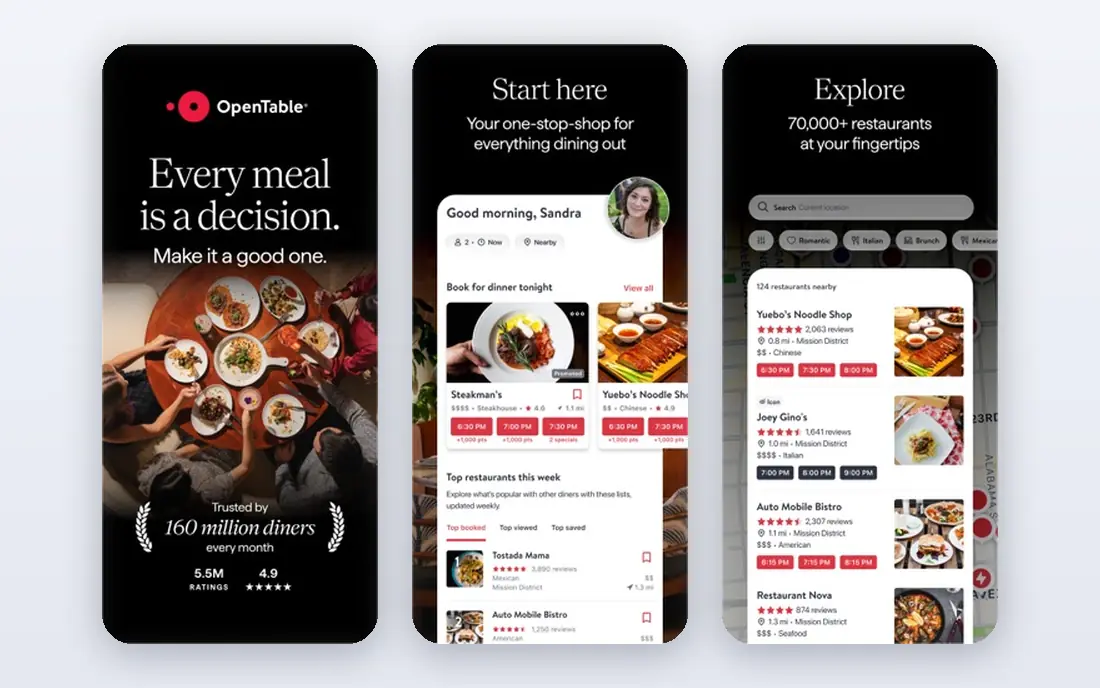
OpenTable remains the default choice for restaurants that need new diners, not just a booking widget. Its marketplace reaches diners who search by neighborhood, cuisine and occasion, and its review system gives restaurants social proof that smaller platforms cannot match. For a new opening in a competitive city, that discovery can fill seats faster than any other single channel.
The cost is the honest catch. Plans start at $149 per month, and network bookings carry per-cover fees that commonly run from $1 to $1.50 per cover, with higher fees on some plans. A busy restaurant can pay far more in cover fees than in subscription fees over a year. If most of your bookings already come from your own website or regulars, a flat-fee rival may save you money.
- Largest US diner marketplace
- Strong review and discovery features
- Wide POS integrations
- Per-cover fees add up
- Higher total cost than flat-fee rivals
Resy positions itself as the premium alternative to OpenTable. Plans start at $289 per month, with a higher tier at $459 per month, and neither charges per-cover fees on the core plans. That flat pricing makes costs predictable for a busy restaurant, and the Resy brand carries weight with upscale diners in major cities.
Resy also benefits from its link to American Express, which can bring cardholder diners to listed restaurants. The trade-off is reach: Resy does not match OpenTable for sheer diner volume, especially outside large cities. For fine dining rooms that already have demand and want a polished booking experience, Resy is a strong fit.
- Flat monthly pricing with no per-cover fees
- Strong brand for upscale dining
- American Express cardholder reach
- Higher starting price than budget tools
- Smaller discovery network than OpenTable
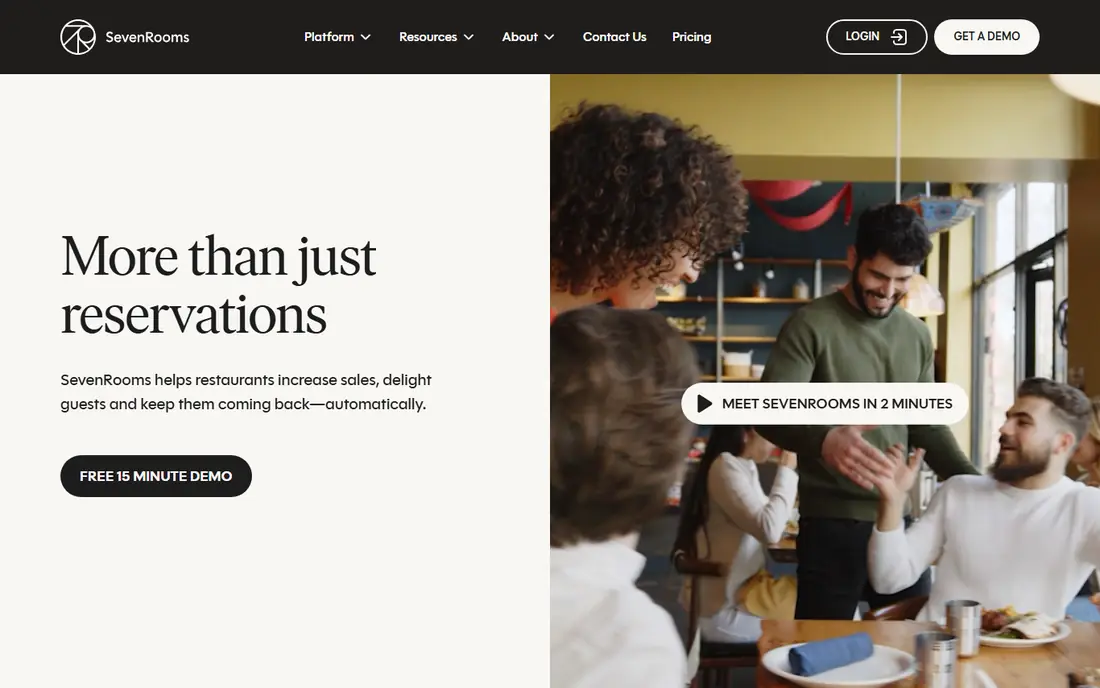
SevenRooms is built around owned guest data. Instead of renting diners from a marketplace, restaurants build detailed profiles from their own bookings, including preferences, visit history and spend patterns, and then use those profiles for marketing. Multi-location groups and hotel restaurants get the most from that approach, since data can follow a guest across venues.
Pricing is quote-based, and published comparisons commonly place it at $500 per month and above for larger setups. That puts SevenRooms out of reach for many single independents, and smaller restaurants may find the setup heavier than they need. For groups that treat guest data as a core asset, it is the category leader.
- Deep guest profiles and marketing tools
- Strong multi-location support
- No per-cover fees disclosed
- Custom pricing can be high
- More system than a small restaurant needs
Tock changed how tasting-menu restaurants sell tables by treating a reservation as a ticket. Guests prepay for a menu or experience, which cuts no-shows sharply and gives the kitchen a firm headcount. That model suits fine dining, pop-ups and special events far better than a standard free reservation.
Plans start at $289 per month, with a higher tier at $459 per month, and prepaid reservations carry a transaction fee of around 2 to 3 percent depending on the plan. Restaurants that do not need prepayment will find simpler and cheaper tools elsewhere. For prepaid dining, Tock remains the standard.
- Strong prepaid and ticketed experiences
- Good for tasting menus
- No-show reduction through prepayment
- Prepaid bookings carry a transaction fee
- Higher cost than simple booking tools
Yelp Guest Manager makes sense for one specific situation: your restaurant already gets a lot of Yelp traffic. In that case, letting diners book straight from your Yelp page removes a step and captures bookings that might otherwise drift away. Plans start at $129 per month, with no per-cover fees, and the system includes waitlist and floor management tools.
The limit is market dependence. In cities where diners search mainly on Google or OpenTable, Yelp Guest Manager adds less value. It also works best as part of a wider Yelp presence, so restaurants with weak Yelp profiles should fix that first. Where Yelp traffic is strong, it is a cost-effective booking route.
- Turns Yelp searches into bookings
- No per-cover fees
- Waitlist and table tools included
- Value depends on Yelp traffic in your market
- Less discovery reach than OpenTable
Toast Tables is not a standalone choice. It is the reservation tool for restaurants already running Toast point of sale, and it only makes sense in that setup. The benefit is a single system: reservations, orders, payments and guest profiles live together, so staff do not juggle two vendors or reconcile data between systems.
Pricing is quote-based and tied to the wider Toast setup, so a restaurant that does not already use Toast should not pick Toast Tables as a reason to switch POS systems. For existing Toast users, though, it is often the cheapest and simplest reservation option, since it avoids a second subscription and a second login for the host stand.
- Native link to Toast POS
- Guest profiles tied to orders
- No separate reservation vendor to manage
- Requires an active Toast POS account
- Pricing is not published
Eat App appeals to restaurants that want a capable booking system without a large monthly bill. A free tier covers basic reservations, and paid plans run up to around $209 to $229 per month depending on the feature set, with no per-cover fees. Table management, guest profiles and integrations with Google and social channels are part of the pitch.
The gap is discovery. Eat App does not bring the diner volume of OpenTable or Resy, so restaurants still need their own marketing to fill seats. For a growing independent that already has steady demand, that trade is fine. For a new restaurant that needs discovery, a marketplace platform may be worth the higher cost.
- Free tier to start
- No per-cover fees
- Table management and guest profiles included
- No large diner marketplace
- Paid plans rise with features
Resos is the value pick for very small restaurants. The free tier covers up to 25 bookings a month with table management and automated reminders, and paid plans start low and rise to around $149 per month, with no per-cover fees and no annual contract. That structure suits cafes, small bistros and restaurants testing online booking for the first time.
The free tier will not last long for a busy dining room, since 25 bookings can pass in a single weekend. Resos also offers fewer integrations than OpenTable or SevenRooms. Still, as a low-risk starting point with a clear upgrade path, Resos is hard to beat for small operators.
- Free tier with up to 25 bookings a month
- No per-cover fees
- No annual contract on paid plans
- Free tier limit is low for busy rooms
- Fewer integrations than larger platforms
Hostme targets independents that want a full reservation toolkit at a predictable price. Plans start at $109 per month, with higher tiers up to around $169 per month, and core plans carry no per-cover fees. The system covers reservations, table management, waitlists and guest messaging in one place, which suits a single restaurant or a small group.
Hostme does not offer a marketplace on the scale of OpenTable, so it will not bring large numbers of new diners on its own. Restaurants that already fill seats through their own website, social channels and regulars will get more from Hostme than restaurants that depend on discovery. For that group, the flat pricing is the main draw.
- Flat monthly pricing
- No per-cover fees on core plans
- Full front-of-house toolkit
- No large diner marketplace
- Smaller brand than OpenTable and Resy
How we picked these
We compared official pricing pages, vendor feature pages and recent independent comparisons for reservation platforms live in the United States in October 2026. We weighed monthly cost, per-cover fees, marketplace reach, guest data depth, table management and POS requirements, and we favored platforms with clear pricing or a clear reason for quote-based pricing. We left out platforms that closed during 2026 and tools that only schedule staff rather than guest reservations.
What to check before you choose reservation software
Start by tracing where your bookings come from today. If a large share arrives through a marketplace search, a discovery platform such as OpenTable or Resy may pay for itself despite higher fees. If most bookings come from your own website, phone or regulars, a flat-fee tool such as Resy, Hostme, Eat App or Resos will usually cost less over a year. Run the math on your actual cover counts, since per-cover fees punish busy restaurants most.
Guest data is the second decision. Some restaurants just need a booking list and a floor plan, while groups and hotels need profiles, marketing and multi-location reporting. SevenRooms leads on data depth, but smaller tools now include useful profiles at a lower price. Ask what you can export if you leave, since guest data that cannot move with you is a weak asset.
Test the host stand workflow before you sign. A system that looks good in a demo can slow down a Friday service if table changes, waitlists and walk-ins take too many taps. Run a trial during a real service, check how reminders and cancellations work, and confirm the POS integration you need is supported. A short trial prevents a long contract regret.
Frequently asked questions
What is the best restaurant reservation software?
OpenTable leads for discovery, Resy leads for upscale flat-fee booking, SevenRooms leads for guest data, and Tock leads for prepaid dining. For small restaurants, Resos and Eat App offer the best low-cost starting points. The best choice depends on where your bookings come from and how much guest data you need.
What is the best restaurant reservation app for a small restaurant?
Resos is a strong starting point, with a free tier for up to 25 bookings a month and no per-cover fees. Eat App also offers a free tier with table management included. Hostme at $109 per month suits small restaurants that have outgrown a free tier but still want predictable flat pricing.
What is the best reservation software for restaurants that need new diners?
OpenTable has the largest diner discovery network in the United States, which makes it the strongest choice for new openings and restaurants in competitive markets. Resy is the next best option for upscale rooms in large cities. Both cost more than flat-fee tools, so weigh the discovery value against the fees.
Does OpenTable charge per cover?
Yes, OpenTable charges per-cover fees on network bookings in addition to its monthly subscription, with fees commonly from $1 to $1.50 per cover depending on the plan. Bookings made through your own website carry a lower fee or a flat option on some plans. Check the current plan terms before you sign, since fees vary by plan.
What is the best app for restaurant reservations without per-cover fees?
Resy, SevenRooms, Tock, Yelp Guest Manager, Eat App, Resos and Hostme all avoid per-cover fees on their core plans, though Tock charges a transaction fee on prepaid bookings. Resy at $289 per month and Hostme at $109 per month are the clearest flat-fee options for independents and upscale rooms respectively.
Do I need reservation software if my restaurant is small?
Even a small restaurant benefits from online booking, since many diners prefer to book online rather than call, and automated reminders cut no-shows. Free tiers from Resos and Eat App make it possible to start at no cost. If your room runs on walk-ins alone and rarely fills, a simple waitlist tool may be enough.
Sources
See where you really rank - block by block
ProMapRanker scans Google Maps across a grid of your service area. Simple monthly plans from $19, white-label on every plan.
Start freeKeep reading
 who has the best home internet service
Who Has the Best Home Internet Service in 2026
Who has the best home internet service in 2026? Compare fiber, cable, and 5G providers on speed, price, data caps, and availability at your address today.
Read → visio alternatives
Best Visio Alternatives in 2026
Compare 9 Visio alternatives for flowcharts, org charts, and network diagrams, with free plans, pricing, and the best pick for teams and solo users in 2026.
Read → top 10 logistics software
Top 10 Logistics Software in 2026
We compared the top 10 logistics software tools for transport, warehousing, visibility and shipping, for shippers, carriers and 3PL teams in 2026 today.
Read →