 ProMapRanker
Best Recruitment Software Direct Hire in 2026

Key takeaways
- Workable and JazzHR suit small to mid-size direct hire teams that want published pricing and fast setup.
- Greenhouse and Lever suit larger teams that need structured interviews, scorecards, and candidate relationship tools.
- Ashby leads for analytics-led teams that want deep hiring reports without a separate business intelligence tool.
- Zoho Recruit and Breezy offer the lowest-cost starts, with free tiers or low monthly plans for small teams.
- Quote-only pricing is common at the top end, so request a full quote for your headcount and hiring volume before comparing.
Quick comparison
| Pick | Great for | Pricing starts at | Free tier | |
|---|---|---|---|---|
 Workable | Small to mid-size direct hire | $299 per month | Free trial | Visit |
 Greenhouse | Structured hiring at scale | See website | No | Visit |
 Lever | ATS plus candidate CRM | See website | No | Visit |
 Ashby | Analytics-led hiring | $400 per month | No | Visit |
 JazzHR | Budget-friendly direct hire | $79 per month | Free trial | Visit |
 Zoho Recruit | Low-cost ATS | Free | Yes | Visit |
 Breezy | Visual pipelines | $157 per month | Yes | Visit |
 SmartRecruiters | High-volume enterprise hiring | See website | No | Visit |
The best recruitment software direct hire
Direct hire software helps an employer hire its own staff, rather than placing temps through an agency. It covers job posting, candidate sourcing, screening, interviews, offers, and onboarding handoffs. The best tool depends on team size, hiring volume, and how much structure your interview process needs.
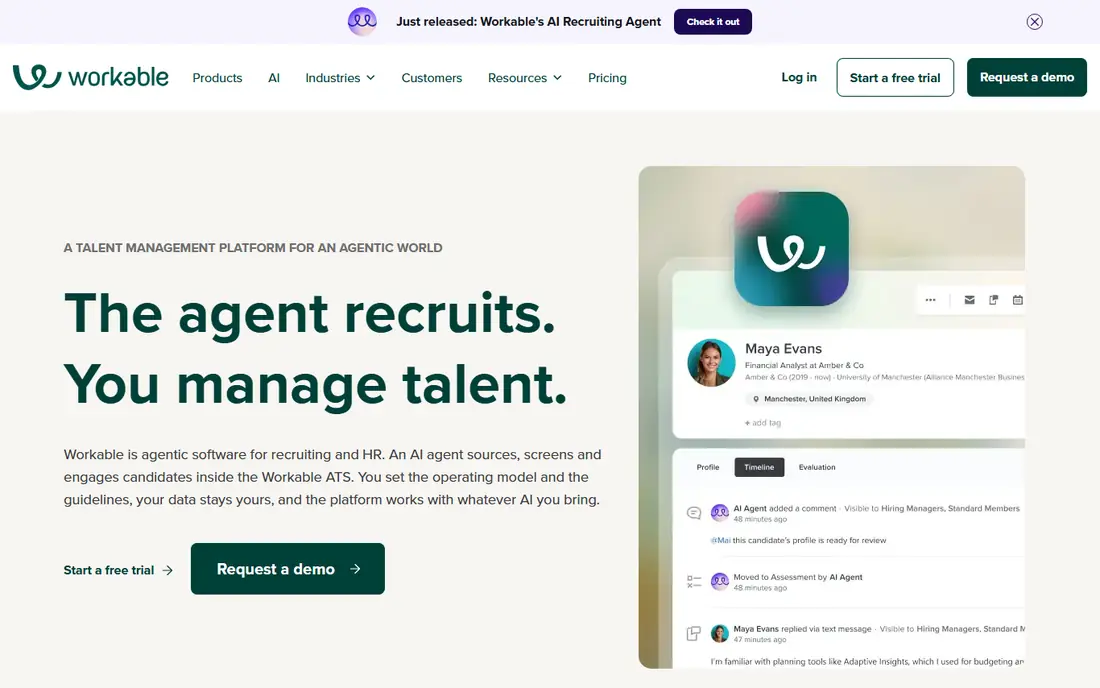
Workable is our pick for most small to mid-size direct hire teams. It posts to major job boards, tracks candidates in a clear pipeline, and offers AI sourcing to find passive candidates. The interface is easy for hiring managers who do not recruit full time, which helps small HR teams move fast.
Pricing is tiered by company headcount, so a growing firm should check the next tier before committing. Advanced reporting and some automation sit on higher plans, but the core hiring flow works well on the standard tier for most teams.
- Published pricing
- One-click posting to many boards
- AI sourcing tools
- Price rises with headcount tier
- Some advanced analytics need higher plans
Greenhouse suits teams that want every candidate judged the same way. Interview kits, scorecards, and structured stages help hiring managers compare candidates fairly and keep a clear record of decisions. That structure also supports diversity and compliance goals for larger employers.
Pricing is quoted by company size and hiring volume, so budget planning needs a sales conversation. Setup takes longer than on simpler tools, and permission settings can feel strict for small teams. For mid-size and larger employers, that rigour is often the point.
- Structured interview kits and scorecards
- Strong reporting
- Good for consistent hiring decisions
- Quote-only pricing
- Setup takes time
- Permissions can feel rigid
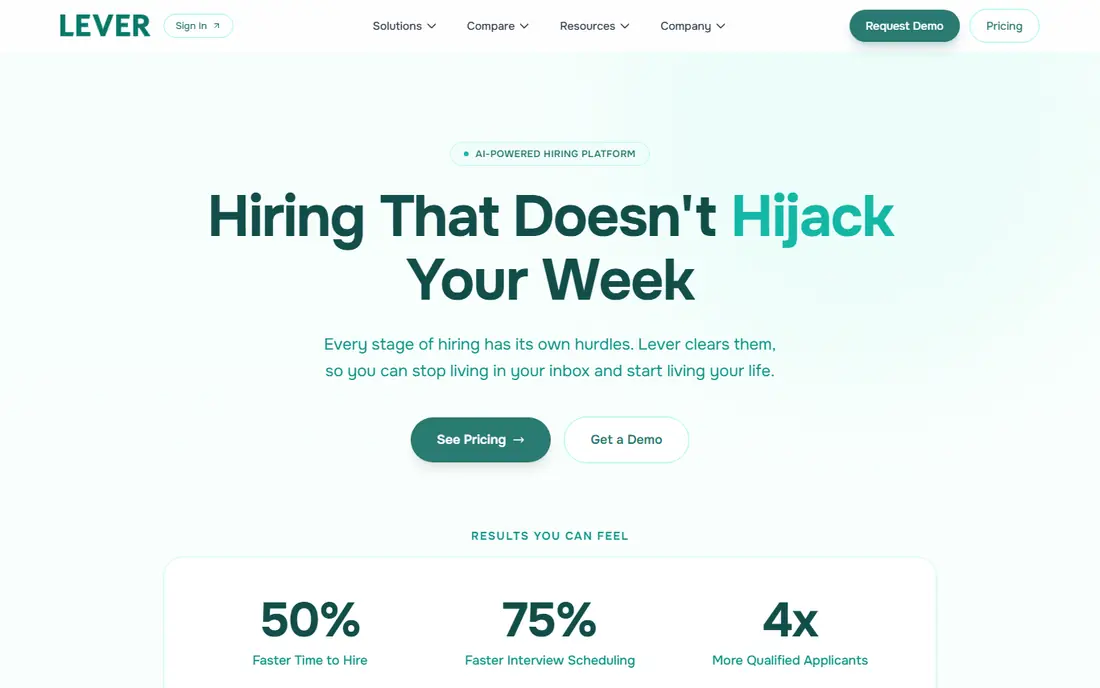
Lever combines an applicant tracking system with a candidate relationship tool, so teams can keep in touch with strong candidates who were not hired this time. Nurture campaigns, talent pools, and pipeline automation help when hiring is ongoing rather than one-off. That makes it strong for growth-stage companies.
Pricing is quoted, and the value depends on whether your team actually uses the CRM side. If you only post jobs and screen applicants, a simpler ATS may cost less. If you build talent pools for hard-to-fill roles, Lever earns its place.
- Native ATS and CRM in one
- Good for nurturing past candidates
- Strong automation
- Quote-only pricing
- Best value for teams that actively nurture talent pools
Ashby suits data-driven teams that want to see time to hire, source quality, interviewer load, and funnel conversion without exporting to another tool. Its analytics are built in, not bolted on, which helps talent leaders spot bottlenecks fast. Pipeline and scheduling tools are also strong for scaling teams.
The entry price is higher than budget rivals, and seat definitions affect the total, so read the pricing terms closely. For teams that make hiring decisions from reports, Ashby is worth the premium. For teams that only need posting and tracking, a cheaper tool may do.
- Deep native analytics
- Clear pipeline reporting
- Good for scaling teams
- Higher entry price
- Seat definitions need careful reading
JazzHR is a budget-friendly choice for small direct hire teams. A flat monthly fee with unlimited users helps small HR teams and hiring managers collaborate without per-seat costs. Setup is fast, and the core pipeline, posting, and screening tools cover most small-business hiring needs.
Lower plans limit monthly job postings, so high-volume teams should check that limit against their hiring plan. Some tools, such as advanced assessments, cost extra. For steady, low-volume hiring, JazzHR offers strong value.
- Flat fee with unlimited users
- Simple setup
- Good for small teams
- Job posting limits on lower plans
- Some features need add-ons
Zoho Recruit suits cost-conscious teams, solo recruiters, and companies already using Zoho apps. The free tier covers basic hiring, and paid plans start low per user, which makes it easy to test before scaling. It also handles both direct hire and agency workflows, which helps mixed teams.
The interface is functional rather than polished, and the best experience comes when paired with other Zoho tools. For a small team that needs a capable ATS at a low price, Zoho Recruit is hard to beat on value.
- Free tier for basic hiring
- Low per-user paid plans
- Integrates with Zoho suite
- Interface is less polished than rivals
- Some features need the Zoho ecosystem
Breezy suits teams that think visually. Drag-and-drop pipelines make it easy to see where every candidate sits, and the candidate experience is clean on mobile, which helps with hourly and frontline hiring. A free tier for a single job lets very small teams start at no cost.
Paid plans rise with team needs, and onboarding and performance modules cost extra. For teams that hire steadily and value a visual workflow, Breezy is a strong mid-range choice.
- Visual drag-and-drop pipelines
- Free tier for one job
- Good mobile candidate experience
- Higher paid tiers for larger teams
- Onboarding tools cost extra
SmartRecruiters suits larger employers with high-volume, multi-location, or global hiring. It handles many brands, languages, and compliance needs in one platform, and its integration list covers major HR and assessment tools. That breadth helps enterprises that hire across countries.
Pricing is quoted, and the platform is larger than a small team needs. For direct hire at enterprise scale, though, its volume handling and compliance tools justify a closer look.
- Built for high-volume global hiring
- Strong compliance and multi-brand support
- Large integration list
- Quote-based pricing
- More platform than a small team needs
How we picked these
We compared official pricing pages, trial terms, and feature pages, plus 2026 recruiting software comparisons. We looked for tools built for direct hire by employers, not only for staffing agencies, and available to new buyers in October 2026. We kept a mix of budget, mid-market, and enterprise tools, with published prices where vendors provide them.
How to choose direct hire software
Start with hiring volume and team size. A team hiring five people a year needs a different tool from a team hiring fifty. Count hiring managers as well as recruiters, since per-user pricing often applies to both, and check headcount tiers for flat-fee tools.
Next, test the candidate experience. Apply for a test job on mobile, check how long the form takes, and see what messages candidates receive. A clunky application form loses good candidates before a recruiter ever sees them, whatever the backend features offer.
Also check interview structure. If hiring managers currently judge candidates differently, a tool with interview kits and scorecards, such as Greenhouse, will help. If your process is already consistent, a simpler pipeline tool may be faster to adopt.
Finally, check integrations and data export. HR system sync, background check tools, calendar scheduling, and job board posting all affect daily work. Ask about data export and contract length, so you can leave without losing candidate history if the tool stops fitting.
Frequently asked questions
What is the best recruitment software for direct hire?
Workable leads for small to mid-size direct hire teams, thanks to published pricing and fast setup. Greenhouse and Lever lead for larger teams that need structured interviews and candidate relationship tools.
What is the best recruiting software for small business?
JazzHR and Zoho Recruit offer the lowest-cost starts for small teams, with flat fees or free tiers. Breezy is another good small-team choice when a visual pipeline matters more than the lowest price.
What is the best HR recruiting software for high-volume hiring?
SmartRecruiters suits high-volume, multi-location hiring, while Greenhouse and Ashby suit mid-size to large teams that need structure and analytics. Check volume limits and pricing tiers before choosing for high-volume roles.
Is there free recruitment software?
Zoho Recruit offers a free tier for basic hiring, and Breezy offers a free tier for a single job. Most other tools on this list offer a free trial rather than a permanent free plan, so check limits before relying on a free tier.
How much does recruitment software cost?
Small-team plans in this guide start from free to about $79 per month, mid-market plans start around $157 to $400 per month, and enterprise tools are quote-only. Add job board costs and add-ons for a true total.
Do these tools post to multiple job boards?
Yes, most tools on this list post to major job boards from one dashboard, and several offer one-click posting to dozens of boards. Check whether posting to your key boards is included on your plan or needs an add-on.
Sources
See where you really rank - block by block
ProMapRanker scans Google Maps across a grid of your service area. Simple monthly plans from $19, white-label on every plan.
Start freeKeep reading
 zendesk alternatives
Best Zendesk Alternatives in 2026
Compare the best Zendesk alternatives in 2026, from budget help desks to AI-first support tools, with current pricing, free plans, and honest trade-offs.
Read → wordpress alternatives
Best WordPress Alternatives in 2026
Looking for the best WordPress alternatives? We compare 8 free and paid options for blogs, business sites, stores, and developer-led projects in 2026.
Read → which real estate company has the best training
Best Real Estate Company Training in 2026
Compare which real estate company has the best training, from Keller Williams and eXp to Compass and Coldwell Banker, by program, mentor, and fit in 2026.
Read →