 ProMapRanker
Best Real Estate Investment Companies in 2026

Key takeaways
- Fundrise, Arrived, and Groundfloor offer the lowest entry points, while CrowdStreet and EquityMultiple focus on accredited investors with larger minimums.
- Fund-style platforms give broad exposure in one investment, while deal-by-deal platforms let you pick specific properties or loans.
- Real estate investments on these platforms are usually illiquid, so plan on holding for months or years rather than trading in and out.
- Fees, accreditation rules, and redemption windows vary widely, and they matter more than a headline return figure.
- This is general information only, not financial advice, and past results do not guarantee future results.
Quick comparison
| Pick | Great for | Pricing starts at | Free tier | |
|---|---|---|---|---|
 Fundrise | Hands-off diversified funds | See website | No | Visit |
 Arrived | Fractional single-family rentals | See website | No | Visit |
 RealtyMogul | Commercial REITs and private deals | See website | No | Visit |
 CrowdStreet | Accredited commercial deals | See website | No | Visit |
 Groundfloor | Short-term real estate debt | See website | No | Visit |
 EquityMultiple | Curated commercial deals | See website | No | Visit |
 DiversyFund | Long-term multifamily growth | See website | No | Visit |
 Yieldstreet | Multi-asset alternatives | See website | No | Visit |
 Roofstock | Buying whole rental homes | See website | No | Visit |
The best real estate investment companies
These companies let US investors buy into real estate without buying and managing a whole property themselves, though the models differ a lot. Some pool money into funds, some sell shares in single homes, and some offer individual commercial deals or loans. Read the offering documents, not just the marketing page, before committing money.
This is not financial advice. Real estate investing carries risk, including loss of capital, illiquidity, and market downturns. Check fees, lock-up periods, and tax treatment, and consider speaking with a qualified financial adviser about your own situation.
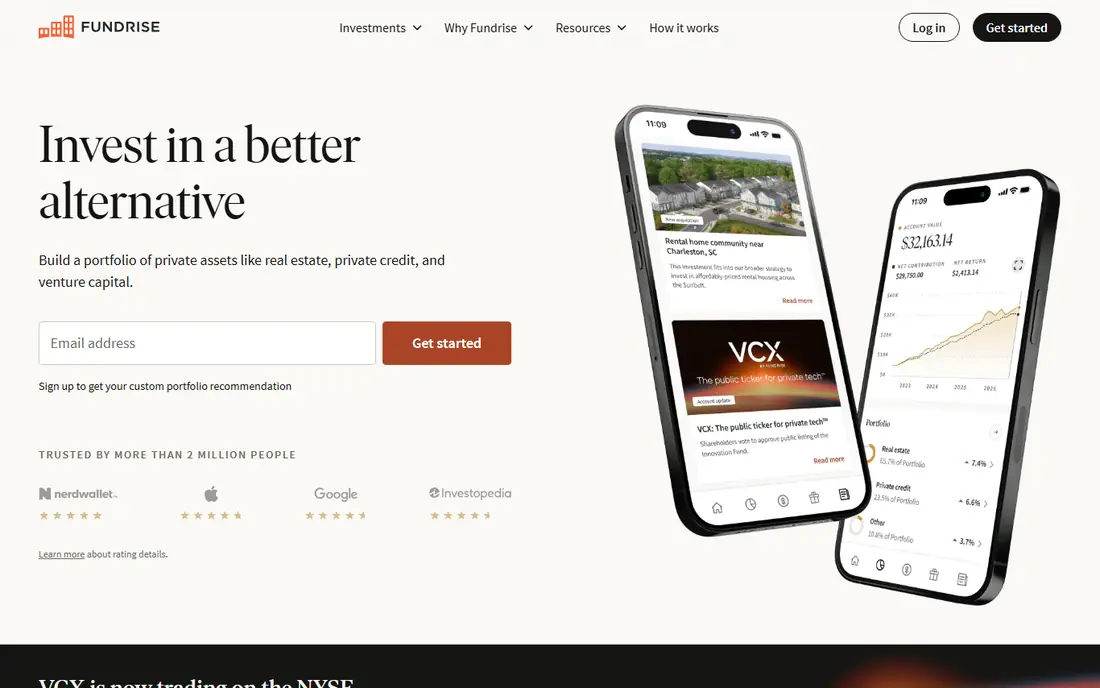
Fundrise is the simplest entry point for a beginner who wants real estate exposure without choosing properties. It pools investor money into diversified funds holding commercial and residential assets, and you choose a broad strategy rather than a single building. The low minimum makes it easy to start small and learn how fund statements, distributions, and redemption windows work.
The trade-off is control and liquidity. You cannot sell a fund share on a daily market, and early redemptions can be limited or penalized, so treat this as a long-term holding. Fundrise suits an investor who is comfortable letting a manager allocate capital and who does not need the money back quickly. It is less suited to someone who wants to research one property at a time.
- Low entry point for diversified real estate funds
- Strategy-based portfolios for income, balance, or growth
- Automatic reinvestment options
- Redemptions are limited and may carry penalties in early years
- You do not pick individual properties
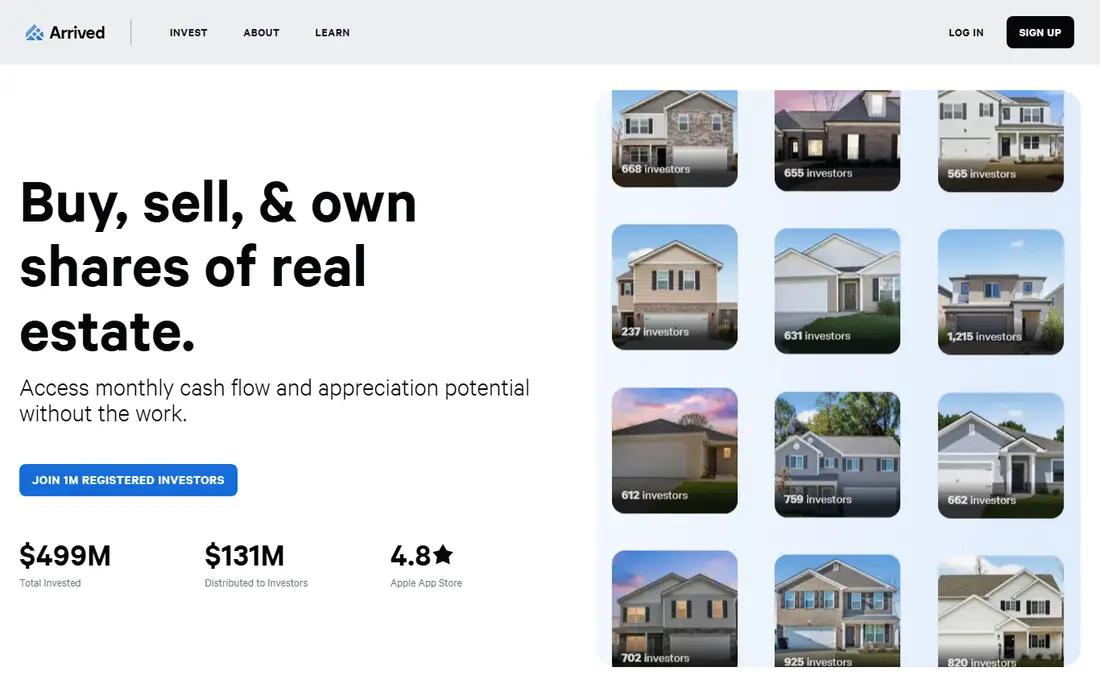
Arrived appeals to investors who like the idea of rental homes but do not want a mortgage, a tenant call, or a repair bill. You buy shares in individual single-family homes or funds of homes, and the pitch is rental income plus potential value change over time. Picking a specific home feels more tangible than buying into a broad fund, and that transparency helps some beginners understand what they own.
That specificity is also the risk. A single home can sit vacant, need repairs, or sit in a soft local market, and your return follows that home rather than a diversified pool. Arrived is best for a small, patient allocation where you have read the property details, the fee structure, and the exit options. It is not a substitute for an emergency fund or a short-term savings goal.
- Shares in specific single-family rental homes
- Lower entry point than most deal platforms
- Rental income focus
- Liquidity is limited
- Returns depend on one home, one market, and one tenant situation

RealtyMogul sits in the middle of this list, with two tracks that serve different investors. Non-accredited investors can access its REIT products, while accredited investors can also review individual private placements. That structure gives a beginner a way in through a REIT, and gives a more experienced investor a path to single commercial deals later.
The cost of that range is complexity. REIT distributions, private placement terms, fees, and hold periods are not the same, and comparing them takes real reading. RealtyMogul suits an investor who wants commercial exposure and is willing to study offering documents. A buyer who wants a single simple fund may prefer Fundrise instead.
- Non-traded REIT options for non-accredited investors
- Private placements for accredited investors
- Commercial focus
- Higher minimums than entry-level funds
- Private deals are illiquid for years
CrowdStreet is built for accredited investors who want to choose commercial deals themselves. The marketplace lists individual projects with sponsor details, property types, and deal structures, so a careful investor can compare offices, apartments, industrial assets, and other commercial property types side by side. For someone with capital and experience, that choice is the main attraction.
The barrier is equally clear. Minimums are high, accreditation is required for most deals, and capital is typically locked until a project exits, which can take years. CrowdStreet is not a beginner platform, and it is not a place to park money you may need soon. It fits a diversified portfolio where real estate is one long-term sleeve, not the whole plan.
- Wide selection of individual commercial deals
- Detailed deal pages and sponsor information
- Marketplace model for comparison
- Accredited investors only for most deals
- High minimums and multi-year illiquidity
Groundfloor offers a different angle: short-term loans secured by real estate, often for renovation or fix-and-flip projects, rather than ownership of a building. Terms are shorter than many equity deals, which appeals to investors who want to see capital return sooner and then decide whether to reinvest. The low per-loan entry point also lets an investor spread money across several loans.
Debt is not risk-free, and that distinction matters. A borrower can default, a project can run late, and a loan payoff can slip, so diversification across loans and careful reading of loan grades matter. Groundfloor suits an investor who understands lending risk and wants shorter cycles. It does not give the same long-term property upside as an equity fund, and it should not be treated as a savings account.
- Low entry point per loan
- Shorter terms than many equity deals
- Debt focus rather than property ownership
- Loan defaults and delays can affect returns
- Debt returns differ from equity upside
EquityMultiple targets accredited investors who want a curated set of commercial real estate deals without sorting through a very large marketplace alone. It offers debt, preferred equity, equity, and fund structures, so an investor can match a deal type to an income or growth goal. Some shorter-term notes add a middle option between a long equity hold and a cash account, though terms still need checking.
The limits are familiar for this category: accreditation, minimums that vary by deal, and illiquidity until exit. EquityMultiple works best as part of a larger alternatives allocation, with each deal read on its own terms. Investors who want daily liquidity or who are not accredited should look at the fund and fractional options earlier in this list.
- Curated commercial debt, equity, and fund options
- Institutional-style deal sourcing
- Shorter-term notes in some offerings
- Accredited focus
- Most deals are illiquid for the deal term
DiversyFund keeps the model simple: a growth-oriented REIT focused on multifamily apartments, with value-add renovation work as part of the strategy. For an investor who believes in rental apartments and wants one clear theme, that simplicity is easier to follow than a platform with dozens of deal types. It is also open to non-accredited investors through its REIT structure, which widens access.
Simplicity brings concentration. A multifamily-only portfolio rises and falls with that sector, and the long-term design means you should not expect quick exits. DiversyFund fits a patient investor who wants apartment exposure as one piece of a broader portfolio. It is less suited to someone who wants income distributions as the main goal, since the growth focus reinvests for appreciation.
- REIT-style multifamily focus
- Open to non-accredited investors in its growth REIT
- Single-strategy simplicity
- Long-term design with limited liquidity
- Concentration in multifamily assets
Yieldstreet is broader than a pure real estate company, and that breadth is the point. Real estate sits alongside other alternative investments, so an investor can build exposure across asset types on one platform rather than opening several accounts. For someone already interested in alternatives, that consolidation can simplify statements and tax documents.
Breadth also adds homework. Each asset class has its own risks, fees, and timelines, and a real estate deal on Yieldstreet cannot be judged with the same checklist as a fund on Fundrise. Check accreditation rules, minimums, and lock-ups deal by deal. Yieldstreet suits an experienced alternatives investor, not a first-time buyer looking for a single simple real estate fund.
- Real estate alongside other alternative assets
- Curated offerings for diversification beyond property alone
- Structured deal pages
- Many offerings require accreditation
- Minimums and terms vary widely by deal
- Complexity across asset classes
Roofstock is different from every fractional platform above because you buy the whole home, not a share. The marketplace lists single-family rental properties, often with tenants already in place and rent history shown, and it connects buyers with property managers and services. For an investor ready to own rental property, that direct ownership brings control over the asset, the manager, and the exit.
Direct ownership also brings direct responsibility. A roof, a vacancy, a bad tenant, or a local market downturn falls on the owner, and financing, insurance, and taxes add layers that fractional investing avoids. Roofstock fits a buyer with capital, a local market thesis, and time for landlord decisions. A small investor who wants passive exposure should stay with the fund and fractional options.
- Marketplace for buying whole single-family rental homes
- Tenant and rent information on listings
- Property management connections
- Requires full home purchase capital
- Landlord responsibilities remain even with a manager
How we picked these
We compared official platform pages, offering descriptions, and current marketplace listings for companies that are live in October 2026 and that truly offer real estate investment access to US investors. We favored a mix of low-entry funds, fractional rentals, commercial deal marketplaces, debt platforms, and direct ownership, so readers at different capital levels and experience levels can see a real option. We did not rank by promised returns, since those figures vary by deal, period, and fees, and we marked prices as See website where minimums and fees vary by offering.
What to check before you invest
Start with time horizon, not return. If you may need the money within a year, most of these platforms are a poor fit, because redemptions are limited and deals can last years. Next, check accreditation: some doors open only to accredited investors, while others use fund structures that allow broader access. Read the fee schedule, the redemption policy, and the tax forms for each offering before you invest.
Build a position slowly
A sensible approach is to start with a small amount on one fund or fractional platform, read the quarterly statements, and learn how distributions, fees, and valuations actually appear. Add deal-by-deal investing only after you can explain a deal structure, a sponsor track record, and an exit path in plain language. Diversify across properties, markets, and deal types rather than placing a large sum in a single home or project.
Frequently asked questions
What is the best real estate investment company?
The best real estate investment company depends on your capital, accreditation status, and time horizon. Fundrise suits hands-off beginners, Arrived suits fractional rental buyers, and CrowdStreet suits accredited investors who want to pick commercial deals.
What is the best real estate investment company for beginners?
Beginners often start with a low-entry fund or fractional platform, because the minimum is smaller and the portfolio is broader than a single deal. Fundrise, Arrived, and Groundfloor all offer lower entry points, but each still carries illiquidity and market risk.
Are the best real estate investment companies open to non-accredited investors?
Some are, through fund and REIT structures, while many individual commercial deals require accreditation. Check each platform and each offering, since access rules vary by product and by state.
How liquid are real estate investment platforms?
Most are illiquid or only partly liquid. Funds may offer quarterly redemption windows with limits, fractional shares may have limited secondary options, and private deals often lock capital until exit. Assume a multi-year hold unless the offering documents say otherwise.
Do real estate investment companies guarantee returns?
No. Distributions, rents, and property values can fall, loans can default, and projects can be delayed. Any platform that promises a fixed return should be read with care, and offering documents, not marketing pages, are the source to trust.
Is direct ownership better than fractional investing?
Direct ownership through a marketplace like Roofstock gives control, but it also brings landlord work, financing, and concentration in one property. Fractional and fund investing gives diversification and less work, but less control and limited liquidity. The better choice follows your capital, time, and risk tolerance.
Sources
See where you really rank - block by block
ProMapRanker scans Google Maps across a grid of your service area. Simple monthly plans from $19, white-label on every plan.
Start freeKeep reading
 zscaler alternatives
Best Zscaler Alternatives in 2026
Looking for zscaler alternatives? We compare 9 SASE and zero trust platforms on architecture, data protection, pricing, and fit for your network and team.
Read → zapier alternatives free
Best Zapier Alternatives Free in 2026
Nine automation tools for zapier alternatives free in 2026, all with genuinely free tiers, plus free plan limits, starting prices and upgrade paths explained.
Read → which platform is best for online reputation
Which Platform Is Best for Online Reputation in 2026
Wondering which platform is best for online reputation? We compare 8 review, listing, and response tools for small and multi-location businesses and agencies.
Read →