 ProMapRanker
Best-Rated Software Config Management Solutions in 2026

Key takeaways
- Ansible is the best starting point for most teams, because it is agentless, free at core, and uses readable YAML.
- Puppet and Chef suit enterprises that need continuous enforcement, compliance reporting and policy-as-code controls.
- Salt suits large, homogeneous estates that need fast, event-driven execution at scale.
- Terraform and Pulumi are provisioning tools that pair with config tools, not replacements for them, so many teams use both.
Quick comparison
| Pick | Great for | Pricing starts at | Free tier | |
|---|---|---|---|---|
 Ansible | Simple agentless automation for most teams | Free | Yes | Visit |
 Puppet | Enterprise enforcement and compliance | See website | Yes | Visit |
 Chef Infra | Policy-as-code for complex infrastructure | See website | Yes | Visit |
 Salt | Fast event-driven automation at scale | Free | Yes | Visit |
 Terraform | Cloud provisioning paired with config tools | Free | Yes | Visit |
 CFEngine | Lightweight enforcement on large estates | See website | Yes | Visit |
 Rudder | Compliance-focused config with a visual interface | Free | Yes | Visit |
 Octopus Deploy | Deployment and config for app releases | See website | Free trial | Visit |
The best-rated software config management solutions
Configuration management keeps servers and systems in a known, desired state. When a setting drifts, a good tool puts it back, reports the change, and leaves an audit trail. The eight tools below cover agentless automation, agent-based enforcement, provisioning and deployment, with different strengths for different team sizes.
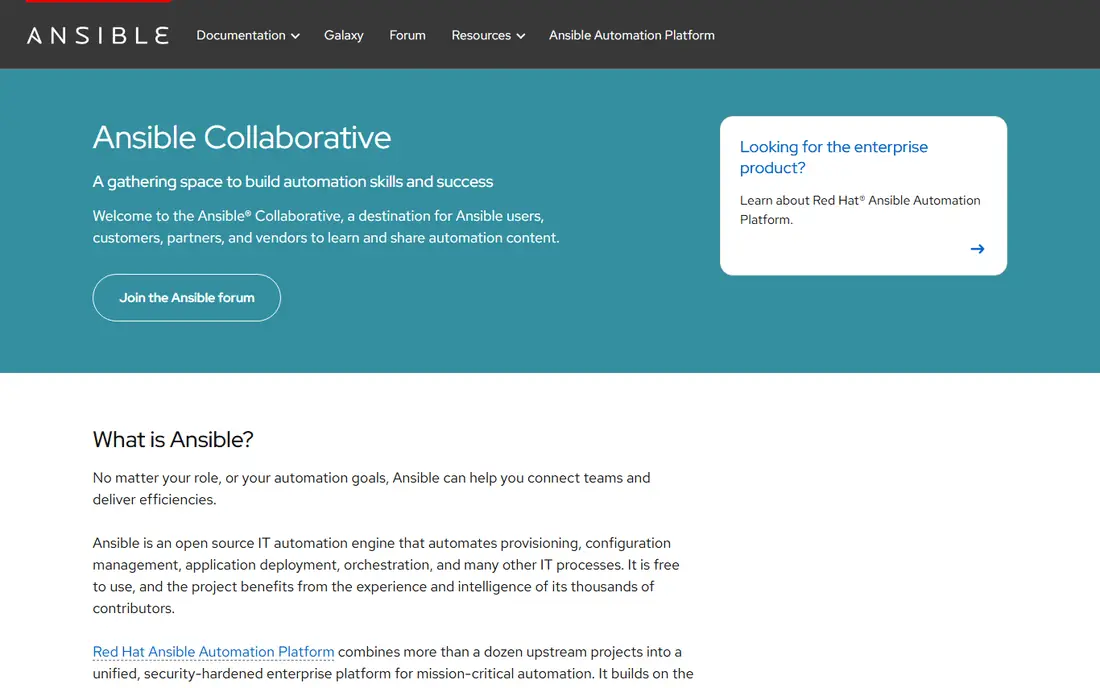
Ansible is the easiest config tool for most teams to start with. It connects over SSH, runs YAML playbooks that read like task lists, and can install packages, manage files, set services and configure users across many servers at once. The open-source engine is free, and thousands of modules cover common operating systems, cloud services and network devices.
Red Hat Ansible Automation Platform adds the enterprise layer, with role-based access, credential vaults, scheduling, audit logs and support, at a quoted price. Teams that start with free Ansible and later need governance can move to that platform without rewriting playbooks. Ansible fits small to mid-size teams best, while very large estates may need tuning or a second tool for orchestration.
- Agentless design using SSH, so no agent to install on most servers
- Readable YAML playbooks
- Large module library
- Performance needs tuning at very large node counts
- Enterprise governance needs the paid Red Hat platform

Puppet is an agent-based platform that defines desired state in its own language, then keeps servers in that state over time. If a file changes or a package is removed, Puppet can restore it on the next run and report the drift. That continuous enforcement suits enterprises with audit needs, where proving a system stayed compliant matters as much as fixing it once.
Puppet Open Source is free, while Puppet Enterprise is quoted, with past listings in the range of $112 to $199 per year for up to 100 nodes depending on features. Teams should confirm current enterprise pricing by quote. Puppet fits large IT estates and regulated environments, while smaller teams may find Ansible faster to learn.
- Continuous enforcement of desired state
- Strong compliance reporting
- Mature enterprise ecosystem
- Puppet language takes training
- Pricing is quoted and varies by node count and edition
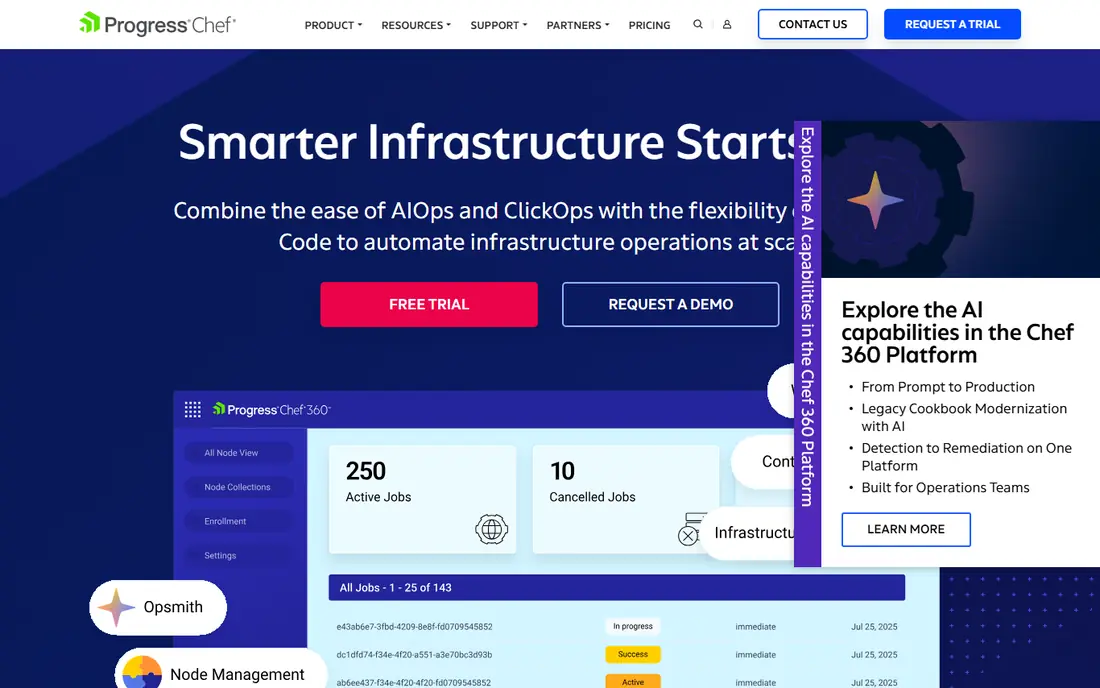
Chef Infra treats infrastructure as code written in Ruby, with cookbooks that define how a server should be configured. Its testing tools, including compliance checks, help teams verify that a cookbook does what it claims before it reaches production. That rigor suits enterprises with complex, custom infrastructure and strict change control.
Chef offers open-source components, with commercial pricing quoted per node. Recent comparisons have listed business tiers around $59 per node per year and enterprise around $189, but teams should confirm current pricing. Chef fits teams already comfortable with Ruby and DevOps workflows, while teams wanting the simplest start should choose Ansible.
- Flexible policy-as-code with Ruby
- Strong testing and compliance tools
- Mature cookbook ecosystem
- Ruby learning curve for new teams
- Setup is more complex than Ansible
- Community activity has slowed in some areas
Salt, from the Salt Project, uses a master and minion model to run commands and apply states across thousands of machines in parallel. Its event system can react to changes in real time, which suits large, homogeneous estates such as data centers and cloud fleets. YAML and Jinja templates define states in a form many Ansible users will recognize.
The open-source Salt Project is free, while enterprise support and management features are sold through VMware by Broadcom channels at quoted prices. Salt remains maintained as an open-source project, but teams should weigh Broadcom ownership when planning long-term support. Salt fits large Linux estates best, while mixed network environments may prefer Ansible module breadth.
- Fast, parallel execution across many nodes
- Event-driven automation and orchestration
- Open-source core
- Setup can be rough for new users
- Documentation and web interface are thinner than rivals
- Network module coverage is narrower than Ansible
Terraform is often listed with config tools, but its job is different. It creates servers, networks, databases and other cloud resources from declarative code, then tracks their state. Once those resources exist, a config tool such as Ansible installs software and sets configuration inside them. Many teams use Terraform and Ansible together for that reason.
Terraform Open Source is free, while HashiCorp Cloud Platform tiers add collaboration, policy and governance at quoted or published prices. Terraform fits cloud teams that want repeatable provisioning across providers. It should not be chosen alone when the main need is ongoing server configuration and drift correction.
- Clear declarative provisioning for cloud resources
- Large provider ecosystem
- State tracking for infrastructure changes
- Provisions resources but does not configure software inside them
- Needs Ansible, Puppet or Chef for full config
CFEngine is one of the oldest config management tools, built for large estates where a lightweight agent matters. Its policy language defines desired state, and its small agent enforces that state with minimal load on each machine. That design suits organizations managing many servers, including older hardware, where a heavy agent would be a problem.
CFEngine offers a community edition, with enterprise pricing quoted. Its community is smaller than Ansible or Puppet, so teams should check available modules and support for their platforms before committing. CFEngine fits large, stability-focused estates, while teams wanting a large modern module library may prefer Ansible.
- Very lightweight agent with low resource use
- Long history in large-scale config enforcement
- Strong policy model
- Smaller community than Ansible or Puppet
- Learning curve for policy language
- Enterprise pricing is quoted
Rudder is an open-source config and compliance platform that combines agent-based enforcement with a clear web interface. Managers can define rules, apply them to node groups, and see compliance status and drift in reports that non-specialists can read. That reporting focus suits regulated teams and public-sector estates where audit evidence matters.
Rudder Open Source is free, with enterprise support and features quoted. Its ecosystem is smaller than Ansible or Puppet, so teams should check integration coverage for their systems. Rudder fits teams that want compliance visibility without building custom reporting on top of another tool.
- Visual compliance reporting and drift detection
- Open-source core
- Good for regulated and public-sector teams
- Smaller ecosystem than Ansible or Puppet
- Agent setup needed on managed nodes
- Enterprise features are quoted
Octopus Deploy focuses on application deployment and release management, with strong handling of configuration variables per environment. Teams can promote a release from test to staging to production, with approvals, rollbacks and a clear audit trail for each deployment. That control suits software teams shipping often to many environments.
Octopus offers a free trial and a free tier for small use in some listings, with larger team pricing quoted. It does not replace Ansible, Puppet or Chef for operating-system configuration, but it pairs well with them: the config tool keeps servers in state, and Octopus handles app releases on top. Teams that mainly need app deployment should shortlist Octopus, while teams that mainly need server enforcement should start with Ansible or Puppet.
- Strong deployment automation with environments and approvals
- Good config variable handling per environment
- Clear release history
- Deployment-focused, not a full server config enforcement tool
- Pricing is quoted for larger teams
- Needs a config tool for OS-level state
How we picked these
We compared official documentation, pricing pages and public reviews for config management tools in active use in 2026. We kept only tools that define desired state, apply it across machines, and report drift or compliance, plus Terraform and Octopus as common pairings that readers often compare with them. Prices are quoted where vendors do not publish a fixed rate, and open-source editions are marked free where the core engine can be used without payment.
What to check before you buy
Start with your estate, not with a feature list. Count servers, operating systems, cloud providers and network devices, and check which tools support them well. A tool with strong Linux support but thin network modules will disappoint a network-heavy team, while a tool with strong Windows support may matter more to another team.
Next, test drift handling, not just first setup. Change a file on a test server, run the tool, and see whether it restores the setting and reports the change. Check how secrets are stored, how approvals work, and how easy it is to roll back a bad change. Finally, consider team skills: YAML teams will move faster with Ansible or Salt, Ruby teams with Chef, and policy teams with Puppet or Rudder. The tool your team can run well beats the tool with the longest feature list.
Frequently asked questions
What is configuration management?
It is the practice of defining how servers and systems should be configured in code, applying that definition across machines, and correcting drift when a system changes from the desired state.
Is Ansible really free?
Yes, the Ansible open-source engine is free. Red Hat Ansible Automation Platform is the paid enterprise tier, with support, governance, scheduling and audit features, at a quoted price.
Which is better, Puppet or Chef?
Puppet emphasizes continuous enforcement and compliance reporting, while Chef emphasizes policy-as-code and DevOps workflows. The better pick depends on team skills, audit needs and existing standards.
Do I need config management if I use containers and Kubernetes?
You need less server-level config, but hosts, networks and non-containerized systems still drift. Many teams use Kubernetes for containers and Ansible or Puppet for what remains.
What is the difference between Terraform and Ansible?
Terraform provisions infrastructure, such as servers and networks. Ansible configures software and settings inside those resources. Teams commonly use both together.
Is Salt still maintained?
Yes. The Salt Project continues as an open-source project with releases and community support. Broadcom owns VMware, which stewards Salt, so teams should review the roadmap when planning long-term use.
Sources
See where you really rank - block by block
ProMapRanker scans Google Maps across a grid of your service area. Simple monthly plans from $19, white-label on every plan.
Start freeKeep reading
 zoro.to alternatives
Best Zoro.to Alternatives in 2026
We compare the best zoro.to alternatives in 2026, listing only legal licensed anime streaming services, from Crunchyroll to free options for fans today.
Read → zip alternatives
Best Zip Alternatives in 2026
We compare the best zip alternatives for buy now, pay later in 2026, covering pay-in-4 plans, fees, spending limits, and credit reporting options today.
Read → yesware alternatives
Best Yesware Alternatives in 2026
Compare the best yesware alternatives for sales email tracking, templates, and sequences, with current pricing and honest tradeoffs for small sales teams.
Read →