 ProMapRanker
Best-Rated RPC Node Service for Web3 in 2026

Key takeaways
- Free tiers differ more than the headline numbers suggest, because some providers bill by weighted compute units and others bill one unit per request.
- Chainstack, Alchemy, Infura, Ankr, dRPC, Blast, GetBlock, and Dwellir all offer a permanent free tier in this list.
- QuickNode is not listed here, because its entry offer is a one-month trial only, not a permanent free tier.
- Model your real call mix before choosing, since archive reads, logs, and trace calls often cost several times more than a simple balance read.
Quick comparison
| Pick | Great for | Pricing starts at | Free tier | |
|---|---|---|---|---|
 Alchemy | Full-stack dApp teams | $49 per month | Yes | Visit |
 Infura | Ethereum and MetaMask ecosystem work | $50 per month | Yes | Visit |
 Chainstack | Predictable request-based pricing | $49 per month | Yes | Visit |
 Ankr | Wide multi-chain access | See website | Yes | Visit |
 dRPC | Decentralised multi-provider routing | $49 per month | Yes | Visit |
 Blast API | Bware Labs multi-chain RPC | See website | Yes | Visit |
 GetBlock | Broad chain coverage | $49 per month | Yes | Visit |
 Dwellir | Low-cost high-volume reads | $49 per month | Yes | Visit |
The best-rated RPC node services for web3
An RPC node service connects an app, wallet, or bot to a blockchain without running your own node. We compared official pricing pages, free tier terms, chain coverage, and public reviews, and we kept only providers with a permanent free tier. This is general information about developer infrastructure, not financial advice, and we make no promise about token prices or returns.
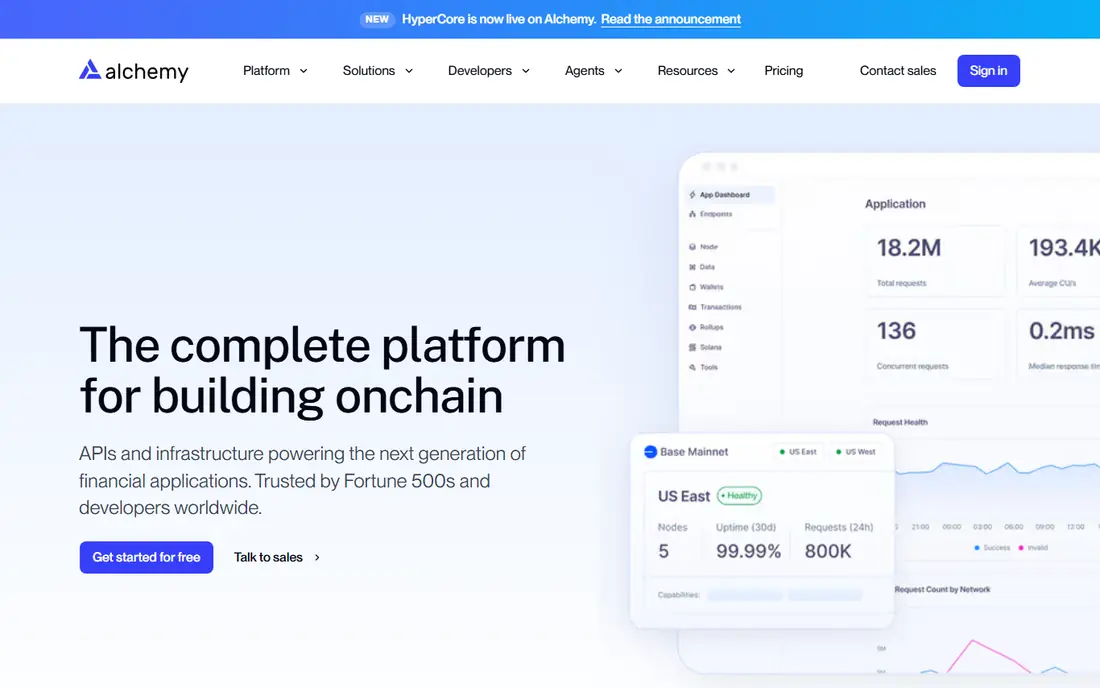
Alchemy fits teams that need more than a raw node connection. Its token, NFT, and webhook APIs turn blockchain data into app-ready screens, which saves building an indexer from scratch. The platform also covers many chains, so a team shipping on several networks can keep one account and one billing model.
The catch is unit maths. Alchemy bills in compute units, weighted by method, so a simple call and a heavy log scan do not cost the same. Budget from your actual call mix, not from the free tier headline, and set usage alerts early so a busy week does not surprise you.
- Rich developer APIs for tokens and NFTs
- Large chain coverage
- Clear dashboards and usage tools
- Compute unit billing makes heavy log and archive work costlier than the headline suggests
- Free tier request volume is lower than request-based rivals
Infura has powered Ethereum apps since 2016, and it remains a natural choice for teams building around MetaMask. Its developer tools, gas API, and SDK links fit products that already live in that ecosystem. For a steady workload with predictable daily volume, the credit model is easy to plan around.
Spiky traffic is the weakness. Because free and paid credits are daily, a quiet day does not bank allowance for a busy day, and hitting the ceiling can block calls until reset. If your app has launch days, airdrops, or event-driven spikes, test a spike on a paid plan before launch.
- Long-running Ethereum infrastructure
- MetaMask ecosystem fit
- Daily credit model suits steady workloads
- Daily credits reset each day, which punishes spiky traffic
- Chain coverage is narrower than some rivals
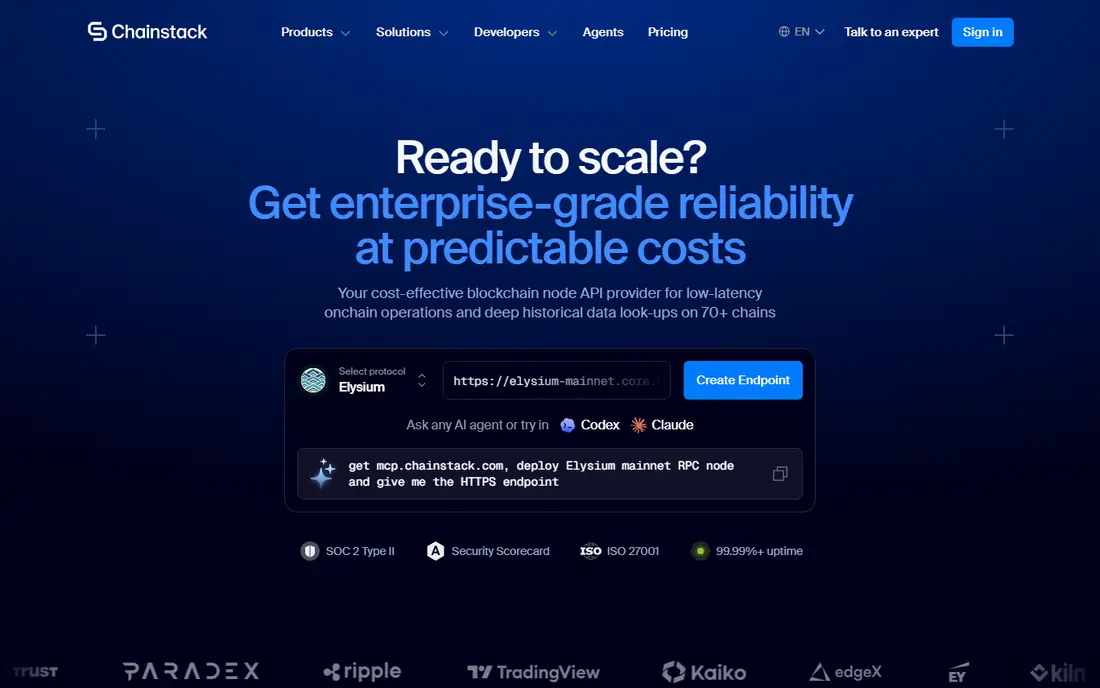
Chainstack stands out for pricing clarity. Ordinary calls cost one request unit each, so the monthly quota maps directly to call count in a way that weighted-unit rivals do not match. Its free tier offers 3 million request units per month at 25 requests per second, which is enough for a real prototype and early production testing.
The limit to note is feature gating. Archive data, detailed node logs, and platform API access start on paid plans, so an indexer or analytics product will likely need to pay. Even so, for a team that values predictable bills, Chainstack is a strong first pick.
- One request unit per ordinary call, which makes budgeting simple
- Free tier of 3 million request units per month
- Global routing
- Archive and trace features sit on higher plans
- Advanced analytics start above the free tier
Ankr suits wallets and multi-chain apps that need many networks under one roof. Its RPC service covers a large set of chains, and its broader infrastructure work means a team can add staking or node services later without changing vendors. Public endpoints also make quick testing simple before committing to a paid key.
Paid features are where the reading matters. Archive access, higher throughput, and some trace methods sit behind premium plans, so check the plan page for the chains and methods you actually use. A free tier that looks generous for simple reads can tighten fast for historical data work.
- Very wide chain coverage
- Public and premium endpoints
- Staking and infrastructure services alongside RPC
- Advanced RPC features such as archive and trace are paid add-ons
- Credit billing needs careful reading
dRPC takes a different approach from a single company running its own nodes. It routes requests across a network of providers, so one provider outage does not have to take your app down. That redundancy is valuable for production apps where downtime shows up at once in user complaints and failed transactions.
The free tier is narrower than the paid tiers. Archive, trace, and WebSocket access are not included free, so teams building indexers or live feeds should price a paid plan from the start. For ordinary read-heavy apps, the free tier is still a useful place to test routing and latency.
- Requests route across many independent providers, which aids uptime
- Flat per-request style pricing on some plans
- Wide chain list
- Free tier excludes archive, trace, and WebSocket access
- Method pricing still needs a call-mix check
Blast API, from Bware Labs, offers shared and dedicated RPC access across a broad set of chains, with JSON-RPC and WebSocket endpoints. It fits dApps and DeFi front ends that need reliable reads without running nodes, and its dashboard gives a single place to manage keys and usage. For a team that wants a second provider for redundancy, Blast is a credible addition.
The honest weakness is familiarity. Fewer tutorials and community examples mention Blast than the largest providers, so onboarding may take a little more reading of official docs. Confirm paid pricing for your exact chains before launch, since plan terms can differ by network.
- Distributed node infrastructure across many chains
- Free and paid tiers under one dashboard
- WebSocket support
- Smaller brand presence than Alchemy or Infura
- Paid plan details vary by chain and need checking
GetBlock is a practical choice when a product must talk to many different blockchains, not only Ethereum and its rollups. It provides API access to full nodes across a large list of networks, so a wallet or explorer team can avoid running a node per chain. Setup is a standard API key flow, which keeps integration time short.
High-volume and historical work need a closer look. Archive availability and rate limits differ by plan, and heavy use can push costs above the entry plan. Start on the free tier, measure your top methods, then choose the paid tier that matches that mix rather than the headline quota.
- Very broad chain coverage, including many non-EVM networks
- Shared and dedicated nodes
- Simple API key setup
- Archive access is plan-dependent
- Paid plan pricing needs a careful read for high-volume work
Dwellir appeals to teams that care most about cost per successful read. Its one-credit-per-response model avoids the weighted-unit surprise, and its entry paid plan has been priced competitively for high-volume simple reads. The free tier, at 100,000 responses per day, also suits a small production app or a staging environment.
The trade-offs are scope and enterprise paperwork. The free plan excludes eth_getLogs, and teams in regulated settings may need compliance documents that larger rivals publish more fully. For a cost-sensitive read-heavy app, those limits are manageable, but they should be checked before a production commitment.
- One credit per response makes costs easy to model
- Free tier of 100,000 responses per day
- Broad chain list
- Free plan excludes some log queries
- Support and compliance attestations are thinner than enterprise rivals
How we picked these
We compared official pricing pages, free tier terms, chain coverage, and public reviews, and we required a permanent free tier for inclusion. We excluded QuickNode from this list because its entry offer is a one-month trial that deactivates afterwards, not a permanent free tier, even though it is a well-known provider. We did not test live nodes ourselves, and we did not promise returns, token prices, or uptime beyond what each provider publishes.
How to choose without overpaying
First, list your top ten methods and their monthly counts, including logs, archive reads, and trace calls. A provider that looks cheap for simple reads can become costly once weighted methods dominate, so run that mix through each pricing page before committing. Second, test latency from the regions your users actually live in, since global routing differs by provider and by chain.
Third, plan for failure. Use two providers, or a fallback endpoint, for any app where a failed read blocks a payment or a login. Set rate-limit alerts, keep a staging key separate from production, and review usage weekly during the first month. Those habits matter more than picking the provider with the largest headline quota.
Frequently asked questions
What is an RPC node service?
It is a hosted service that runs blockchain nodes and gives your app an endpoint to read chain data and send transactions. Your app sends JSON-RPC requests to that endpoint instead of running and syncing a node itself.
Is a free tier enough for production?
It can be enough for a small app with steady, light traffic, but it is not enough for heavy, spiky, or archive-heavy workloads. Free tiers usually cap requests per second and exclude some methods, so measure your traffic before relying on one.
Why is QuickNode not on this list?
QuickNode is excluded here because its entry offer is a one-month trial, not a permanent free tier. This list was built around permanent free tiers only, so a trial-only offer does not meet that rule.
Should I use one provider or two?
Use two for production apps where downtime blocks users, with a fallback endpoint and health checks. For a prototype or a personal project, one provider is fine, and you can add redundancy later.
Do RPC providers affect token prices or returns?
No. An RPC provider moves data and transactions, but it does not set token prices, guarantee returns, or make an investment safer. Treat any claim of guaranteed returns as a warning sign, not a feature.
Sources
See where you really rank - block by block
ProMapRanker scans Google Maps across a grid of your service area. Simple monthly plans from $19, white-label on every plan.
Start freeKeep reading
 worlds best local seo company
8 Worlds Best Local SEO Companies for Map Pack Growth in 2026
Compare the worlds best local seo company options for Google Business Profile work, citations, reviews, and multi-location rankings and reporting in 2026.
Read → world's best web hosting company
World's Best Web Hosting Company in 2026
Searching for the world's best web hosting company? We compared 10 hosts on price, renewal rates, speed, and support to help you choose well today in 2026.
Read → who's got the best nanny tax services
Who's Got the Best Nanny Tax Services in 2026
We answer who's got the best nanny tax services, comparing full filing, back taxes, software, and pricing so families can handle nanny taxes correctly.
Read →