 ProMapRanker
Best-Rated RPC Node Service in 2026

Key takeaways
- Only permanent free tiers are marked as free here; trial-only offers are marked as a trial, not as a free plan.
- Free tiers carry rate limits and no SLA in most cases, so they suit testing and small apps, not production traffic.
- Credit and compute-unit pricing makes headline allowances misleading, so model your actual method mix before choosing.
- Use two providers or a fallback for production, because a single shared endpoint can fail or throttle at the worst time.
Quick comparison
| Pick | Great for | Pricing starts at | Free tier | |
|---|---|---|---|---|
 Alchemy | Developer tooling plus RPC access | See website | Yes | Visit |
 Infura | Ethereum-first projects and MetaMask tooling | $50 per month | Yes | Visit |
 Chainstack | Teams wanting simple request-unit pricing | $49 per month | Yes | Visit |
 dRPC | Redundancy across many providers | See website | Yes | Visit |
 Ankr | Cost-sensitive multi-chain testing | See website | Yes | Visit |
 Dwellir | Simple per-response pricing | $49 per month | Yes | Visit |
 Tenderly | EVM teams needing simulation and trace tools | See website | Yes | Visit |
 NOWNodes | Broad chain coverage on a small budget | See website | Yes | Visit |
The best-rated rpc node service
We compared RPC providers on free tier permanence, rate limits, archive access, pricing model, and tooling. QuickNode is not listed here, because its free offer is a one-month trial only, and we do not present trial-only tools as free.
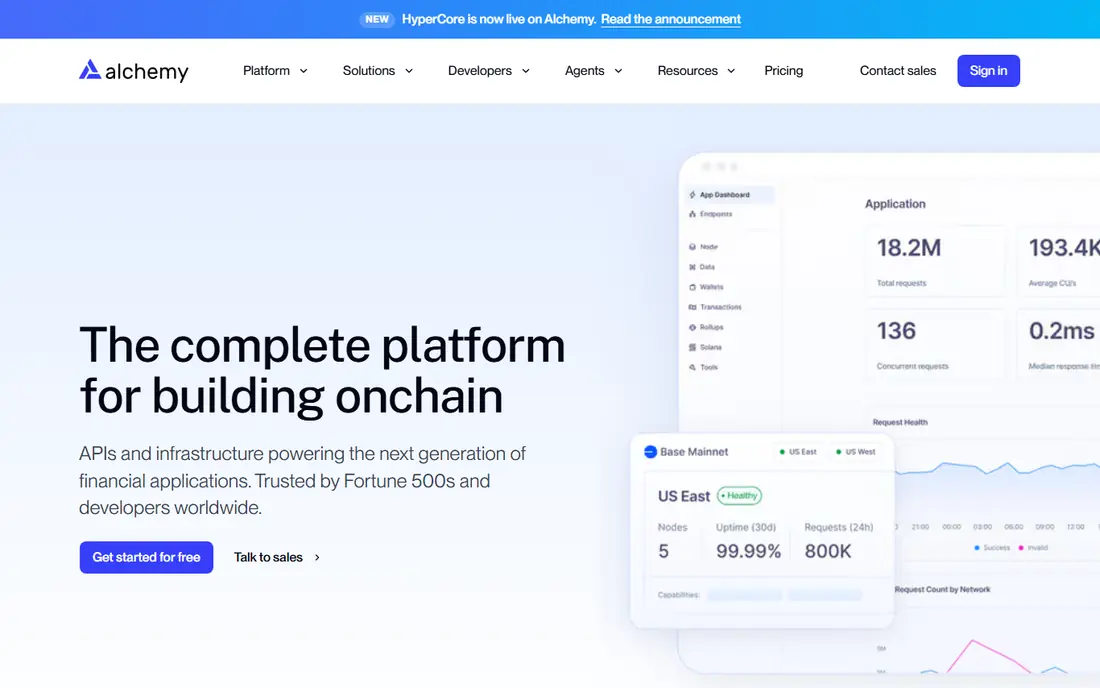
Alchemy is the most tool-rich RPC provider in this list, pairing standard node access with webhooks, transaction simulation, enriched token data, and debug and trace APIs. That tooling matters when an app needs more than raw block data, because it can reduce the extra services a team must run itself. Its free tier is permanent in published comparisons, at 30 million compute units a month, which suits prototypes and small apps.
The catch is compute units. Different methods cost different units, so a log-heavy app can burn its allowance far faster than a simple block-number app. The free tier also has rate limits and no SLA, so treat it as a development tier and move to a paid plan, with a fallback provider, before launch.
- Permanent free tier with 30 million compute units a month in comparisons
- Webhooks, simulation, and token APIs
- Broad chain coverage
- Compute-unit pricing makes costs hard to forecast for heavy methods
- Free tier has throughput limits and no production SLA
Infura has run Ethereum RPC access since the early years of the chain and remains a default for many MetaMask and ConsenSys-adjacent tools. Its free Core tier is permanent in published comparisons, at 3 million credits a day, while paid tiers step up to larger daily allowances. That daily model suits apps with steady traffic, because the allowance refreshes each day rather than once a month.
The weakness is credit weighting. A simple call costs far fewer credits than a log query, so an app that scans logs can exhaust a daily allowance quickly. Paid tiers add archive, debug, and trace access, but free-tier users should check which methods are limited before building around Infura alone.
- Permanent free tier with daily credits
- Long history with Ethereum tooling
- Archive and debug access on paid tiers
- Daily credit reset means unused capacity does not roll over
- Heavy log methods cost many credits
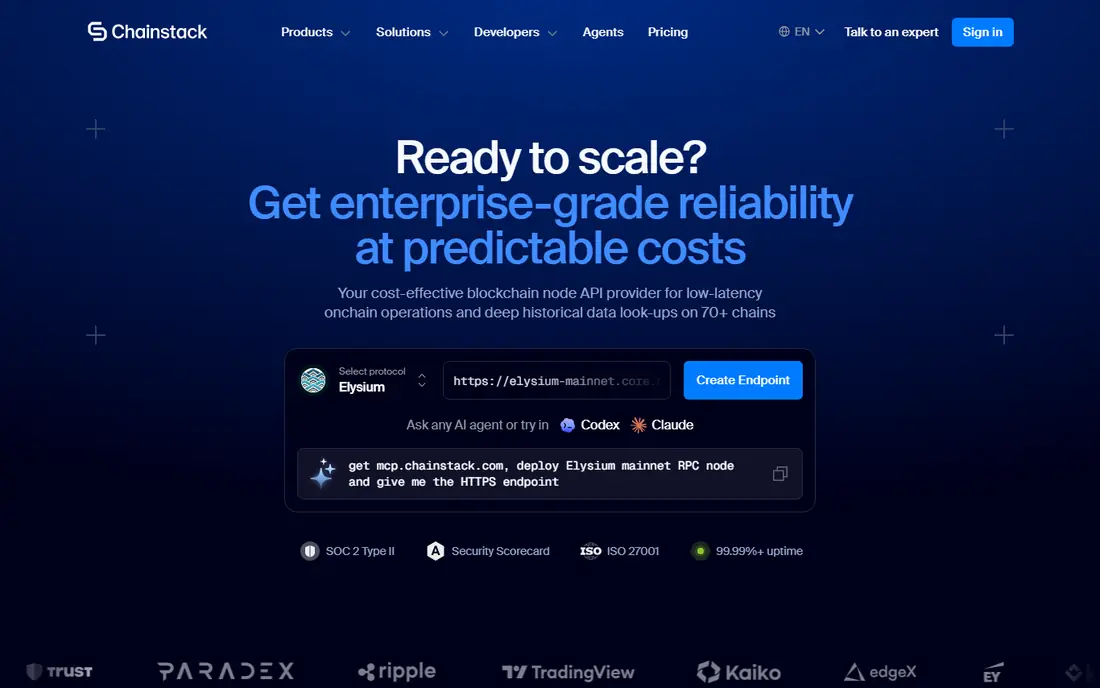
Chainstack appeals to teams that dislike compute-unit math. Most calls cost one request unit, with archive reads costing more, which makes monthly forecasting easier than with heavily weighted credit systems. Its free tier is permanent in published comparisons, at 3 million request units a month, and paid plans start near forty-nine dollars a month for a much larger allowance.
The honest limit is that archive and dedicated options still cost more, and very high throughput needs an enterprise plan. For a standard app with predictable traffic, though, the simpler unit model is a real advantage, because the bill matches the request count more closely.
- Permanent free tier with 3 million request units a month
- Simpler one-to-one unit model for most calls
- Dedicated node options
- Archive reads cost extra units
- Top throughput needs higher tiers or enterprise plans
dRPC is built around redundancy: it routes requests across multiple underlying providers, so one provider outage does not necessarily take your app down. Published comparisons describe a large free allowance, around 210 million compute units a month, with a rate limit near 100 requests per second. That makes it attractive for testing and for apps that need many chains without managing several provider accounts.
The catch is feature limits on the free tier. Archive, trace, and WebSocket access are limited or paid in comparisons, so an app that needs those features should check the paid plan before building around the free tier. As with all free tiers, there is no production SLA, so use dRPC as part of a fallback plan, not as your only endpoint.
- Large permanent free allowance in comparisons
- Routing across multiple node providers
- Broad chain coverage
- Free tier excludes some advanced features such as archive, trace, and WebSocket in comparisons
- Method costs vary by unit weight
Ankr offers a large free credit allowance in published comparisons, around 200 million credits a month, plus a pay-as-you-go model for teams that want to avoid a monthly plan. Its coverage spans many chains, which suits a wallet or explorer that needs to add a new chain without a new vendor each time. WebSocket and HTTPS access are standard parts of its RPC offering.
The weakness is that archive access and higher throughput sit on paid tiers, and free-tier rate limits apply. Ankr is a strong testing and small-app choice, but a production app should confirm archive depth, throughput, and support terms on a paid plan before relying on it alone.
- Large free credit allowance in comparisons
- Pay-as-you-go option
- Broad multi-chain coverage
- Archive and some advanced features are paid
- Free tier has rate limits and no SLA
Dwellir stands out for pricing clarity: comparisons describe one credit per response, for every method, which removes the surprise of weighted compute units. Its free tier is permanent at 100,000 responses a day, with a 20 requests per second limit, and paid plans start near forty-nine dollars a month. Archive access is described as available on all plans, which is unusual and useful for apps that need history from the start.
The limit is free-tier scope. Published comparisons note that the free plan excludes log queries, so an app that needs logs must move to a paid plan. Dwellir is also a smaller provider than the largest names, so check its status history and support terms before making it your sole production endpoint.
- One credit per response for most methods
- Permanent free tier at 100,000 responses a day
- Archive on all plans in comparisons
- Free tier excludes some log methods in comparisons
- Smaller brand than Alchemy or Infura
Tenderly is less a bare RPC endpoint and more a developer platform for EVM chains, with simulation, debugging, alerts, and trace tools alongside node access. That tooling helps teams test transactions before sending them, debug failed calls, and monitor contracts, which can save far more time than a slightly cheaper RPC rate. Its free tier is permanent in comparisons, at 25 million Tenderly Units a month.
The honest catch is scope. Tenderly focuses on EVM chains, so a multi-chain app with Solana, Bitcoin, or other non-EVM chains will still need another provider. Free-tier throughput is also limited, so production apps should confirm paid throughput, archive depth, and SLA terms before launch.
- Permanent free tier with 25 million Tenderly Units a month in comparisons
- Simulation, debugging, and trace tools
- EVM focus
- EVM-only focus limits non-EVM chains
- Paid throughput and SLA terms need checking for production use
NOWNodes covers a very wide set of networks, including less common chains that larger providers may not support, plus RPC, WebSocket, and archive options that vary by network. Its free tier is permanent in comparisons, at 100,000 requests, and paid plans start at a low monthly figure for a larger allowance. That breadth suits a wallet, explorer, or research tool that needs many chains under one dashboard.
The limit is scale. One hundred thousand free requests will not carry a production app, and archive access varies by chain and plan. Use NOWNodes for breadth and testing, and confirm the exact chain, method, and archive support you need before committing to a paid plan.
- Permanent free tier with 100,000 requests in comparisons
- Coverage across 120 or more networks
- Dedicated node options
- Free allowance is small for production
- Archive and dedicated features depend on plan
How we picked these
We compared published 2026 RPC provider comparisons and vendor pricing pages, and we kept only providers with a permanent free tier described in those sources. We excluded trial-only free offers from the free column, and we marked QuickNode out for that reason. We did not invent throughput, SLA, or archive claims, and where sources disagreed we used the more conservative figure or wrote See website. We did not claim hands-on load testing, and we note that limits and pricing change often.
How to choose a free tier without risking production
First, check permanence in writing: is the free tier permanent, or does it expire after a trial period? A trial is useful for evaluation, but it is not a free plan for a live app. Second, check the rate limit and the method weights. A free tier that allows many simple calls may still throttle log, trace, or archive calls that your app depends on.
Third, assume no SLA on free tiers. That means no guaranteed uptime, no guaranteed response time, and no compensation if the endpoint fails. For production, add a second provider, cache where you can, and set alerts for errors and latency. Finally, model your real method mix for a week, not just your total request count, because weighted pricing can make two apps with the same request count pay very different amounts.
Frequently asked questions
What is an RPC node service?
It provides an endpoint your app calls to read blockchain data, send transactions, and query history, without running your own node. Providers run shared or dedicated nodes, handle scaling and maintenance, and charge by requests, credits, or compute units.
Which RPC providers have a permanent free tier?
Alchemy, Infura, Chainstack, dRPC, Ankr, Dwellir, Tenderly, and NOWNodes are described in 2026 comparisons as having permanent free tiers, with different allowances and limits. Always check the current vendor page, because free tiers change, and do not treat a trial as a permanent free plan.
Why is QuickNode not listed as free here?
Published comparisons describe QuickNode free access as a one-month trial with a limited credit allowance, not a permanent free tier. We list it out of the free column for that reason. It remains a paid provider option for teams that want its tooling and throughput, but it should not be budgeted as free.
Do free RPC tiers come with an SLA?
In most cases, no. Free tiers usually carry rate limits, lower throughput, and no uptime guarantee. That is fine for testing, prototypes, and small apps, but production apps should use a paid plan, a fallback provider, or both.
How do compute units and credits affect cost?
Providers weight methods differently, so a log or trace call can cost many times more than a simple block call. Two apps with the same request count can therefore pay very different amounts. Model your actual method mix, including logs and archive calls, before comparing headline allowances.
Should I use one RPC provider or several?
For production, use at least two, or a routing service plus a direct fallback, so one outage or throttle does not stop your app. For testing, one free tier is enough, provided you know its limits and do not build a launch plan around a trial allowance.
Sources
See where you really rank - block by block
ProMapRanker scans Google Maps across a grid of your service area. Simple monthly plans from $19, white-label on every plan.
Start freeKeep reading
 worlds best local seo company
8 Worlds Best Local SEO Companies for Map Pack Growth in 2026
Compare the worlds best local seo company options for Google Business Profile work, citations, reviews, and multi-location rankings and reporting in 2026.
Read → world's best web hosting company
World's Best Web Hosting Company in 2026
Searching for the world's best web hosting company? We compared 10 hosts on price, renewal rates, speed, and support to help you choose well today in 2026.
Read → who's got the best nanny tax services
Who's Got the Best Nanny Tax Services in 2026
We answer who's got the best nanny tax services, comparing full filing, back taxes, software, and pricing so families can handle nanny taxes correctly.
Read →