 ProMapRanker
Best Quantum Computing Companies in 2026

Key takeaways
- There is no single best quantum computing company yet, because firms use different physics, from superconducting and trapped ion to photonic and neutral atom systems.
- IBM leads on public roadmap detail and cloud access, while Google leads on surface-code error correction work with its Willow chip.
- IonQ and Quantinuum lead on trapped ion accuracy and logical qubit work, while D-Wave remains the most commercially focused annealing option.
- Most buyers in 2026 access quantum hardware through cloud services, not by buying a machine outright.
- This guide is based on publicly reported factors, not a verified ranking, and it is not investment advice. Quantum hardware is still early stage and roadmaps can change.
Quick comparison
| Pick | Great for | Pricing starts at | Free tier | |
|---|---|---|---|---|
 IBM Quantum | Cloud access and roadmap depth | See website | Yes | Visit |
 Google Quantum AI | Error correction research | See website | No | Visit |
 IonQ | Trapped ion accuracy | See website | No | Visit |
 Quantinuum | High fidelity trapped ion systems | See website | No | Visit |
 Microsoft Azure Quantum | Cloud access to many providers | See website | Yes | Visit |
 D-Wave | Annealing and optimisation | See website | No | Visit |
 Rigetti Computing | Superconducting full stack | See website | No | Visit |
 PsiQuantum | Photonic fault tolerance path | See website | No | Visit |
 Xanadu | Photonic software and hardware | See website | Yes | Visit |
The best quantum computing companies
We compared public roadmaps, hardware announcements, cloud access and commercial focus for companies active in 2026. The best quantum computing company for a given team depends on the problem type, the need for cloud access, and how much error correction matters, rather than on qubit count alone.
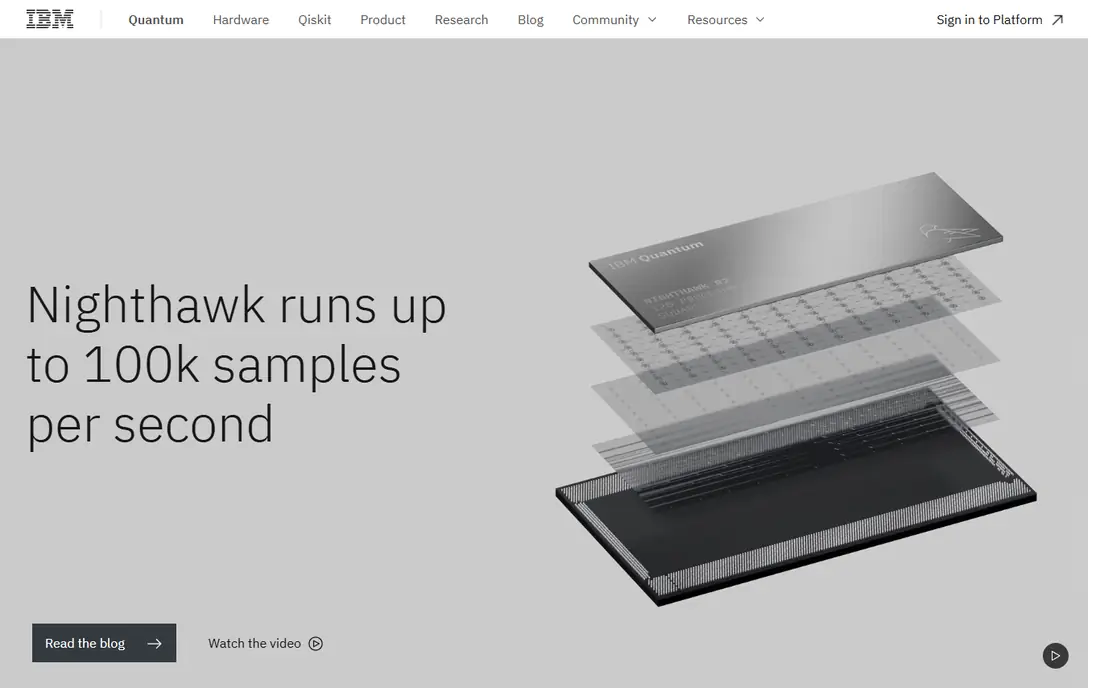
IBM Quantum is the most accessible entry point for many teams, because it has offered cloud access to real quantum hardware since 2016 and publishes a detailed roadmap. Its superconducting systems include the 156 qubit Heron line and the larger Condor system, with a stated path toward the fault tolerant Starling system by 2029. For researchers and enterprises that want to run circuits today, that combination of access and roadmap is hard to match.
The catch is that qubit count alone does not equal useful computing power. Error rates, connectivity and error correction still limit what these systems can do for practical work. IBM is targeting verifiable quantum advantage by the end of 2026, but that is a goal, not a delivered result for general workloads. Start with free cloud tiers where available, and judge results on your own problem.
- Detailed public roadmap
- Cloud access since 2016 through Quantum Composer and cloud tools
- Broad developer ecosystem
- Superconducting systems still face error correction limits
- Enterprise pricing is quote-based
Google Quantum AI made headlines in 2019 with its 53 qubit Sycamore processor, and its more recent Willow chip work focuses on scaling qubits while reducing errors through surface-code error correction. That error correction focus matters more than raw qubit count, because useful quantum computing needs logical qubits that stay reliable long enough to finish a calculation. Google pairs this hardware work with DeepMind simulation research and large engineering resources.
The limit for buyers is access. Google Quantum AI is primarily a research programme, not a straightforward commercial cloud service you can buy like other providers on this list. It belongs here because its error correction results shape the whole field, but teams that need to run jobs today will usually pair Google research with cloud access from IBM, IonQ or another provider.
- Willow chip with below-threshold surface-code work
- Strong research output
- Deep engineering resources
- No general commercial cloud quantum product like rivals
- Access is mainly research-led

IonQ builds trapped ion systems, which are known for high accuracy and long coherence times, plus all-to-all connectivity between qubits. That connectivity can reduce the extra steps needed to run some circuits, which helps on near-term hardware. IonQ systems are available through cloud providers, and the firm has reported a sixth generation platform in 2026, which shows continued hardware progress.
Trapped ion scaling is still a hard engineering problem, and IonQ faces the same error correction gap as every other firm. Pricing is based on usage and contracts, so costs depend heavily on the jobs you run. For teams that value accuracy and connectivity over raw qubit count, IonQ is a leading choice to test.
- High accuracy trapped ion systems
- All-to-all connectivity
- Cloud access through major cloud providers
- Scaling trapped ion systems remains hard
- Pricing is usage and contract based
Quantinuum, formed from Honeywell Quantum Solutions and Cambridge Quantum, builds trapped ion systems with a strong focus on fidelity. Its Helios system is a 98 qubit commercial system reported in 2026, and its joint work with Microsoft on logical qubits has produced notable error correction milestones. For chemistry and research workloads, Quantinuum is often cited as a strong option.
Access is mainly through partnerships and contracts, rather than a simple self-serve signup, so smaller teams may find it harder to start. Public reports also note a smaller commercial footprint than some rivals in areas such as networking and on-premises references. If fidelity and logical qubit progress matter most for your work, Quantinuum belongs on the shortlist.
- High fidelity trapped ion hardware
- Logical qubit work with Microsoft
- Strong chemistry and research focus
- Commercial access is contract-led
- Smaller commercial footprint than IBM or IonQ in some areas
Microsoft Azure Quantum is less a single hardware maker and more a cloud platform that gives access to hardware from several partners, alongside Microsoft research. Its Majorana 1 chip, announced in 2025, is based on topological qubits, which aim to be more resistant to errors by design. That approach could be a major advance if it scales, but topological claims remain debated in the research community.
For buyers, the practical value is choice. Azure Quantum lets teams try different hardware types without committing to one vendor, and it fits teams already using Azure. Free tiers and credits vary, so check current terms. The platform suits experimentation across providers, rather than a bet on one physics approach.
- One cloud entry point to several hardware providers
- Majorana 1 topological research
- Integration with Azure tools
- Topological claims remain debated
- Hardware access depends on partner availability
D-Wave takes a different path from most firms here. It builds quantum annealers, which are designed for optimisation problems such as scheduling, routing and logistics, rather than general-purpose gate-model computing. That narrow focus is also its strength, because D-Wave has the earliest commercial deployments and a clearer set of near-term use cases.
The limit is scope. If your problem is not an optimisation problem that maps well to annealing, D-Wave will not replace a gate-model system. Pricing is contract and usage based. For logistics, scheduling and similar optimisation work, D-Wave is worth testing, but do not judge it by the same yardstick as a general quantum computer.
- Earliest commercial deployments
- Focus on optimisation problems
- Cloud access for annealing workloads
- Annealing is not general gate-model computing
- Fit is narrow compared with gate-model rivals
Rigetti Computing builds full-stack superconducting systems, including its own chip fabrication, which gives it control over design and production. Its Ankaa line, including Ankaa-3, shows continued superconducting progress, and its modular scaling approach aims to link smaller chips into larger systems. For teams that want a superconducting alternative to IBM and Google, Rigetti is the main pure-play option.
As a smaller public company, Rigetti carries more financial risk than the large tech firms on this list, and its scale remains smaller. Access and pricing are contract-led. Rigetti suits teams that want superconducting hardware diversity or a partner for custom work, provided they weigh the pure-play risk.
- In-house fabrication
- Full-stack superconducting systems
- Cloud access options
- Smaller scale than IBM and Google
- Financial and scaling risks are higher for a pure-play firm
PsiQuantum is building photonic quantum computers, which use light-based qubits and aim for fault tolerance at large scale. Its approach leans on standard semiconductor fabrication methods, which could help manufacturing if the design works at scale. The firm is building large utility-scale facilities aimed at fault tolerant machines, which signals serious long-term intent.
The drawback is timing. PsiQuantum does not offer a general commercial system you can buy and run jobs on today in the way cloud providers do. It belongs on this list for its fault tolerance path and scale of investment, not for near-term access. Teams planning long-term strategy should watch it, while teams needing jobs run now should look elsewhere first.
- Photonic approach aimed at fault tolerance
- Large facility building programme
- Uses standard chip fabrication methods
- No general commercial system for sale today
- Timelines are long and uncertain
Xanadu builds photonic quantum hardware and software, including PennyLane, a software library used by many researchers for quantum machine learning and hybrid computing. That software reach gives Xanadu influence beyond its hardware alone, since researchers can build and test ideas in PennyLane even before running them on photonic chips. Cloud access options exist for testing.
Photonic hardware remains early stage, and Xanadu scale is smaller than IBM, Google or IonQ. Pricing and access depend on the programme and cloud tier. Xanadu suits researchers and teams interested in photonic approaches and quantum software, especially those already using PennyLane.
- Photonic hardware and software stack
- PennyLane software is widely used
- Cloud access options
- Photonic systems are still early stage
- Commercial scale is smaller than large rivals
How we picked these
We compared public roadmaps, hardware announcements, cloud access and commercial activity in 2026, and we kept only firms with verifiable systems, cloud access or major facility programmes. We grouped firms by approach, since superconducting, trapped ion, photonic, neutral atom and annealing systems are not directly comparable on qubit count alone. We did not assign scores, because no single score fairly compares different physics approaches.
What to check before you choose a quantum provider
Start with the problem, not the headline qubit count. A system with fewer, more accurate qubits can beat a larger, noisier system on real work. Ask for error rates, connectivity, coherence and logical qubit results, and test the same problem on more than one system where cloud access allows it.
Match the approach to the workload
Gate-model systems suit general algorithm research, chemistry and hybrid workloads, while annealing suits optimisation. Photonic and neutral atom systems are promising but vary in maturity and access. If your workload is optimisation, test D-Wave early. If it is chemistry, look closely at Quantinuum, IonQ and Microsoft partner systems. If it is general research, cloud access from IBM or Azure Quantum gives the widest starting point.
Check access, cost and software
Cloud pricing is usually based on usage, shots or time, so a short test can still cost real money. Check free tiers, credits, queue times and software support before committing. PennyLane, Qiskit and other software stacks shape how fast your team can work, so pick a provider whose software your team already knows or can learn quickly.
Plan for change
Quantum roadmaps shift often, and a leader today may not lead in three years. Avoid locking a long-term strategy to one vendor without a cloud or software path out. Keep classical and hybrid methods in your plan, since most useful near-term work combines classical computing with quantum hardware, rather than replacing classical systems outright.
Frequently asked questions
Which quantum computing company is best?
There is no single best quantum computing company in 2026, because the answer depends on the metric. IBM leads on roadmap detail and cloud access, Google leads on surface-code error correction research, IonQ and Quantinuum lead on trapped ion accuracy, and D-Wave leads on annealing. Judge providers on your workload, not on a single headline number.
What is the best quantum computing company for beginners?
IBM Quantum and Microsoft Azure Quantum are good starting points for beginners, because both offer cloud access, learning materials and software tools. Xanadu PennyLane is also useful for learning, since it is widely used for quantum software work. Start with free tiers or credits and a small, well-defined problem.
Can I buy a quantum computer for my business?
In most cases, no, and you do not need to. Most businesses access quantum hardware through cloud services from IBM, IonQ, Rigetti, D-Wave and others, or through Azure Quantum. Buying and running a machine outright is a major facility and engineering commitment suited only to very large research organisations.
Is quantum computing useful today?
Quantum computing is useful for research, optimisation tests and hybrid pilots, but it has not replaced classical computing for general work. Practical advantage on a useful workload remains a goal for most providers, not a routine result. Treat near-term projects as research and learning, with clear success measures.
Should I invest in quantum computing stocks based on this list?
This article is not investment advice, and a strong technology position does not guarantee a strong stock return. Pure-play quantum firms carry high risk, while large tech firms have many other businesses that affect their share price. Do your own research and consider professional advice before investing.
Sources
See where you really rank - block by block
ProMapRanker scans Google Maps across a grid of your service area. Simple monthly plans from $19, white-label on every plan.
Start freeKeep reading
 zscaler alternatives
Best Zscaler Alternatives in 2026
Looking for zscaler alternatives? We compare 9 SASE and zero trust platforms on architecture, data protection, pricing, and fit for your network and team.
Read → zapier alternatives free
Best Zapier Alternatives Free in 2026
Nine automation tools for zapier alternatives free in 2026, all with genuinely free tiers, plus free plan limits, starting prices and upgrade paths explained.
Read → which platform is best for online reputation
Which Platform Is Best for Online Reputation in 2026
Wondering which platform is best for online reputation? We compare 8 review, listing, and response tools for small and multi-location businesses and agencies.
Read →