 ProMapRanker
Best QA Software in 2026: 9 Tools Compared


Standalone test management and reporting · Pricing starts at: $22 per user per month
Key takeaways
- TestRail remains the reference standalone test management tool, with deep reporting and a clear $22 per user per month Essentials starting price for small cloud teams.
- Zephyr and Xray are the best choices for teams that live in Jira, because testing stays inside the issue workflow rather than in a separate system.
- Qase, Testiny and Tuskr give smaller teams a free starting point, which helps a team move off spreadsheets without an enterprise budget.
- PractiTest and Tricentis qTest suit larger QA organisations that need traceability, dashboards and enterprise governance across many projects.
Quick comparison
| Pick | Great for | Pricing starts at | Free tier | |
|---|---|---|---|---|
| TestRail | Standalone test management and reporting | $22 per user per month | Free trial (30 days) | Visit |
 Zephyr | Jira-native test management | See website | No | Visit |
 PractiTest | Traceability and QA dashboards | $47 per user per month | Free trial | Visit |
 Tricentis qTest | Enterprise test management | See website | No | Visit |
 Xray | Jira-native testing for Agile teams | See website | No | Visit |
 Testmo | Unified manual and automated testing | $59 per month | Free trial | Visit |
 Qase | Cloud teams wanting a free start | $35 per user per month | Yes | Visit |
 Kualitee | Budget-conscious QA teams | See website | Yes | Visit |
 Testiny | Lightweight test management for small teams | $18.50 per user per month | Yes | Visit |
The best qa software
In this article, QA software means test management software: the system where a QA team stores test cases, plans test runs, records results, links defects and reports coverage. It is not a single automated testing framework, though most tools here also import results from automation. The right tool depends on whether your team lives in Jira, how much traceability you need, and whether you want a standalone workspace or a tool inside another platform. We compared official pricing pages, product pages and public reviews for tools still sold and supported in October 2026.
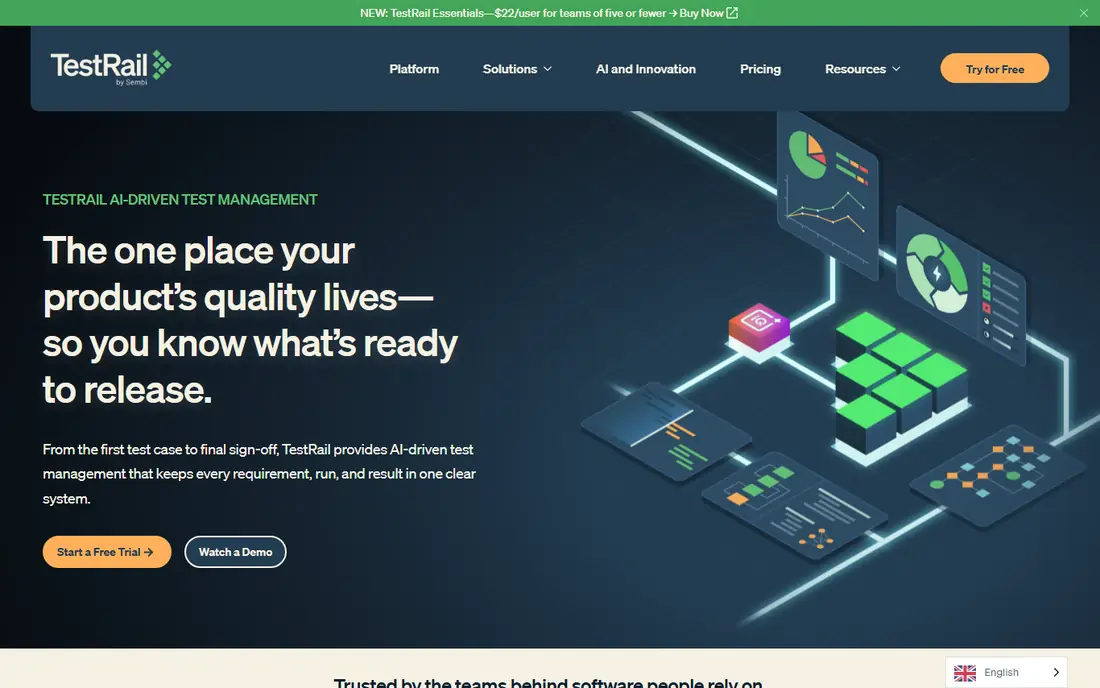
TestRail is the established standalone test management tool, and it is still the reference many teams compare against. It organises test cases into suites and sections, supports test plans, milestones and runs, and offers reporting that shows coverage and progress across projects. Integrations with Jira, GitHub, GitLab, Azure DevOps and automation tools let results flow in without manual copying.
Pricing is clear for cloud teams: Essentials at $22 per seat per month with annual billing for up to five users, Professional at $37 per seat per month with annual billing, and Enterprise at a higher annual rate. A 30-day trial is available on every plan, with no permanently free plan. For a team that wants a dedicated, mature test repository outside Jira, TestRail is the safest default.
- Deep reporting and milestone tracking
- Structured test suites and version control
- Many integrations including Jira and GitHub
- Per-seat cost climbs at scale
- Interface feels dated to some users
- Self-hosting needs higher tiers and more seats
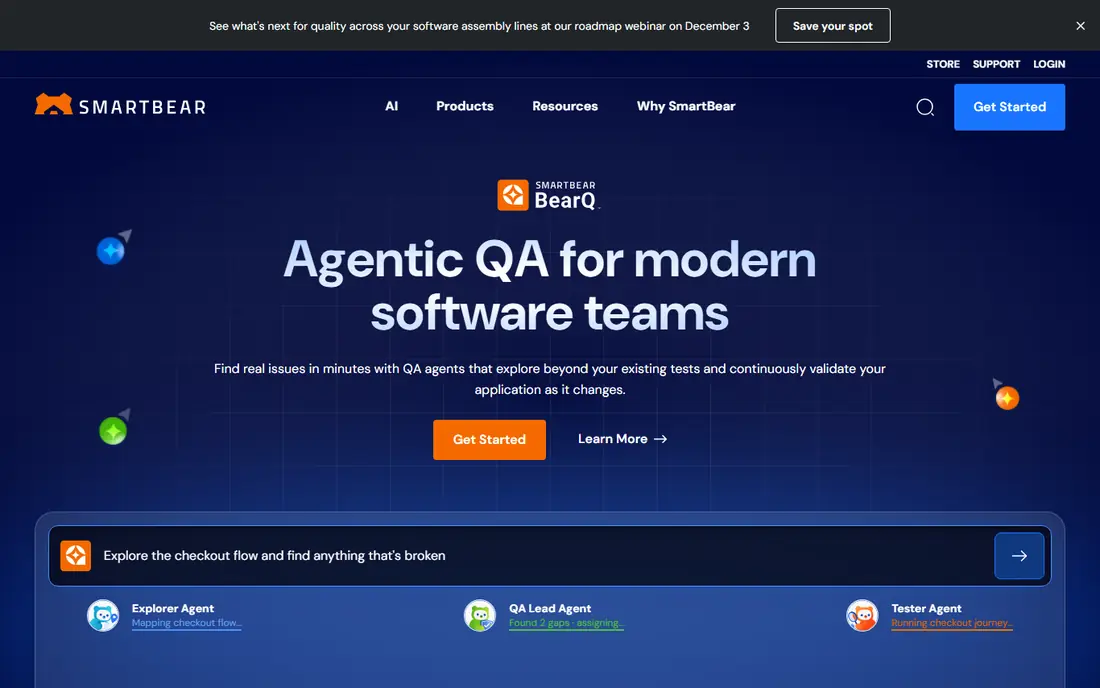
Zephyr, from SmartBear, is a test management app that runs inside Jira, with Zephyr Scale renamed to Zephyr and Zephyr Squad now Zephyr Essential in Atlassian Marketplace listings. Test cases, executions and reports live alongside Jira issues, so a tester does not switch systems to link a failure to a defect. Structured libraries, reusable test components and cross-project reporting help larger Jira teams keep test assets organised.
The limit is obvious: without Jira, Zephyr has no standalone workspace, and pricing follows the Atlassian Marketplace model based on Jira user tiers, so we list it as See website. For a team whose developers, product managers and testers already work in Jira every day, that native fit outweighs the lack of a standalone option.
- Testing inside Jira
- Structured test libraries and reusable components
- Cross-project reporting
- Useless without Jira
- Pricing follows Atlassian Marketplace tiers
- Jira administration shapes the purchase
PractiTest is a standalone QA management platform focused on traceability and visibility. Requirements, test cases, runs and defects link together, so a manager can trace a requirement through testing to a defect and back, and dashboards show progress across projects without exporting to spreadsheets. Integrations with Jira, automation tools and CI systems keep results current.
The Team plan is listed at $47 per tester per month with annual billing, which makes it more expensive than TestRail Professional for a similar team size. That premium buys traceability depth and dashboard quality, but a small team may not need all of it. For a QA organisation that must show coverage and traceability to stakeholders, PractiTest is a strong, if pricey, choice.
- End-to-end traceability from requirements to defects
- Management-grade dashboards
- Strong Jira and automation links
- Premium per-seat price
- Minimum tester counts on some plans
- Learning curve for full traceability setup
Tricentis qTest is the enterprise test management suite from Tricentis, built for large programmes that need centralised test cases, execution, defect tracking and reporting across many teams. Its strength is scale and governance, plus links to the wider Tricentis ecosystem, including Tosca for test automation. Large organisations with formal QA processes and audit needs will find its controls familiar.
Pricing is quote-based through Tricentis sales, with no public rate card, so we list it as See website. Onboarding and administration are heavier than for a small cloud tool, and a small team will pay in complexity for features it never uses. For an enterprise QA organisation, especially one already using Tricentis tools, qTest is a credible shortlist pick.
- Enterprise-scale test management
- Deep Tricentis ecosystem links including Tosca
- Strong governance and reporting
- Quote-based pricing
- Enterprise onboarding weight
- Overkill for small teams
Xray is a Jira-native test management app that treats tests as Jira issue types, so requirements, tests, executions and defects share the same workflow. That design gives automatic traceability and makes test status visible in the same boards and reports developers already use. Behaviour-driven development support suits Agile teams that write tests in Gherkin or similar formats.
Like Zephyr, Xray is useless without Jira, and its price follows the Atlassian Marketplace model based on Jira user tiers, starting from around $10 per month for a small Jira tier in third-party listings, so we list it as See website. For a Jira-centred Agile team that wants testing inside Jira rather than in a separate tool, Xray is the direct alternative to Zephyr.
- Native Jira testing with automatic traceability
- Behaviour-driven development support
- Scales with Jira user tier
- Not a standalone workspace
- Pricing follows Jira tiers
- Setup needs Jira administration skill
Testmo unifies manual testing, session-based exploratory testing and automated test results in one workspace, with a modern interface that feels lighter than older enterprise tools. Teams can run manual cases, record exploratory sessions with notes and screenshots, and import automation results from CI pipelines, so one dashboard shows the full picture. That unified view is its main advantage over a manual-only repository.
Pricing is bundle-based rather than per-seat only: the Team plan is listed at $59 per month with five users included in recent comparisons, with higher bundles for larger teams. There is no on-premise server edition, which rules it out for regulated teams that require self-hosting. For a cloud team that wants manual and automated testing together, Testmo is a clean, modern choice.
- Unified manual, exploratory and automated testing
- Session-based exploratory testing
- Broad CI and automation links
- Cloud only, with no on-premise edition
- Bundle pricing can overshoot tiny teams
- Free plan is not offered
Qase is a cloud test management tool with a free tier, which makes it easy for a small team to start without a budget approval. It offers test case management, shared reusable steps, defect tracking and automation links, with a Teams plan at $35 per user per month with annual billing in recent listings. The interface is modern and quick to learn, which helps a team moving off spreadsheets.
The free tier limits projects, storage and history, so a growing team will need to move to a paid plan fairly soon. For a small Agile team that wants a clean cloud workspace and a free start, Qase is a good first tool. For a large enterprise with deep reporting and governance needs, TestRail or PractiTest may fit better.
- Free tier to start
- Shared reusable steps
- API and automation links
- Modern cloud workspace
- Free tier limits projects, storage and history
- Paid price rises with team size
- Manual workflows are less deep than TestRail in places
Kualitee is a QA management tool positioned for budget-conscious teams, with a free plan and AI-assisted features for test case creation and management, plus native defect tracking. It covers test cases, execution, defects and reporting in a cloud workspace that is simpler to learn than an enterprise suite. That combination suits a small or mid-size team that wants modern QA tooling without a high per-seat price.
Published starting prices vary across listings, from around $12 per user per month in some vendor comparisons to higher figures elsewhere, so we list it as See website and suggest confirming the current rate card. Feature depth is lower than TestRail or PractiTest for very large programmes. For a cost-conscious team that wants a free start and AI help with test cases, Kualitee is worth a trial.
- Free plan available
- AI-assisted test management
- Native defect tracking
- Lower cost positioning
- Published starting prices vary by listing
- Smaller feature surface than enterprise rivals
- AI features need checking in a trial
Testiny is a lightweight, modern test management tool for small teams, with a free tier for up to three users and a Starter plan at $18.50 per user per month in recent listings. It covers test cases, test runs and results in a simple workspace, without the configuration weight of an enterprise suite. A self-hosting option in some plans suits teams that want more control over their data.
Its youth is the trade-off. The feature surface is smaller than TestRail or PractiTest, and enterprise integrations and reporting are less deep. For a small team that wants a simple, affordable test repository and does not need enterprise governance, Testiny is an attractive, low-risk start.
- Free for up to three users
- Simple modern test management
- Self-hosting option in some plans
- Younger product with a smaller feature surface
- Fewer enterprise integrations
- Reporting depth is lower than TestRail
How we picked these
We compared official pricing pages, product pages and public reviews for QA software that is still sold and supported in October 2026. We kept tools that cover test case management, execution and defect linking as their core job, and we left out pure automation frameworks and bug trackers that do not manage test cases. Where pricing followed a marketplace tier or varied by listing, we wrote See website rather than repeat a single uncertain figure.
We also mixed standalone, Jira-native and budget tools, because a Jira team, a standalone QA team and a small startup do not need the same system. The write-ups state the platform fit and the pricing model for each tool, so a buyer can rule out options that require a platform they do not use or a budget they do not have.
What to check before you buy
Start with your defect and automation links, not the test case editor. Ask each vendor to show a failed test linking to a defect, a defect fix linking back to a retest, and an automation result importing into a run without manual copying. If any of those steps needs a spreadsheet, the tool will create manual work every release.
Next, test reporting for the audience that will actually read it. A manager needs coverage by requirement and by release, a developer needs failing tests by build, and an auditor needs traceability from requirement to result. Ask for those exact reports in a trial, using your own test cases if possible, rather than accepting a demo dashboard.
Finally, price the whole team, including read-only viewers, automation-only users and future growth. Some tools charge for every seat, some offer free viewers, and Jira-native tools price against your whole Jira user tier, which can change the total dramatically. A 30-day trial is useful only if you test with real cases, real automation and real stakeholders during that window.
Frequently asked questions
What are the best tools for QA?
TestRail, PractiTest and Tricentis qTest are strong standalone tools, while Zephyr and Xray are best for Jira-native teams. Qase, Testiny and Kualitee suit smaller teams that want a free start. The best tool depends on your platform, your traceability needs and your budget, so trial with your real test cases.
What is the best QA software for Jira teams?
Zephyr and Xray are the leading Jira-native choices, because testing lives inside Jira issues, boards and reports. Zephyr suits teams that want structured test libraries, while Xray suits Agile teams that want behaviour-driven development support and automatic traceability. Both price against Jira user tiers, so check the Marketplace calculator for your instance size.
Does QA software include automated testing?
Most tools here manage test cases and import automation results, but they are not automation frameworks themselves. Testmo, Qase and PractiTest link to CI and automation tools, while TestRail and qTest focus on management and reporting. You will still need an automation framework such as Playwright or Selenium to write and run automated tests.
How much does QA software cost?
Prices in this list range from free tiers for Qase, Kualitee and Testiny to $47 per user per month for PractiTest, with TestRail Essentials at $22 per user per month. Jira-native and enterprise tools are quote or Marketplace priced, so the total depends on your Jira tier or contract. Ask for a written quote for your full team, including viewers.
Can QA software replace spreadsheets for testing?
Yes, that is its main job, provided the team uses it for daily runs and defect links. A test management tool centralises cases, results, defects and reports, with history that spreadsheets cannot match. Migration from spreadsheets is easier if the tool offers an importer, so check that feature before you commit to a large move.
Sources
See where you really rank - block by block
ProMapRanker scans Google Maps across a grid of your service area. Simple monthly plans from $19, white-label on every plan.
Start freeKeep reading
 zscaler alternatives
Best Zscaler Alternatives in 2026
Looking for zscaler alternatives? We compare 9 SASE and zero trust platforms on architecture, data protection, pricing, and fit for your network and team.
Read → zapier alternatives free
Best Zapier Alternatives Free in 2026
Nine automation tools for zapier alternatives free in 2026, all with genuinely free tiers, plus free plan limits, starting prices and upgrade paths explained.
Read → which platform is best for online reputation
Which Platform Is Best for Online Reputation in 2026
Wondering which platform is best for online reputation? We compare 8 review, listing, and response tools for small and multi-location businesses and agencies.
Read →