 ProMapRanker
Best Push Notification Software for Developers in 2026


Small apps that want a full dashboard fast · Pricing starts at: Free
Key takeaways
- Firebase Cloud Messaging gives you free, unlimited delivery, but you build the segments, scheduling and dashboard yourself.
- OneSignal and Pushwoosh offer the most useful free tiers for small apps, with real dashboards and SDKs included.
- Knock and Novu suit teams that treat notifications as infrastructure, with workflows, preferences and one API across channels.
- Airship and Braze are built for large brands with complex journeys, and their pricing reflects that scope.
- Consent and opt-out handling matter as much as delivery speed, so check how each tool stores tokens and honours unsubscribes.
Quick comparison
| Pick | Great for | Pricing starts at | Free tier | |
|---|---|---|---|---|
| OneSignal | Small apps that want a full dashboard fast | Free | Yes | Visit |
 Firebase Cloud Messaging | Android-first apps and Google stack teams | Free | Yes | Visit |
 Pusher Beams | Transactional alerts from your server | $29 per month | Yes | Visit |
 Pushwoosh | Mid-size apps that want every feature included | Free | Yes | Visit |
 Airship | Large brands with complex journeys | See website | No | Visit |
 Braze | Personalised campaigns at enterprise scale | See website | No | Visit |
 Knock | Product notifications with user preferences | Free | Yes | Visit |
 Novu | Open source notification infrastructure | Free | Yes | Visit |
The best push notification software for developers
We compared official pricing pages, SDK documentation and channel coverage for each tool below, with a focus on what a developer actually touches day to day: setup, token handling, sending, and debugging when a message does not arrive.
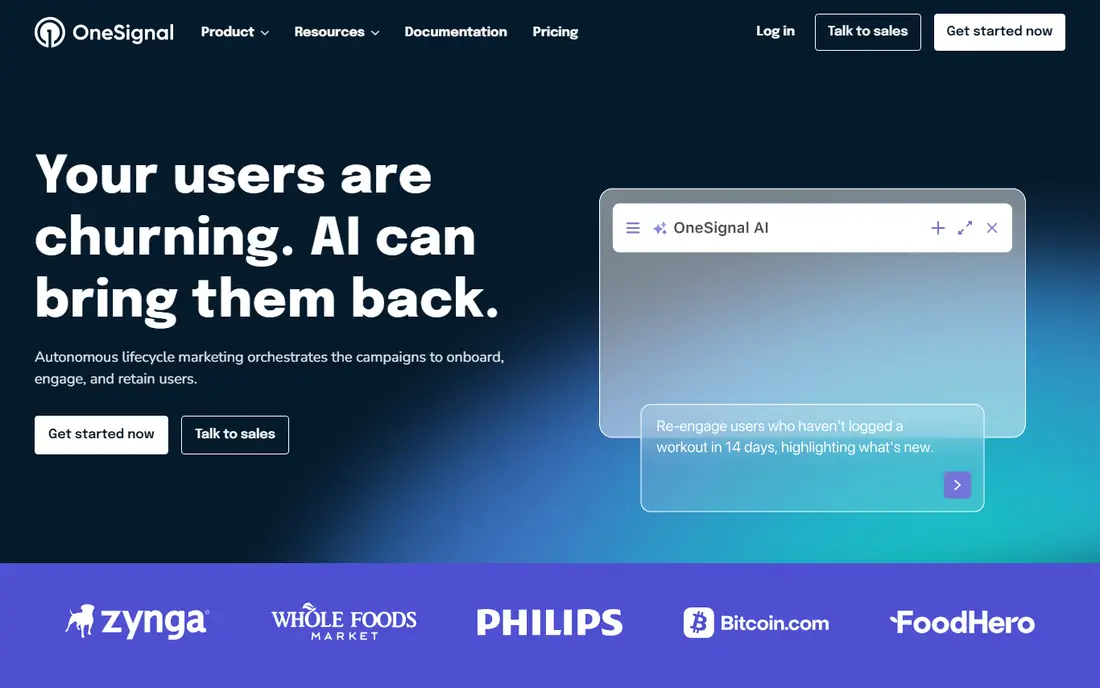
OneSignal is the easiest starting point on this list for most small teams. You add an SDK, collect tokens, and you can send a first push from the dashboard within an afternoon, while the API stays available for everything you later automate. Segments, journeys, A/B tests and delivery reports are built in, so a product manager can run a campaign without asking an engineer to write a one-off script. The free plan covers mobile push and in-app messaging up to 1,000 monthly active users per organisation, with web push and a monthly email allowance alongside it. That is enough to launch, learn from real users, and prove that push helps retention before you pay. The catch is the billing unit: once your active audience grows, the monthly cost grows with it, even in months when you send less. Check the Growth plan math against your real active count, not your total installs, before you commit.
- Generous free tier
- SDKs for iOS, Android, web and cross-platform frameworks
- Push, email, in-app and SMS in one account
- Costs scale with monthly active users
- Advanced analytics and personalisation sit on higher plans
Firebase Cloud Messaging
Great for: Android-first apps and Google stack teams
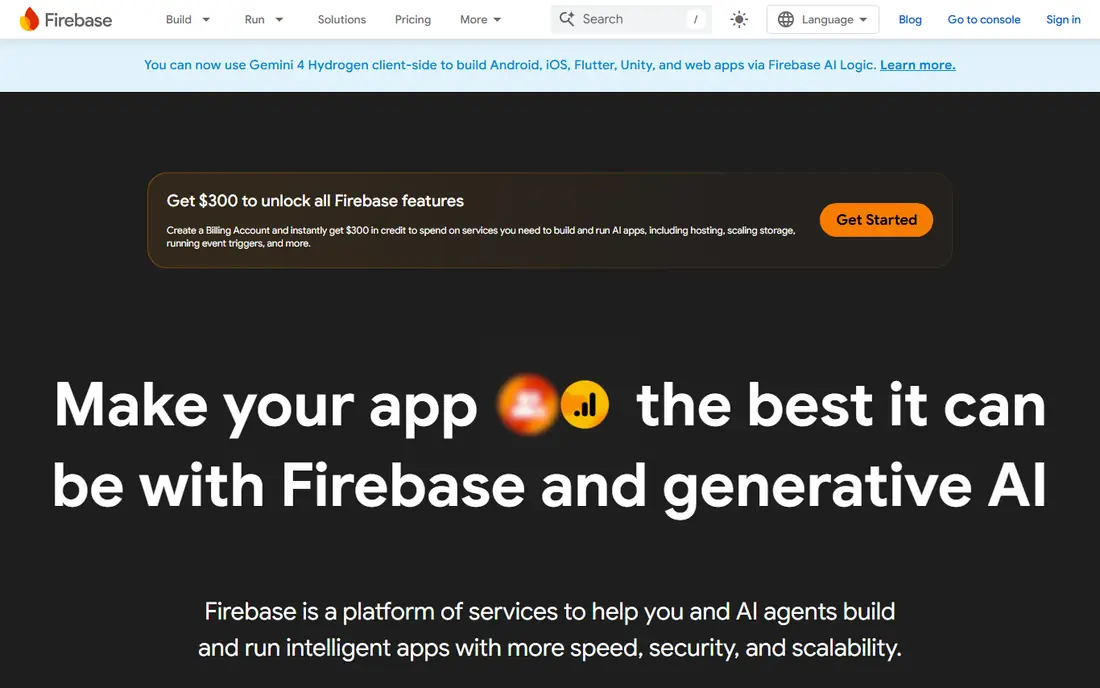
Firebase Cloud Messaging, usually called FCM, is the delivery pipe underneath a large share of Android push traffic, and Google lists it as no-cost on Firebase plans. If your app already uses Firebase for auth, analytics or a database, FCM slots in with little extra setup, and you keep full control over how messages are triggered from your own backend. For teams that want to own the logic, that control is the point. The trade is effort. FCM sends messages well, but it does not give you a polished marketer dashboard, rich journey builder or detailed campaign analytics out of the box. You will write code for topics, targeting, scheduling and opt-out handling, and you will need another tool for reporting. Teams that want a dashboard on day one should pair FCM with a platform like OneSignal or Knock, or pick one of those instead. If your budget is zero and your engineers are comfortable, FCM is hard to beat.
- Free and unlimited message delivery
- Native Android delivery through Google services
- Works for iOS and web as well
- No built-in campaign dashboard or deep segmentation
- You build scheduling, analytics and preference screens yourself
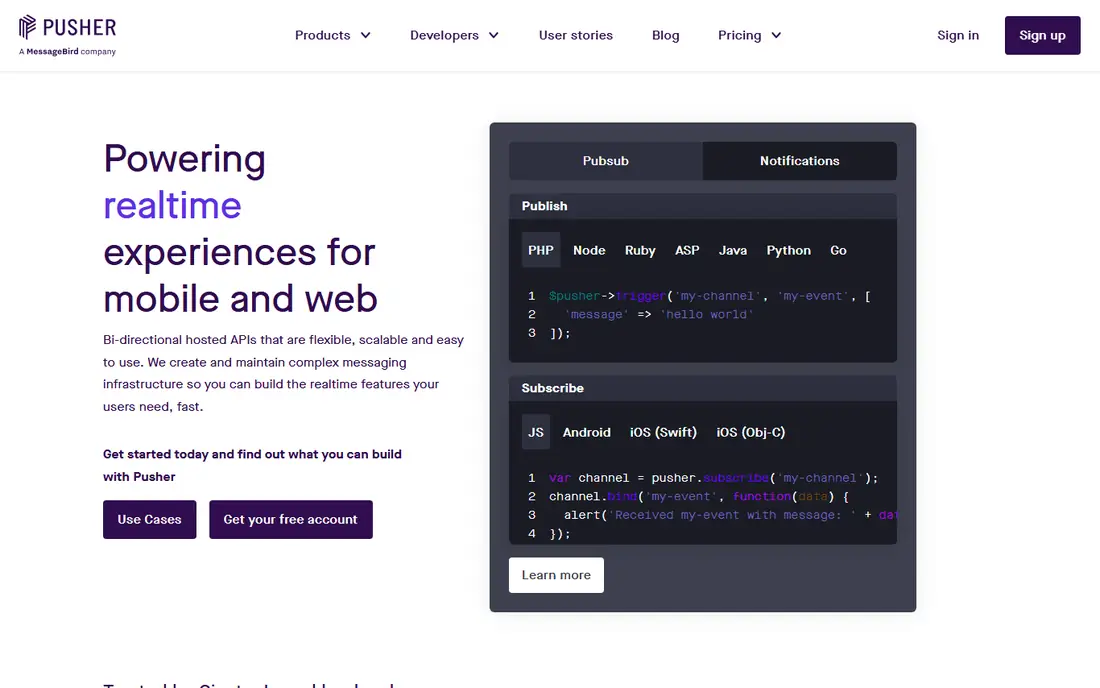
Pusher Beams takes a deliberately narrow job and does it cleanly: your server publishes a message to an interest, and subscribed devices receive it. That model fits order updates, chat messages, score alerts and other transactional events far better than a weekly marketing blast tool. The SDKs for iOS, Android and web are small, and the docs read like they were written for engineers rather than marketers. A free Sandbox tier covers up to 1,000 subscribers, and paid tiers start at 29 dollars a month for 10,000 subscribers. The limit to watch is scope. Beams does not try to be a full customer engagement platform, so if you later want journeys, rich analytics or email in the same place, you will add a second tool. For a backend team that mainly needs reliable transactional push, that focus is a strength, not a gap.
- Simple publish API for transactional push
- Interest-based targeting without building segments
- Predictable tiered pricing
- No marketing campaign suite
- Costs rise faster than free-first rivals at small scale
Pushwoosh stands out for a simple pricing promise: every plan includes the full platform, including segmentation, journeys, A/B testing, API access and analytics, with no feature locked behind an enterprise tier. Pricing is based on monthly active users rather than message count, and push sends themselves are unlimited. That combination suits apps that send often to a steady audience, such as news, sports or messaging products. Your project stays free while it remains within 1,000 monthly active users, and paid usage is billed per 1,000 active users, with a push-only option that costs less than the omnichannel option. The honest weakness is familiarity. Pushwoosh has a smaller public community and fewer third-party tutorials than OneSignal, so answers to unusual setup questions can take longer to find. If you value an ungated feature set over the largest ecosystem, it deserves a trial.
- Free while under 1,000 monthly active users
- Unlimited push sends on all plans
- Full features without enterprise-only gates
- Pricing is per active user, so quiet growth still adds cost
- Smaller community than OneSignal
Airship is built for brands that run mobile engagement as a serious operation, with teams who need journeys that react to behaviour in real time across push, in-app messages, SMS, email and mobile wallet passes. Its segmentation and orchestration depth goes well past what a small-app dashboard offers, and its consent manager helps large teams keep opt-in records in order. If you send millions of messages and need that control, Airship is in the right tier. The barrier is access and cost. Pricing is custom and usage-based, driven by monthly active users, volume and channels, and there is no free plan for a side project to grow into. Small teams will find the sales process and the onboarding effort heavy for what they need. Treat Airship as a shortlist item only when your audience and your journey complexity already justify an enterprise conversation.
- Cross-channel journeys across push, in-app, SMS and email
- Real-time audience building from behaviour
- Consent and preference tooling for large teams
- No published list price and no free plan
- Overkill for a small app or a solo developer
Braze is a customer engagement platform first and a push tool second, and that framing explains both its power and its price. It processes user behaviour in real time, so a cart abandon, a content view or a booking change can trigger a personalised push within minutes, across mobile, web and email. Large consumer brands use it to run lifecycle campaigns that smaller tools cannot model without a lot of custom code. You will not find a self-serve price or a free tier here, and implementation typically needs data integration work before campaigns feel personal. That makes Braze a poor fit for an indie app, and a sensible fit for a funded company with a dedicated growth or lifecycle team. If your push program is really a retention program, and you have the team to feed it clean events, Braze earns its place on the shortlist.
- Real-time event streaming for personalised push
- Push, in-app, email and content cards in one platform
- Strong fit for retail, media and travel apps
- Custom pricing with no public entry price
- Implementation takes real engineering time
Knock solves a different problem from a marketing push tool: the product notifications your app cannot afford to get wrong, such as mentions, order updates, billing alerts and invites. Each user can choose channels per notification type, and workflows support batching, delays and conditional logic, so twelve small events can become one digest instead of twelve pings. When delivery fails, the observability tooling traces a notification from trigger to provider, which saves painful debugging sessions. The Developer plan is free with 10,000 messages a month, which is generous for building and testing. The jump to Starter at 250 dollars a month for 50,000 messages is where small teams pause, and it is fair to call that steep. Use Knock when notification preferences and reliability are core product features, and pair it with FCM or APNs for the final delivery hop, which Knock expects you to connect.
- Per-user, per-channel preference model
- Batching and digests cut notification noise
- End-to-end observability for debugging
- Starter plan at 250 dollars a month is steep for small teams
- Push still delivers through Apple and Google services underneath
Novu gives engineering teams one notification layer across channels instead of a separate integration for every provider. You define workflows in code or in the dashboard, add an in-app inbox component, and let Novu route each message to push, email, SMS or chat through the providers you connect. Because the core is open source, teams that need to self-host or audit the code can do so, which matters in regulated or privacy-sensitive work. The cloud free tier covers a useful volume of workflow runs but keeps only 24-hour activity retention, so it works better as a development tier than a production audit trail. Paid plans start around 30 dollars a month for longer retention, with a much larger Team tier after that. If you want to own your notification infrastructure and avoid rebuilding it for every new channel, Novu is the most flexible option here, provided you accept the operating effort that comes with it.
- Open source and self-hostable under an MIT licence
- One API for push, email, SMS, in-app and chat
- Workflow and preference features included
- Free cloud tier keeps only short activity retention
- Paid jump to the Team tier is steep
How we picked these
We compared official pricing pages, SDK and API documentation, channel coverage and consent features for tools that developers actually integrate, not just marketing platforms that mention push in passing. We kept only tools that are live in October 2026, support iOS and Android or web push, and offer a documented API or SDK. We favoured tools with clear free or trial access for small teams, and we noted where pricing is custom so you can budget honestly.
Choosing the right push tool for your app
Start from your sending pattern, not from a feature list. A transactional app that sends order updates needs a reliable API and good debugging, while a content app that sends daily digests needs segmentation, scheduling and frequency caps. Count your monthly active users and your expected sends per user, because some tools bill by active users and others bill by messages, and the cheaper option flips once your audience grows. Consent deserves a line in your plan before you send anything. End users should be able to opt in clearly, change their preferences, and opt out without deleting your app, and your tool should record that choice and stop sending promptly. On iOS, users grant or refuse notification permission at the system level, and on Android, notification settings and channels give users control per category, so use categories and preference screens rather than one all-or-nothing switch. Test the full path, from permission prompt to opt-out to re-subscribe, on a real device before launch. Finally, run a small paid or free trial with real traffic. Send to a test segment, check delivery and open reporting, break something on purpose, and see how fast you can find the failure in the logs. A tool that looks cheap on the pricing page can cost more in engineering time if its docs are thin or its delivery reports are vague.
Frequently asked questions
What is the cheapest push notification software for developers?
Firebase Cloud Messaging is free for delivery itself, with no per-message charge, though you build the dashboard and targeting yourself. OneSignal and Pushwoosh both offer free tiers up to 1,000 monthly active users, which cover most launches. Compare your active user count, not your install count, before choosing.
Do users have to opt in to push notifications?
Yes, in practice. Mobile platforms ask users for notification permission, and users can turn notifications off in system settings or inside your app at any time. You should also offer clear in-app preference controls and honour opt-outs promptly, since unwanted push is a fast route to uninstalls.
Can I send push notifications to iOS and Android from one tool?
Yes. Every tool on this list supports both platforms, though delivery itself travels through Apple Push Notification service on iOS and Firebase Cloud Messaging on Android. The tool you pick sits above those services and gives you one API, one audience and one set of reports.
What is the difference between FCM and a platform like OneSignal?
FCM is a delivery service: it moves a message to a device. OneSignal adds a dashboard, segments, journeys, A/B testing and analytics on top of that delivery. Teams with engineering time can use FCM alone, while teams that want marketers to run campaigns usually add a platform.
How do I handle users who opt out?
Store the opt-out with the user record, stop sending to that token or category, and keep the preference if the user reinstalls where your system can recognise them. Test opt-out on each channel you use, since turning off push should not also silence an email the user still wants, or the reverse.
Is Novu really free?
Novu is open source, so you can self-host the core without a licence fee, and its cloud plan has a free tier. Paid cloud plans add retention, team features and higher volumes, and you still pay your underlying push, email or SMS providers where those charge.
Sources
See where you really rank - block by block
ProMapRanker scans Google Maps across a grid of your service area. Simple monthly plans from $19, white-label on every plan.
Start freeKeep reading
 what’s the best risk software for enterprises
What Is the Best Risk Software for Enterprises in 2026
We compared what’s the best risk software for enterprises on risk registers, controls, third-party risk, and reporting, with pricing notes for large teams.
Read → what's the best pam software for enterprises
What is the Best PAM Software for Enterprises in 2026
Find what's the best pam software for enterprises, with vaulting, session recording, just in time access and pricing compared for large enterprise IT teams.
Read → what’s the best grc software
What Is the Best GRC Software in 2026
We compared what’s the best grc software on risk, compliance, audit and vendor risk, so teams can pick a platform that fits their frameworks and budget.
Read →