 ProMapRanker
Best Property Management Software for Landlords in 2026

Key takeaways
- TurboTenant, Avail, and Innago cover listings, screening, and rent collection at no monthly cost for landlords, though tenants or applicants may pay some fees.
- RentRedi is the simplest paid step up, with one flat monthly price for unlimited units instead of per-unit billing.
- DoorLoop and Buildium are better when real accounting, owner statements, and team workflows matter more than a low entry price.
- Commercial landlords should price by unit count and payment volume, not by the headline plan, since screening and payment fees change the total.
Quick comparison
| Pick | Great for | Pricing starts at | Free tier | |
|---|---|---|---|---|
 TurboTenant | Free landlord starter | Free | Yes | Visit |
 Avail | Free leasing and state leases | Free | Yes | Visit |
 Innago | Free core management | Free | Yes | Visit |
 RentRedi | Flat-rate unlimited units | $12 per month | No | Visit |
 TenantCloud | Low-cost accounting | $15 per month | No | Visit |
 Rentec Direct | Small managers and trust accounting | $25 per month | Free trial (14 days) | Visit |
 DoorLoop | Easy full-service management | $69 per month | No | Visit |
 Buildium | Deep accounting at scale | $62 per month | Free trial (14 days) | Visit |
The best property management software for landlords
The best landlord property management software depends on how many doors you run and who handles the money. A landlord with three units needs clean rent collection and leases, while a manager with other owners needs trust accounting and owner reports. These eight tools cover that range, including options for commercial property management software needs at the larger end.
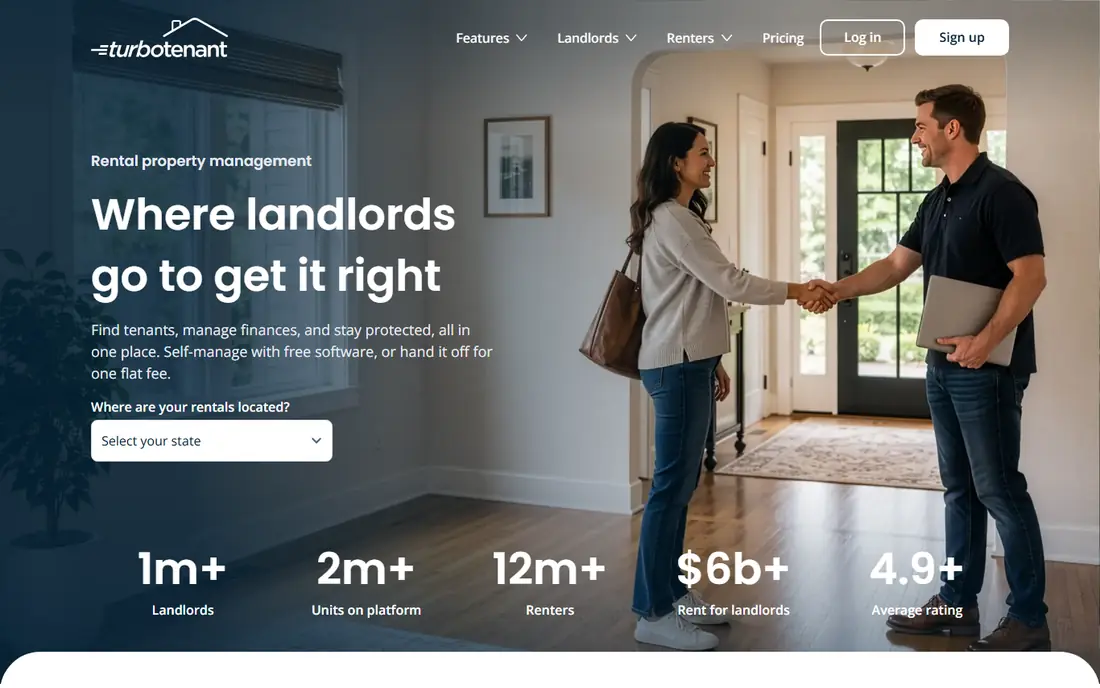
TurboTenant is the easiest free place to start if you manage your own rentals and want to stop chasing rent by bank transfer and paper forms. The free plan covers listings, rental applications, screening requests, and online rent collection, which is enough for many landlords with a handful of units. Paid plans, starting around $12.42 per month on annual billing for Essentials, add more automation and reporting.
The main limit is depth. TurboTenant is not a full accounting system, so a landlord with several owners, complex books, or commercial leases may need DoorLoop, Rentec Direct, or Buildium instead. For a self-managing landlord who wants a fast, low-cost start, TurboTenant is our pick for most people.
- Free plan with listings, applications, and rent collection
- Applicant-paid screening available
- No per-unit cap on the free plan
- Paid plans needed for the full feature set
- Tenants may pay some payment fees
- Accounting is lighter than Buildium
Avail, part of the Realtor.com network, is built around the leasing funnel, and its lease templates are the reason many small landlords choose it. The free Unlimited plan includes listings, applications, screening, state-specific leases with e-signing, rent collection, maintenance tracking, and basic income and expense tracking. That is a strong package for a landlord who fills vacancies often.
The paid step is where the maths changes. Unlimited Plus at $9 per unit per month adds faster payouts, waived bank transfer fees, custom leases, and priority support, but ten units cost $90 per month. Use Avail free for leasing, and only pay Plus while your portfolio stays small or while you need faster payouts.
- State-specific, lawyer-reviewed lease templates
- Free Unlimited plan with unlimited units
- Listing syndication included
- Unlimited Plus costs $9 per unit per month
- Tenants pay $2.50 per bank transfer on the free plan
- No native mobile app
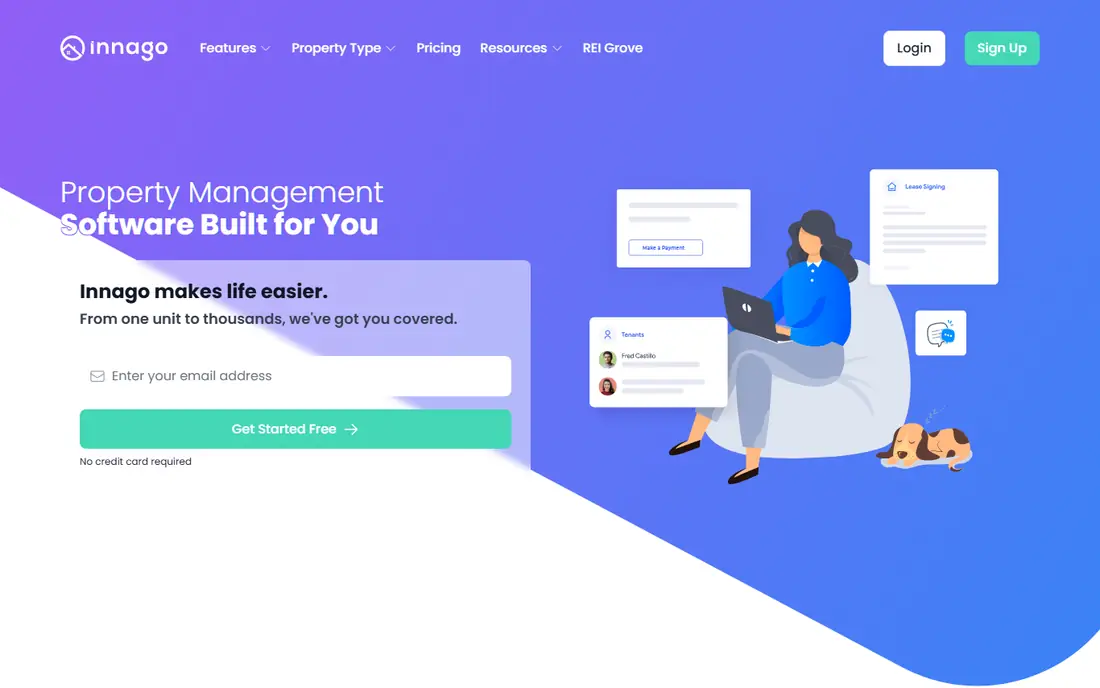
Innago is the most generous free option for landlords who want core management without a subscription. Landlords can manage unlimited properties, collect rent online, run screening, sign leases, track maintenance, and store documents at no monthly cost. That makes it a clear pick for a landlord who wants to keep fixed costs near zero while the portfolio grows.
Free does not mean nobody pays. Tenants may pay screening fees and payment processing fees, including around $2 for ACH payments and about 2.99 percent for card payments, unless the landlord chooses to absorb the ACH fee. If you are comfortable with that model and do not need deep accounting, Innago is hard to beat on price.
- No monthly fee for landlords
- Unlimited properties on the core plan
- Screening, leases, rent collection, and maintenance included
- Revenue comes from transaction and screening fees
- Reporting is simpler than paid rivals
- Some features are less polished
RentRedi solves the most annoying part of landlord software pricing: the bill that rises with every new door. For $12 per month on annual billing, or $29.95 month to month, landlords get the full suite for unlimited units, tenants, and bank accounts. That includes rent collection, listings, applications, screening, maintenance, messaging, and reporting, without tier charts to decode.
The trade-off is that there is no free tier, so you pay from day one, and screening can cost applicants $39.99, or $49.99 with income verification. For landlords with five to one hundred units who want one predictable bill, RentRedi is the value pick among paid tools. For a landlord with one or two units, a free tool may still be cheaper.
- One flat price for unlimited units
- All features included on the plan
- Rent, listings, screening, maintenance, and messaging in one place
- No free plan
- Screening fees can be tenant-paid
- Monthly billing is much higher than annual billing
TenantCloud is a good middle step between a free leasing tool and a full management platform. Starter, from $15 per month on annual billing, covers rent collection, maintenance, applications, screening, and basic accounting for unlimited properties, with limits set by active leases rather than property count. Growth and Pro add lease building, owner tools, and deeper tax reporting.
The current version has no free plan, so new accounts start with a 14-day trial rather than a free tier. That is a change from older listings, so do not rely on old guides that describe a free plan. For a landlord who wants real accounting at a low price and can work with email support, TenantCloud is a strong, low-cost choice.
- Low entry price for accounting and rent collection
- Unlimited properties on paid plans
- Native mobile apps for landlords and tenants
- No free plan in 2026
- Higher tiers needed for full reporting and QuickBooks sync
- Support is mainly email and chat
Rentec Direct is the pick for a small property manager who handles money for other owners. Rentec Pro suits landlords and investors, while Rentec PM adds trust accounting, owner accounting, and an owner portal. Starter covers up to ten properties from $25 per month, and Pro and PM start from $50 per month and scale with units, with a two-week trial and no setup fee.
The interface will not win design awards, and the price still rises as units are added, so a large manager should compare Buildium as well. For a small management company, Rentec Direct offers the accounting controls that free tools lack, at a lower price than most full platforms. Screening at $10 to $18 per report on Pro and PM is also cheaper than many rivals.
- Genuine trust accounting on the PM edition
- Owner portal for managers
- Low screening costs on Pro and PM
- Interface is more functional than modern
- Price rises with unit count
- No long-term free tier
DoorLoop is the easiest full-service option for landlords who want everything in one place and do not want to learn a complex system. Starter starts at $69 per month on annual billing, or $99 month to month, for up to ten units, and includes rent collection, screening, communication, CRM access, and accounting. Pro and Premium add team tools, advanced accounting, maintenance portals, and integrations.
The catch is the unit cap. Once you pass ten units on Starter, per-unit charges apply, and Pro starts at $149 per month on annual billing. For one to twenty units, DoorLoop is a strong pick for ease of use. For a very large portfolio, compare Buildium, which is built for deeper accounting at scale.
- Guided onboarding and simple interface
- Rent, screening, accounting, and maintenance in one place
- Scales to thousands of units
- Starter capped at ten units on the annual price
- Price rises with units above the cap
- No free plan
Buildium is the veteran platform for landlords and managers who need serious accounting, not just rent collection. Essential starts at $62 per month, Growth at $192, and Premium at $400, with prices rising by unit count. All plans include core accounting, maintenance, leasing, and tenant portals, while Growth and Premium add automation, business analytics, and an open API.
That depth comes with a higher total cost. Tenant screening, e-signatures on lower tiers, and payment processing fees sit on top of the subscription, so the effective monthly cost runs above the headline. For a landlord with fifty to five hundred units, or a manager with owner clients to report to, Buildium is worth the price. For a landlord with a few doors, start with a free tool instead.
- Deep accounting with bank reconciliation and 1099 filing
- Owner statements and portals
- Rental listing syndication and screening built in
- Price rises with unit count
- Screening, e-signatures, and payment fees add up
- Onboarding required on higher plans
How we picked these
We compared official pricing pages, feature lists, and public reviews for tools that handle long-term rentals in the US. We kept tools that are live in October 2026 and that cover at least rent collection, tenant records, and maintenance or leasing. We favoured clear pricing and a real free or low-cost entry point for small landlords, and we kept larger platforms where accounting depth justifies the price. This is general information, not financial or legal advice, and local rental law still applies.
Choosing by portfolio size and property type
Start with your unit count, because it decides the pricing model that hurts least. One to five units usually fit a free tool, five to fifty units fit RentRedi or TenantCloud, and fifty-plus units or owner-client work fit DoorLoop or Buildium. Commercial property needs extra care, since commercial leases, multiple owners, and trust accounting are not handled well by every landlord app, so check those features before you commit. For the best commercial property management software, confirm lease handling and owner reporting first, since these are also among the best property management apps for landlords who want accounting depth without a large management company.
Next, list the jobs you will actually do each month. If you only collect rent and handle maintenance, a free tool is enough. If you need owner statements, 1099 filing, bank reconciliation, or a resident portal for a commercial building, pay for accounting depth. A tool that looks cheap but forces you back to spreadsheets for tax time is not cheap.
Finally, check payment fees and screening costs in writing. Some tools charge landlords, some pass fees to tenants, and some do both depending on the plan. A $2 ACH fee per payment, a card fee near 3 percent, and a screening fee near $40 per applicant can matter more than a $10 difference in subscription price over a year.
Frequently asked questions
What is the best property management software for landlords with a few units?
TurboTenant, Avail, and Innago are the best starting points, because their core plans are free and cover listings, screening, leases, and rent collection. RentRedi is the next step if you want one paid tool for unlimited units. Pick the free tool whose lease and payment flow feels clearest, since you will use it for every tenancy.
What is the best landlord property management software for commercial property?
DoorLoop and Buildium are stronger for commercial and mixed portfolios, because they offer deeper accounting, owner reporting, and team workflows. Rentec Direct PM is also worth a look for small managers who need trust accounting. Check commercial lease handling, owner portals, and multi-entity accounting before you choose, since not every landlord app supports them well.
Is there a good free property management app for landlords?
Yes, TurboTenant, Avail, and Innago all offer free core plans, and each covers a slightly different strength. TurboTenant is best for a simple start, Avail is best for state-specific leases, and Innago is best for free core management with no monthly fee. Remember that free plans often pass screening or payment fees to tenants or applicants.
How much does property management software cost per month?
Free tools cost $0 per month for landlords, low-cost paid tools start at $12 to $15 per month, and full platforms start at $62 to $69 per month before unit and payment fees. Large portfolios can pay $192 to $400 per month on Buildium, depending on tier and unit count. Always add screening, payment, and e-signature fees to the headline price.
Do I need software if I only have one rental?
You do not need it, but a free tool can still help with a lease, rent collection, and a paper trail for taxes. A spreadsheet works for one unit, yet it offers no tenant portal, late fee automation, or screening workflow. Start free, and only pay when the time saved is worth more than the subscription.
Can tenants pay rent online with these tools?
Yes, all eight tools support online rent collection, though payment methods, payout speed, and fees vary. Bank transfers are usually cheapest, while card payments carry a percentage fee that may fall on the tenant or the landlord depending on the plan. Check payout timing before you rely on a tool for mortgage day, since some free plans pay out more slowly.
Sources
See where you really rank - block by block
ProMapRanker scans Google Maps across a grid of your service area. Simple monthly plans from $19, white-label on every plan.
Start freeKeep reading
 outreach alternatives
Outreach Alternatives in 2026
Compare outreach alternatives for 2026, from Salesloft and Apollo to HubSpot and Lemlist, with pricing, channels, features, limits, and honest trade-offs.
Read → best web conference tools
Best Web Conference Tools in 2026
Compare the best web conference tools for meetings, webinars and team calls, with current pricing, free plans and honest limits for each option here today.
Read → best voice cloning tools
Best Voice Cloning Tools in 2026
Compare the best voice cloning tools in 2026, from ElevenLabs and Descript to Resemble and Cartesia, with consent rules, pricing, licenses, and limits.
Read →