 ProMapRanker
Best Prop Trading Companies in 2026

Key takeaways
- Most firms here run an evaluation first, then a funded or simulated account, and the rules matter more than the headline account size.
- Profit splits commonly sit between 80 percent and 90 percent, with higher splits sometimes tied to add-ons or scaling milestones.
- Futures-focused firms such as Topstep work differently from forex and CFD firms, so match the firm to the market you actually trade.
- Fees are usually one-time challenge fees or monthly subscriptions, and they are normally non-refundable if you fail the evaluation.
- This article is general information only, not financial advice, and trading carries a real risk of loss.
Quick comparison
| Pick | Great for | Pricing starts at | Free tier | |
|---|---|---|---|---|
 FTMO | Traders who want an established firm | $99 | No | Visit |
 FundedNext | Traders who want flexible evaluations | $32.99 | No | Visit |
 The5ers | Traders building an account slowly | $19 | No | Visit |
 E8 Markets | Traders who want large accounts | $48 | No | Visit |
 FundingPips | Budget-conscious traders | $33 | No | Visit |
 Topstep | Futures traders | See website | Free trial | Visit |
 Alpha Capital Group | Traders who want simple rules | $37 | No | Visit |
 FXIFY | Traders who want evaluation choice | $59 | No | Visit |
The best prop trading companies
We compared firms on evaluation structure, stated profit splits, payout timing, platform choice and how clearly the rules are published. The firms below cover forex, CFD and futures trading.

FTMO is the firm we point to first for traders who value a long track record over the lowest entry fee. Its challenges run in one-step and two-step forms, with account sizes from 10,000 dollars to 200,000 dollars. The two-step model sets profit targets alongside daily and maximum loss limits, which keeps the evaluation structured rather than open ended.
The practical appeal is the payout setup. FTMO states that the first reward can be taken after 14 days, with later rewards available on demand, and profit splits run up to 90 percent. That matters because some firms lock traders into fixed monthly payout windows. The trade-off is price: the smallest challenge starts higher than several rivals here, and failing means paying again. Read the full rule set before buying, since breaking a loss limit ends the attempt even if you are close to the target.
- Long operating history
- Clear published rules
- Multiple platforms including MetaTrader 4, MetaTrader 5, cTrader and DXtrade
- Challenge fees are not refunded on failure
- Profit targets and loss limits require disciplined risk control
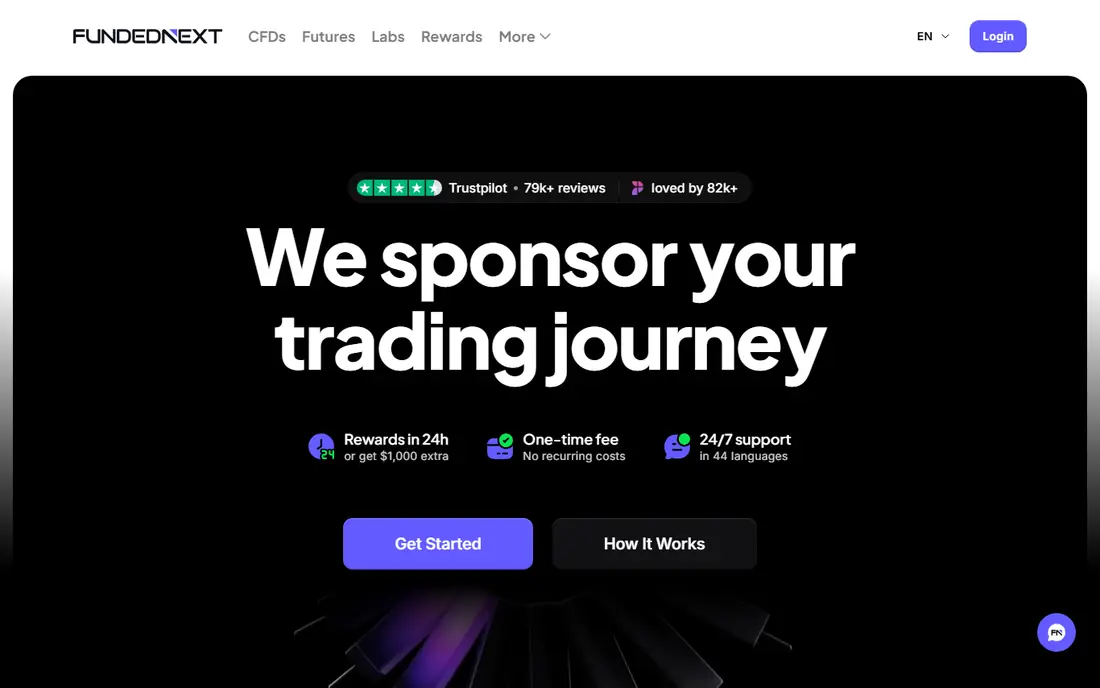
FundedNext suits traders who dislike being rushed. Several of its evaluations carry no time limit, which lets a trader wait for setups that fit their plan instead of forcing trades to beat a deadline. Entry fees start lower than FTMO, and the firm publishes reward cycles ranging from five business days to 14 days depending on the program.
The catch is that headline terms are not the whole story. The top profit split of 95 percent applies with an add-on, and standard splits are lower. Traders should also check which instruments and strategies are allowed on their chosen program, since scalping and news trading rules vary. For a trader who trades a few times a week and wants room to breathe, FundedNext is a strong middle option between cost and flexibility.
- No time limit on some evaluations
- Reward cycles as short as five business days
- Profit splits up to 95 percent with an add-on
- The highest split needs a paid add-on
- Rules differ between evaluation types, so comparison takes care

The5ers takes a different angle from firms built around fast payouts. Its programs are designed around steady growth, with scaling milestones that increase account size as traders meet targets over time. Entry starts at 19 dollars for a small account, which makes it one of the cheapest ways to test a prop firm without much money at stake.
That low price comes with a slower rhythm. The first withdrawal typically comes 14 days after funding, and the highest profit splits apply to traders who progress through the scaling plan. This is a good fit for a trader with a consistent, low-risk method who is happy to build over months. It is a poor fit for someone who wants quick payouts or trades aggressively for large short-term gains.
- Very low entry price
- Scaling programs for long-term growth
- Profit splits from 80 percent to 100 percent for qualifying traders
- First withdrawal timing is later than some rivals
- Growth-focused programs reward patience over speed
E8 Markets is worth a look for traders who already trade size and want headroom. Its top account size reaches 500,000 dollars, well above the 200,000 dollar ceiling at several rivals. Entry fees start at 48 dollars, and the firm offers several evaluation formats, including a one-step option for traders who want a shorter path to funding.
Speed is part of the pitch, with first payouts possible in as little as three days on some programs. The standard profit split is 80 percent, which is lower than the top splits elsewhere, though it can rise with scaling. Traders should weigh that against the account size: a smaller split on a larger account may still suit a trader who manages risk well, but it is not the best deal for someone trading a small account.
- Accounts up to 500,000 dollars
- First payout possible in as little as three days on some programs
- Customizable evaluations
- Profit split on the standard program is 80 percent
- Large accounts still carry strict loss limits
FundingPips has grown quickly by keeping entry fees low and terms easy to grasp. Challenges start at 33 dollars, and profit splits can reach 100 percent for traders who qualify through scaling. The firm covers forex and CFD trading, and its evaluation formats suit traders who want a straightforward challenge without a long list of add-ons.
The main limitation is payout timing. Rewards run on bi-weekly or monthly cycles rather than on demand, so traders who need fast access to profits may prefer FTMO or E8 Markets. Terms at fast-growing firms also change more often than at older firms, so the price and rules you see in a review may differ from the live terms. Check the firm's own site on the day you buy.
- Low entry fees
- Profit splits from 80 percent to 100 percent
- Bi-weekly or monthly reward cycles
- Reward cycles are fixed rather than on demand
- Rules and account options change often, so re-check before buying
Topstep is the clear pick in this list for futures traders. It is a long-running firm focused on CME futures, and its model uses a monthly subscription for the evaluation rather than a single challenge fee. Traders pick an account size, trade within the firm's loss limits, and move to a funded account after passing.
The subscription model cuts both ways. It lowers the upfront cost of a first attempt, and a free trial lets new traders test the platform. But a slow evaluation can cost more over several months than a one-time fee elsewhere. The profit split runs up to 90 percent. Futures traders who already use platforms such as TradingView or NinjaTrader-style workflows should check platform support before subscribing, since futures tooling differs from forex platforms.
- Long-running futures specialist
- Monthly subscription model rather than one-time challenge fees
- Up to 90 percent profit split
- Futures only, so forex traders should look elsewhere
- Subscription costs add up if the evaluation takes months
Alpha Capital Group appeals to traders who get frustrated by dense rule books. Its evaluations are presented with straightforward loss limits and profit targets, and payouts can be requested on demand rather than on a fixed cycle. Entry starts at 37 dollars, which keeps the cost of a first attempt modest.
The trade-off is history. The firm does not have the decade-long record of FTMO or Topstep, so traders are trusting a newer operation with their fees and payouts. The 90 percent split also requires an add-on, with 80 percent as the standard. For a trader who values clarity and flexible payouts and is comfortable with a newer firm, it is a reasonable choice. Cautious traders may prefer to start with a small account here.
- Clear, simple rule set
- On-demand payouts
- Profit splits from 80 percent to 90 percent
- Smaller public track record than FTMO or Topstep
- Top split needs an add-on
FXIFY stands out by offering one, two and three-phase evaluations, so traders can pick how much structure they want before funding. A one-phase evaluation suits confident traders who want a faster path, while a three-phase route spreads the targets across more steps. Accounts start at 5,000 dollars on the two-phase program, with fees from 59 dollars.
Payouts are a strength, with the first payout available on demand and splits reaching up to 100 percent on some programs. The downside is choice overload: with so many programs, add-ons and account sizes, it is easy to buy the wrong evaluation. Compare the total cost, including any add-ons, against a simpler rival before committing. Traders who know exactly which format suits them will get the most from FXIFY.
- One, two or three-phase evaluations
- On-demand first payout
- Profit splits up to 100 percent on some programs
- Entry price is higher than budget rivals
- The range of programs can confuse first-time buyers
How we picked these
We compared published evaluation terms, account sizes, profit splits, payout timing and platform support from the firms' own sites and current roundups, and we favored firms with clear, public rules. We excluded firms with no verifiable operating presence and firms whose terms could not be confirmed from a public source. Prices and splits change often in this market, so treat every figure here as a starting point and confirm it on the firm's own site before paying.
What to check before you pay for a challenge
Start with the loss rules, not the account size. A 200,000 dollar account with a tight daily loss limit can be harder to pass than a smaller account with forgiving rules. Read the daily loss limit, the maximum loss limit, the profit target and any rules on holding trades over weekends or around news events. These four items decide most failures.
Next, work out the true cost. Add the challenge fee, any add-ons for a higher split or faster payout, and the cost of a second attempt if you fail. A cheap challenge that you need to buy three times costs more than a pricier one you pass first time. Also check the payout method and timing, since some firms pay on fixed cycles and others on demand.
Finally, be honest about your own trading. Prop firms reward consistent risk control, not big wins. If your method relies on large position sizes or holding through major news, check that the firm allows it. If it does not, no profit split makes the firm a good fit. This article is general information only and is not financial advice. Trading carries risk, most traders lose money, and you should never pay a challenge fee with money you cannot afford to lose.
Frequently asked questions
What is a prop trading company?
A prop trading company, often called a prop firm, lets traders use a simulated or firm-backed account after passing an evaluation. Traders pay a fee or subscription for the evaluation, follow loss limits and profit targets, and then share a portion of simulated profits with the firm under its payout terms.
What are the best trading funding companies for beginners?
Beginners usually do best with a firm that has simple rules, a low entry fee and no strict time limit. The5ers and FundingPips are low-cost starting points in this list, while FTMO suits beginners who want the most established firm and are willing to pay more for it.
How much does a prop firm challenge cost?
Challenge fees in this list start from 19 dollars for a small account and rise with account size, with monthly subscriptions as an alternative at futures firms such as Topstep. Add-ons for higher splits or faster payouts can raise the total, so check the full price before buying.
Do prop firms pay real money?
Payouts are normally based on simulated trading profits under the firm's terms, and each firm sets its own payout cycle, minimum payout and verification steps. Payouts are not promised or guaranteed, and a firm can change its terms, so read the current payout policy before you start.
Can you lose money with a prop firm?
Yes. The challenge fee is usually non-refundable if you fail, and trading itself carries risk of loss. Some firms also charge for add-ons or monthly subscriptions. Only use money you can afford to lose, and treat any fee as spent the moment you pay it.
Are prop trading firms regulated like brokers?
Most prop firms are not regulated as brokers, because they typically offer simulated accounts rather than live brokerage accounts. That makes the firm's reputation, published rules and payout history more important, since traders have less regulatory protection than they would with a licensed broker.
Sources
See where you really rank - block by block
ProMapRanker scans Google Maps across a grid of your service area. Simple monthly plans from $19, white-label on every plan.
Start freeKeep reading
 zoro.to alternatives
Best Zoro.to Alternatives in 2026
We compare the best zoro.to alternatives in 2026, listing only legal licensed anime streaming services, from Crunchyroll to free options for fans today.
Read → zip alternatives
Best Zip Alternatives in 2026
We compare the best zip alternatives for buy now, pay later in 2026, covering pay-in-4 plans, fees, spending limits, and credit reporting options today.
Read → yesware alternatives
Best Yesware Alternatives in 2026
Compare the best yesware alternatives for sales email tracking, templates, and sequences, with current pricing and honest tradeoffs for small sales teams.
Read →