 ProMapRanker
Best Procure-to-Pay Software for Office Supplies in 2026


Large enterprises with complex spend categories · Pricing starts at: See website
Key takeaways
- Office supplies are indirect spend: the winning feature is a controlled catalog and approval workflow, not a special office-supply module.
- Precoro is the rare mid-market option with published pricing, at $499 per month, while enterprise suites are quote based.
- Ramp offers a free core plan for US teams, but procurement depth is a paid add-on, so check what the free tier actually covers.
- Start small: a catalog, approval rules and three-way matching for routine supplies will fix most maverick spending before a full suite is needed.
Quick comparison
| Pick | Great for | Pricing starts at | Free tier | |
|---|---|---|---|---|
| Coupa | Large enterprises with complex spend categories | See website | No | Visit |
 SAP Ariba | Enterprises already running SAP | See website | No | Visit |
 Oracle Procurement Cloud | Large Oracle ERP customers | See website | No | Visit |
 Precoro | Mid-market teams wanting transparent PO control | $499 per month | No | Visit |
 Procurify | Mid-size companies needing live budget visibility | See website | No | Visit |
 Zip | Companies whose bottleneck is intake and approvals | See website | No | Visit |
 Airbase | Mid-market companies wanting purchasing plus AP | See website | No | Visit |
 Ramp | US startups wanting free spend management first | Free | Yes | Visit |
 Ivalua | Enterprises with complex, non-standard processes | See website | No | Visit |
The best procure-to-pay software for office supplies
We read this topic as procure-to-pay for indirect spend including office supplies: an employee requests pens, paper, toner or break-room goods, the request is approved against a budget, a purchase order goes to an approved supplier, the invoice is matched and payment follows.
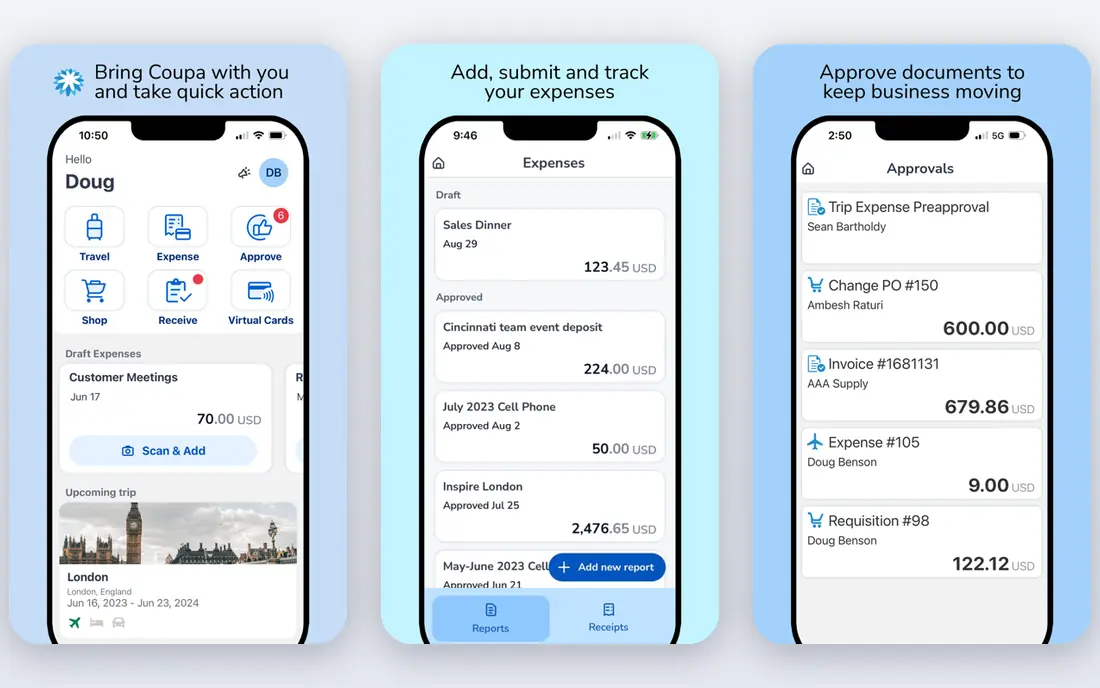
Coupa is the full-suite answer for a large company that buys everything through one system, office supplies included. Employees buy from guided catalogs, approvals route by budget and policy, purchase orders, invoices and payments follow in the same workflow, and spend analytics show where indirect categories are drifting. Supplier management and contract tools sit beside the buying workflow for larger procurement teams.
That breadth is the reason smaller buyers should pause. Coupa contracts are enterprise sized and implementations run for months, so a company whose pain is mainly stationery and toner will pay for sourcing, contracts and analytics depth it may not use for years. Coupa fits when office supplies are one category inside a much larger spend program that needs one governed system.
- Full source-to-pay coverage from request to payment
- Supplier catalogs and guided buying
- Strong spend analytics
- Pricing is quote only and enterprise sized
- Rollout takes months
- Overkill for a team whose main problem is office supplies alone
SAP Ariba is the procurement choice for the SAP world, covering sourcing, supplier management, catalog buying, contracting, invoicing and payments through the Ariba Network. For an SAP shop, office supply catalogs, purchase orders and invoice matching can run inside the same ecosystem as finance, with supplier network scale that smaller tools cannot match.
Outside SAP, the case is thin. Pricing is custom quoted, implementations are long, and the platform assumes an SAP-shaped organization. A non-SAP company buying mainly office supplies and other indirect goods will get faster value from Precoro, Procurify or Zip. SAP shops should start here and validate catalog and approval fit before entertaining alternatives.
- Deepest SAP ERP integration
- Very large supplier network
- Full source-to-pay depth for global buyers
- Pricing is quote only
- Long implementations
- Little sense outside an SAP estate
Oracle Procurement Cloud brings requisitioning, purchase orders, supplier management, invoicing and payments into Oracle Fusion Cloud ERP. For a company already on Oracle, office supply requests can flow from catalog to approval to purchase order to matched invoice without a separate procurement platform or integration project. Finance gains one set of books for the whole cycle.
The same logic limits its audience. Companies not running Oracle face a full ERP decision to gain a procurement tool, which rarely makes sense for indirect spend alone. Oracle Procurement Cloud fits when the ERP decision is already made and procurement needs to live inside it, not when a team is shopping for a standalone office-supply workflow.
- Procurement inside Oracle Fusion with no separate integration layer
- PO, invoice and payment workflows tied to ERP finance
- Strong for Oracle estates
- Pricing is quote only by modules and users
- Enterprise rollout
- Weak fit for companies not running Oracle
Precoro is the transparent option in a category full of quotes. Core starts at $499 per month billed annually, with an Automation tier at $999 per month, covering purchase requests, approvals, purchase orders, supplier catalogs, invoicing and budget control. For a mid-market team, that published price makes budgeting and comparison far easier than an enterprise sales cycle.
The scope is deliberately narrower than a full source-to-pay suite. Sourcing events, deep contract management and global supplier network depth are thinner here, but for office supplies and routine indirect spend, tight PO control and budget visibility matter more. Precoro suits a team that wants control quickly, without a multi-quarter rollout.
- Published pricing with Core at $499 per month billed annually
- Tight purchase order and approval control
- Faster rollout than enterprise suites
- No free plan
- Narrower sourcing and contract depth than Coupa or Ariba
- Larger global programs may outgrow it
Procurify centers on a problem finance teams feel daily: knowing what a purchase does to the budget before it is approved, not after the invoice arrives. Requests for office supplies route through approvals with live budget impact shown, purchase orders follow, and invoices and payments close the loop. That visibility helps managers stop overspend in categories that look small line by line but add up across an office.
Pricing is modular and quote based, so a team should confirm which modules its quote includes rather than assuming full procure-to-pay depth. Procurify fits a mid-size company where finance needs that live budget view and where routine indirect buying is frequent enough to justify a dedicated tool.
- Live budget visibility as requests are approved
- Catalog and approval workflows for routine buying
- Modular pricing by scope
- Pricing is quote based
- Full procure-to-pay depth varies by module
- Smaller teams may find the sales process heavy for office supplies alone
Zip fixes the front door of procurement. Employees submit one intake form for a purchase, approvals route automatically, and the request flows into the ERP or finance system behind it. For office supplies, that matters because the usual failure is not the catalog: it is employees buying outside the process, with no approval and no record until the invoice appears.
Zip is an orchestration layer, not a full suite, so it works best when the company already has an ERP or accounts payable system to receive the approved request. Companies whose main pain is intake friction and approval delays should demo Zip first, before buying a full suite whose depth they may not need.
- Purchase intake and approvals that employees actually use
- Orchestration across existing ERP and finance tools
- Good fit as a layer on top of an ERP
- Pricing is quote only
- Not a full source-to-pay suite on its own
- Needs an ERP or AP system behind it for the payment side
Airbase combines guided purchasing with accounts payable, so an office supply request, its approval, its bill and its payment live in one system. Employees request through guided workflows, finance approves with budget context, and AP matches and pays without rekeying into a separate tool. Cards and expense handling can sit beside procurement for teams that want one spend system.
Pricing is quote based, and the platform is aimed at mid-market companies rather than global enterprises with deep sourcing needs. Airbase suits a mid-market team that wants purchasing plus AP together, with controls strong enough to stop off-process buying but without an enterprise suite rollout.
- Purchasing, approvals, bill pay and cards in one system
- Guided procurement with approval controls
- AP closing the loop on the same platform
- Pricing is quote based
- US-focused strengths may suit US teams best
- Enterprise sourcing depth is thinner than Coupa or Ariba
Ramp starts from spend management rather than procurement, and its free core plan covers cards, expenses, travel and basic accounts payable. That makes it an attractive starting point for a US startup or small team that mainly needs to control card spending on office supplies and other routine purchases without a subscription. Procurement workflows sit on top as a paid add-on.
The honest limit is depth. Free Ramp is not a full procure-to-pay suite, and a team that needs catalog buying, three-way matching and supplier management at scale should price the paid procurement tier before comparing it with Precoro or Procurify. Ramp fits best when free spend control is the priority and procurement needs are still light.
- Free core plan with cards, expenses and basic AP
- Procurement available as a paid add-on
- Fast setup for small teams
- Procurement depth is paid, not in the free core
- US focus
- Larger enterprises may need a fuller suite
Ivalua is the configurability pick among enterprise suites. It covers source-to-pay on a single platform that can be shaped around non-standard approval chains, supplier processes and category rules, which suits large buyers whose procurement does not fit a standard template. Office supply catalogs and approvals can sit inside that wider governed process.
That flexibility costs implementation effort and enterprise pricing, so a team buying mainly office supplies will rarely need it. Ivalua fits when the enterprise already has complex, varied procurement processes that a standard suite would force into awkward workarounds, and when office supplies are one category inside that larger program.
- Highly configurable single platform
- Source-to-pay depth for complex buying
- Suits non-standard approval and supplier processes
- Pricing is quote only by modules and scope
- Configuration effort is significant
- Overkill for routine office supply buying alone
How we picked these
We compared vendor pricing pages, procurement guides and product documentation for tools that cover the full procure-to-pay cycle, or a clear part of it, in October 2026. We favored products that handle catalog buying, approvals, purchase orders, invoice matching and payment for indirect spend, and we marked pricing as See website where vendors quote rather than publish a price. We did not invent contract values or savings figures.
What to check before you buy for office supplies
Start with the catalog. Confirm how approved suppliers and items are loaded, whether punchout catalogs are supported for your main suppliers, and how prices and substitutions are handled when a listed item is out of stock. A clean catalog does more for office supply control than any analytics dashboard.
Next, map approvals to real budgets. Test a request for a routine item, a bulk order and an urgent out-of-policy item, and check that budget impact, approver routing and three-way matching behave as expected. Finally, confirm the payment side: invoice matching rules, payment timing and ERP or accounting integration decide whether the system saves finance time or just moves work from one screen to another.
Frequently asked questions
What is procure-to-pay software?
It is software that covers the buying cycle from request to payment: an employee requests goods, the request is approved, a purchase order is issued, the supplier invoices, the invoice is matched to the order and receipt, and payment follows. Office supplies are a common indirect category inside that cycle.
Is procure-to-pay software worth it for office supplies alone?
It can be, if off-process buying, missing approvals or invoice surprises are frequent. A lighter tool such as Precoro or Ramp may be enough for supplies alone, while a full suite makes sense when many spend categories need the same control.
How much does procure-to-pay software cost?
Precoro publishes Core at $499 per month billed annually, Ramp offers a free core plan with paid procurement add-ons, and enterprise suites such as Coupa, SAP Ariba, Oracle and Ivalua price by quote. Mid-market tools such as Procurify, Zip and Airbase are also quote based.
What is three-way matching?
It is the check that compares the purchase order, the supplier invoice and the goods receipt before payment. If quantity or price does not match, the invoice is held for review instead of being paid automatically, which catches errors in routine categories such as office supplies.
Can employees still buy from their usual office supplier?
Yes, if that supplier is set up in the catalog or punchout system with agreed prices. The point of procure-to-pay is not to change suppliers for its own sake, but to route buying through approved suppliers, prices and approvals.
Do I need a full suite if I already have an ERP?
Not always. Many companies add Zip for intake and approvals on top of their ERP, which fixes the employee experience without replacing finance systems. Consider a suite only when sourcing, contracts or global compliance outgrow what the ERP does natively.
Sources
See where you really rank - block by block
ProMapRanker scans Google Maps across a grid of your service area. Simple monthly plans from $19, white-label on every plan.
Start freeKeep reading
 worlds best local seo company
8 Worlds Best Local SEO Companies for Map Pack Growth in 2026
Compare the worlds best local seo company options for Google Business Profile work, citations, reviews, and multi-location rankings and reporting in 2026.
Read → world's best web hosting company
World's Best Web Hosting Company in 2026
Searching for the world's best web hosting company? We compared 10 hosts on price, renewal rates, speed, and support to help you choose well today in 2026.
Read → who's got the best nanny tax services
Who's Got the Best Nanny Tax Services in 2026
We answer who's got the best nanny tax services, comparing full filing, back taxes, software, and pricing so families can handle nanny taxes correctly.
Read →