 ProMapRanker
Best Preceptor Matching Service in 2026


Largest published network and paperwork support · Pricing starts at: $12.75 per clinical hour
Key takeaways
- Placement is never guaranteed, even by a paid service: your school must approve the site and preceptor, and a match can fall through.
- Compare the total for your required hours, not just a headline hourly rate or flat fee, and check what paperwork is included.
- NPHub and Clinical Match Me publish the clearest pricing here, while several rivals are quote-based.
- Free routes through your school, alumni, and professional groups are worth trying first, especially if your deadline is months away.
Quick comparison
| Pick | Great for | Pricing starts at | Free tier | |
|---|---|---|---|---|
| NPHub | Largest published network and paperwork support | $12.75 per clinical hour | Free trial | Visit |
 PreceptorLink | NP-led personalized matching | See website | No | Visit |
 Clinical Match Me | Flat-fee matching with no upfront deposit | $1,995 per rotation | No | Visit |
 Preceptor Point | Quote-based nationwide matching | See website | No | Visit |
 Clinical Preceptor Rescue | Hourly quote-based matching | See website | No | Visit |
 FNP Preceptor | Family practice rotations with full planning | See website | No | Visit |
 Clinician Nexus | Free school-linked rotation platform | Free | Yes | Visit |
 ENP Network | Self-serve directory and listings | See website | No | Visit |
The best preceptor matching service
This is general information only, not a guarantee of placement, school approval, or a passing evaluation. We compared matching services for nurse practitioner students, with pricing and terms from vendor pages and 2026 comparison guides.
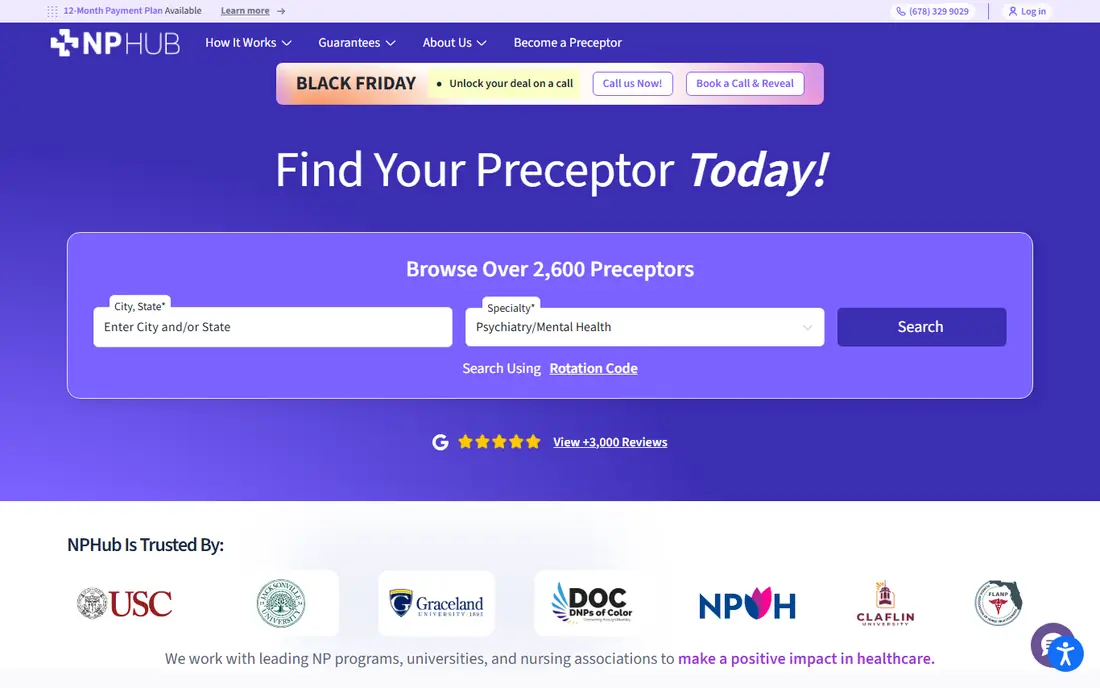
NPHub is the largest preceptor matching service in this list by its own published figures, with thousands of rotations coordinated across many states and specialties, including family, psychiatric mental health, pediatrics, women's health, and acute care. Students can browse available rotations, reserve a placement, and get a coordinator who handles school paperwork, affiliation agreements, and credentialing steps. Pricing starts at twelve dollars and seventy-five cents per clinical hour, with a minimum total and a refundable deposit described on its site.
The honest limit is total cost and approval. A 160-hour rotation at that starting rate costs over two thousand dollars before any variation by state or specialty, and your program must still approve the site and preceptor. NPHub describes a replacement or refund promise if a placement cannot be provided, but read the exact terms before paying, and confirm your school allows paid preceptors.
- Published hourly pricing and payment plans
- Paperwork and affiliation support
- Large nationwide network described on its site
- Total cost rises with required hours
- A match still needs school approval, and placement is not guaranteed
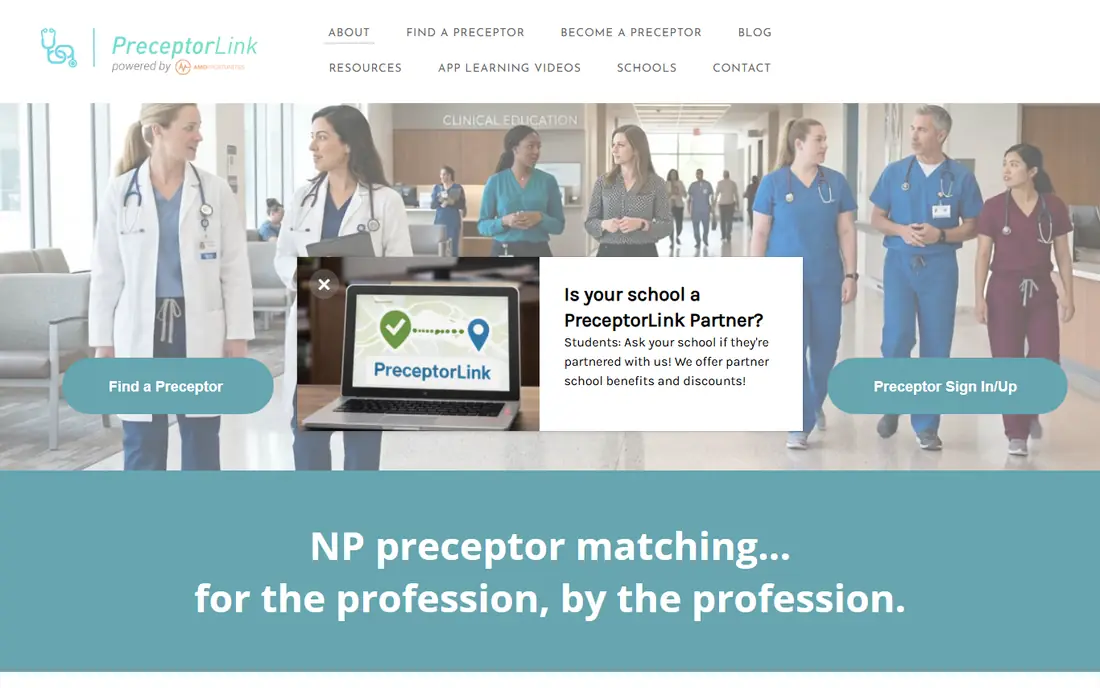
PreceptorLink is run by a nurse practitioner-led team and has matched NP preceptors since 2014, according to its own site. Its pitch is personalized matching rather than a fully automated database: a team works with the student on specialty, location, and availability, helps with paperwork, and stays in contact through its app. That human approach can help when a student has a tight specialty, a rural location, or a complex school form.
The trade-off is price clarity. Comparisons describe typical rotation costs and an application fee, plus a deposit, but the exact total is quote-based. Ask for the full rotation total, what happens if no suitable match is found, and how far a replacement preceptor may be from your home before you pay.
- NP-led team with matching since 2014 described on its site
- Personalized matching and paperwork help
- App-based communication
- Pricing is quote-based
- Deposit terms are less transparent than flat-fee rivals in comparisons
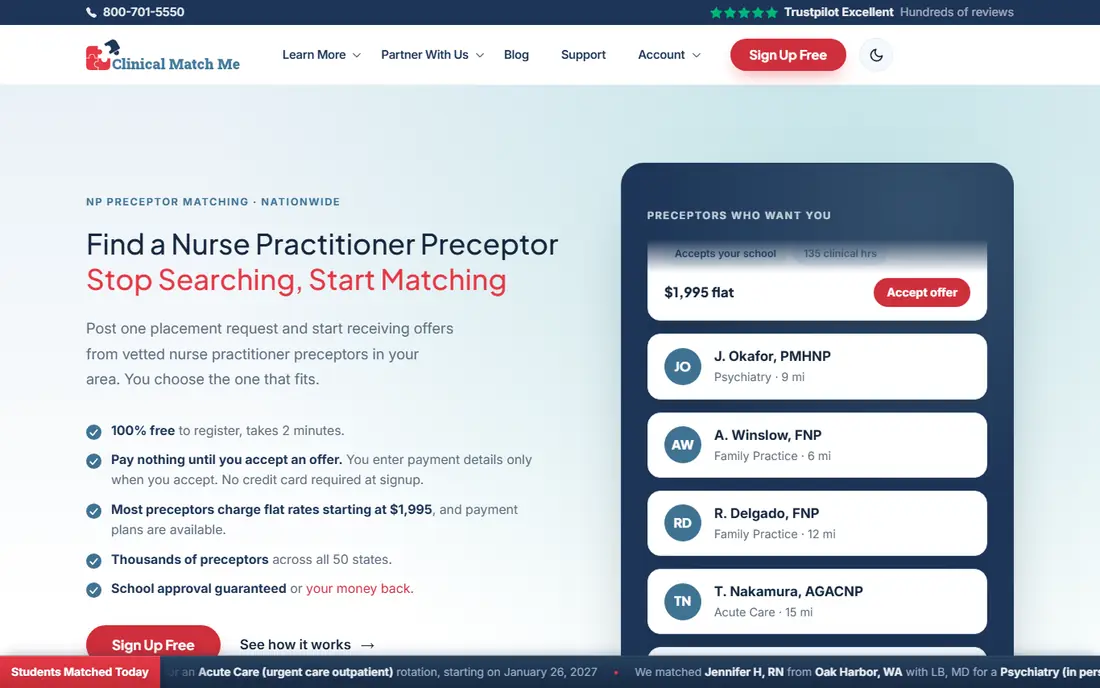
Clinical Match Me stands out for payment timing: comparisons describe no deposit, with payment only after you accept an offer, and payment plans up to 24 months. Its flat fee covers up to 250 hours, with extra blocks for longer rotations. That structure lowers upfront risk, because you do not pay before you see a proposed preceptor and site.
The limit is fit for short rotations. A student who needs far fewer than 250 hours may pay more than an hourly service would charge for that rotation, while a student who needs a full rotation gets a clearer total. Check the money-back terms in writing, including what counts as a school rejection and how quickly a refund is paid.
- Flat fee for up to 250 hours in comparisons
- Pay only after you accept a match
- Money-back terms described for school rejection or cancellation
- Additional hours cost extra
- Flat fee may be high for a short rotation
Preceptor Point offers nationwide preceptor matching with payment plans, and it advertises a placement or money-back guarantee. That promise can sound reassuring when a deadline is close, but the value depends on the fine print: what counts as a placement, how long the search lasts, and what happens if your school rejects the site. Ask for those terms in writing before you rely on the guarantee.
The weakness is price transparency. Pricing is not published, and comparisons describe a deposit and a quote given on a sales call. Get the total for your required hours, the deposit refund terms, and the replacement process in an email or contract, not just on a call.
- Nationwide sites and payment plans described in comparisons
- Placement or money-back guarantee advertised
- Pricing is quote-based and given on a sales call
- Guarantee terms need careful reading
Clinical Preceptor Rescue is a smaller hourly service that comparisons describe as starting near twelve dollars and fifty cents per hour, with a full total given after an intake form and call. Its name signals its niche: students whose own search has stalled, or whose original preceptor fell through, and who need a faster rescue option. That focus can be useful when a rotation start date is near and the usual routes have not worked.
The catch is transparency. Payment plans and refund terms are not fully published in comparisons, so a student should ask for the total, the payment schedule, and the replacement terms before committing. As with every paid service, school approval is still required, and a rescue match is not a guaranteed pass.
- Hourly pricing from twelve dollars and fifty cents an hour in comparisons
- Intake-based total given after a call
- Focus on rescue placements
- Full total is quote-based
- Refund and payment terms are not fully published
FNP Preceptor focuses on family nurse practitioner placements and describes planning the full set of rotations up front, rather than pricing one rotation at a time. Its site states that you pay only once each preceptor and site are confirmed, and that its fee covers sourcing, eligibility checks, and affiliation work, not a payment to the preceptor. That clarity about what the fee covers is helpful, because paid preceptor arrangements raise questions about who is paid and why.
The limit is scope and price. Pricing depends on objectives, geography, timeline, setting, and clinician criteria, so the total is quote-based. Students outside family practice, or who need a single specialty rotation, should check whether this service covers their track before starting an intake.
- Full lifespan planning for FNP rotations
- Pay only after preceptor and site are confirmed in its description
- Clear scope on sourcing and paperwork
- Pricing is quote-based and depends on geography and timeline
- FNP focus limits other specialties
Clinician Nexus is different from the paid matching services above: it is a rotation platform that is free for students to use, with no fees to hold an account or apply for rotations, according to its help center. Schools and clinical sites use it to post and manage rotations, and school coordinators can complete onboarding steps in the system. That makes it a strong first check, especially if your program already uses it.
The honest limit is that free does not mean guaranteed. Availability depends on which schools and sites use the platform, and a student still needs school approval and site acceptance. Use Clinician Nexus alongside your school list and alumni contacts, and treat paid matching as a backup if those routes do not produce a placement in time.
- Free for students to use and apply
- School coordinators can take part in onboarding
- Rotation management in one platform
- Not a paid matching guarantee
- Availability depends on schools and sites on the platform
ENP Network is a self-serve directory, not a full matching service. Students can search listings, post a seeking notice, and contact preceptors directly, with a low-cost pass option described in comparisons for a set period. That model suits a student with time, local contacts, and confidence in outreach, because the cost is far lower than a full service.
The trade-off is effort and risk. There is no placement guarantee, and the student handles outreach, follow-up, and paperwork coordination. If your deadline is close or your own outreach has already stalled, a full matching service may save more time than the directory saves money.
- Large open directory
- Students can post seeking listings
- Low-cost pass option described in comparisons
- No placement guarantee, because it is self-serve
- Students handle outreach and follow-up themselves
How we picked these
We compared vendor pages, help centers, and 2026 comparison guides for NP preceptor services, and we favored services that describe matching, paperwork support, and refund or replacement terms in their own material. We did not invent placement counts, success rates, or prices, and where pricing was quote-based we wrote See website. We treated vendor claims about speed and network size as vendor claims, and we added the placement disclaimer throughout, because school approval and preceptor availability decide the outcome.
How to choose without overspending
Start with free routes and your program rules. Ask your clinical coordinator whether paid preceptors are allowed, which sites are already affiliated, and what forms are required. Check your school database, alumni group, employer, and professional association chapters, and keep a simple tracker of who you contacted and when you followed up. Many students find a placement this way, with no matching fee at all.
If you move to a paid service, compare totals for your exact required hours, not headline rates. Ask for the deposit, payment plan, refund terms, replacement process, and what happens if your school rejects the site. Get those answers in writing, and do not pay a large nonrefundable sum before a preceptor and site are confirmed. Finally, plan for a fallback: if a preceptor withdraws, how quickly will the service find a replacement, and what happens to your rotation dates if it cannot?
Frequently asked questions
How much does a preceptor matching service cost?
It varies by model. NPHub starts at twelve dollars and seventy-five cents per clinical hour with a minimum total, Clinical Match Me lists a flat fee near one thousand nine hundred and ninety-five dollars for up to 250 hours, and several rivals are quote-based. Always calculate the total for your required hours, including any deposit and extra hour blocks.
Is placement guaranteed if I pay?
No. A paid service can match you with a preceptor and handle paperwork, but your school must approve the site and preceptor, and a match can fall through if a preceptor withdraws or a site changes its rules. Check the replacement and refund terms in writing before you pay.
Does my school allow paid preceptors?
It depends on the program. Some programs allow third-party matching services if the site and preceptor meet program criteria, while others discourage or restrict paid placements. Confirm with your clinical coordinator before committing to a fee, and keep that confirmation in writing.
How early should I start searching?
Start as early as your program allows, especially for competitive specialties or locations. A free search through school, alumni, and employer contacts can take weeks or months, while a paid service may move faster but still needs time for school approval and affiliation paperwork.
What should I ask before paying a matching service?
Ask for the total cost for your hours, deposit and refund terms, replacement process, payment plan, and what paperwork is included. Ask whether the preceptor is paid, how the service vets credentials, and what happens if your school rejects the site. Get the answers in a contract or email.
Can I find a preceptor for free?
Yes, many students do, through their school, alumni, employer, professional groups, and free platforms such as Clinician Nexus where their program uses it. Free routes take more outreach and follow-up, but they cost nothing in matching fees and often produce a site your school already knows.
Sources
- https://www.nphub.com
- https://www.preceptorlink.com
- https://www.clinicalmatchme.com
- https://www.preceptorpoint.com
- https://www.clinicalpreceptorrescue.com
- https://fnppreceptor.com
- https://www.cliniciannexus.com
- https://www.enpnetwork.com
- https://www.nphub.com/blog/how-much-do-np-preceptors-cost
- https://www.nphub.com/blog/best-nurse-practitioner-placement-agencies
See where you really rank - block by block
ProMapRanker scans Google Maps across a grid of your service area. Simple monthly plans from $19, white-label on every plan.
Start freeKeep reading
 worlds best local seo company
8 Worlds Best Local SEO Companies for Map Pack Growth in 2026
Compare the worlds best local seo company options for Google Business Profile work, citations, reviews, and multi-location rankings and reporting in 2026.
Read → world's best web hosting company
World's Best Web Hosting Company in 2026
Searching for the world's best web hosting company? We compared 10 hosts on price, renewal rates, speed, and support to help you choose well today in 2026.
Read → who's got the best nanny tax services
Who's Got the Best Nanny Tax Services in 2026
We answer who's got the best nanny tax services, comparing full filing, back taxes, software, and pricing so families can handle nanny taxes correctly.
Read →