 ProMapRanker
Best Portfolio Support Software for VCs in 2026


Relationship-driven portfolio support · Pricing starts at: See website
Key takeaways
- Portfolio support means different jobs at different firms, from collecting KPIs to tracking introductions, hiring help, and board work, so pick a tool for your actual bottleneck.
- Visible and Standard Metrics lead on structured KPI collection from portfolio companies, while Affinity leads on relationship-driven support work.
- Carta and Juniper Square suit firms that also need fund administration and LP reporting tied to real fund data.
- Most VC platforms price by quote, so ask for a written quote that covers users, portfolio companies, and reporting features before comparing.
- A tool only helps if portfolio companies actually submit data, so weigh ease of submission as heavily as dashboard quality.
Quick comparison
| Pick | Great for | Pricing starts at | Free tier | |
|---|---|---|---|---|
| Affinity | Relationship-driven portfolio support | See website | Free trial | Visit |
 Visible | KPI collection and LP reporting | See website | Yes | Visit |
 Edda | All-around VC workflow in one workspace | See website | Free trial | Visit |
 Rundit | Portfolio monitoring plus LP reporting | See website | Free trial | Visit |
 Vestberry | Portfolio intelligence and KPI dashboards | See website | Free trial | Visit |
 Carta | Fund administration tied to cap tables | See website | No | Visit |
 Juniper Square | LP reporting and fund administration | See website | No | Visit |
 Standard Metrics | Standardized portfolio metrics | See website | Free trial | Visit |
 Tactyc | Reserve planning and follow-on modeling | See website | Free trial | Visit |
The best portfolio support software for vcs
Portfolio support software helps venture capital firms help the companies they already backed. That work includes collecting operating metrics, preparing LP updates, making introductions, tracking hiring help, and managing board and follow-on decisions. We compared official product pages and public documentation for tools that serve VC firms today.

Affinity is the most widely used VC relationship platform, and its strength for portfolio support is tracking people, not just numbers. The platform captures relationship context, meetings, and deal activity automatically, which helps a platform team see who knows whom, which introductions were made, and which portfolio companies need help. That network view is hard to rebuild in a spreadsheet.
For a firm whose support work is mostly introductions, hiring help, and fundraising support, Affinity fits well. The drawback is price clarity, since plans are quote-based and scale with team size and features. Smaller funds should also check whether they need full CRM depth or only portfolio tracking. If introductions are the core of your value-add, Affinity is the natural starting point.
- Relationship intelligence across deals and portfolio
- Strong introduction tracking
- Widely used by VC teams
- Pricing is quote-based
- CRM depth can be more than a tiny fund needs
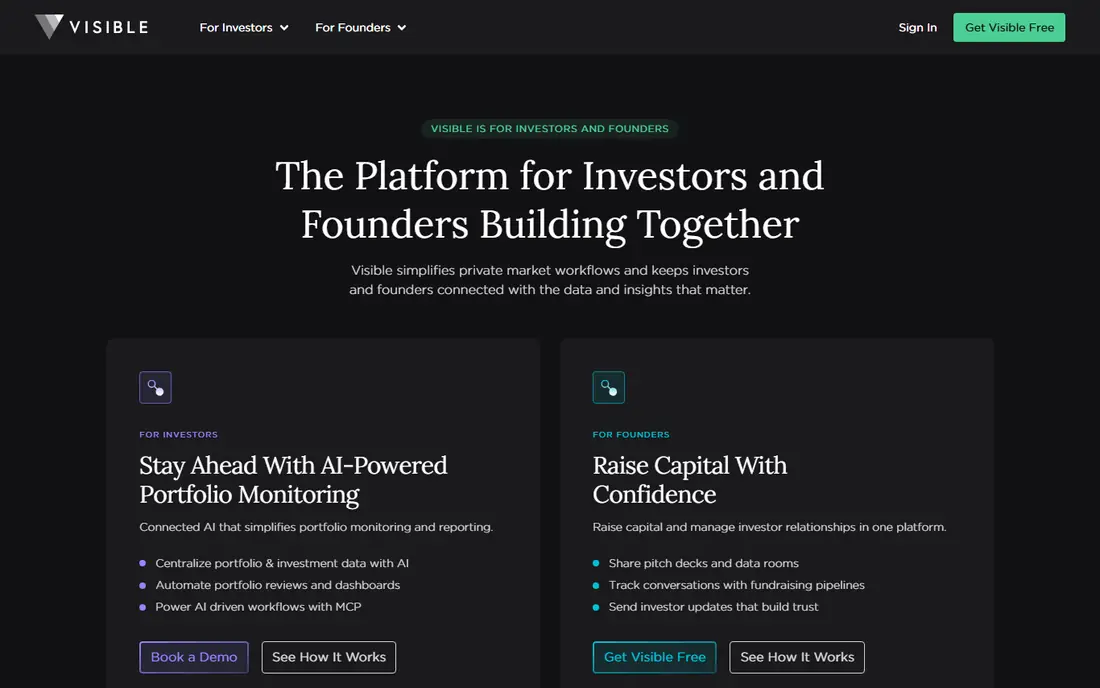
Visible focuses on the most common portfolio support pain: getting clean, regular data from portfolio companies. Founders submit metrics through structured updates, and the firm turns those updates into dashboards, portfolio views, and LP reports. That structured flow beats chasing numbers over email, especially as a portfolio grows past twenty companies.
Visible offers a free tier, which lets a small fund test collection with a few companies before paying. The limit is scope: Visible is a reporting and monitoring tool, not a fund accounting system, so firms still need separate administration for capital calls and distributions. For KPI collection and LP updates, it is one of the clearest choices in this list.
- Structured data collection from portfolio companies
- Free tier available
- LP-ready dashboards and updates
- Less suited to full fund accounting
- Deeper features sit on paid plans
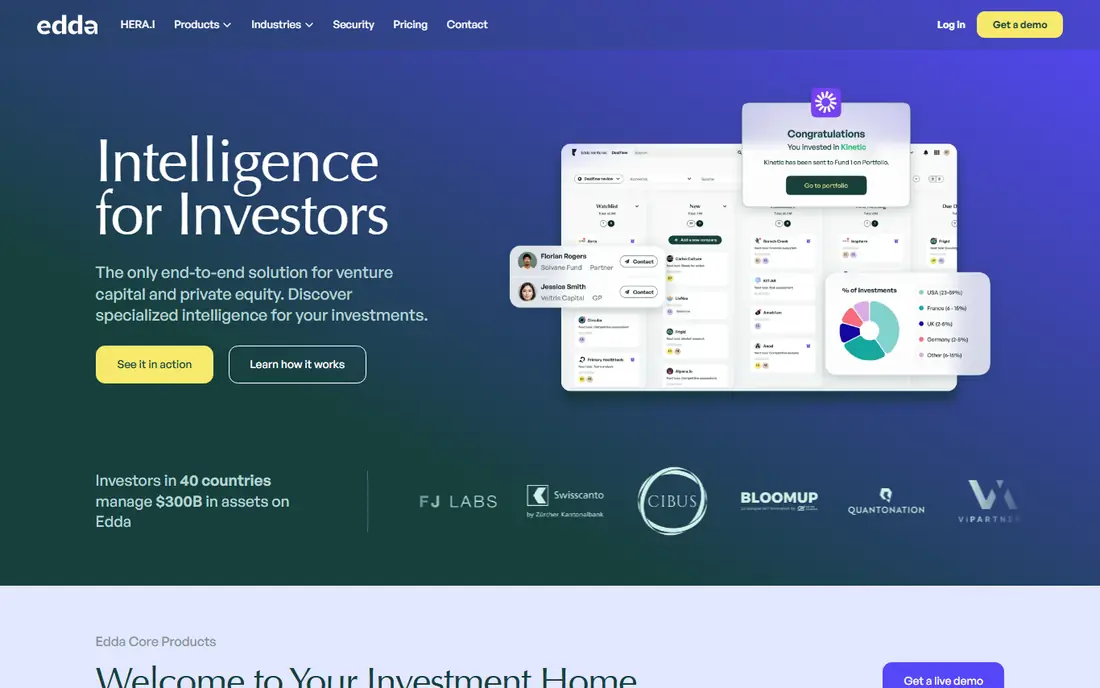
Edda covers deal flow, portfolio tracking, and LP reporting in a single workspace, which appeals to firms tired of stitching several tools together. Portfolio companies, contacts, documents, and updates live in one place, and the team can share notes and tasks around each company. That shared workspace helps platform and investment teams stay aligned on who needs help and what was promised.
The trade-off is overlap. A firm already happy with a separate CRM or fund admin tool may find Edda duplicates part of that stack. Pricing is quote-based, so total cost only becomes clear after a demo and scoping call. For an emerging manager building a first full stack, Edda offers a coherent single home for portfolio work.
- Deal flow through LP reporting in one workspace
- Collaborative portfolio tracking
- Network features
- Pricing is quote-based
- Breadth can overlap with tools a firm already owns
Rundit is a portfolio management and LP reporting platform for VC and private equity teams, built around dashboards and data ingestion from Excel and Google Sheets. That spreadsheet-friendly approach matters, because many portfolio companies already report in spreadsheets and resist a new portal. Rundit meets them partway and still produces structured portfolio views and LP reports.
The platform suits firms whose bottleneck is turning messy company data into clean LP reporting packs. It is less of a relationship CRM than Affinity and less of a fund admin system than Carta, so buyers should judge it on monitoring and reporting alone. Pricing is quote-based. For reporting-led portfolio support, Rundit deserves a trial.
- Dashboard and spreadsheet-based reporting workflows
- Interactive LP reporting
- Portfolio monitoring focus
- Pricing is quote-based
- Smaller brand than Carta or Affinity
Vestberry focuses on portfolio intelligence: collecting KPIs from companies, consolidating metrics across a fund, and turning them into dashboards and LP reports. Built-in metric handling helps when companies report the same idea in different formats, since the platform can map them to a common set. That consolidation is where many firms lose time in spreadsheets.
Vestberry fits firms that want a monitoring-first tool with strong dashboards, rather than a CRM or a full fund admin system. Pricing is quote-based, and buyers should confirm which reporting automation features sit on each tier. For a team whose main pain is messy metrics and slow quarterly packs, Vestberry is a strong candidate.
- KPI collection with built-in metric consolidation
- Dashboard views
- Excel-based LP reporting automation
- Pricing is quote-based
- Reporting automation depth varies by plan
Carta connects equity management with fund administration, which gives portfolio support a firmer data base. Ownership, valuations, and fund events sit near LP reporting, so updates to investors can tie back to real records rather than copied figures. Firms already using Carta for cap tables get the most value, since the data is already in place.
The catch is scope and price. Carta is a broad platform with quote-based pricing, and a firm that only needs KPI collection may find it heavier than Visible or Standard Metrics. It also works best when portfolio companies use Carta too, which is not always the case. For firms that want administration and portfolio data in one system, Carta is a leading option.
- Connects cap table data to fund operations
- LP access and portfolio valuations
- Broad fund admin coverage
- Pricing is quote-based
- Fuller value comes when portfolio companies also use Carta
Juniper Square is a fund administration platform with a strong LP portal, capital call processing, and reporting. For portfolio support, its value is indirect but real: clean LP reporting, accurate capital accounts, and a professional investor portal free the team to spend time on companies instead of reporting mechanics. Larger funds in particular rely on it for investor operations.
The limit is focus. Juniper Square is an administration system first, not a tool for tracking introductions, hiring help, or company KPIs day to day. Pricing is quote-based and reflects its enterprise positioning. Firms should pair it with a monitoring or CRM tool if they also need hands-on portfolio support tracking.
- Strong LP portal and reporting
- Capital call and distribution handling
- Trusted by larger funds
- Pricing is quote-based
- More admin system than day-to-day portfolio support tool
Standard Metrics focuses on one job and does it well: collecting comparable metrics across a portfolio so a firm can compare companies fairly. Standard templates reduce the back-and-forth over definitions, and the platform turns submissions into portfolio views and LP-ready reports. That standardization matters when a fund holds companies at different stages with different reporting habits.
The trade-off is breadth. Standard Metrics does not try to be a CRM, a deal flow tool, or a fund admin system. Firms that want one platform for everything should look at Edda or Carta instead. For a firm whose quarterly reporting is slowed by inconsistent metrics, Standard Metrics is a focused and credible fix.
- Comparable KPI collection across a fund
- Standardized templates
- LP reporting support
- Pricing is quote-based
- Narrower focus than all-in-one VC platforms
Tactyc serves a different part of portfolio support: deciding where to spend reserves and which companies deserve follow-on capital. The platform models portfolio construction, reserves, and follow-on scenarios, so partners can test what happens if a company raises, stalls, or needs a bridge. That planning view complements KPI tools, which show what happened rather than what to do next.
Tactyc is not a replacement for Visible or Standard Metrics, since it does not collect company KPIs or produce LP packs on its own. Pricing is quote-based. For a firm making active follow-on decisions across a growing portfolio, Tactyc adds a planning layer the other tools in this list do not cover.
- Specialist reserve and portfolio construction modeling
- Follow-on scenario planning
- Clear fund-level views
- Pricing is quote-based
- Not a KPI collection or LP reporting tool
How we picked these
We compared official product pages and public documentation for tools that serve VC firms in October 2026. We favored platforms with real VC deployments, clear portfolio or LP reporting features, and current product pages. We left out generic CRMs, generic reporting tools, and data providers with no portfolio support workflow. Where a vendor does not publish a price, we wrote See website rather than repeating third-party estimates as fact.
How to choose portfolio support software for your firm
Start by naming the bottleneck. If founders miss reporting deadlines, pick a collection-first tool such as Visible or Standard Metrics and judge it on founder ease, not dashboard polish. If the team loses track of introductions and hiring help, pick a relationship tool such as Affinity. If LP packs take weeks, pick a reporting-led tool such as Rundit or Vestberry. If follow-on decisions feel like guesswork, add Tactyc to the shortlist.
Next, test with real companies. Ask three portfolio companies to submit a real quarterly update through the trial, then build one LP update from that data. That test exposes template friction, missing metrics, and export limits faster than any demo. Also confirm user limits, portfolio company limits, and data export terms in writing, since those terms decide whether the tool still fits at twice the portfolio size.
A note on cost and data
Most VC platforms in this list price by quote, and totals vary with team size, company count, and reporting features. Get a written quote for your exact counts before comparing vendors. Also ask who owns the data, how it exports, and what happens to company submissions if you leave. Portfolio data is a long-term asset, and export terms matter as much as the dashboard.
Frequently asked questions
What is portfolio support software for VCs?
It is software that helps a venture firm support the companies it already backed. Common jobs include collecting KPIs, preparing LP reports, tracking introductions and hiring help, managing board work, and planning follow-on investments. Different tools cover different parts of that work.
Is portfolio support software the same as fund administration software?
No, though they overlap. Fund administration covers capital calls, distributions, accounting, and LP records. Portfolio support covers company monitoring, reporting, and value-add work. Tools such as Carta and Juniper Square lean toward administration, while Visible and Standard Metrics lean toward monitoring.
How much does VC portfolio software cost?
Most platforms price by quote, based on team size, portfolio company count, and features. Some offer a free tier or trial for small funds. Always request a written quote for your exact counts, and ask what counts as a billable user or company.
Do portfolio companies need to learn new software?
Usually they submit data through a simple form or portal, not the full platform. Ease of submission is a key buying test, since a tool fails if founders avoid it. Trial the founder experience with real companies before signing.
Can one tool cover deal flow, portfolio support, and LP reporting?
Some, such as Edda, try to cover the full workflow in one workspace. Others specialize in one job. A single tool is simpler, while specialist tools often do their one job better. Choose based on which bottleneck costs your firm the most time.
How do we measure whether portfolio support software works?
Track reporting completion rates, time to produce an LP update, number of introductions logged, and hiring help delivered. If reporting gets faster and support activity becomes visible, the tool is working. If founders still report by email, the tool is not.
Sources
See where you really rank - block by block
ProMapRanker scans Google Maps across a grid of your service area. Simple monthly plans from $19, white-label on every plan.
Start freeKeep reading
 zoro.to alternatives
Best Zoro.to Alternatives in 2026
We compare the best zoro.to alternatives in 2026, listing only legal licensed anime streaming services, from Crunchyroll to free options for fans today.
Read → zip alternatives
Best Zip Alternatives in 2026
We compare the best zip alternatives for buy now, pay later in 2026, covering pay-in-4 plans, fees, spending limits, and credit reporting options today.
Read → yesware alternatives
Best Yesware Alternatives in 2026
Compare the best yesware alternatives for sales email tracking, templates, and sequences, with current pricing and honest tradeoffs for small sales teams.
Read →