 ProMapRanker
Best Pokemon Card Value Apps in 2026

Key takeaways
- TCGplayer gives the most useful North American market baseline, because many scanners draw on its prices.
- Collectr and MonPrice suit collectors who want fast camera scanning and a running collection total.
- CardGrader.AI suits the grading question, by estimating whether a card may be worth sending for grading.
- Always check the exact variant, because holo, reverse holo, first edition, and graded copies can price very differently.
Quick comparison
| Pick | Great for | Pricing starts at | Free tier | |
|---|---|---|---|---|
 TCGplayer | North American market prices | Free | Yes | Visit |
 Collectr | Fast scanning and collection totals | Free | Yes | Visit |
 CardGrader.AI | Grading decision help | Free | Yes | Visit |
 MonPrice | Quick multi-game scanning | Free | Yes | Visit |
 Pokellector | Set checklists and collection tracking | Free | Yes | Visit |
 PriceCharting | Price history and trends | Free | Yes | Visit |
 Ludex | Variant and parallel accuracy | See website | No | Visit |
 eBay | Recent sold listings | Free | Yes | Visit |
 Cardmarket | European market prices | Free | Yes | Visit |
The best Pokemon card value apps
Card prices vary by set, condition, variant, and recent sales, and no app can promise a value or a return. Use these apps to check prices, then confirm high-value cards against recent sold listings before you buy or sell.

For many readers, the first question is fit, not features. TCGplayer is the baseline many collectors check first, because its market prices reflect a large North American marketplace.
The catch is interpretation: a market price is a guide from listings and sales data, not a promise that your copy will sell for that amount. Before you commit, check the current pricing and terms on the official site, because plans and limits change. We compared official feature pages, pricing pages, and app store listings for this guide, and we did not claim hands-on testing that did not happen.
- Large marketplace data
- Scanner in app
- Collection and price history tools
- Scanning can be uneven
- Prices reflect listings, not a guarantee
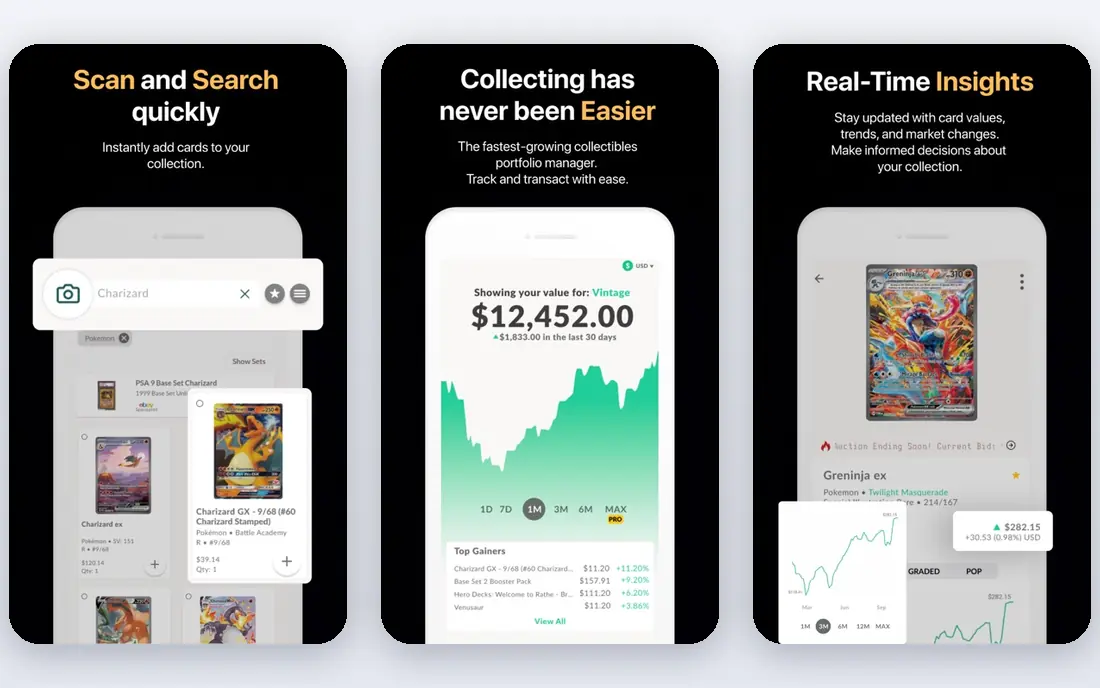
This one earns its place for a clear reason. Collectr scans cards into a collection with a running total, which suits collectors working through binders or boxes.
The catch is verification: scan a valuable card twice and check the variant, because a fast scan can match the wrong version. Before you commit, check the current pricing and terms on the official site, because plans and limits change. We compared official feature pages, pricing pages, and app store listings for this guide, and we did not claim hands-on testing that did not happen.
- Camera scanning
- Binder and collection tracking
- Market value graphs
- Some features sit behind paid tiers
- Scanner accuracy varies by card
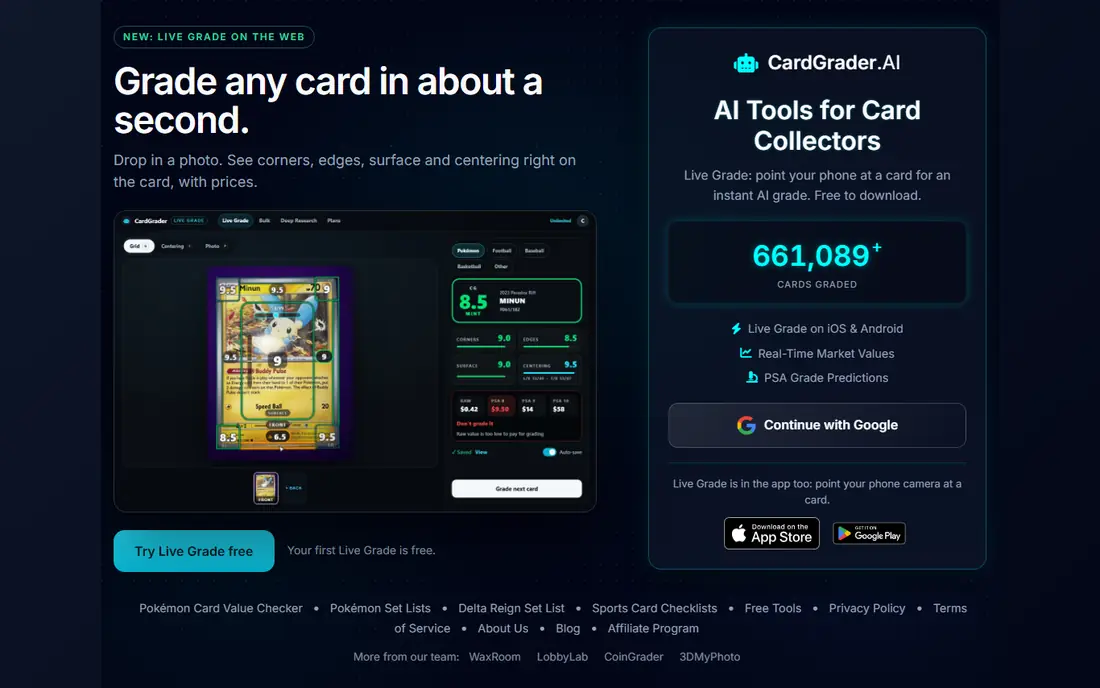
Here the value is practical rather than flashy. CardGrader.AI focuses on the question collectors actually ask: is this card worth grading, and what might it grade?
The catch is expectation: an AI estimate is a guide, and the grading company makes the final call after handling the card. Before you commit, check the current pricing and terms on the official site, because plans and limits change. We compared official feature pages, pricing pages, and app store listings for this guide, and we did not claim hands-on testing that did not happen.
- Free web scanner
- Grade estimates for centering, corners, edges, and surface
- Raw vs graded prices
- Estimates are not a grading guarantee
- App coverage varies
What stands out here is how little setup it takes to get going. MonPrice scans Pokemon and other trading cards quickly and keeps a collection value in one place.
The catch is depth: it is best for quick checks and totals, while rare or graded cards still deserve a second source. Before you commit, check the current pricing and terms on the official site, because plans and limits change. We compared official feature pages, pricing pages, and app store listings for this guide, and we did not claim hands-on testing that did not happen.
- Fast scanner
- Large card database
- Pokemon plus other games
- Some advanced features are paid
- Price source should be checked per card
This pick suits a narrower group, and that focus is its strength. Pokellector helps collectors track which cards they own by set, which is useful when you are completing a set rather than pricing one card.
The catch is pricing: it is a checklist and collection tool first, so pair it with a market app for values. Before you commit, check the current pricing and terms on the official site, because plans and limits change. We compared official feature pages, pricing pages, and app store listings for this guide, and we did not claim hands-on testing that did not happen.
- Set checklists
- Collection progress
- Simple card lookup
- No camera scanner focus
- Prices need a separate market check
For readers who want a calmer option, this one fits. PriceCharting shows how a card price has moved over time, which helps collectors avoid buying at a short-term peak.
The catch is reading: a price spike with few sales can mislead, so check sales volume and recent sold listings alongside the chart. Before you commit, check the current pricing and terms on the official site, because plans and limits change. We compared official feature pages, pricing pages, and app store listings for this guide, and we did not claim hands-on testing that did not happen.
- Historical price data
- Graded price views
- Collection tracking
- Interface is data-heavy
- Some tools need an account
This is the pick to check when the leaders feel too heavy. Ludex built its name on telling apart parallels and variants that other scanners lump together, which matters a lot for modern cards.
The catch is price: real use needs a paid plan, so it suits dealers and high-volume collectors more than casual checkers. Before you commit, check the current pricing and terms on the official site, because plans and limits change. We compared official feature pages, pricing pages, and app store listings for this guide, and we did not claim hands-on testing that did not happen.
- Strong variant matching
- EBay sold data focus
- List-to-eBay tools
- Paid plan needed for real use
- Steepest subscription on this list
A quieter option can still be the right one, and this is a good example. eBay sold listings show what buyers actually paid, which is the strongest reality check for any app price.
The catch is noise: active listings, best offers, and graded vs raw mixes can distort the picture if you do not filter to sold, same-variant results. Before you commit, check the current pricing and terms on the official site, because plans and limits change. We compared official feature pages, pricing pages, and app store listings for this guide, and we did not claim hands-on testing that did not happen.
- Real transaction data
- Sold listings filter
- Huge card supply
- Prices include fees and shipping effects
- Listings need variant care
The last pick rounds out the list for a specific need. Cardmarket is the main European marketplace for Pokemon cards, and its prices reflect European supply and demand.
The catch is region: a Cardmarket price may differ from a US price, so use it as the European check, not a universal value. Before you commit, check the current pricing and terms on the official site, because plans and limits change. We compared official feature pages, pricing pages, and app store listings for this guide, and we did not claim hands-on testing that did not happen.
- European marketplace data
- Condition-based listings
- Large card catalog
- European focus
- US prices can differ
How we picked these
We compared official feature pages, pricing pages, app store listings, and public reviews for each product, and we kept only products that exist, work in October 2026, and truly fit the topic. Where a price or limit could not be verified from the vendor, we wrote See website rather than guessing a figure.
How to check a Pokemon card value without guessing
Identify the card exactly before you trust a price. Set, card number, rarity symbol, holo pattern, and any first edition stamp all change the result. A scanner can speed this up, but for any card that looks valuable, confirm the variant by eye against the listing the app matched.
Compare at least two sources for expensive cards. Use a market price from TCGplayer or Cardmarket, then check recent sold listings on eBay for the same variant and condition. If the two disagree by a lot, the card may have thin sales, a condition gap, or a variant mismatch.
Treat condition honestly. A card with whitening, scratches, or a bent corner is not a near-mint card, even if it looks fine in a sleeve. For high-value cards, grading costs, shipping, and time all reduce the net result, so factor those in before you decide to grade or sell.
Frequently asked questions
What is the most accurate Pokemon card value app?
No single app is exact, because prices move with sales and condition. TCGplayer market prices plus recent eBay sold listings give a stronger check than any one scanner number alone.
Can I scan a card with my phone camera to get its value?
Yes, apps such as Collectr, MonPrice, and CardGrader.AI scan cards and return a price estimate. Scanners can misread variants, so confirm valuable matches by set and card number.
Do graded cards need a different app?
Graded cards are best checked by certification number where the app supports it, because grade changes value sharply. Some scanners read slab labels, while others only price raw cards.
Why do two apps show different prices for the same card?
Apps use different data sources, update at different times, and may match different variants or conditions. Thin sales for rare cards also make prices jump between sources.
Should I grade a card based on an app estimate?
An app estimate can help you decide, but grading costs money and time, and the final grade may differ. Only grade cards where the likely graded value, after fees, clearly beats the raw value.
Sources
See where you really rank - block by block
ProMapRanker scans Google Maps across a grid of your service area. Simple monthly plans from $19, white-label on every plan.
Start freeKeep reading
 zscaler alternatives
Best Zscaler Alternatives in 2026
Looking for zscaler alternatives? We compare 9 SASE and zero trust platforms on architecture, data protection, pricing, and fit for your network and team.
Read → zapier alternatives free
Best Zapier Alternatives Free in 2026
Nine automation tools for zapier alternatives free in 2026, all with genuinely free tiers, plus free plan limits, starting prices and upgrade paths explained.
Read → which platform is best for online reputation
Which Platform Is Best for Online Reputation in 2026
Wondering which platform is best for online reputation? We compare 8 review, listing, and response tools for small and multi-location businesses and agencies.
Read →