 ProMapRanker
Best Platforms for Subscriber Experience in 2026

Key takeaways
- Chargebee and Recurly suit subscription businesses that need flexible billing, self-service portals, and strong churn recovery.
- Zuora and Maxio suit large or finance led teams with complex contracts, revenue recognition, and multi entity billing.
- Stripe Billing suits developer led teams already on Stripe, with API first subscription logic and smart payment retries.
- Paddle suits small software sellers that want global tax and compliance handled as merchant of record.
- Zoho Billing and Recharge suit smaller teams, with Zoho for general billing and Recharge for Shopify subscriptions.
Quick comparison
| Pick | Great for | Pricing starts at | Free tier | |
|---|---|---|---|---|
 Chargebee | Flexible subscription billing | See website | Yes | Visit |
 Zuora | Enterprise quote to revenue | See website | No | Visit |
 Stripe Billing | Developer led subscriptions | See website | No | Visit |
 Recurly | Churn recovery and retention | See website | No | Visit |
 Maxio | B2B SaaS finance operations | See website | No | Visit |
 Paddle | Global software sales | See website | No | Visit |
 Zoho Billing | Low cost SMB billing | See website | Yes | Visit |
 Recharge | Shopify subscriptions | See website | No | Visit |
The best platforms for subscriber experience
Subscriber experience covers the whole journey after signup: managing a plan, pausing or skipping, updating payment details, viewing invoices, getting help with a failed payment, and cancelling without friction. The platforms below all support subscription billing plus customer facing controls, and all are live in October 2026. We judged them on self-service, billing flexibility, dunning, reporting, and ease of integration.
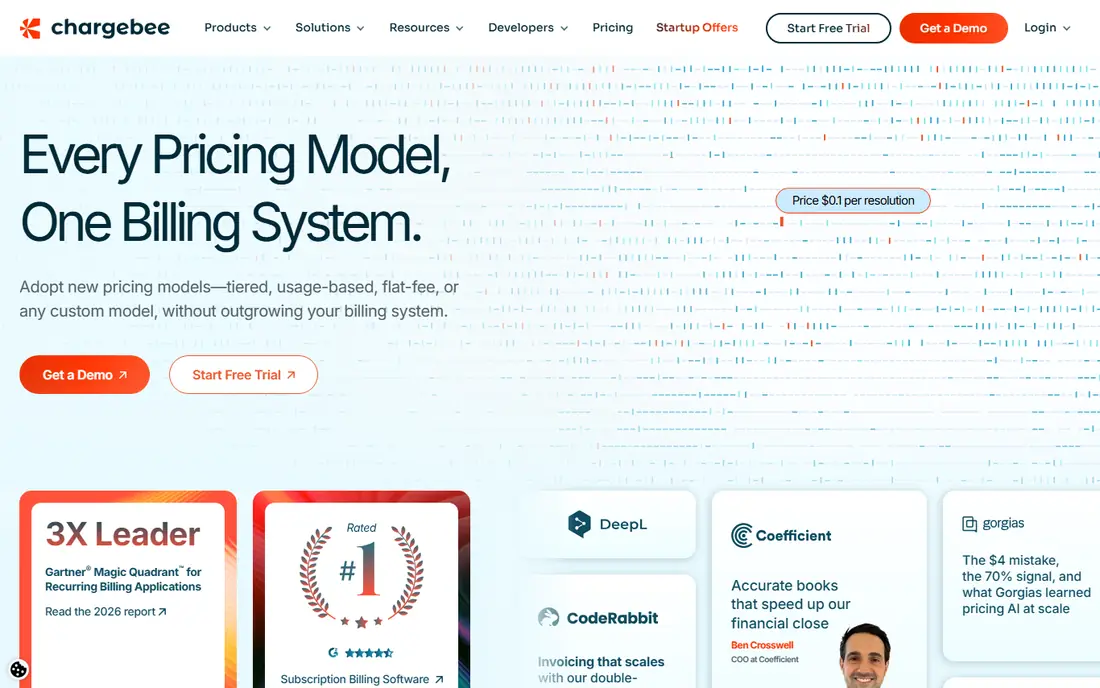
Chargebee gives subscription businesses flexible billing for plans, trials, add ons, usage, and hybrid models, with a customer portal where subscribers can upgrade, downgrade, pause, or cancel within rules you set. That self-service control reduces support tickets for routine changes, while dunning and retry logic help recover failed payments without manual chasing. Integrations with accounting, CRM, and payment gateways suit teams that need billing to fit existing systems.
Pricing needs attention, since Chargebee has used free starter, revenue based, and monthly plan terms at different times, and the right tier depends on billed volume. Teams should confirm current terms, gateway fees, and which portal features sit on their plan. For growth stage SaaS and subscription businesses, Chargebee offers a strong balance of flexibility and subscriber control.
- Broad plan, trial, and proration options
- Customer portal for plan changes
- Many integrations and gateways
- Pricing tiers and revenue based terms need a careful read
- Advanced features sit on higher plans
Zuora is the enterprise reference for subscription businesses with complex contracts, bundles, amendments, and revenue rules. It handles quote to revenue work, including subscription orders, billing, payments, and revenue recognition across accounting standards, which helps finance teams with multi entity and multi currency operations. Large media, telecom, and SaaS companies use it where billing logic goes beyond simple monthly plans.
That depth comes with enterprise implementation effort and a sales led pricing process. Smaller teams will find faster value elsewhere, and Zuora needs skilled admin for configuration and reporting. For a large organisation where contract complexity is the main problem, Zuora offers breadth that simpler billing tools cannot match.
- Deep quote to cash and revenue recognition
- Multi entity and complex contract support
- Strong for media and enterprise SaaS
- Quote based enterprise pricing
- Implementation and admin effort can be high

Stripe Billing suits developer led teams that already take payments with Stripe, since subscription logic, trials, proration, usage billing, and customer portal features sit inside the Stripe platform. Smart retries use payment data to recover failed charges, and the customer portal lets subscribers update payment methods and manage plans without custom code. That speed helps early stage and product led teams launch subscriptions quickly.
The limit is Stripe dependence. Teams that need multiple gateways, complex enterprise contracts, or deep revenue recognition may need Chargebee, Recurly, Maxio, or Zuora beside or instead of Stripe Billing. Pricing is tied to recurring volume plus processing fees, so model costs at your expected volume. For Stripe standardised teams, it is a natural pick.
- API first subscription logic
- Smart retries for failed payments
- Fast launch for teams already on Stripe
- Stripe only payments
- Complex non Stripe gateway or accounting needs may need extra tools
Recurly focuses on keeping subscribers, with smart retry logic, dunning campaigns, and subscriber controls for pausing, skipping, swapping, and changing plans. That focus suits consumer subscriptions, streaming, publishing, and SaaS businesses where involuntary churn from failed payments is a large revenue leak. A gateway agnostic approach also helps teams that use more than one payment provider.
Pricing has moved across published monthly and quote based terms, so buyers should confirm current plan costs and which recovery features are included. Recurly is less of a full enterprise quote to cash suite than Zuora, but for retention and recovery it is a strong specialist. Teams that lose revenue to failed payments should trial its dunning results first.
- Strong dunning and revenue recovery
- Subscriber portal with pause and plan controls
- Multi gateway support
- Pricing is quote based on current plans
- Advanced analytics and features sit on higher tiers
Maxio combines billing from the former Chargify with revenue recognition from SaaSOptics, giving B2B SaaS teams billing, contracts, usage tracking, and finance reporting in one platform. Finance teams can manage plans, add ons, upsells, and renewals, while tracking metrics such as monthly recurring revenue, churn, and expansion. That finance led view suits sales led SaaS companies with annual contracts and usage components.
Consumer subscription features such as storefront style subscriber portals are less central than in Recurly or Recharge, so B2C teams should test the portal experience early. Pricing includes published entry tiers plus quote based higher tiers for advanced revenue recognition and multi entity work. For B2B SaaS finance operations, Maxio is a strong shortlist pick.
- Billing plus revenue recognition for B2B SaaS
- Usage and contract handling
- Strong SaaS metrics and reporting
- Quote based higher tiers
- Best fit is B2B SaaS, so consumer subscription depth is thinner
Paddle acts as merchant of record for software sellers, which means it handles payments, global sales tax, VAT, and compliance on your behalf. Subscribers get checkout, billing, plan changes, and dunning through Paddle, while sellers avoid building tax logic for dozens of countries. That model suits lean software teams selling globally, especially small and mid size SaaS companies without a tax team.
The trade off is control and cost. Merchant of record fees apply per transaction, and sellers give up some direct control over gateway and tax configuration compared with Stripe Billing or Chargebee. Teams with complex enterprise contracts or existing tax infrastructure may prefer a direct billing platform. For global software sales with a small team, Paddle removes a large compliance burden.
- Merchant of record handling global tax and compliance
- Unified billing and subscriber management
- Good for lean teams
- Merchant of record fees apply per transaction
- Less direct control over payments and tax setup than a direct gateway
Zoho Billing suits small businesses that need subscription invoicing, a customer portal, and automated billing without enterprise cost. Subscribers can view invoices, update details, and manage subscriptions through the portal, while teams automate recurring charges, reminders, and payment tracking. Links to other Zoho apps help teams already using Zoho for CRM, accounting, or support.
Enterprise depth is the limit. Complex contracts, advanced revenue recognition, and multi entity billing are better served by Zuora or Maxio, and some advanced subscription features sit on higher Zoho tiers. For a small business that wants low cost, quick setup, and a usable subscriber portal, Zoho Billing offers strong value.
- Low cost entry with a free plan
- Quick setup
- Customer portal and automated invoicing
- Zoho ecosystem links
- Enterprise billing depth trails Zuora and Maxio
- Advanced subscription logic sits on higher tiers
Recharge is built for ecommerce subscriptions on Shopify, where subscribers manage recurring orders rather than software licences. Its customer portal lets shoppers skip, pause, swap products, change frequency, and update payment details, while merchants can run retention offers and bulk updates. That self-service control matters for physical subscriptions, where a missed delivery or a wrong product variant quickly becomes a support ticket.
The fit is narrow by design. Businesses outside Shopify gain less, and pricing depends on plan and store volume, so confirm current terms for your store size. For a Shopify brand whose revenue depends on repeat orders, Recharge offers the most subscriber focused tool on this list.
- Built for Shopify subscriptions
- Subscriber portal for skip, pause, swap, and bulk updates
- Strong retention tools
- Best fit is Shopify stores
- Non Shopify businesses gain less
- Pricing depends on plan and store volume
How we picked these
We compared official feature pages, pricing pages, documentation, and public reviews for subscription platforms, and we kept only products that are live in October 2026. We favoured self-service portals, flexible billing, dunning and recovery, and reporting that links subscriptions to retention. We did not claim hands-on testing, and we used See website for pricing where vendors use quote based, volume based, or changing plan terms. We did not list Chargify as a separate alternative, since it merged into Maxio.
How to choose a subscriber experience platform that keeps customers
Start with the subscriber moments that cause tickets and churn. List the top reasons subscribers contact support, such as failed payments, plan changes, pauses, address changes, and cancellations, then test each platform on those exact flows. A platform that handles billing well but makes pausing hard will still lose subscribers who only needed a short break.
Test the portal as a subscriber
Sign up, change a plan, pause, update a card, view an invoice, and cancel in a trial account, on mobile and desktop. Check whether changes take effect at once, whether proration is clear, and whether cancellation asks for feedback without blocking exit. A portal that hides controls or confuses proration creates support work and bad feeling, even if backend billing is correct.
Check dunning before you need it
Ask how failed payments are retried, how subscribers are notified, and how grace periods work. Test a failed card flow and see what the subscriber sees, what your team sees, and how quickly a recovered payment restores access. Dunning quality often decides more revenue than a small price difference between platforms.
Plan for growth and finance needs
Confirm how usage billing, annual contracts, multi currency, tax, and revenue recognition will work as you grow, not just at launch. A platform that fits fifty subscribers may struggle at fifty thousand, or when finance needs auditable revenue schedules. Ask for migration and data export terms, so a future switch does not trap subscriber history.
Frequently asked questions
What is the best platform for subscriber experience?
Chargebee and Recurly suit flexible billing and retention, Zuora and Maxio suit enterprise and finance led teams, Stripe Billing suits developer led Stripe teams, and Recharge suits Shopify stores. Pick by business model, contract complexity, and gateway needs.
What makes a good subscriber portal?
Clear plan controls, easy pause and skip options, simple payment updates, visible invoices, and a cancellation flow that does not hide or block exit. The portal should work on mobile, show proration clearly, and confirm each change at once.
How do platforms reduce involuntary churn?
They retry failed payments with smart logic, notify subscribers to update cards, offer grace periods, and surface dunning data to your team. Recurly and Stripe Billing are known for this focus, while Chargebee and Recharge also include dunning and recovery tools.
Should a small business use a free billing plan?
A free plan, such as Chargebee starter terms where available or Zoho Billing free tier, can suit a very small subscriber base. Check subscriber, invoice, and feature limits, since growth often moves teams to paid tiers quickly.
Is Paddle different from Stripe Billing?
Yes. Paddle is a merchant of record that handles global tax and compliance for you, while Stripe Billing is a billing platform on top of Stripe payments. Paddle suits lean global software sellers, while Stripe Billing suits teams that want direct Stripe control.
Sources
See where you really rank - block by block
ProMapRanker scans Google Maps across a grid of your service area. Simple monthly plans from $19, white-label on every plan.
Start freeKeep reading
 worlds best local seo company
8 Worlds Best Local SEO Companies for Map Pack Growth in 2026
Compare the worlds best local seo company options for Google Business Profile work, citations, reviews, and multi-location rankings and reporting in 2026.
Read → world's best web hosting company
World's Best Web Hosting Company in 2026
Searching for the world's best web hosting company? We compared 10 hosts on price, renewal rates, speed, and support to help you choose well today in 2026.
Read → who's got the best nanny tax services
Who's Got the Best Nanny Tax Services in 2026
We answer who's got the best nanny tax services, comparing full filing, back taxes, software, and pricing so families can handle nanny taxes correctly.
Read →