 ProMapRanker
Best Platform for Personalized Student Learning in 2026


Free, learner-led lessons across subjects · Pricing starts at: Free
Key takeaways
- Khan Academy is the best free learner-first starting point, with lessons a student can follow without a paid account.
- DreamBox and ALEKS adapt most deeply by subject, with DreamBox for elementary math and ALEKS for older math and science.
- IXL suits a student who needs targeted skill practice, while Zearn suits a student who needs a full lesson first.
- Prodigy, SplashLearn, and Boddle motivate through games, but parents should watch the paid extras inside free games.
- Age range matters more than brand here, so match the tool to the student grade and subject before paying.
Quick comparison
| Pick | Great for | Pricing starts at | Free tier | |
|---|---|---|---|---|
| Khan Academy | Free, learner-led lessons across subjects | Free | Yes | Visit |
 DreamBox | Adaptive math that adjusts lesson by lesson | See website | No | Visit |
 IXL | Targeted skill practice by grade and subject | $9.95 per month | No | Visit |
 ALEKS | Adaptive math and science for older students | See website | No | Visit |
 Prodigy | Game-based math and English practice | Free | Yes | Visit |
 Zearn | Full math lessons with built-in help | Free | Yes | Visit |
 SplashLearn | Game-based learning for younger children | See website | Yes | Visit |
 Boddle | Game-based practice with free learning content | Free | Yes | Visit |
The best platforms for personalized student learning
This list looks at personalization from the student side, which is what a learner actually experiences when they sit down to work. We compared official feature pages, pricing pages, app store listings, and public reviews, and we judged each tool by how it adapts, how it motivates, and how clear its cost is for families.
Khan Academy works best as a student library with a path through it. A learner watches a short lesson, practices a skill, and moves on only after showing mastery, which means gaps get filled rather than skipped. Subjects run from early math through calculus, with science, computing, economics, history, and SAT preparation alongside, all free.
The student experience is steady rather than exciting. There is no game world to explore, and a younger or easily distracted learner may need a parent or teacher to set a routine. For a student who can follow a lesson and practice with focus, Khan Academy is the strongest free personalized learning tool available, and it costs nothing to try first.
- Full lessons and practice at no cost
- Mastery-based path lets students fill gaps
- Covers math, science, computing, and test prep
- Calm format suits focused learners more than game lovers
- Self-direction needs parent or teacher support
- Depth varies by subject
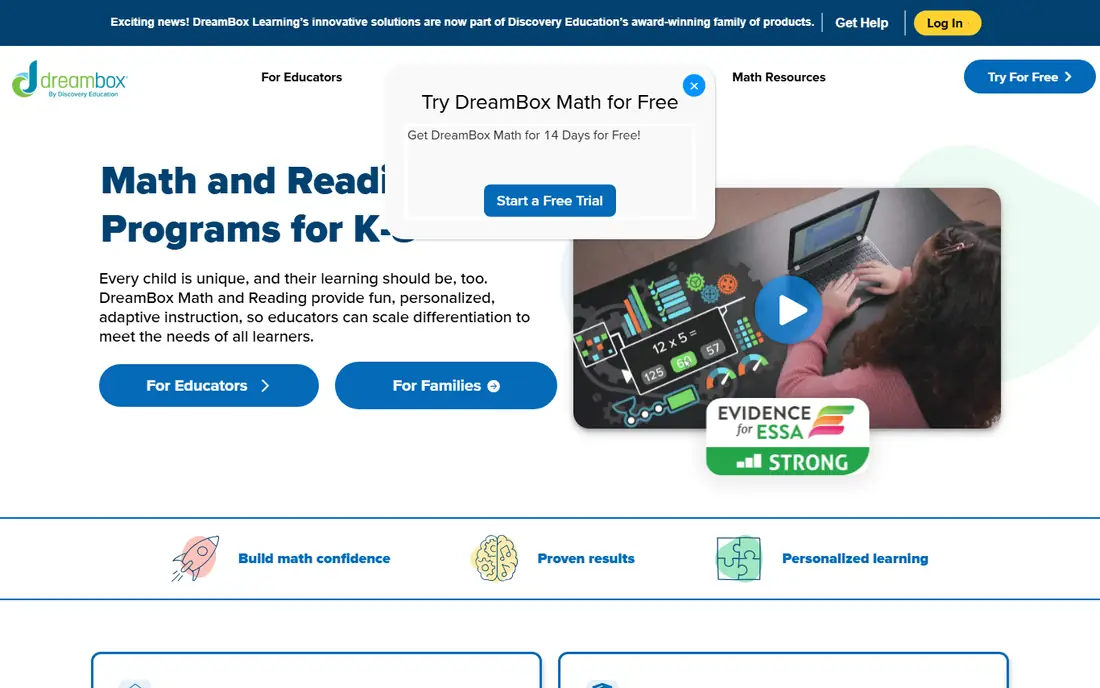
DreamBox feels different to a student because the lesson itself changes as they answer. A wrong approach leads to a different path, a hint, or a visual model, rather than a simple mark and a move on. That in-lesson adaptation is why it suits math learners who sit at different levels in the same class, and why teachers value its reports.
DreamBox covers math only, from kindergarten through grade 8, so reading or science needs another tool. Pricing for families and schools is paid and varies, so check the vendor site for current figures. For a student who needs math that meets them where they are, DreamBox is the most adaptive math experience here.
- Adapts within a lesson, not just between tests
- Visual, game-like math for kindergarten through grade 8
- Reports show where a student struggles
- Math only
- Home and school pricing is quoted or paid
- Needs regular sessions to adapt well
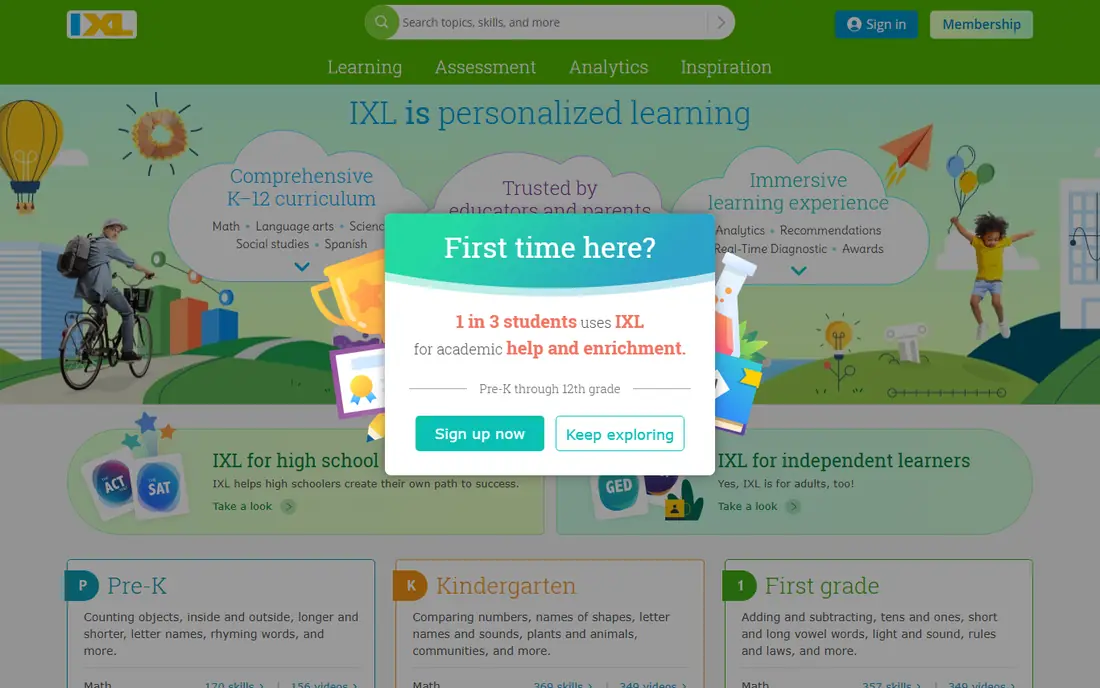
IXL suits a student who already knows what to work on, or whose diagnostic has named the gap. A learner picks a skill, such as fractions or grammar, and works through short questions with instant feedback, while the system tracks mastery by skill. Coverage spans pre-K through grade 12 across math, language arts, science, and social studies.
The student experience is practice, not teaching in the Zearn sense, so a learner who needs a full explanation first may struggle. Family plans list from $9.95 per month for one subject for one child in recent summaries, with higher tiers for more subjects. For closing a named skill gap, IXL is the most precise practice tool here.
- Thousands of skills organized by grade and topic
- Diagnostic finds the right starting level
- Instant feedback and explanations on practice
- Practice-heavy format can feel like drill
- Full access is paid
- Free practice is limited to a small daily amount
ALEKS, from McGraw Hill, starts with an adaptive assessment that maps a student knowledge state, then builds a learning path from what the student is ready to learn next. That assessment-first design suits older students in algebra, geometry, precalculus, and college math, where gaps from earlier years block new topics. Periodic reassessment updates the path as the student learns.
ALEKS is not a game, and younger children will likely prefer Prodigy or SplashLearn. Pricing is handled through schools, courses, or direct purchase depending on the product, so check the vendor site for the version you need. For an older student who needs a clear, adaptive math path, ALEKS is the most rigorous option here.
- Adaptive assessment maps what a student knows and is ready to learn
- Strong for middle school, high school, and college math
- Science courses for older students
- Paid product with school or course pricing
- Interface is functional rather than playful
- Younger students are not the focus
Prodigy turns practice into a game where correct answers power a character through a fantasy world. Students choose pets, explore, and battle, while the questions underneath adapt to their level and cover standards-aligned math and English skills. For a student who avoids worksheets, that game layer can turn ten minutes of practice into thirty without a fight.
Parents should set expectations early. Memberships, listed from $9.95 per month or $58.95 per year for families in recent summaries, add game rewards and science content, and children will notice them. The core curriculum content remains free, so a family can use Prodigy without paying. For motivation first, Prodigy is the strongest game-based pick here.
- Core math and English curriculum content is free
- Fantasy game keeps many students practicing longer
- Questions adapt to student level
- Membership extras are visible inside the game
- Game layer can distract from learning
- Science content sits behind membership
Zearn feels like a lesson, not just a practice set, and that is its strength for students. A learner watches a short video, works with visual models, and gets hints and feedback when stuck, all inside a digital lesson that mirrors classroom teaching. The pace is calm, and the support is built in rather than added as a separate help page.
Zearn covers math only, and students use it on the web rather than through a mobile app, which matters for tablet-heavy homes. Instructional content is free, while school accounts add premium features. For a student who needs to understand a topic first, then practice it, Zearn is the best free lesson-first choice here.
- Teaches the concept before practice, with short videos
- Visual models and built-in help when stuck
- Instructional content is free
- Math only, kindergarten through grade 8
- Web-based, with no student mobile apps
- Less game motivation than Prodigy
SplashLearn gives younger students a colorful, game-based path through math and reading, with difficulty that adapts as a child answers. Early learners meet counting, addition, phonics, and reading skills through games, rewards, and short challenges, which suits short, regular sessions after school. Teachers can use it free in class, and parents get progress reports at home.
The age ceiling is firm, since content stops at grade 5, and family subscriptions are paid with prices that vary by billing period. For a child in pre-K through grade 5 who learns best through play, SplashLearn is a strong, focused choice, best paired with a calmer tool like Khan Academy as the child grows.
- Adaptive games for pre-K through grade 5
- Math and reading in one playful place
- Teacher and parent reports show progress
- Range ends at grade 5
- Family pricing is paid and varies
- Needs internet, with no offline mode for most play
Boddle takes a fairer approach to free game learning than many rivals. All learning content is free, while Premium, listed at $5.83 per month billed yearly in recent summaries, buys in-game rewards such as pet perks and shop items rather than gating the curriculum itself. Students play games, answer math and English questions, and build characters, while teachers and parents follow progress.
Boddle suits elementary students, and older learners will outgrow it. Its subject range is narrower than Khan Academy or IXL, so it works best as a practice companion rather than a full curriculum. For a family that wants game motivation without paying for access to learning itself, Boddle is the most honest free-game model here.
- All learning content is free, with paid extras only for game rewards
- Covers math and English for elementary students
- Classroom-friendly game format
- Elementary focus, so older students age out
- Premium buys game perks, not learning content
- Smaller subject range than IXL or Khan Academy
How we picked these
We compared official feature pages, pricing pages, app store listings, and public reviews, and we judged each tool from the learner experience, not from the teacher dashboard alone. That is the difference from a teacher-tools list, since a tool can have a strong dashboard and still feel dull or confusing to the student using it. We did not repeat vendor claims about score gains as fact, and we noted where pricing is paid, quoted, or varies.
How to match a tool to a student
Start with age and subject, then with learning style. A younger child who needs play will do better with SplashLearn, Prodigy, or Boddle, while an older student who needs a math path will do better with ALEKS or DreamBox. A student who needs a lesson first suits Zearn, while a student who needs to close a named gap suits IXL.
Then test for two weeks, not two months. Watch whether the student starts sessions without prompting, whether the difficulty feels right, and whether the reports show real progress on the target skill. A tool that a student enjoys but never advances on is entertainment, and a tool that advances a student who hates it will not last. The right tool is the one the student will actually use and learn from.
Frequently asked questions
What is the best free personalized learning platform for students?
Khan Academy is the best free choice for most students, with full lessons and practice across many subjects at no cost. Zearn instructional math content is also free, and Prodigy core math and English content is free. Start with those before paying for any adaptive tool.
How does adaptive learning actually work?
Adaptive tools change the next task based on answers, so a student who struggles gets support or easier steps, and a student who succeeds gets harder work. DreamBox adapts within a lesson, ALEKS adapts from an assessment of what a student knows, and IXL adapts by skill mastery. The method differs, but the goal is the same, which is work at the right level.
Are game-based learning apps effective?
Games can increase time on task, which helps practice, but the learning still depends on the questions underneath. Prodigy, SplashLearn, and Boddle all tie game progress to curriculum questions, which is a good sign. Watch whether a child is learning the skill or just chasing rewards, and pair games with a lesson tool like Zearn or Khan Academy where needed.
Should parents pay for IXL, DreamBox, or ALEKS?
Pay only after a free trial or a clear gap. IXL suits a named skill gap, DreamBox suits adaptive elementary math, and ALEKS suits older math. If Khan Academy or Zearn already covers the need for free, keep the money. Check current pricing on each vendor site, since school and family prices differ.
Do these platforms share student data?
Data handling varies by vendor, so parents and schools should read the privacy policy before creating accounts for children. Look for statements on advertising, data retention, and parental consent, and prefer district or class rostering where available. Avoid tools that require more personal data than the learning task needs.
Can one platform cover all subjects and ages?
No single tool here covers every subject and age well. Khan Academy comes closest on breadth and cost, but it lacks the game motivation some younger students need and the deep adaptation of DreamBox or ALEKS in math. Most families do best with one free core tool plus one specialist for the weakest subject.
Sources
See where you really rank - block by block
ProMapRanker scans Google Maps across a grid of your service area. Simple monthly plans from $19, white-label on every plan.
Start freeKeep reading
 worlds best local seo company
8 Worlds Best Local SEO Companies for Map Pack Growth in 2026
Compare the worlds best local seo company options for Google Business Profile work, citations, reviews, and multi-location rankings and reporting in 2026.
Read → world's best web hosting company
World's Best Web Hosting Company in 2026
Searching for the world's best web hosting company? We compared 10 hosts on price, renewal rates, speed, and support to help you choose well today in 2026.
Read → who's got the best nanny tax services
Who's Got the Best Nanny Tax Services in 2026
We answer who's got the best nanny tax services, comparing full filing, back taxes, software, and pricing so families can handle nanny taxes correctly.
Read →