 ProMapRanker
Best Platform for Content E-Commerce in 2026

Key takeaways
- Gumroad and Payhip are the fastest low-cost ways to sell a first digital product, because both start free with a per-sale fee.
- Podia, Teachable, and Kajabi suit course and membership businesses that want a full site, checkout, and email in one place.
- Shopify is best when digital content sits alongside physical products or a larger store catalog.
- Lemon Squeezy and Whop help with tax handling, licensing, and community-style memberships.
- Fees matter more than monthly price at low volume, and monthly price matters more once sales grow.
Quick comparison
| Pick | Great for | Pricing starts at | Free tier | |
|---|---|---|---|---|
 Gumroad | First product launch | Free | Yes | Visit |
 Payhip | Budget digital sellers | Free | Yes | Visit |
 Podia | Courses and community in one place | See website | Free trial | Visit |
 Teachable | Structured online courses | $39 per month | Free trial | Visit |
 Kajabi | Premium course and coaching business | $179 per month | Free trial | Visit |
 Shopify | Full store with digital and physical products | $39 per month | Free trial | Visit |
 Lemon Squeezy | Software and tax handling | Free | Yes | Visit |
 Sellfy | Storefront with digital and print-on-demand | See website | Free trial | Visit |
 Whop | Memberships and community offers | Free | Yes | Visit |
The best platforms for content e-commerce
This article covers platforms for selling digital content: courses, downloads, templates, memberships, and coaching offers. That is a different job from selling only physical goods, because you need secure file delivery, license handling, course hosting, or recurring membership billing. We compared official pricing pages, feature pages, and current platform comparisons to check fees, free plans, and what each platform actually includes.

Gumroad is where many creators sell their first digital product, because setup takes minutes and there is no monthly fee. Upload a file, set a price, and you can sell ebooks, templates, courses, memberships, or software licenses the same day. As merchant of record, Gumroad handles sales tax, which removes a major headache for a solo seller.
The fee is the trade-off. At 10% plus $0.50 per direct sale, Gumroad takes a meaningful cut once volume grows, and Discover marketplace sales cost more. Treat Gumroad as a launchpad: validate demand here, then move to a lower-fee platform when monthly fees would cost less than the per-sale fees you are paying.
- No monthly fee to start
- Merchant of record handling for sales tax
- Fast setup for downloads, courses, and memberships
- 10% plus $0.50 per direct sale
- Higher fee on Discover marketplace sales
- Limited storefront customization
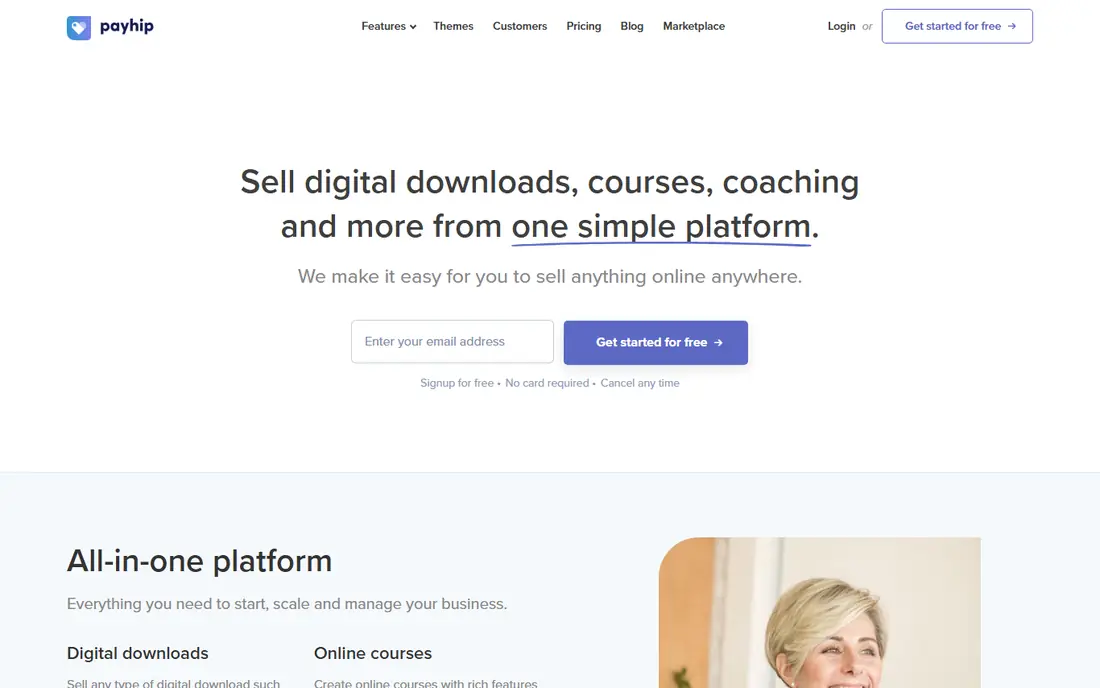
Payhip is a strong budget alternative to Gumroad, with a free plan that charges 5% per sale and paid plans that reduce or remove that fee. It handles downloads, courses, memberships, and subscriptions, and it helps with EU VAT, which matters for sellers with European buyers. Setup is simple, and you can run a storefront without building a website.
The storefront is simpler than Podia or Kajabi, so a course business that needs deep community, coaching, and email tools may outgrow it. For a seller focused on downloads and simple courses, Payhip keeps costs low while sales are still growing.
- Free plan with 5% per sale
- EU VAT handling
- Supports downloads, courses, and subscriptions
- Free plan fee adds up at volume
- Storefront is simpler than a full course platform

Podia suits creators who want courses, downloads, and community without stitching several tools together. You can host a course, sell a download, run a webinar, and run a membership community from the same account, with email marketing built in. That all-in-one approach saves time for a small team that does not want to manage separate tools.
Podia is not a full ecommerce system for a large physical catalog, so a store with hundreds of physical products will fit Shopify better. For a content business, though, the combination of course hosting, community, and email in one subscription is a clear advantage.
- Courses, downloads, webinars, and community in one tool
- Built-in email marketing
- No platform fee on higher plans
- Pricing varies by plan and year
- Less suited to large physical catalogs
Teachable is built for educators who want a structured course with lessons, quizzes, certificates, and student progress tracking. The course builder is straightforward, and coaching and membership features let you sell more than a single course. For a teacher, trainer, or consultant turning knowledge into a course, Teachable is a natural fit.
Lower plans include transaction fees, so check the fee on your plan against your expected sales. Marketing automation is lighter than Kajabi, so a business that relies heavily on funnels and email campaigns may need an extra tool. For course-first selling, Teachable covers the core job well.
- Strong course builder and student tools
- Coaching and membership options
- Clear pricing tiers for educators
- Transaction fees on lower plans
- Marketing tools are lighter than Kajabi
Kajabi is the premium all-in-one option for a course and coaching business that is already selling. It combines a website builder, course hosting, email marketing, funnels, and community in one system, with no platform transaction fee on paid plans. That breadth suits a business that wants one vendor for marketing and delivery.
The price is the barrier. At $179 per month to start, Kajabi only makes sense once sales cover that cost comfortably. A new seller should start cheaper, validate a course, and move to Kajabi when the business needs its marketing depth and can afford the subscription.
- Website, courses, email, and funnels in one platform
- Strong marketing automation
- No platform transaction fee on paid plans
- Highest monthly price on this list
- More than a new seller needs
Shopify is the best choice when digital content is part of a larger store, not the whole business. You get a full storefront, checkout, discount tools, and a large app range, and you can add digital delivery or course apps as needed. That flexibility suits a brand that sells merchandise, print products, and digital downloads together.
Shopify is not a course platform out of the box. Course hosting, membership gating, and student tracking need apps, which add cost and setup. If your business is mostly courses, Podia, Teachable, or Kajabi will be simpler. If your business is mostly a store, Shopify is the stronger base.
- Full ecommerce storefront
- Large app range for digital delivery and courses
- Strong for mixed physical and digital catalogs
- Course hosting needs apps or integrations
- Monthly fee plus payment processing
Lemon Squeezy is popular with software and SaaS sellers because it acts as merchant of record, handling global sales tax, and it delivers license keys for software products. There is no monthly fee to start, with a per-sale fee instead, which makes it easy to test a product without a subscription.
Course and community features are lighter than a dedicated course platform, so a course business may prefer Teachable or Podia. For a developer selling software, templates, or digital tools, Lemon Squeezy removes tax and licensing work that would otherwise need extra tools.
- Merchant of record for global tax
- License key delivery for software
- No monthly fee to start
- Per-sale fee adds up at volume
- Less course and community depth than Podia or Kajabi
Sellfy gives you a storefront for digital products with print-on-demand as an option, which suits creators who sell both downloads and merchandise. Paid plans charge no platform transaction fee, so your cost is the monthly subscription plus payment processing. Setup is fast, and the storefront is cleaner than a marketplace listing.
Course hosting is basic compared with Teachable or Podia, so a serious course business will feel the limits. For a creator selling downloads, templates, music, or art, with some print products on the side, Sellfy is a simple and affordable storefront.
- Storefront for digital products
- Print-on-demand options
- No platform transaction fee on paid plans
- Course features are basic
- Smaller ecosystem than Shopify
Whop is built for memberships, courses, and community offers, with a marketplace where buyers can discover products. You can create offers, set pricing, and manage members from one dashboard, with a low per-sale fee and no monthly fee to start. That model suits Discord communities, trading groups, coaching memberships, and similar offers.
A seller who wants a fully branded standalone site may prefer Podia or Shopify, because Whop's marketplace framing is part of the experience. For a community-led content business, though, Whop's discovery, membership tools, and low entry cost are a strong combination.
- Memberships, courses, and community offers in one marketplace
- Low per-sale fee
- Easy offer creation
- Marketplace model suits community sellers best
- Less control than a standalone site
How we picked these
We compared official pricing and feature pages for platforms that sell digital content, including courses, downloads, memberships, and software. We kept platforms that are live in October 2026 and that handle checkout and delivery for digital products, and we left out pure marketplaces that take a large commission and give you little control. Where pricing varied by source, we used See website rather than publishing a figure we could not verify on the vendor page.
How to choose a content e-commerce platform
Start with your product type. Downloads and templates need secure delivery and low fees, courses need a course builder and student tools, and memberships need recurring billing and community. Then do the fee math: at low volume, a free plan with a per-sale fee is cheapest, while at higher volume a monthly subscription with no platform fee wins.
Check tax handling next, especially if you sell internationally. A merchant of record platform removes tax work, while other platforms leave it to you. Finally, test checkout as a buyer. Buy your own product, check delivery, and see how the receipt, download link, and member access work before you promote it publicly.
Frequently asked questions
What is the best platform for content e-commerce?
Gumroad is best for a first launch, Podia is best for courses plus community, and Shopify is best for a full store with physical and digital products. The right pick depends on whether you sell courses, downloads, memberships, or a mix.
What are the best tools for content e-commerce?
For tools that cover content for e-commerce, Gumroad, Payhip, and Lemon Squeezy handle downloads and tax with low startup cost, while Teachable, Podia, and Kajabi handle courses and memberships. Shopify adds a full store when you need one.
What is the best platform for selling digital courses?
Teachable is a strong course-first pick, Podia adds community and email in one tool, and Kajabi adds full marketing funnels at a higher price. Choose based on course depth, marketing needs, and budget.
Is there a free platform for selling digital content?
Yes. Gumroad, Payhip, Lemon Squeezy, and Whop all start free with a per-sale fee. That fee becomes expensive at volume, so compare it against a monthly subscription once sales grow.
How do fees work on content platforms?
Some platforms charge a monthly subscription plus payment processing, some charge only a per-sale fee, and some charge both. Always add payment processing to the platform fee to get your true cost per sale.
Can I sell memberships and downloads on the same platform?
Yes. Gumroad, Payhip, Podia, Whop, and Shopify with apps all support downloads and memberships, though membership depth varies. Check recurring billing, member access, and cancellation handling on your chosen plan.
Sources
See where you really rank - block by block
ProMapRanker scans Google Maps across a grid of your service area. Simple monthly plans from $19, white-label on every plan.
Start freeKeep reading
 zscaler alternatives
Best Zscaler Alternatives in 2026
Looking for zscaler alternatives? We compare 9 SASE and zero trust platforms on architecture, data protection, pricing, and fit for your network and team.
Read → zapier alternatives free
Best Zapier Alternatives Free in 2026
Nine automation tools for zapier alternatives free in 2026, all with genuinely free tiers, plus free plan limits, starting prices and upgrade paths explained.
Read → which platform is best for online reputation
Which Platform Is Best for Online Reputation in 2026
Wondering which platform is best for online reputation? We compare 8 review, listing, and response tools for small and multi-location businesses and agencies.
Read →