 ProMapRanker
Best PIM Tools for App Development Teams in 2026


Flexible enterprise PIM with open-source option · Pricing starts at: Free
Key takeaways
- In this article, PIM means product information management, which is the system that holds product names, attributes, images, and channel-ready content in one place.
- Akeneo, Pimcore, and Plytix cover the widest range of budgets, from free community or free tiers up to enterprise plans.
- Salsify, inriver, and Bluestone PIM suit large catalogs and retailer syndication, but they are quote-based and need a scoped project.
- App teams should pick a PIM with a clear API, workflow, and channel connectors, since developers live with those choices long after launch.
Quick comparison
| Pick | Great for | Pricing starts at | Free tier | |
|---|---|---|---|---|
| Akeneo | Flexible enterprise PIM with open-source option | Free | Yes | Visit |
 Pimcore | Developer-led custom PIM | Free | Yes | Visit |
 Salsify | Retailer syndication and digital shelf | See website | No | Visit |
 inriver | Complex B2B catalogs | See website | No | Visit |
 Plytix | Mid-market PIM with built-in DAM | Free | Yes | Visit |
 Sales Layer | Easy PIM for manufacturers | See website | Free trial | Visit |
 Catsy | Catalog and channel publishing | See website | Free trial | Visit |
 Bluestone PIM | Multi-channel retail PIM | See website | No | Visit |
 Ergonode | Open PIM for growing teams | Free | Yes | Visit |
The best pim tools for app development teams
We compared official feature pages, pricing pages, documentation, and public reviews for product information management tools that app development teams can build against. Here, PIM means product information management, not personal information management, and every tool below manages product data for apps, stores, and sales channels.
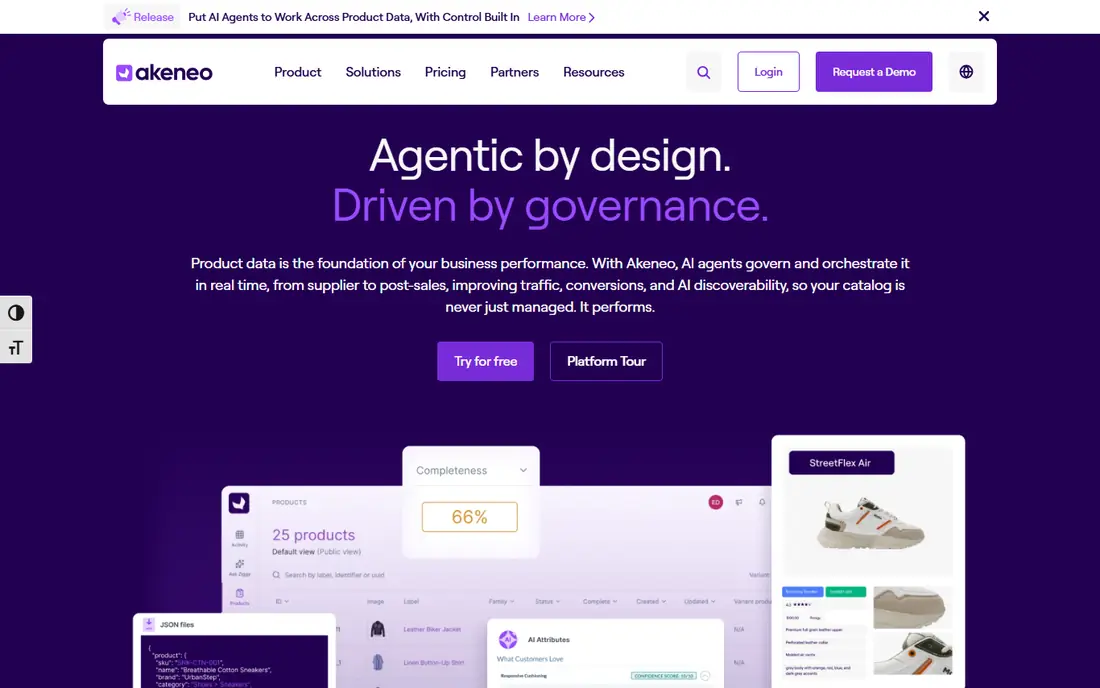
Akeneo suits app teams that need a PIM their product and engineering staff can both understand. The interface shows data completeness at a glance, so a team can see which products lack images, descriptions, or required attributes before publishing to an app or store. An API and app marketplace help developers connect the PIM to storefronts, mobile apps, and internal tools without rebuilding product data each time.
The trade-off is cost and implementation. Community Edition is free to license but needs hosting and engineering, while paid cloud plans are quote-based and can run into tens of thousands per year. Small teams should start with the community route only if they have developer time, and larger teams should scope channels, languages, and SKU counts before requesting a quote.
- Community Edition is free to self-host
- Clear data completeness views
- Wide app marketplace and API for app teams
- Paid SaaS plans are quote-based and costly for small teams
- Heavy customisation needs partner help

Pimcore appeals to app development teams that want to shape the data model themselves. As an open-core platform, it combines product information, digital assets, and master data in one system, so a team can model complex products, variants, and relationships without forcing them into a rigid template. Developers get API access and self-hosting control, which suits teams with strict hosting or integration rules.
The honest limit is effort. Pimcore rewards a team with engineering capacity, but it punishes a team that expects a plug-and-play setup. Implementation, upgrades, and hosting all need attention, and paid editions add cost on top of engineering time. If your team builds software for a living, that control is a benefit. If it does not, a hosted SaaS PIM will be calmer.
- Open-core platform with deep customisation
- PIM plus DAM and data hub in one system
- Strong fit for teams that want control
- Needs developer capacity to run well
- Enterprise and cloud pricing is quote-based

Salsify fits brands that sell through many retailers and marketplaces and need one source of truth for product content. Syndication connectors push enriched data to retailer sites, while digital shelf analytics show how content performs once it is live. For a large catalog with many channels, that loop between publishing and measurement is the main reason to pay enterprise prices.
The downside is access and effort. Pricing is quote-based, there is no free plan, and onboarding takes time and staff. Smaller app teams with one storefront will not use the syndication depth, and they should not pay for it. Salsify earns its place when retailer coverage, not just internal product data, is the core problem.
- Deep retailer and marketplace syndication
- Digital shelf analytics next to product content
- Single source of truth for large catalogs
- Enterprise pricing with no public price
- Heavier onboarding curve
inriver suits B2B teams with complex catalogs, where a product may have many variants, price lists, and channel rules. The SaaS platform handles enrichment, workflow, and syndication in one place, and digital shelf tools help teams see how content lands with retailers. That combination matters when product data must serve distributors, sales teams, and online stores at once.
The trade-off is scale and cost. inriver is priced for mid-market and enterprise teams, with no free plan and a project that needs scoping, training, and data cleanup. A team with a simple catalog will find it heavy, while a team with thousands of SKUs and strict B2B rules will use the structure well. Ask for a quote tied to SKU count, channels, and users.
- Strong fit for complex B2B catalogs and variants
- Syndication and digital shelf tools included
- Multi-tenant SaaS setup
- Enterprise pricing with no public price
- Implementation needs planning and training
Plytix is the clearest value pick for growing ecommerce and app teams. A free tier covers a small catalog, and paid plans publish monthly prices by SKU band, which makes budgeting far easier than quote-only rivals. Built-in digital asset management keeps images next to product data, and paid plans add channel feeds, catalogs, and data sheets that app teams can use directly.
The limits are modular. Add-ons are priced separately, so a team that needs every module should total the full stack before comparing with rivals. Very large catalogs move into higher tiers, and enterprise needs may still call for a custom quote. For a mid-market team that wants transparent pricing and a fast start, Plytix is easy to recommend.
- Free tier for small catalogs
- Published monthly pricing by SKU band
- Built-in DAM and channel feeds on paid plans
- Add-on modules cost extra
- Very large catalogs need higher tiers
Sales Layer suits manufacturers and distributors whose product teams, not just developers, must enrich data every day. The interface is built for marketers, with catalogs, attributes, and channel publishing that do not require code for routine work. That ease of use matters when the people who know the products are not the people who build the app.
The catch is pricing opacity. Plans are custom and quote-based, with a trial but no permanent free plan, so a team must request a scoped quote based on catalog size and channels. Small teams replacing spreadsheets should compare the total with Plytix and Ergonode first. Mid-market manufacturers that value ease of adoption may still find Sales Layer worth the quote.
- Interface built for marketers and product teams, not only developers
- Strong fit for manufacturers and B2B distributors
- Channel connectors included
- Pricing is custom and quote-based
- No permanent free plan
Catsy fits brands that need to turn product data into catalogs and channel listings without juggling several tools. Product content, images, and channel rules sit in one workflow, so a team can prepare a catalog for a store, a marketplace, or a print output from the same source data. That publishing focus suits teams whose main pain is getting accurate content out, not just storing it.
The limits are transparency and scale signals. Pricing is quote-based, and Catsy has a smaller public review footprint than Akeneo or Salsify, so buyers should ask for references in their own sector. A demo with your real catalog, including variants and images, will show faster than a feature list whether the workflow fits your team.
- Catalog creation and channel publishing in one tool
- Good fit for brands that publish to many stores
- Workflow for product content teams
- Pricing is quote-based
- Smaller public review footprint than the largest PIM vendors
Bluestone PIM suits retailers and brands that sell across many channels and need one system for product data, media, and publishing. The platform is built around multi-channel retail, so enrichment, approval, and channel output follow a clear workflow rather than a set of disconnected exports. That structure helps when a catalog grows and more people touch product data.
The trade-off is the usual enterprise pattern. Pricing is quote-based with no free plan, and a successful rollout needs data cleanup and channel mapping upfront. Teams with a single store and a small catalog will find it heavy, while retailers with several channels and a growing SKU count will use the depth. Scope users, SKUs, languages, and channels before requesting a price.
- Built for multi-channel retailers and brands
- Product data, media, and channel publishing together
- Scalable for growing catalogs
- Pricing is quote-based
- Implementation needs a scoped project
Ergonode suits growing teams that want an open PIM with a free starting point. A free plan covers a small product set, and paid tiers add capacity and features as the catalog grows. API flexibility helps app developers connect the PIM to storefronts, and version tracking helps product teams see what changed and when, which matters for catalogs with frequent updates.
The limits are ecosystem size and scale cost. Ergonode does not match the partner and marketplace depth of Akeneo or Pimcore, and paid tiers climb as products and users grow. For a team that wants a low-cost start with room to grow, and that values API access over a huge app marketplace, Ergonode is a fair pick.
- Free plan for small catalogs
- Open approach with API flexibility
- Version tracking and collaboration for product teams
- Paid tiers rise with scale
- Smaller ecosystem than Akeneo or Pimcore
How we picked these
We compared official feature pages, pricing pages, documentation, and public reviews for product information management tools live in October 2026. We kept tools that app development teams can build against through APIs and channel connectors, that cover a range of budgets, and that truly manage product data rather than only product feeds. We left out feed-only tools and general data platforms with no PIM workflow.
How app teams should choose a PIM
Start with the data model. List your product types, attributes, variants, and required fields for each channel, and test whether the PIM models them cleanly or forces workarounds. Check the API for reading and writing products, assets, and categories, and ask how webhooks or exports signal changes to your app. A PIM that cannot push clean updates will create stale app content no matter how nice its interface looks.
Next, test the workflow with real people. Give product managers, marketers, and developers the same sample catalog and watch where each group stalls. Check approval flows, completeness scoring, translation handling, and asset linking, since those daily tasks decide adoption. Also confirm channel connectors for your stores and marketplaces, and ask what happens when a channel rejects a product, since error handling is where weak tools show.
Finally, price the full project, not just the licence. Add implementation, data cleanup, hosting where relevant, training, and add-on modules to the quote, and model the cost at twice your current SKU count. A free community edition can still be costly if it needs a developer full time, while a SaaS quote can be fair if it removes hosting and upgrade work. Pick the total that your team can run for two years, not just the cheapest first year.
Frequently asked questions
What does PIM mean for app development teams?
PIM means product information management, which is the system that stores, enriches, and publishes product data to apps, stores, and channels. It holds names, descriptions, attributes, prices, images, and variants in one place, so apps and stores pull the same approved data. That shared source reduces errors and duplicate work.
What is the best pim tool for app development teams?
Akeneo suits flexible enterprise needs, Pimcore suits developer-led custom builds, and Plytix suits mid-market teams that want clear pricing. The best pick depends on catalog size, channels, budget, and whether your team has developers to run a self-hosted system. Test with your real catalog before committing.
Is there a free PIM tool?
Yes. Akeneo Community Edition and Pimcore Community Edition are free to license for self-hosting, while Plytix and Ergonode offer free tiers for small catalogs. Free options still need time for setup, hosting, or data cleanup, so count engineering time as part of the cost.
How is a PIM different from a spreadsheet?
A PIM adds structure, workflow, completeness checks, asset links, and channel publishing that a spreadsheet cannot enforce at scale. Spreadsheets work for a small catalog, but they break when many people edit data, when variants grow, and when several channels need different formats. A PIM keeps one approved version of each product.
Do app teams need a PIM if they already have an ERP?
Often yes, since an ERP holds transactional and stock data, while a PIM holds rich, channel-ready product content. The two systems complement each other, with the ERP feeding core data and the PIM enriching it for apps and stores. Connect them through APIs so product content stays in sync.
Sources
See where you really rank - block by block
ProMapRanker scans Google Maps across a grid of your service area. Simple monthly plans from $19, white-label on every plan.
Start freeKeep reading
 worlds best local seo company
8 Worlds Best Local SEO Companies for Map Pack Growth in 2026
Compare the worlds best local seo company options for Google Business Profile work, citations, reviews, and multi-location rankings and reporting in 2026.
Read → world's best web hosting company
World's Best Web Hosting Company in 2026
Searching for the world's best web hosting company? We compared 10 hosts on price, renewal rates, speed, and support to help you choose well today in 2026.
Read → who's got the best nanny tax services
Who's Got the Best Nanny Tax Services in 2026
We answer who's got the best nanny tax services, comparing full filing, back taxes, software, and pricing so families can handle nanny taxes correctly.
Read →