 ProMapRanker
Best PIM Software for Ecommerce Site in 2026


Midsize to enterprise brands with complex catalogs · Pricing starts at: See website
Key takeaways
- A PIM earns its keep when product data stays consistent across your store, marketplaces and retailer channels, not when it simply stores attributes.
- Plytix and Pimcore offer lower entry points for smaller catalogs, while Akeneo, Salsify and inRiver suit larger, more complex catalogs.
- Syndication and digital shelf features matter most for brands selling through retailers, while store-first brands can focus on enrichment and publishing speed.
- Check connector quality for your exact store platform before buying, because a weak Shopify or WooCommerce link will undo the PIM benefit.
Quick comparison
| Pick | Great for | Pricing starts at | Free tier | |
|---|---|---|---|---|
| Akeneo | Midsize to enterprise brands with complex catalogs | See website | No | Visit |
 Salsify | Large brands focused on retailer syndication | See website | No | Visit |
 Plytix | Growing ecommerce teams that want PIM plus asset management | See website | Yes | Visit |
 Pimcore | Developer-led teams that want open, customizable PIM | See website | Yes | Visit |
 inRiver | B2B and multi-channel brands with complex catalogs | See website | No | Visit |
 Sales Layer | Teams that want an easy PIM with strong data quality tools | See website | No | Visit |
 Syndigo | Brands and retailers that need large-scale content syndication | See website | No | Visit |
 Catsy | Manufacturers and distributors that need PIM plus asset management | See website | No | Visit |
 PIMworks | Growing brands that want AI-assisted enrichment and syndication | See website | No | Visit |
The best pim software for ecommerce site teams
Product information management software gives an ecommerce team one place to enrich, approve and publish product data. Without it, titles, specs, images and prices drift apart across channels, and fixing listings becomes constant manual work. We compared official product pages and public reviews for the tools below.

Akeneo is the most widely cited PIM for brands with large or complex catalogs, and its data model is the reason. It handles product families, variants, attributes and localized content in a structured way, so a team can manage thousands of SKUs without losing control of which fields are complete. Its connector ecosystem also helps, with links to major ecommerce platforms and marketplaces.
The catch is effort. Akeneo rewards a team that plans its catalog model carefully, and a rushed setup can make enrichment slower rather than faster. Smaller stores with a simple catalog may find Plytix or Sales Layer quicker to adopt, while brands with variant-heavy or multi-language catalogs will get more value from Akeneo.
- Strong catalog modeling for complex products
- Large connector ecosystem
- AI-assisted enrichment features
- Pricing is quote-based
- Implementation can be a project for large catalogs

Salsify is built for brands that sell through retailers and marketplaces and need listings to stay accurate everywhere. It combines PIM, digital asset management, syndication and digital shelf analytics, so a team can publish product content to many channels and see how listings perform. For a consumer brand with many retail partners, that combination is hard to replace with a store-only tool.
The trade-off is price and scale. Salsify is an enterprise platform, and its cost and implementation suit brands with substantial catalog and channel complexity. If you sell mainly through your own store, a smaller PIM will likely give you the same core benefit for less money and effort.
- Wide retailer syndication network
- Digital shelf analytics
- PIM plus enhanced content in one platform
- Pricing is quote-based
- Enterprise scale and cost suit larger brands
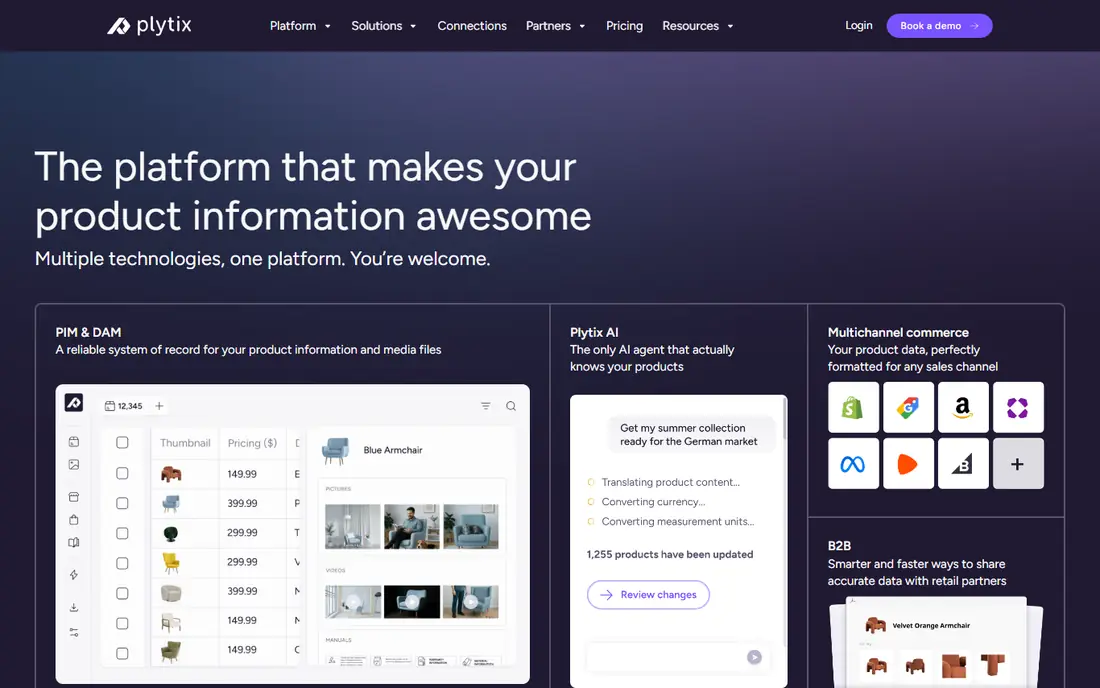
Plytix suits growing ecommerce teams that want a shared catalog workspace without enterprise cost. It combines product data and digital assets, so images and specs live alongside attributes, and teams can collaborate on enrichment with workflows and completeness scoring. Shopify and BigCommerce connections help store-first teams publish faster.
The detail to check is outputs. Some channel publishing tools and AI credits are priced separately, so confirm which outputs your store and marketplaces need are included in the plan you choose. For a team with a moderate catalog and a clear channel list, Plytix is one of the best value options here.
- PIM plus digital asset management in one tool
- Free plan for smaller catalogs
- Unlimited users on paid plans in vendor descriptions
- Some channel outputs are add-ons
- Pricing varies by plan and add-ons
Pimcore appeals to teams that want control. Its open-source platform combines PIM with digital asset management, content management and master data management, and developers can shape the data model and workflows to fit unusual catalogs. For a company with in-house engineering and complex data needs, that flexibility is a real advantage.
The honest catch is ownership. Pimcore is not a low-admin SaaS tool, and self-hosting or heavy customization needs ongoing developer time. If your team has no developers, a hosted SaaS PIM will be faster and safer, even if it offers less customization.
- Open-source foundation
- PIM, DAM, CMS and master data in one platform
- Deep customization
- Needs developer time to set up and maintain
- Paid support plans are quote-based or tiered
inRiver focuses on complex, multi-channel catalogs, with strengths in B2B manufacturing and distribution. It handles product relationships, supplier data and channel publishing, which helps brands whose catalogs include technical specs, compatibility data or many variants. Its syndication tools also help teams push consistent data to retailers and marketplaces.
Smaller ecommerce teams may find inRiver more system than they need, and its pricing reflects its enterprise positioning. For a B2B brand with a large, technical catalog and several sales channels, inRiver is a strong shortlist candidate.
- Strong product modeling for B2B catalogs
- Syndication and supplier onboarding
- Digital shelf features
- Pricing is quote-based
- Better suited to midsize and larger teams
Sales Layer
Great for: Teams that want an easy PIM with strong data quality tools
Sales Layer is often praised for ease of use, which matters when product teams, not developers, own the catalog. It offers data quality scoring, AI-assisted enrichment and connectors for ecommerce platforms and marketplaces, so a team can find gaps, fix them and publish without waiting on IT. That workflow suits manufacturers and distributors moving from spreadsheets to a real PIM.
The limit is scale on the syndication side. Sales Layer covers common channels well, but brands with very large retailer networks may need Salsify or Syndigo for that depth. For a midsize team that values speed and usability, Sales Layer is a balanced choice.
- Approachable interface for non-technical teams
- Data quality scoring
- Connector library for common channels
- Pricing is quote-based
- Less enterprise syndication depth than Salsify
Syndigo suits brands and retailers that live or die by product content across many partners. It combines PIM with content syndication and data quality checks, so listings stay consistent and complete across retailer networks. Consumer packaged goods brands with many SKUs and retail partners are its core audience.
Pricing needs careful review, because some Syndigo pricing is tied to items or content volumes rather than a simple monthly plan. Get a quote based on your actual SKU count and channel list, and confirm what data quality monitoring and support are included.
- Large content syndication network
- Data quality monitoring
- Strong fit for consumer packaged goods brands
- Pricing is quote-based and can be item-based
- Complex licensing for some teams
Catsy combines PIM and digital asset management with multi-channel publishing, which suits manufacturers and distributors that manage both specs and images. Bulk editing and retailer-ready templates help teams update large catalogs without editing products one by one, and Shopify integration helps store-first teams as well.
The main drawback is simply profile. Catsy has fewer public reviews than the largest PIM vendors, so a demo with your own catalog data matters more. Test bulk edits, image handling and export formats for your top retail channel before committing.
- PIM plus digital asset management
- Retailer-ready export templates
- Bulk editing for large catalogs
- Pricing is quote-based
- Less well known than Akeneo or Salsify
PIMworks
Great for: Growing brands that want AI-assisted enrichment and syndication
PIMworks targets growing brands that want enrichment and syndication without enterprise complexity. It offers automated content enrichment, workflow management and multi-channel publishing, which helps a team move from spreadsheet catalogs to a structured system. AI assistance can speed up titles, descriptions and attribute completion, though human review still matters for accuracy.
As a smaller vendor, PIMworks needs the same demo test as Catsy: load a sample of your real catalog, enrich it, and publish to your store. If that workflow feels fast and the output is clean, it can be a good value alternative to the enterprise names.
- AI-assisted catalog enrichment
- Multi-channel syndication
- Workflow tools for product teams
- Pricing is quote-based
- Smaller vendor profile than the largest PIM platforms
How we picked these
We compared official product pages and public reviews for PIM tools that are live in October 2026 and serve ecommerce sites, not only internal master data teams. We favored tools with catalog enrichment, approval workflows and publishing to stores or channels, and we wrote See website where a vendor does not publish pricing. Open-source options are noted where a free edition exists, with the setup cost stated plainly.
What to check before you buy PIM software
Start with your worst product data problem, not a feature list. If listings differ across channels, prioritize syndication and channel connectors. If your catalog is incomplete, prioritize enrichment, completeness scoring and workflows. Then test the tool with 50 real products, including variants, images and localized fields, before you sign.
Connectors, images and approvals
Confirm that the connector for your store platform handles variants, prices, stock and images the way you expect, and check how image versions are managed. Also test approval workflows, because a PIM that lets anyone publish unfinished data will recreate the mess it was meant to fix.
Frequently asked questions
What does PIM software do for an ecommerce site?
A PIM stores product attributes, images and descriptions in one place, lets teams enrich and approve them, and publishes consistent data to your store and other sales channels. It reduces manual copy work and listing errors.
Is PIM software only for large stores?
No. Small stores can start with Plytix or Pimcore, while larger brands need Akeneo, Salsify or inRiver. The right size depends on SKU count, variant complexity and how many channels you sell through.
How is a PIM different from a spreadsheet?
A spreadsheet can store product data, but it cannot easily manage approvals, image versions, channel-specific fields or publishing rules. A PIM adds structure, completeness checks and channel outputs that keep data consistent as a catalog grows.
Do I still need a DAM with a PIM?
Many PIM tools, including Plytix, Pimcore and Catsy, include digital asset management, so images live with product data. If your PIM lacks DAM features, you may need a separate asset tool or a clear image workflow.
How long does PIM implementation take?
It depends on catalog size and data quality. A small catalog on a SaaS PIM can go live in weeks, while a large, messy catalog on an enterprise PIM can take months. Clean your core attributes before migration to shorten the project.
Sources
See where you really rank - block by block
ProMapRanker scans Google Maps across a grid of your service area. Simple monthly plans from $19, white-label on every plan.
Start freeKeep reading
 zscaler alternatives
Best Zscaler Alternatives in 2026
Looking for zscaler alternatives? We compare 9 SASE and zero trust platforms on architecture, data protection, pricing, and fit for your network and team.
Read → zapier alternatives free
Best Zapier Alternatives Free in 2026
Nine automation tools for zapier alternatives free in 2026, all with genuinely free tiers, plus free plan limits, starting prices and upgrade paths explained.
Read → which platform is best for online reputation
Which Platform Is Best for Online Reputation in 2026
Wondering which platform is best for online reputation? We compare 8 review, listing, and response tools for small and multi-location businesses and agencies.
Read →