 ProMapRanker
Best Performance Marketing Platforms in 2026


Shopify profit and attribution · Pricing starts at: See website
Key takeaways
- Triple Whale and Northbeam suit ecommerce brands that need profit and attribution clarity beyond last-click reports.
- Madgicx, Revealbot, and Smartly suit paid social teams that need automation, creative testing, and rules at scale.
- Adverity and Funnel suit teams that pull data from many ad sources into one reporting view.
- Impact and Phonexa suit partnership and lead or call tracking, which paid media dashboards often miss.
- DashThis suits agencies that need fast client reporting, but it does not replace attribution or creative tools.
Quick comparison
| Pick | Great for | Pricing starts at | Free tier | |
|---|---|---|---|---|
| Triple Whale | Shopify profit and attribution | See website | Free trial | Visit |
 Northbeam | Media mix and attribution for larger brands | See website | No | Visit |
 Madgicx | Meta advertising automation | See website | Free trial | Visit |
 Revealbot | Rule-based ad automation | See website | Free trial | Visit |
 Smartly | Enterprise creative at scale | See website | No | Visit |
 Adverity | Multi-source marketing data | See website | No | Visit |
 Funnel | Marketing data collection | See website | Free trial | Visit |
 Impact | Partnership performance | See website | No | Visit |
 Phonexa | Lead and call tracking | See website | No | Visit |
 DashThis | Client reporting dashboards | See website | Free trial | Visit |
The best performance marketing platforms
Performance marketing platforms help teams spend paid budgets with clearer evidence: which channels drive profit, which creatives work, and where spend is wasted. We compared official product pages, pricing pages, and 2026 comparison guides, and we focused on what each tool actually measures or automates, not on vague claims about growth.
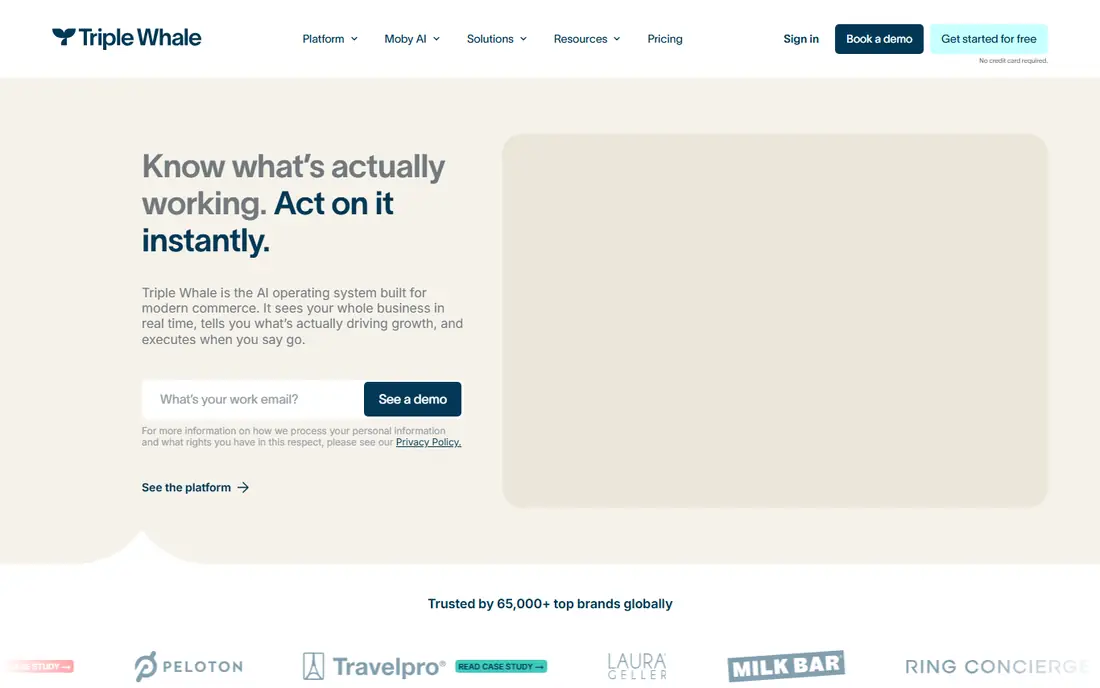
Triple Whale is built for Shopify brands that want to see profit, not just revenue, next to ad spend. It pulls orders, costs, and ad data into views that help teams judge whether a campaign is truly profitable after product and shipping costs. Creative reporting and channel views help teams spot which ads deserve more budget.
The limit is scope. Triple Whale shines for Shopify ecommerce, but teams outside Shopify will get less value. Pricing is also tied to your business size and data needs, so request a quote based on monthly revenue and ad spend. For Shopify brands that argue about attribution every week, it can settle many debates with shared numbers.
- Shopify-native profit and attribution views
- Creative and channel reporting
- Integrates with major ad platforms
- Best value is Shopify centered
- Pricing depends on revenue and data volume

Northbeam suits established direct-to-consumer brands that need a fuller view of how channels work together. It combines attribution and media mix modeling to estimate the effect of each channel, which helps when last-click reports undervalue upper-funnel work. Leadership teams often like its reporting because it ties media to business outcomes.
Northbeam is not a small-brand tool. It is custom priced and aimed at brands with meaningful monthly spend, and it needs clean data inputs to work well. If your spend is small or your tracking is messy, fix tracking first, then revisit Northbeam. For larger brands, it is one of the clearest attribution options.
- Media mix modeling and multi-touch views
- Built for larger direct-to-consumer brands
- Strong reporting for leadership
- Custom pricing
- Best suited to brands with substantial monthly spend
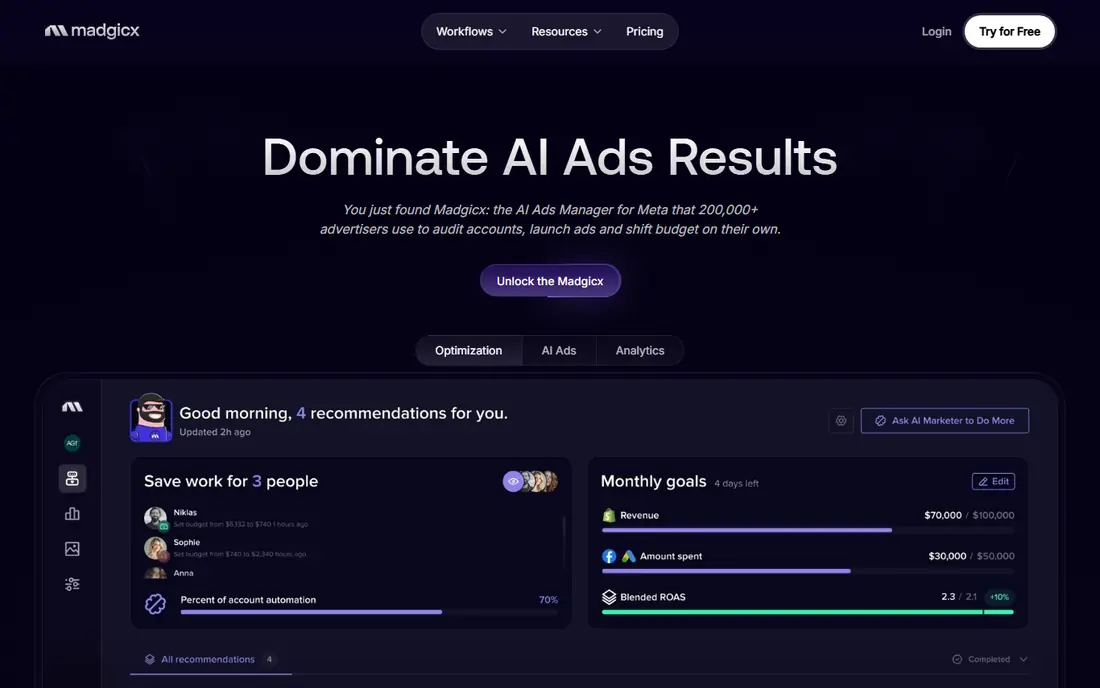
Madgicx focuses on Meta advertising for ecommerce brands, with tools for audience building, creative insights, and automation. It helps teams find winning combinations of creative and audience, then scale them with rules rather than manual checks. Third-party listings have placed its entry pricing in a range that smaller ecommerce teams can test.
The catch is focus. Madgicx is strongest on Meta, so teams that split spend across search, TikTok, and other channels will still need other reporting tools. It also has many features, so new users should start with one workflow, such as creative testing, before turning on broad automation. For Meta-heavy brands, it is a practical pick.
- AI audiences and creative insights for Meta
- Automation for scaling winners
- Ecommerce focused
- Meta-heavy focus
- Smaller teams may find the feature set broad
Revealbot gives performance marketers control through custom rules: pause a losing ad set, raise budget on a winner, or alert the team when cost per result crosses a line. It supports Meta and Google Ads, and it suits teams that know their thresholds and want automation to enforce them around the clock. Bulk tools also help agencies manage many accounts.
Rules are only as good as the logic behind them. A poorly set rule can pause good ads or scale bad ones, so teams should test rules on a small budget first. Pricing scales with ad spend, so model it against your monthly spend. For teams that want control rather than black-box automation, Revealbot is a strong choice.
- Custom automation rules for Meta and Google
- Bulk editing
- Clear control over budgets and bids
- Rules need careful setup and monitoring
- Pricing depends on ad spend
Smartly helps large brands produce and test many ad creatives across channels, with automation for creative versioning and campaign management. It suits teams that run hundreds of creative variants and need to know which combinations work, rather than teams running a handful of ads. Agencies also use it to manage large client portfolios.
Smartly is enterprise priced and aimed at large spend levels, so small brands will find it out of reach. The value shows when creative volume is high and manual testing cannot keep up. If your team tests a few ads per month, a smaller automation tool will be more cost-effective.
- Dynamic creative at scale
- Strong Meta and multi-channel support
- Built for large brands and agencies
- Custom pricing
- Aimed at large budgets, not small advertisers
Adverity pulls marketing data from many sources into one place, cleans and harmonizes it, and feeds dashboards and warehouses. Large teams with dozens of ad platforms use it to stop manual spreadsheet work and to compare channels on shared definitions. Its connector count is a real advantage when your stack is broad.
Adverity is custom priced and aimed at larger teams, and it is a data tool, not an attribution model on its own. Teams still need to decide how to measure success and build reports on top of clean data. If your main pain is data collection across many sources, Adverity is a top pick. If your main pain is attribution, pair it with a tool such as Northbeam or Triple Whale.
- Hundreds of platform connectors
- Data harmonization
- Reporting for large teams
- Custom pricing
- Needs data and reporting skills to get full value
Funnel is similar in spirit to Adverity: it collects marketing data, transforms it, and sends it to dashboards, spreadsheets, or warehouses. Agencies like it because it can standardize reporting across clients, and in-house teams like it because it reduces manual data pulls. It covers many common ad, social, and analytics sources.
Funnel does not, by itself, tell you which channel caused a sale. It gives you clean data to analyze elsewhere, so budget for a dashboard or attribution layer if you need that. Pricing depends on data volume and features, so test it with your actual sources during a trial. For data plumbing, it is a reliable option.
- Marketing data connectors and transformation
- Feeds dashboards and warehouses
- Agency friendly
- Custom pricing for larger use
- Reporting still needs a dashboard tool
Impact, formerly Impact.com, helps brands run partnership programs: affiliates, creators, publishers, and other partners, with tracking, contracts, and payouts in one system. Performance marketing is not only paid search and paid social, and partnership channels often need different tracking than ad platforms provide. Impact fills that gap with partner-level reporting.
The catch is effort. A partnership platform only pays off if you recruit, manage, and support partners, which takes staff time. Pricing is custom, and small programs may find it heavy. For brands that already drive meaningful revenue through partners, or plan to, Impact is the most complete option on this list.
- Partnership, affiliate, and creator tracking
- Contract and payout tools
- Fraud and compliance controls
- Custom pricing
- Needs partner management time to pay off
Phonexa focuses on lead and call performance, which matters for insurance, finance, home services, and other lead-driven verticals. It tracks leads and calls in real time, routes them to the right buyer or team, and reports on quality and outcomes. That visibility helps teams stop paying for low-quality leads and focus on sources that convert.
Phonexa is less relevant for ecommerce brands that sell directly online. It is custom priced, and setup needs care around routing rules and compliance. For lead generation teams, though, it covers a measurement gap that general ad dashboards miss, and it pairs well with paid media tools.
- Real-time lead and call tracking
- Routing and distribution
- Analytics for lead buyers and sellers
- Custom pricing
- Best fit is lead generation, not ecommerce
DashThis helps agencies and in-house teams build client-ready dashboards from many marketing sources, with templates and white-label options. It suits teams that spend too much time copying numbers into slides each month. Third-party listings have placed its entry pricing in a range that small agencies can afford, with a free trial to test templates.
DashThis does not solve attribution or automate campaigns. It shows numbers clearly, but your team still needs to interpret them and act. That limit is fine if reporting is your main pain. If you need attribution or creative automation, choose DashThis as a reporting layer, not as your only performance tool.
- Fast client dashboards
- Many marketing integrations
- White-label reporting for agencies
- Reporting only, not attribution or automation
- Larger data needs can raise cost
How we picked these
We compared official product pages, pricing pages, and 2026 comparison guides, and we kept only tools that are live and sold for performance marketing in October 2026. We favored a mix of attribution, creative automation, data, partnership, and reporting tools, because performance marketing covers all of those jobs. We did not claim hands-on testing. Where pricing was custom, we wrote See website rather than guessing.
What to check before you buy
Start with the question you need answered each week. If it is profit by channel, shortlist attribution tools. If it is creative winners, shortlist creative tools. If it is client reporting, shortlist reporting tools. Buying one tool to answer every question usually leads to a tool that answers none of them well.
Next, check tracking and data quality. Attribution tools need clean conversion data, creative tools need clear naming, and data tools need stable connectors. Run a trial with your real accounts, not demo data, and compare the tool's numbers with your ad platform and store data. Finally, confirm pricing against spend, revenue, or data volume, and ask what happens when you grow past a tier.
A note on attribution limits
No attribution tool can perfectly prove which ad caused a sale, especially after privacy changes on mobile and browsers. Treat attribution as a decision aid, not as exact truth. Use it alongside incrementality tests, holdouts, and profit data, and be wary of any vendor that promises perfect attribution.
Frequently asked questions
What is the best performance marketing platform?
The best performance marketing platform depends on your job. Triple Whale and Northbeam lead for attribution, Madgicx and Revealbot lead for paid social automation, and Adverity and Funnel lead for marketing data.
What is the best performance marketing software for ecommerce?
For Shopify ecommerce, Triple Whale is a strong pick for profit and attribution. Madgicx suits Meta-heavy ecommerce teams, while Smartly suits large brands with high creative volume. Check which channels drive your sales before choosing.
What are the best performance marketing tools for agencies?
DashThis suits agency reporting, Funnel and Adverity suit agency data collection, and Revealbot suits agency campaign automation. Agencies often use one tool from each group rather than a single platform.
What is the best platform and software for lead generation?
Phonexa is a strong pick for lead and call tracking, because it covers routing and quality in real time. Pair it with paid media tools for campaign management, since Phonexa focuses on leads, not ad creative.
How much do performance marketing platforms cost?
Many are custom priced based on ad spend, revenue, or data volume, while smaller tools publish entry prices or offer trials. Always model cost against your spend and revenue, not just the headline monthly fee.
Do I still need Google Analytics if I use a performance platform?
Yes, in most cases. Performance platforms add attribution, automation, or reporting depth, but analytics tools still help with on-site behavior and conversion tracking. Use them together and reconcile key numbers regularly.
Sources
See where you really rank - block by block
ProMapRanker scans Google Maps across a grid of your service area. Simple monthly plans from $19, white-label on every plan.
Start freeKeep reading
 zscaler alternatives
Best Zscaler Alternatives in 2026
Looking for zscaler alternatives? We compare 9 SASE and zero trust platforms on architecture, data protection, pricing, and fit for your network and team.
Read → zapier alternatives free
Best Zapier Alternatives Free in 2026
Nine automation tools for zapier alternatives free in 2026, all with genuinely free tiers, plus free plan limits, starting prices and upgrade paths explained.
Read → which platform is best for online reputation
Which Platform Is Best for Online Reputation in 2026
Wondering which platform is best for online reputation? We compare 8 review, listing, and response tools for small and multi-location businesses and agencies.
Read →