 ProMapRanker
Best People Counting Software in 2026

Key takeaways
- Accuracy depends on hardware and placement as much as software, so budget for installation and a manual count check.
- Density offers a low-cost sensor option from $149 plus $8 per month, while FootfallCam lists a $79 per month software app after a trial.
- V-Count publishes sensor prices from $299 to $799 plus software from $9 to $49 per sensor per month, which helps multi-store budgeting.
- Privacy matters: prefer systems that count anonymously and explain what data is stored, especially where cameras are used.
Quick comparison
| Pick | Great for | Pricing starts at | Free tier | |
|---|---|---|---|---|
 Density | Anonymous occupancy counting | $8 per month | No | Visit |
 FootfallCam | Retail footfall analytics | $79 per month | Free trial (7 days) | Visit |
 V-Count | Published sensor pricing | $9 per sensor per month | No | Visit |
 Xovis | High-accuracy 3D counting | See website | No | Visit |
 Irisys | Thermal people counting | See website | No | Visit |
 SenSource | Flexible counting hardware | See website | No | Visit |
 RetailNext | Retail analytics at scale | See website | No | Visit |
 ShopperTrak | Established retail traffic data | See website | No | Visit |
The best people counting software
People counting software turns entrances, aisles and rooms into numbers a business can plan around: peak hours, conversion, staffing and space use. We compared official product pages, published pricing and public buyer reports, and we favoured systems still sold in October 2026 with clear hardware and privacy explanations.
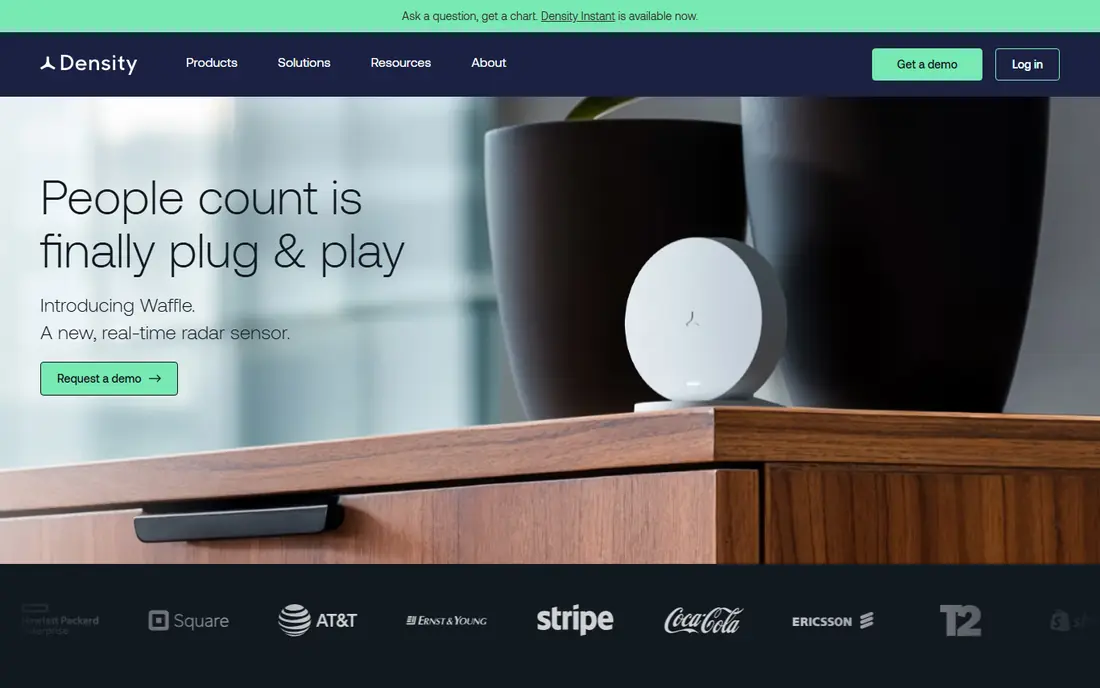
Density is built around anonymous counting, which is its main selling point for offices, universities and public venues. Its sensors measure presence without identifying individuals, so a building manager can show live occupancy, manage capacity and plan space use without creating a record of who was where. That privacy approach also simplifies conversations with staff and visitors who may worry about camera-based tracking.
The newer Waffle sensor is priced at $149 for the sensor plus $8 per month for software, and it is designed for self-installation in minutes, which suits temporary or small deployments. Larger Density systems are priced by quote, so the Waffle price should not be treated as the cost of a full enterprise rollout. For a team that wants trustworthy occupancy numbers with a clear privacy story, Density is a strong starting point.
- Anonymous by design
- Real-time occupancy
- Low-cost Waffle sensor option
- Software price excludes sensor hardware
- Larger deployments need a quote
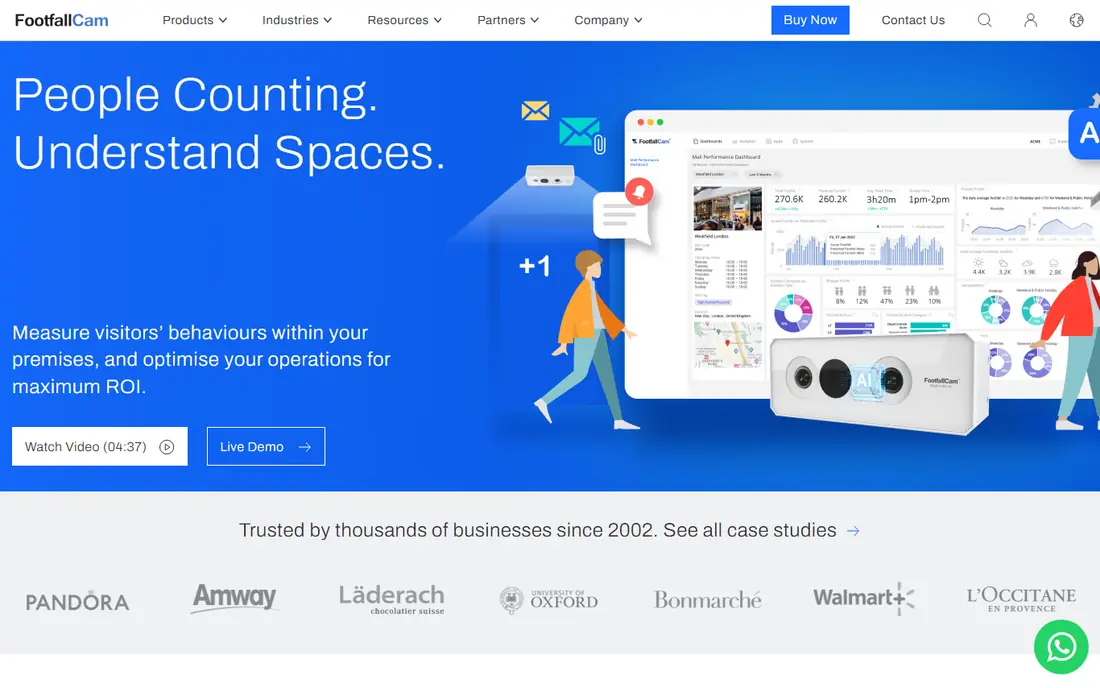
FootfallCam is a retail specialist, and its reports reflect that focus. Beyond simple in and out counts, it covers outside traffic, turn-in rate, dwell time and group counting, which helps a store judge whether a window display or promotion actually brought people inside. A location analysis app is listed with a free 7-day trial followed by $79 per month, while small retailer packages are reported from around $850 to $1,500 including hardware and setup depending on layout.
The catch is that the software price is only part of the total. Counters, cabling, installation and support must be priced for each store, and larger estates will need a quote. FootfallCam suits a retailer that wants decision-ready reports rather than raw counts, and that is willing to pay for proper entrance coverage instead of a single cheap sensor at one door.
- Retail-focused reports
- Dwell and turn-in metrics
- Small retailer packages
- Hardware and installation add cost
- Full pricing often by quote
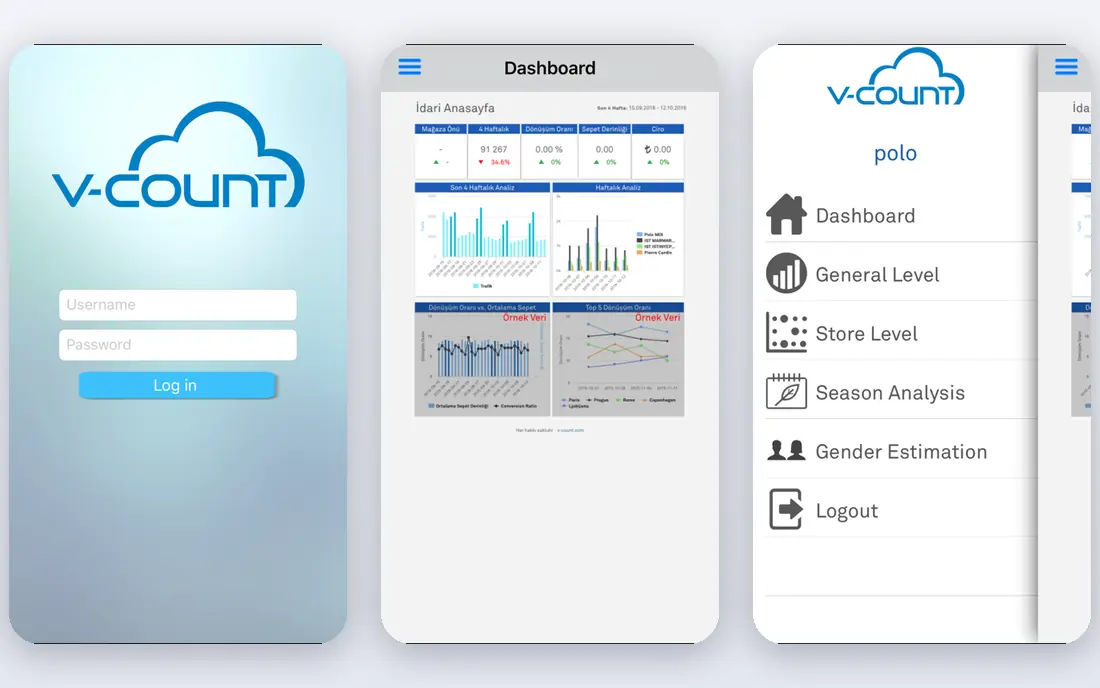
V-Count stands out in this category for publishing prices. Its competitor comparison pages put sensors at $299 to $799 paid once, plus BoostBI software at $9 to $49 per sensor per month, which makes multi-store budgeting far easier than with quote-only vendors. The range covers different ceiling heights and entrance types, and the analytics platform turns counts into traffic, conversion and performance reports.
Publishing prices does not remove installation work. Placement advice, ceiling height, door width and power or network access still decide accuracy, and a floor plan review is part of a sensible rollout. V-Count suits a retailer or venue operator who wants to compare total cost across stores before a sales process, and who values a sensor range that can cover both small shops and larger entrances.
- Clear published sensor and software prices
- Wide sensor range
- Retail analytics platform
- Hardware cost is separate
- Installation planning still needed
Xovis uses 3D sensors to count people passing through a defined area, and it is widely used in airports, retail and transport settings where accuracy under busy conditions matters. A 3D view helps separate individuals in groups and handle wide entrances better than a simple beam counter, which is why it appears in places where a miscount could affect staffing, safety or commercial decisions.
The trade-off is cost and setup. Pricing is quote-based, and professional installation and calibration are usually part of the project. Xovis is best for a venue or retailer that needs high confidence in counts at scale and can justify a larger upfront project. A single small shop that only needs a rough daily total will likely find a simpler sensor sufficient.
- 3D sensor accuracy
- Wide coverage per sensor
- Strong airport and retail record
- Quote-based pricing
- Professional installation usually needed
Irisys counts people with thermal sensing rather than visible camera images, which gives it a distinct privacy advantage. Heat signatures are counted without recording recognisable faces, and thermal sensing keeps working in lighting conditions that can trouble ordinary cameras. That combination suits retailers, libraries, museums and public buildings that want footfall data without the privacy concerns of video analytics.
Pricing is quote-based, and the analytics experience can depend on how the system is configured and integrated. Irisys is not a plug-and-play consumer gadget, it is a professional counting system that needs correct mounting and calibration. For a venue that must balance measurement with public trust, thermal counting is a credible middle path between a simple beam counter and a full video analytics platform.
- Thermal sensing without camera images
- Works in varied light
- Established retail use
- Quote-based pricing
- Analytics depth varies by partner setup
SenSource offers a range of people counting hardware and software, from overhead sensors to beam counters and queue management tools. That flexibility helps a business with mixed spaces, such as a store with a wide main entrance, a narrow side door and a service counter queue that also needs measurement. Its software turns counts into traffic patterns, peak periods and staffing guidance.
The range itself is the main challenge for a first-time buyer, because choosing the wrong sensor for a ceiling height or entrance width will hurt accuracy. Pricing is quote-based, so a site survey or floor plan review is worth requesting before ordering. SenSource suits an operator with several different entrance types who wants one vendor for the whole estate rather than a different gadget at each door.
- Multiple sensor types
- People counting plus queue tools
- US-based support history
- Quote-based pricing
- Product range can confuse first-time buyers
RetailNext is an analytics platform for retailers that want to connect footfall to sales and store performance. It combines traffic counts with conversion, shopper journey and staffing analysis, which helps a chain compare stores, test layouts and judge promotions on evidence rather than guesswork. Large retailers use it precisely because it can standardise measurement across many locations.
That scale is also its limit for smaller buyers. Pricing is quote-based, implementation is a project rather than a purchase, and a single independent shop will not use most of the platform. RetailNext is the right choice for a chain or a growing retailer that already tracks sales by store and wants traffic data at the same standard. A small shop should start with a simpler counter and upgrade only when store comparison becomes a real need.
- Deep retail analytics
- Conversion and shopper journey insight
- Large retailer deployments
- Quote-based pricing
- More than a small shop needs
ShopperTrak, part of Sensormatic, is one of the longest-established names in retail traffic counting. Its strength is experience across many store formats and the ability to benchmark a store against wider traffic patterns, which helps retailers judge whether a sales change reflects their store or the wider market. Counting hardware, analytics and reporting are offered as a managed service rather than a standalone app.
Pricing is quote-based and the rollout is enterprise-oriented, so a small retailer should expect a sales and survey process rather than an online checkout. ShopperTrak suits a retailer or mall operator that values established measurement standards and benchmarking. For a single shop, the same money may buy a simpler system plus staff time to act on the data, which is often the more valuable investment.
- Long retail history
- Benchmarking options
- Wide store coverage experience
- Quote-based pricing
- Enterprise-oriented rollout
How we picked these
We compared official product pages, published pricing and public buyer reports, and we favoured systems still sold in October 2026 that count people in real spaces, not just website visitors. Where a vendor publishes a price, we used it. Where pricing is quote-based, we wrote See website rather than presenting a third-party estimate as a vendor price. We also weighed privacy, because a counting system that records identifiable video needs a much stronger justification than an anonymous sensor.
How to get accurate counts
Start with the entrance, not the software. Measure ceiling height, door width and traffic flow, and place the sensor directly over the counting line with a clear view. Exclude staff where the tool allows it, because staff movements can distort customer counts. Then check accuracy with a manual count over a busy period and a quiet period, and keep that check as the baseline.
Finally, decide what action each number will trigger. Peak-hour counts should change staffing, conversion data should change layout or promotion decisions, and occupancy data should change room booking or capacity rules. A counter that nobody reviews is just a cost, while a simple counter reviewed weekly can change how a store or venue runs.
Frequently asked questions
How accurate is people counting software?
Accuracy depends on sensor type, placement, entrance width and crowd density. Overhead 3D and thermal sensors generally perform better in busy conditions than simple beam counters, but every system should be checked against a manual count after installation.
Does people counting software use cameras?
Some systems use cameras or video analytics, while others use thermal sensors, 3D sensors or anonymous presence sensors. If privacy is a concern, ask exactly what is recorded, whether images are stored, and how long data is kept.
What is the difference between footfall and conversion?
Footfall is the number of people entering a space, while conversion is the share of those visitors who buy, book or complete another desired action. Conversion needs both traffic data and sales or booking data, so the counting system must connect to point-of-sale or booking records.
Can people counting software work in a small shop?
Yes, small retailer packages exist, and self-install sensors such as Density Waffle are designed for smaller spaces. The key is to count every entrance used by customers, because a single sensor at the main door will undercount a shop with a side entrance.
Do I need one sensor per entrance?
In general, yes, because each entrance is a separate counting line. Wide entrances may need more than one sensor or a sensor with wider coverage, and the vendor should advise on coverage based on door width and ceiling height.
Sources
See where you really rank - block by block
ProMapRanker scans Google Maps across a grid of your service area. Simple monthly plans from $19, white-label on every plan.
Start freeKeep reading
 what’s the best risk software for enterprises
What Is the Best Risk Software for Enterprises in 2026
We compared what’s the best risk software for enterprises on risk registers, controls, third-party risk, and reporting, with pricing notes for large teams.
Read → what's the best pam software for enterprises
What is the Best PAM Software for Enterprises in 2026
Find what's the best pam software for enterprises, with vaulting, session recording, just in time access and pricing compared for large enterprise IT teams.
Read → what’s the best grc software
What Is the Best GRC Software in 2026
We compared what’s the best grc software on risk, compliance, audit and vendor risk, so teams can pick a platform that fits their frameworks and budget.
Read →