 ProMapRanker
Best Peer Code Review Software for Remote Teams (2026)

Atlassian-centric teams using Jira · Pricing starts at: See website
Direct answer
If you need Atlassian-centric teams using Jira, Bitbucket Pull Requests is the first tool to look at here. Listed starting prices: GitLab Merge Requests from $15 per user a month and GitHub Pull Requests from $4 per user a month. GitLab Merge Requests fits teams seeking an all-in-one DevOps product; Crucible fits teams wanting adaptable, standalone code review. The other 3 tools in the list cover narrower or pricier cases.
Choosing peer code review software for remote teams usually comes down to price, fit and limits. This ProMapRanker guide sets 6 tools side by side on those three points, with the facts kept short and checkable.
Key takeaways
- The list opens with Bitbucket Pull Requests, aimed at Atlassian-centric teams using Jira.
- GitLab Merge Requests, GitHub Pull Requests: these are the 2 tools out of 6 that offer a free plan.
- Review Board fits organizations needing self-hosted, multi-VCS review.
- One limit worth knowing about GitLab Merge Requests: can be complicated for small teams.
Quick comparison
| Pick | Great for | Pricing starts at | Free tier | |
|---|---|---|---|---|
| Bitbucket Pull Requests | Atlassian-centric teams using Jira | See website | Not stated | Visit |
 GitLab Merge Requests | Teams seeking an all-in-one DevOps system | $15 per user a month | Yes | Visit |
 Crucible | Teams wanting adaptable, standalone code review | See website | Not stated | Visit |
 GitHub Pull Requests | Teams already using GitHub for hosting | $4 per user a month | Yes | Visit |
 Gerrit Code Review | Teams needing rigorous, workflow-driven reviews | See website | Not stated | Visit |
 Review Board | Organizations needing self-hosted, multi-VCS review | See website | Not stated | Visit |
The 6 tools in detail
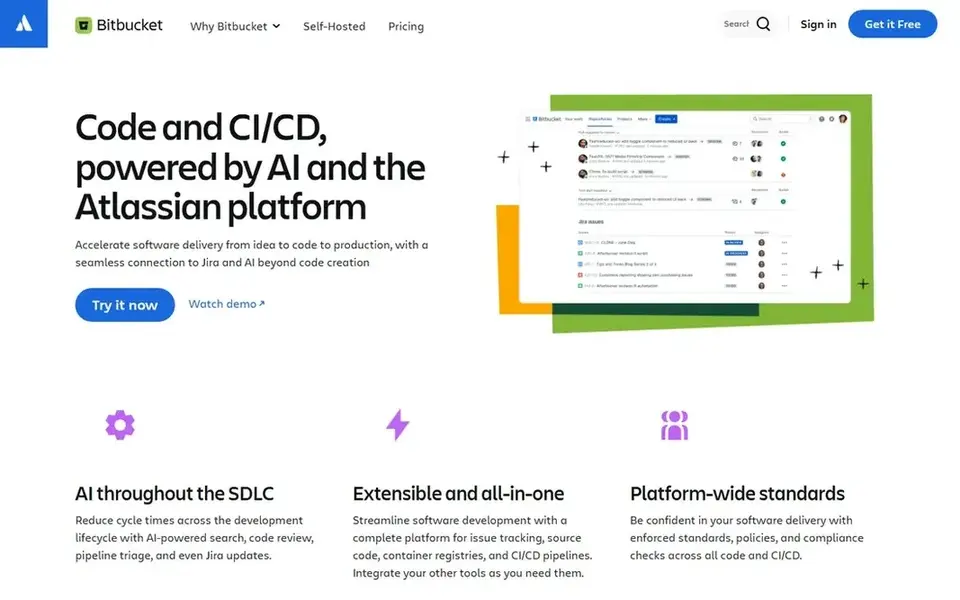
Choose Bitbucket Pull Requests for Atlassian-centric teams using Jira. Bitbucket Pull Requests is the code review tool within Atlassian's Bitbucket product. It lets teams to review code, leave comments, and approve changes before merging.
Points against: Restricted to Bitbucket repositories.
Like other platform-specific tools, it only works with Bitbucket-hosted repositories. If your team uses several version control systems or needs deep review workflows, a standalone option like Review Board could be a better fit. Also, remote teams that already use Jira for issue tracking will find the integration smooth, as pull requests can link straight to Jira issues. The feature set is solid for entry-level review but may lack some advanced customization found in dedicated tools. No starting price is listed for Bitbucket Pull Requests here; confirm pricing on the vendor site. On free options: Not stated.
- Tight integration with Jira and Confluence
- Built-in CI/CD with Bitbucket Pipelines
- Fewer third-party integrations than some rivals

GitLab Merge Requests is built with teams seeking an all-in-one DevOps platform in mind. If you prefer a lighter-weight tool or are deeply invested in another ecosystem like GitHub, GitLab might be more than you need. From a buyer's view, the system's breadth can be overwhelming for teams that only need code review, and the self-managed version demands administrative effort.
GitLab Merge Requests is the code review feature within GitLab, an intelligent orchestration product for the software lifecycle. It makes it possible for teams to review code changes, run pipelines, and run deployments in one place. Remote teams appreciate the built-in CI/CD and the capacity to enforce approval rules. GitLab Merge Requests cost at the entry level: $15 per user per month. GitLab Merge Requests has a free plan.
Limits to weigh: Self-hosting needs maintenance.
- Supports merge request approvals and code owners
- Integrated with GitLab's CI/CD and issue tracking
- Can be complicated for small teams
Crucible is a good fit for teams wanting adaptable, standalone code review. Crucible is Atlassian's standalone code review tool that works with several version control systems. It lets teams to review code, discuss changes, and track defects in a collaborative environment.
In practice, as a separate product, Crucible brings another tool to handle, and its pricing may be a consideration for budget-conscious teams. It lacks the deep integration with Bitbucket that some might expect. Also, remote teams that use a mix of version control systems or want a dedicated review tool separate from their hosting product will find Crucible a solid fit. It links up with Jira for smooth issue tracking. Check the vendor site for Crucible pricing; none is listed in this comparison. Free plan details: Not stated.
The main drawbacks: Separate product from Bitbucket.
- Gives you in-depth review workflows
- Supports SVN, Git, Mercurial, CVS, Perforce
- Can be expensive for large teams

GitHub Pull Requests serves teams already using GitHub for hosting. Remote teams benefit from threaded comments, review requests, and status checks that keep everyone informed. It is a strong match for teams that already use GitHub for version control and want a review process that feels integrated and familiar.
It lets teams propose changes, discuss them inline, and merge code once approved. If your team hosts code elsewhere or needs highly customized review processes, consider a standalone tool like Review Board or Gerrit instead. Starting cost for GitHub Pull Requests: $4 per user per month. GitHub Pull Requests includes a free tier.
Limits to weigh: Advanced features may need extra setup.
- Built-in code review workflow with comments and approvals
- Supports automation and CI checks
- Restricted to GitHub-hosted projects
Gerrit Code Review
Great for: Teams needing rigorous, workflow-driven reviews
Where Gerrit Code Review fits: teams needing rigorous, workflow-driven reviews. Gerrit Code Review is a self-hosted tool aimed at Git-based projects that need strict review processes. It enforces a change-based workflow where each commit is reviewed before merging.
Where it falls short: Needs self-hosting and maintenance.
More specifically, consider Gerrit only if you need its specific workflow controls. On top of that, remote teams that require in-depth audit trails and granular permissions will find Gerrit capable. Gerrit's complexity can be a barrier for teams accustomed to more straightforward pull request models. On top of that, setup and continuing maintenance need technical expertise. No starting price is listed for Gerrit Code Review here; confirm pricing on the vendor site. Free plan details: Not stated.
- Fine-grained access controls and permissions
- Capable support for Gerrit's change-based workflow
- Steep ramp-up time for new users
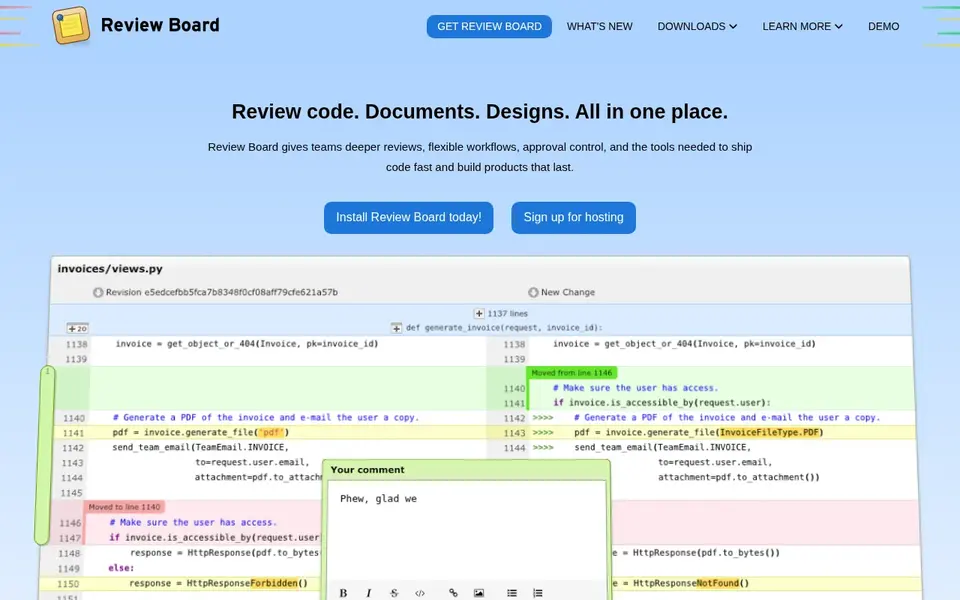
Review Board is designed for organizations needing self-hosted, multi-VCS review. It is also handy for teams that review documents alongside code.
What to check first: Needs server setup and maintenance.
If you prefer a cloud-hosted option with minimal setup, consider GitHub or GitLab. This comparison lists no price for Review Board; ask the vendor. As for free access: Not stated.
- Bundles document review capabilities
- Supports plenty of version control systems
- Interface may feel dated to some users
How the list was put together
ProMapRanker looked at what each vendor publishes: pricing, plan limits, feature coverage for peer code review software for remote teams and stated drawbacks. No hands-on testing is claimed. Seat minimums, billing terms and add-ons can move the real cost, so the starting prices here are a guide and not a quote. The ranking is editorial: typical fit first, then clear pricing, then free access. If your needs are unusual, read the profiles rather than relying on position.
Before you commit
- Get a written quote from Bitbucket Pull Requests, Crucible, Gerrit Code Review and Review Board; the list shows no starting price for them.
- Look at free plan limits closely: GitLab Merge Requests and GitHub Pull Requests have one, and the caps decide whether it is usable for real work.
- Before choosing Bitbucket Pull Requests, weigh its main limit: restricted to Bitbucket repositories.
- See whether GitLab Merge Requests offers onboarding or training, and whether it is included in the price.
- Involve the people who will use Review Board daily; a short pilot beats a long feature checklist.
Frequently asked questions
Do these tools publish their prices?
Not all of them. Bitbucket Pull Requests, Crucible, Gerrit Code Review and Review Board publish no starting price, so expect a quote request for those. The rest, GitLab Merge Requests included, show a starting price, though seats and billing terms still change the final cost.
What is peer code review software?
Peer code review software helps teams examine code changes collaboratively before merging them into the primary codebase. It supplies a structured way to comment, discuss, and approve changes, improving code quality and knowledge sharing.
Is Bitbucket Pull Requests the right pick for everyone comparing peer code review software for remote teams?
No single tool suits every team. Bitbucket Pull Requests comes first because it fits Atlassian-centric teams using Jira, while GitLab Merge Requests suits teams seeking an all-in-one DevOps platform and Crucible suits teams wanting flexible, standalone code review. Match the tool to your own size, budget and workflow before deciding.
Can I use these tools with any version control system?
Some, like GitHub Pull Requests and Bitbucket Pull Requests, are tied to their respective systems. Others, like Review Board and Crucible, support several systems. Check compatibility before choosing.
Why is code review software important for remote teams?
Remote teams depend on code review software to maintain visibility and collaboration across distributed locations. It centralizes discussions, tracks feedback, and ensures that changes are reviewed by the right people, regardless of time zones.
Can I try these tools before paying?
Often, yes. GitLab Merge Requests and GitHub Pull Requests have a free plan. Use your own data and a real task during the test, and check what the free tier or trial limits before you rely on it.
Sources
See where you really rank - block by block
ProMapRanker scans Google Maps across a grid of your service area. Simple monthly plans from $19, white-label on every plan.
Start freeBrowse all guides
← Best Enterprise Reputation Management Software in 2026Best Performance Review Software for Small Business (2026) →
 best ai document review software for real estate law firms
AI Document Review Software for Real Estate Law Firms (2026)
Best AI document review software for real estate law firms in 2026: 5 tools with starting prices, free plans and limits. The catches are listed up front.
Read → best ai code review software for startups
AI Code Review Software for Startups: Best Picks of 2026
6 best AI code review software for startups, with entry costs, free tiers and the buyer each one serves. Caveats come with every verdict. Decide faster.
Read → top review software for dental practices
Review Software for Dental Practices in 2026: Top 6 Compared
Weighing the top review software for dental practices? We lined up 6 products by cost, free access and fit. Where a tool struggles is spelled out. Facts only.
Read → paperform alternatives
Best Paperform Alternatives in 2026
Compare the best paperform alternatives for forms, payments, and surveys, with free plans and pricing that suit small teams in 2026 for your next form.
Read → best 360 feedback tools
Best 360 Feedback Tools in 2026
Best 360 feedback tools compared for 2026: eight live platforms for 360 degree feedback, reviews, and leadership development for teams and leaders today.
Read → best paid survey apps
Best Paid Survey Apps in 2026
We compared the best paid survey apps for cash, gift cards and low cashouts, so you can pick the best survey app to make money in spare moments safely.
Read →More in Reviews & Reputation · All guides A to Z by date · Latest guides