 ProMapRanker
Best Payroll Software for Large Business in 2026

Key takeaways
- Large business payroll is mostly quote based, so compare total cost, including implementation, not only a per-employee rate.
- Workday suits global enterprises that want HR, finance and planning in one system, while ADP suits deep US tax and compliance needs.
- Dayforce suits shift-based workforces, and UKG Pro suits workforce management at scale.
- Rippling is the clearest published price here, at $8 per employee per month for US payroll, plus platform fees.
- Plan for parallel payroll runs and a dedicated internal team; enterprise implementation is a project, not a switch.
Quick comparison
| Pick | Great for | Pricing starts at | Free tier | |
|---|---|---|---|---|
 Workday HCM | Global enterprises | See website | No | Visit |
 ADP Vantage HCM | Large US employers | See website | No | Visit |
 UKG Pro | Workforce management at scale | See website | No | Visit |
 Dayforce | Continuous payroll for large teams | See website | No | Visit |
 Oracle HCM | Oracle-based enterprises | See website | No | Visit |
 SAP SuccessFactors | SAP-based enterprises | See website | No | Visit |
 Rippling | Modern unified payroll | $8 per employee per month | No | Visit |
 Paycom | Single-database HCM | See website | No | Visit |
 Paylocity | Growing large employers | See website | No | Visit |
The best payroll software for large business
We compared official product pages, pricing pages and public documentation for enterprise payroll platforms live in October 2026. The list covers unified HCM suites, payroll specialists and modern platforms, since large businesses choose payroll inside a wider HR and finance stack. This is not financial advice; payroll choices affect tax, benefits and compliance, so involve your finance and legal teams before you commit.

Workday is the unified choice for a large global company that wants HR, payroll, finance and planning in one cloud system. One data model means headcount, pay, skills and cost data stay linked, and Prism Analytics can combine HR and finance data for workforce planning. That unity is why many global enterprises standardize on Workday despite the cost.
The trade is time and price. Pricing is quote based, contracts are often multi-year, and implementation for a large enterprise can take 12 to 18 months with parallel runs. Training and change management are real work, not an afterthought. If your company already runs Workday finance, the case is stronger. If you only need payroll, a specialist may be cheaper and faster.
- Unified HCM, finance and planning data
- Strong analytics and reporting
- Global payroll through in-house and partner coverage
- Pricing is quote based
- Implementation can take 12 to 18 months
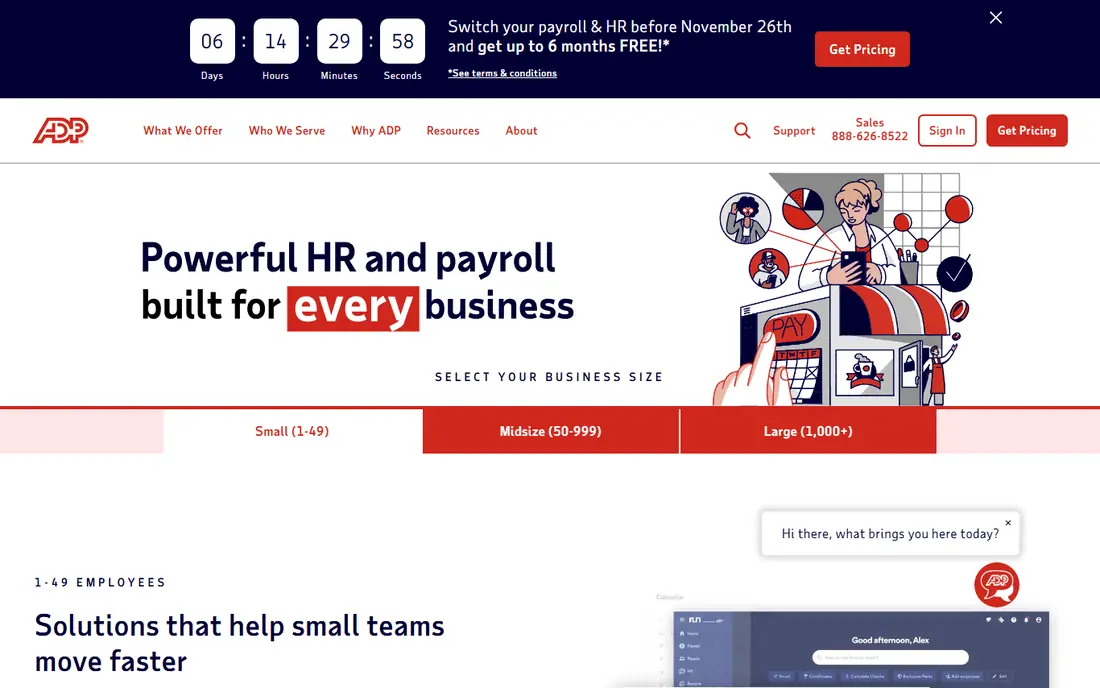
ADP Vantage HCM is ADP's enterprise suite for employers with 1,000 or more staff, built on ADP's long payroll history. It covers payroll, tax filing, workforce management, talent and compliance, with built-in support for programs such as OFCCP, EEOC and FCRA where relevant. For a large US employer in a regulated industry, that compliance depth is a real advantage.
Pricing for Vantage is quote based, and third-party figures vary, so get a written ADP quote for your headcount and modules. Some users report a steep learning curve and a dated feel in places. If payroll accuracy and US compliance are your top risks, ADP's depth is hard to match. If you want a modern unified analytics platform, compare it closely with Workday.
- Deep US tax filing and compliance
- Payroll, talent and workforce tools in one suite
- Broad industry coverage in the US
- Pricing is quote based for Vantage
- Interface can feel complex for managers

UKG Pro, from UKG, combines HR, payroll and workforce management for large employers, with particular strength in scheduling and time tracking. Shift-based industries such as healthcare, retail, hospitality and manufacturing benefit from its workforce tools, which link schedules, time, attendance and pay in one flow. That link reduces manual pay adjustments for complex shift rules.
Pricing is quote based, and implementation for a large workforce takes planning, data cleanup and testing. UKG Pro is less of a finance planning platform than Workday or Oracle, so check whether you need that depth. For a large employer where workforce management is the hard part, UKG Pro is a leading choice.
- Strong scheduling, time and attendance tools
- Payroll and HR in one system
- Suits healthcare, retail and manufacturing workforces
- Pricing is quote based
- Implementation needs careful planning
Dayforce, from Ceridian, is built around continuous payroll: pay is recalculated as time, schedule and HR data change, rather than only at the end of a pay period. That model helps large, shift-based teams spot pay errors earlier and close payroll faster. It also covers workforce management, talent and global payroll for large employers.
Like other enterprise suites, Dayforce pricing is quote based and implementation is a major project. Teams should budget for data migration, parallel runs and training. If your payroll pain comes from shift complexity and late adjustments, Dayforce's continuous model is worth a close look. If your pain is global finance planning, Workday or Oracle may fit better.
- Continuous payroll calculation as data changes
- Strong time, scheduling and pay tools
- Global payroll coverage for large employers
- Pricing is quote based
- Implementation is a major project
Oracle HCM, part of Oracle Fusion Cloud HCM, suits large companies already running Oracle ERP, finance or supply chain tools. Payroll, HR, talent and workforce data sit alongside finance data, which helps with cost planning and reporting. Global payroll and compliance tools support large, multi-country employers.
The value case weakens if you do not use Oracle elsewhere, since implementation and integration effort rise. Pricing is quote based, and enterprise deals need a full Oracle quote. For an Oracle shop, Oracle HCM is the natural payroll and HR choice. For a non-Oracle company, compare it with Workday on analytics and total cost before deciding.
- Deep integration with Oracle ERP and finance
- Global HR and payroll tools
- Strong reporting and compliance controls
- Pricing is quote based
- Best value requires Oracle stack adoption
SAP SuccessFactors is SAP's cloud HCM suite, covering core HR, payroll, talent and workforce planning. For a company running SAP ERP or S/4HANA, it offers the deepest integration for headcount, pay and cost data. Global payroll supports complex, multi-country rules, which matters for large manufacturers and multinationals.
Implementation is often long, and pricing is quote based, so plan for a full SAP engagement. Non-SAP companies may find Workday or ADP simpler to adopt. If your finance and operations already run on SAP, SuccessFactors keeps payroll inside a system your IT team already knows, which reduces integration risk.
- Deep integration with SAP ERP and S/4HANA
- Global payroll and talent tools
- Strong for complex, multi-country workforces
- Pricing is quote based
- Implementation can be long and complex
Rippling is the modern option for a large business that wants a unified platform without a legacy implementation timeline. US payroll starts at $8 per employee per month billed annually, plus a platform fee, with HR, benefits, time tracking, IT and spend tools available as modules. That published starting price makes early budgeting much easier than with quote-only suites.
The catch is that the $8 figure is a starting point, not a total. Large employers will add modules, global payroll and implementation help, and total cost per employee rises with each add-on. Rippling suits a growing large employer that values speed and a modern interface. Very large global enterprises with complex union or multi-country rules should test it against Workday, ADP or SAP first.
- Published starting price for US payroll
- HR, IT and finance in one platform
- Fast setup compared with legacy suites
- Large enterprise modules are quoted
- Global payroll and add-ons raise total cost
Paycom offers HR, payroll, talent, time and benefits in a single-database system, so data entered once flows to pay without rekeying. That design reduces errors for large US employers with complex pay rules, and employee self-service lets staff check pay, time and benefits in one place. Its Beti tool lets employees review their own pay before payroll runs, which can catch errors early.
Pricing is quote based, and global payroll coverage is less deep than ADP GlobalView or Workday's partner network. For a large US employer that wants one system and strong self-service, Paycom is a solid choice. For a heavily global workforce, compare global coverage and local compliance support carefully.
- One database for HR, payroll, time and talent
- Employee self-service tools
- Strong US payroll and compliance tools
- Pricing is quote based
- Global payroll is less deep than ADP or Workday
Paylocity serves mid-market and growing large employers with HR, payroll, time, benefits and talent tools in a modern cloud platform. Its employee experience, reporting and mobile tools suit companies that want a friendly system for managers and staff, not only for payroll admins. It has grown into larger employer deals in recent years.
Pricing is quote based, and the largest global enterprises may need deeper global payroll or finance planning than Paylocity offers. For a company moving from a small business payroll tool to a true large business platform, Paylocity offers a manageable step up. Test its reporting, integrations and global coverage against your five-year headcount plan.
- Modern interface for HR and payroll
- Strong reporting and employee experience tools
- Good fit for mid-market to large employers
- Pricing is quote based
- Very large global needs may need a bigger suite
How we picked these
We checked official product pages, pricing pages and public documentation for payroll platforms that serve large employers in October 2026. We kept suites and specialists that handle high headcounts, multi-state or global tax, and complex pay rules. Where a vendor quotes rather than publishes a price, we wrote See website instead of repeating a third-party estimate as fact.
What to check before you buy
Start with a payroll audit, not a demo. List your pay types, unions, shift rules, states and countries, benefits, garnishments and reporting needs. Give that list to each vendor and ask for a written answer on what is standard, what is an add-on and what needs custom work. A demo that skips your hardest pay rule will not reveal the real cost.
Test implementation honestly. Ask for a timeline, a data migration plan, a parallel run plan and a named implementation team. Large payroll projects fail on data quality and change management more than on software features. Budget for a dedicated internal team, clean HR data and training for managers and staff.
Finally, price the total contract. Include license fees, implementation, training, integrations, global payroll fees and annual increases. Ask about contract length, renewal terms and exit data access. Payroll is hard to switch once live, so the contract terms matter as much as the first-year price.
Frequently asked questions
What is the best payroll software for large business?
There is no single winner. Workday suits global enterprises, ADP Vantage suits large US employers with deep compliance needs, Dayforce suits shift-based teams, and UKG Pro suits workforce management at scale. Rippling suits a modern unified platform with published starting pricing. Match the tool to your ERP, workforce type and global footprint.
How much does payroll software for large business cost?
Most enterprise vendors are quote based, so total cost depends on headcount, countries, modules and implementation. Rippling publishes US payroll from $8 per employee per month billed annually, plus a platform fee. Expect implementation and first-year total cost to be well above the license fee alone, so get a written total quote.
Should large businesses use a PEO instead of payroll software?
A professional employer organization suits companies that want to outsource HR compliance, benefits and payroll administration. The trade is control, since the PEO becomes the employer of record for tax and benefits purposes. Companies with established HR teams usually prefer direct HCM software such as Workday, UKG or ADP.
What is the difference between Workday and ADP?
Workday is a unified cloud HCM with finance and planning, best for global enterprises that want one system. ADP is a payroll specialist with deep tax and compliance infrastructure, offering products by company size from RUN to Workforce Now to Vantage HCM. Workday leads on unified analytics, while ADP leads on payroll processing depth.
How long does enterprise payroll implementation take?
Typical timelines are about six months for mid-market platforms such as Rippling, Paycom or Paylocity, and 12 to 18 months for Workday, Oracle or SAP. Data migration, integrations, parallel runs and change management drive the timeline. Budget a dedicated internal team and insist on parallel payroll runs before go-live.
Can large business payroll software handle global payroll?
Yes, but coverage varies. ADP GlobalView and Celergo, Workday partner networks, Oracle HCM, SAP SuccessFactors and Dayforce all support global payroll, with different mixes of in-house and partner coverage. Check each country you operate in, including local tax, benefits and reporting rules, before you sign.
Sources
See where you really rank - block by block
ProMapRanker scans Google Maps across a grid of your service area. Simple monthly plans from $19, white-label on every plan.
Start freeKeep reading
 zscaler alternatives
Best Zscaler Alternatives in 2026
Looking for zscaler alternatives? We compare 9 SASE and zero trust platforms on architecture, data protection, pricing, and fit for your network and team.
Read → zapier alternatives free
Best Zapier Alternatives Free in 2026
Nine automation tools for zapier alternatives free in 2026, all with genuinely free tiers, plus free plan limits, starting prices and upgrade paths explained.
Read → which platform is best for online reputation
Which Platform Is Best for Online Reputation in 2026
Wondering which platform is best for online reputation? We compare 8 review, listing, and response tools for small and multi-location businesses and agencies.
Read →