 ProMapRanker
Best Payroll Software for Healthcare in 2026

Key takeaways
- Healthcare payroll differs from generic payroll because of shift differentials, per-diem staff, credential-based pay, and multi-site schedules.
- Gusto and Rippling suit small and tech-forward practices with published pricing, while ADP, Paychex, and UKG suit larger systems.
- Viventium and Paycor stand out for home health, post-acute care, and shift-heavy teams that need specific pay rules.
- Most enterprise healthcare payroll tools are quote-based, so compare total first-year cost, including implementation, not just a headline rate.
Quick comparison
| Pick | Great for | Pricing starts at | Free tier | |
|---|---|---|---|---|
 Gusto | Small clinics and independent practices | $49 per month | No | Visit |
 Rippling | Tech-forward multi-location practices | $8 per person per month | No | Visit |
 Paylocity | Mid-size practices needing self-service | See website | No | Visit |
 ADP Workforce Now | Large systems and hospital networks | See website | No | Visit |
 Paychex Flex | Multi-state operations with HR support | See website | No | Visit |
 UKG Pro | Hospital workforce analytics | See website | No | Visit |
 Paycor | Shift differentials and rotating schedules | See website | No | Visit |
 Viventium | Home health and post-acute care | See website | No | Visit |
The best payroll software for healthcare
We compared these tools on payroll accuracy, shift and credential pay rules, tax filing, benefits, time tracking, and how well each one fits a specific healthcare setting. This article is general information only, not tax or legal advice. Payroll tax, overtime, and benefits rules vary by state and by worker type, so confirm key decisions with qualified advisers.
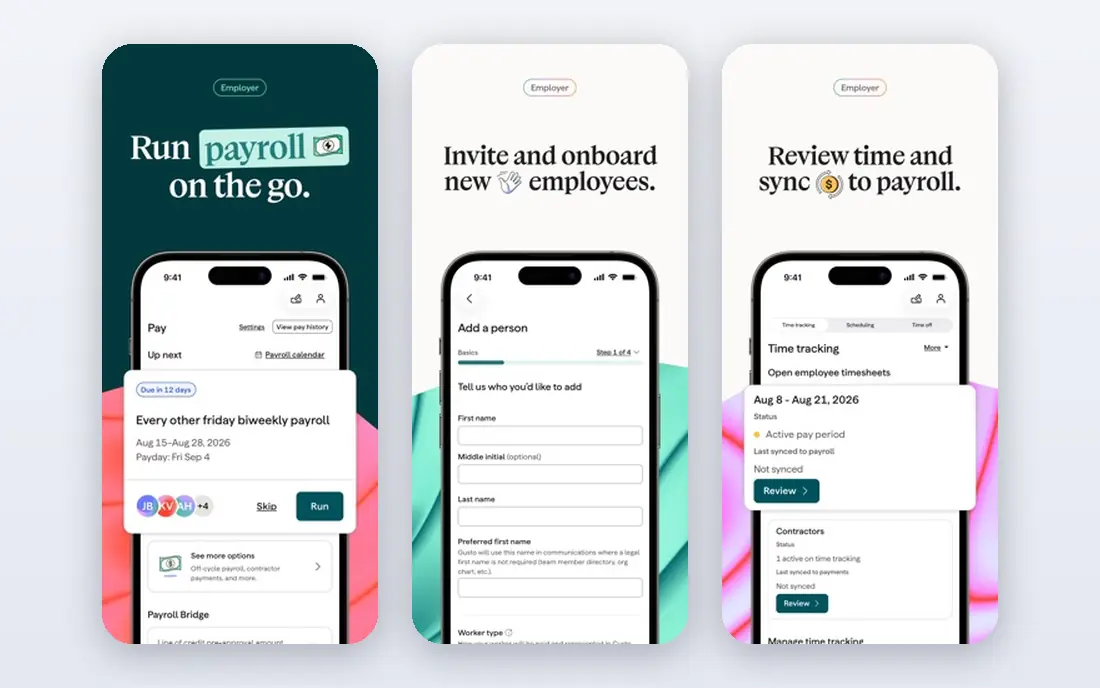
Gusto is the easiest fit for a small clinic that wants payroll, benefits, and tax filing without a steep learning curve. Simple starts at $49 per month plus $6 per person per month, with Plus at $80 and Premium at $180 per month before per-person fees. It handles unlimited payroll runs, automated tax filings, direct deposit, and time tracking for hourly workers, which covers most small practice needs.
The limit is healthcare-specific pay complexity. Gusto handles standard hourly, salary, and contractor pay well, but shift differentials, credential-based pay, and multi-entity hospital payroll need more specialised tools. For a solo practice, a dental office, or a small therapy clinic, Gusto is a strong, affordable start. For a hospital or a large multi-site group, shortlist an enterprise platform instead.
- Simple setup and clear pricing
- Automated payroll and tax filing
- Benefits and contractor payments included on higher tiers
- Less depth for complex shift differentials
- Larger hospital systems will outgrow it
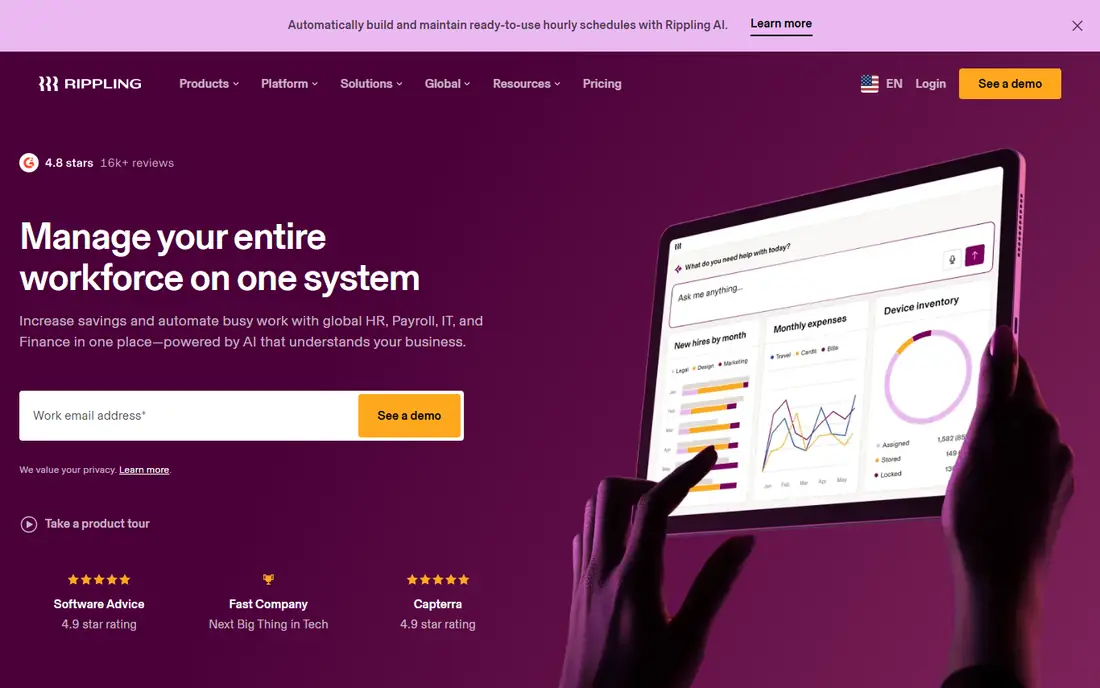
Rippling suits tech-forward practices that run several locations, entities, or contractor mixes and want one system for HR, IT, and payroll. Its published starting price from $8 per person per month, plus a base fee, makes early budgeting easier than quote-only rivals, and payroll add-ons are priced separately. Onboarding can trigger payroll, benefits, and device access in one workflow, which helps multi-location teams.
Rippling is not a healthcare-only tool, so shift differentials, credential tracking, and per-diem rules need setup and testing against your real pay schedules. It also becomes more expensive as modules stack up. If your practice values a modern, unified platform and has operations staff to configure it, Rippling is a strong choice. If you need healthcare pay rules out of the box, compare Paycor and Viventium first.
- Published starting price
- Unified HR, IT, and payroll
- Handles multiple locations and EINs well
- Modular pricing grows with add-ons
- Healthcare-specific pay rules need configuration
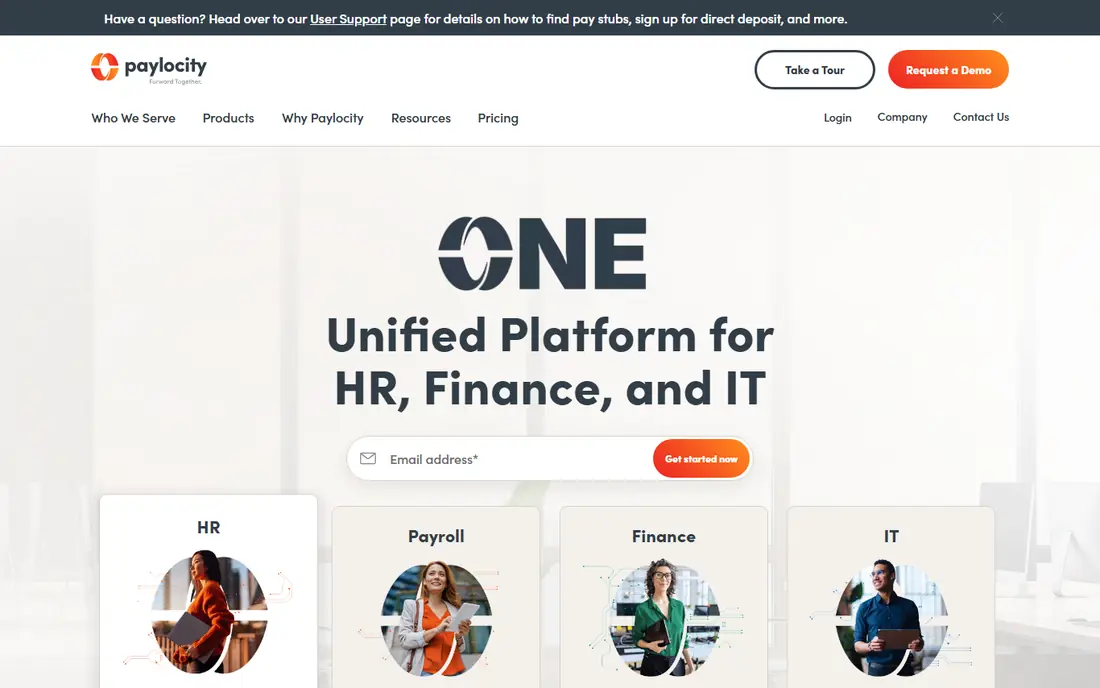
Paylocity is an all-in-one HR and payroll platform that fits mid-size healthcare practices well. It supports credential-based pay calculations, multi-entity payroll, cross-shift processing, and general ledger mapping, which helps practices with rotating staff and varied pay rules. Employee self-service, mobile access, and payroll compliance training resources also reduce the admin load on HR teams.
Paylocity pricing is quote-based, so budgeting requires a sales conversation and a clear headcount and module list. Implementation also takes planning, especially for multi-site groups. For a mid-size practice that has outgrown a small-business tool but does not need a full hospital HCM suite, Paylocity is a balanced, capable option.
- All-in-one HR and payroll
- Credential-based pay calculations
- Multi-entity and cross-shift payroll support
- Quote-based pricing
- Implementation and training take time
ADP Workforce Now is a payroll-centred HR platform for mid-size to large organisations, including healthcare systems with many locations. Its strengths are payroll accuracy, automated tax filing, and compliance support for multi-location operations, with add-ons for ACA, wage and tax, garnishments, and related post-payroll work. New-hire reporting and pay data integrations help large teams keep records consistent.
The trade-offs are price and complexity. ADP is quote-based, and costs climb as modules are added, while the interface can feel dated and the learning curve steep for smaller teams. Support experiences also vary by account size. For a large hospital network that needs proven payroll depth and compliance infrastructure, ADP remains a leading shortlist option. Smaller practices should start with a simpler, published-price tool.
- Deep payroll and tax infrastructure
- Multi-location compliance support
- Broad HR and benefits modules
- Quote-based pricing
- Interface can feel dated and complex for smaller teams
Paychex Flex combines payroll, HR, benefits, and time tracking in a cloud platform with a strong mobile app. For healthcare, it offers regulatory monitoring, flexible employee payout options, and HR support that helps multi-state operations keep up with changing rules. Its Pre-Check tools help catch payroll errors before processing, which matters when pay runs include shift differentials and overtime.
Paychex pricing is quote-based, and choosing the right modules takes care, since the platform covers a wide range. A free trial period is offered in some cases, which helps a team test the workflow. Paychex suits multi-state practices and mid-size groups that want vendor support alongside software, rather than a purely self-serve tool.
- Mobile app and flexible payout options
- Healthcare regulatory monitoring
- HR support services
- Quote-based pricing
- Module choices can be confusing at signup
UKG Pro is a full HCM platform for larger, distributed workforces, with payroll, HR, talent, and workforce analytics in one system. Its payroll engine calculates pay in real time through the pay period, and its analytics tools surface patterns in staffing, overtime, and labour cost. Earned wage access and flexible pay options also appeal to hospital workforces with many hourly staff.
UKG Pro does not publish pricing, and implementation usually needs a dedicated admin or partner, with custom reporting requiring deeper skills. That makes it a poor fit for a small clinic, and a strong fit for a hospital system that needs labour analytics and global payroll depth. If your team has the admin capacity to run it, UKG Pro can become a central workforce system, not just a payroll tool.
- Real-time payroll calculations
- Workforce analytics and labour insights
- Global payroll support
- Quote-based pricing
- Implementation needs dedicated admin or partner support
Paycor stands out for healthcare teams where shift differentials and rotating schedules drive pay. It handles varied shift premiums, overtime rules, and schedule-based pay in a way that generic payroll tools often require manual workarounds for. Time and attendance integration keeps hours, schedules, and pay in sync, which reduces errors for teams with many part-time, per-diem, and rotating staff.
Paycor pricing is quote-based, and its ecosystem is smaller than the largest HCM vendors, so integration checks matter for EHR and scheduling tools. For a mid-size healthcare organisation whose main payroll pain is shift complexity, Paycor is a focused and credible choice. For a very large hospital system, compare it against UKG and ADP on analytics and scale.
- Strong shift differential and schedule handling
- Healthcare-focused payroll workflows
- Time and attendance integration
- Quote-based pricing
- Smaller ecosystem than ADP or UKG
Viventium is built specifically for home health, skilled nursing, and post-acute care organisations, and that focus shows in its payroll features. It handles split shifts, multiple job codes, live-in caregiver arrangements, and shift differential and FLSA automation, and it generates Payroll-Based Journal reporting natively for CMS upload, rather than requiring a manual export step. That PBJ support alone saves time for post-acute teams.
Viventium covers recruiting, onboarding, time and attendance, payroll, ACA compliance, and reporting in one platform, with an HR concierge option for compliance questions. Reporting depth and occasional performance issues are noted drawbacks, and pricing is quote-based in practice despite some third-party listings. For home health and post-acute care, Viventium is the most specialised option in this list, and it deserves a top spot on a shortlist for that setting.
- Built for home health and post-acute care
- Native PBJ reporting for CMS
- Shift differential and FLSA automation
- Quote-based pricing in practice
- Reporting can feel clunky for some users
How we picked these
We compared official pricing pages, product descriptions, and public healthcare payroll comparisons for shift pay, credential pay, tax filing, and multi-site support. We kept only tools that are live in October 2026 and that genuinely support healthcare payroll needs, rather than generic payroll tools with no healthcare features. Where a vendor does not publish a price, we wrote See website.
What to check before you buy
Test your real pay rules, not a demo pay run. Give each vendor a sample schedule with shift differentials, per-diem staff, overtime, credential premiums, and multi-site hours, and check the output line by line. Confirm tax filing coverage for every state you operate in, and ask how year-end forms, ACA reporting, and PBJ reporting, where relevant, are handled.
Also confirm implementation help, data migration, and parallel run support. A payroll switch should include at least one parallel run before go-live, so errors surface before staff are paid incorrectly. Finally, get total first-year cost in writing, including setup, training, and any per-pay-run fees, since quote-based tools can differ widely once those costs are added.
Frequently asked questions
What makes healthcare payroll different?
Healthcare payroll must handle shift differentials, night and weekend premiums, per-diem and float staff, credential-based pay, and multi-site schedules. It also touches ACA reporting, PBJ reporting for post-acute care, and multi-state tax rules, which generic payroll tools may not cover well.
What is PBJ reporting?
Payroll-Based Journal reporting is a CMS requirement for certain post-acute providers, such as skilled nursing facilities, to report staffing hours. Tools like Viventium generate PBJ data natively for CMS upload, which saves manual export and formatting work.
How much does healthcare payroll software cost?
Small clinic tools start at $49 per month plus per-person fees, such as Gusto, while Rippling starts from $8 per person per month plus a base fee. Most mid-size and enterprise tools, including ADP, Paychex, UKG, Paycor, and Viventium, are quote-based, so total cost depends on headcount, modules, and implementation.
Should a small clinic use a healthcare-specific tool?
Not always. A small clinic with simple hourly and salary pay can use Gusto or Rippling well. A healthcare-specific tool becomes valuable when shift differentials, credential pay, PBJ reporting, or multi-site scheduling create regular manual workarounds.
Is this article tax or legal advice?
No. This article is general information only, not tax or legal advice. Payroll tax, overtime, and benefits rules vary by state and worker type, so confirm decisions with qualified tax and legal advisers.
Sources
See where you really rank - block by block
ProMapRanker scans Google Maps across a grid of your service area. Simple monthly plans from $19, white-label on every plan.
Start freeKeep reading
 zscaler alternatives
Best Zscaler Alternatives in 2026
Looking for zscaler alternatives? We compare 9 SASE and zero trust platforms on architecture, data protection, pricing, and fit for your network and team.
Read → zapier alternatives free
Best Zapier Alternatives Free in 2026
Nine automation tools for zapier alternatives free in 2026, all with genuinely free tiers, plus free plan limits, starting prices and upgrade paths explained.
Read → which platform is best for online reputation
Which Platform Is Best for Online Reputation in 2026
Wondering which platform is best for online reputation? We compare 8 review, listing, and response tools for small and multi-location businesses and agencies.
Read →