 ProMapRanker
Best Payroll Software for Global Teams in 2026


Mixed teams of employees and contractors · Pricing starts at: $29 per employee per month
Key takeaways
- Payroll and EOR prices are different products, so compare the rate for your exact worker type.
- Deel and Remote publish payroll starting rates, while several enterprise tools are quote-based.
- Aggregators suit teams with many countries, while owned-entity tools suit teams that value direct control.
- Always confirm setup, off-cycle and year-end fees, since headline rates rarely show the full annual cost.
Quick comparison
| Pick | Great for | Pricing starts at | Free tier | |
|---|---|---|---|---|
| Deel | Mixed teams of employees and contractors | $29 per employee per month | No | Visit |
 Remote | Teams wanting owned-entity depth and compliance focus | $29 per employee per month | No | Visit |
 Papaya Global | Larger teams needing payroll aggregation and analytics | See website | No | Visit |
 Oyster | Remote-first teams hiring internationally for the first time | See website | No | Visit |
 Rippling | Teams wanting HR, IT and payroll in one system | See website | No | Visit |
 Multiplier | Mid-market teams expanding into new countries | See website | No | Visit |
 G-P | Larger teams needing enterprise-scale EOR | See website | No | Visit |
 CloudPay | Enterprises running payroll through their own entities | See website | No | Visit |
The best payroll software for global teams
This guide compares global payroll tools, including payroll aggregators, employer of record platforms and unified HR suites. The right model depends on whether you have local entities, hire through an EOR, or pay contractors.
Employment law, tax and payroll rules vary by country, and they change often. This guide is general information only, not legal advice. Confirm contracts, taxes, benefits and worker classification with qualified advisers in each country before hiring or running payroll.
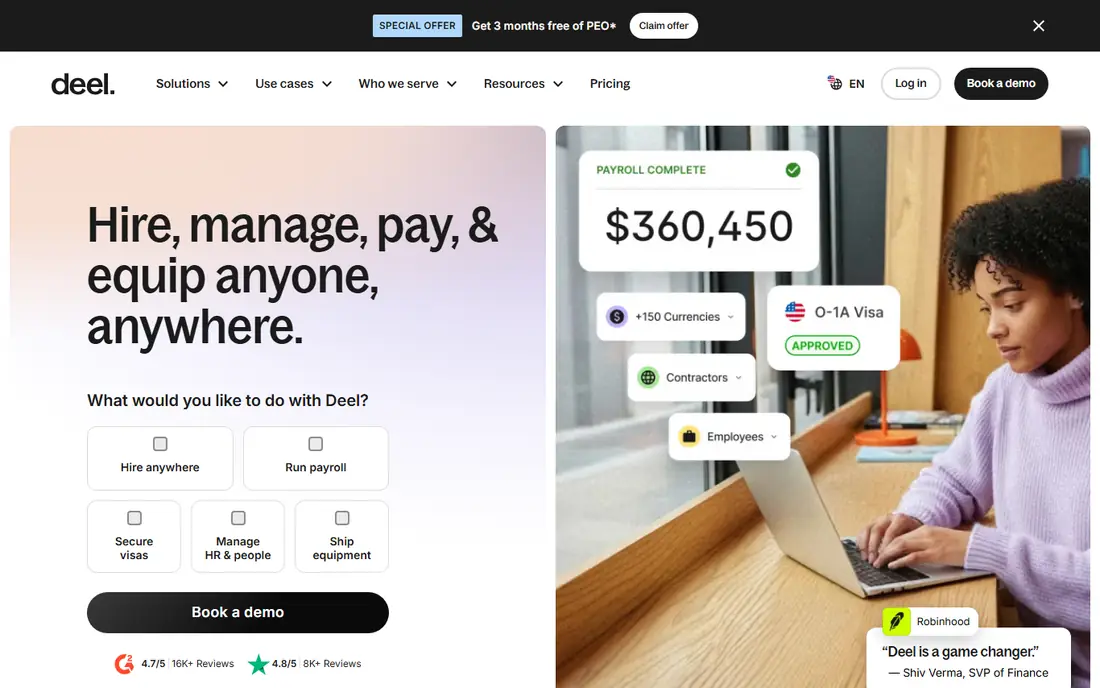
Deel suits companies running contractors, EOR employees and direct payroll side by side. Global payroll starts at $29 per employee per month in published comparisons, while EOR and contractor plans sit at higher rates, so teams should compare the exact worker type. Consolidated reporting helps finance teams see pay, taxes and contractor costs in one dashboard, rather than in separate country spreadsheets that are hard to reconcile at month end.
EOR costs climb quickly at scale, and implementation fees can apply per entity, so large rollouts need a full quote. Support also varies by country, which matters when a local payroll question is urgent. Choose Deel when one platform for mixed worker types matters more than the lowest single-country price, and when consolidated reporting will save finance time every month.
- Global payroll plus EOR and contractor tools
- Consolidated reporting
- Wide country coverage
- EOR pricing is far higher than payroll pricing
- Setup fees may apply per entity
- Support varies by country
Remote suits teams that value owned-entity infrastructure and clear compliance handling. Its owned-entity model gives it direct control in many markets, which can help with data handling and local expertise. Contractor, EOR and payroll options sit in one platform, with immigration and equity tools for teams that hire across borders, so a growing company does not need a new vendor for each new hire type.
Payroll pricing differs from EOR pricing, and off-cycle runs and year-end processing may add cost, so confirm the full annual picture. Enterprise needs are also quoted, which makes early budgeting less precise. Pick Remote when compliance depth and entity ownership matter more than the cheapest headline rate, and when direct control over local employment matters to the business.
- Owned entities in many markets
- EOR and contractor payroll
- Immigration and equity support
- EOR pricing is higher than payroll pricing
- Year-end and off-cycle work may cost extra
- Enterprise needs are quoted
Papaya Global
Great for: Larger teams needing payroll aggregation and analytics

Papaya Global fits larger teams that need to aggregate payroll across many countries and providers. Its platform centralises payments, reporting and workforce data, which helps finance leaders compare costs across regions. Analytics tools support planning and variance checks, rather than leaving each country payroll in a separate report that must be merged by hand each month.
Pricing varies by service model, and setup, platform and cycle fees may apply, so published starting figures should not be treated as a full quote. Its enterprise focus also means smaller teams may find simpler tools faster to adopt. Choose Papaya when aggregation and analytics matter more than a simple small-team payroll tool, and when finance needs one consolidated view across many markets.
- Multi-country payroll aggregation
- Central payments
- Workforce analytics
- Enterprise focus
- Pricing varies by model
- Setup and platform fees may apply
Oyster suits remote-first teams making their first international hires. EOR coverage spans many countries, with local expertise to guide contracts, benefits and compliance steps. Contractor payments sit beside EOR, so teams can start with contractors and move to employees as headcount grows, without changing platform for the first international steps.
EOR pricing is high per employee, and standalone payroll scope is narrower than aggregator rivals, so teams should confirm coverage country by country. Quoted tiers also vary, which makes a direct price comparison harder without a sales conversation. Pick Oyster when first-time international hiring and guided support matter most, and when the team values help with local rules over the lowest rate.
- EOR in many countries
- Contractor payments
- Local expertise and benefits guidance
- Standalone payroll scope is narrower than some rivals
- EOR pricing is high
- Quoted tiers vary
Rippling suits teams that want HR, IT and payroll in one system, rather than separate tools for each. Core HR, device management and finance tools share the same employee record, which cuts duplicate data entry across teams. Global payroll sits as an add-on, with contractor and EOR options for international workers, so a US-centred team can extend abroad without a second HR system.
Modular pricing means the total depends on which products are chosen, and global payroll depth varies by country. Implementation also needs planning, especially when HR, IT and payroll data must be migrated together. Choose Rippling when one unified platform matters more than a payroll-only specialist, and when the wider HR and IT benefits justify the modular cost.
- Unified HR, IT and finance platform
- Global payroll add-on
- Strong integrations
- Modular pricing adds up
- Global payroll depth varies by country
- Implementation needs planning
Multiplier fits mid-market teams expanding into new countries without setting up local entities first. EOR and payroll options cover many countries, with contractor tools for flexible hiring beside full employees. Onboarding support helps teams move faster in unfamiliar markets, where local contracts and benefits differ sharply, and where a mistake in the first contract can be costly to fix.
Pricing is largely quoted, with setup and statutory fees possible on top of headline rates, so get a country-by-country quote. Coverage must also be checked per country, since a high total country count can hide gaps in a specific market. Pick Multiplier when expansion speed and EOR breadth matter more than published price clarity, and when onboarding support will shorten time to first hire.
- EOR and payroll across many countries
- Contractor tools
- Onboarding support
- Pricing is largely quoted
- Fees beyond headline rates may apply
- Coverage must be checked per country
G-P suits larger teams that need enterprise-scale employer of record coverage. Its EOR model lets companies hire in many countries without a local entity, with onboarding and compliance support built around that model. Contractor tools and analytics sit beside EOR, which helps larger teams manage a mixed global workforce from one platform, with reporting that finance and HR can both use.
Pricing is quote-based and EOR rates are high, so smaller teams may find payroll aggregators or contractor tools more affordable. Payroll-only needs may also fit other tools better, since G-P is built around EOR first. Choose G-P when enterprise scale and EOR depth matter more than low cost, and when the hiring plan spans many countries at once.
- EOR in many countries
- Contractor tools
- Enterprise onboarding and analytics
- Quote-based pricing
- EOR costs are high
- Payroll-only needs may fit other tools better
CloudPay fits enterprises that run payroll through their own entities and need finance-grade control. Its platform links payroll to treasury and finance systems, which helps large teams manage payments, funding and reporting across countries. Multi-country reporting gives finance leaders a consolidated view, rather than a patchwork of local payroll reports that must be merged each cycle.
Pricing is quote-based and implementation is an enterprise project, so it is not a quick pick for small teams. Teams should also confirm which countries, currencies and payment methods sit in scope for their rollout. Pick CloudPay when treasury integration and enterprise reporting matter most, and when payroll is already run through owned entities that need a stronger central layer.
- Global payroll with treasury links
- Finance integration
- Multi-country reporting
- Enterprise and quote-based
- Less suited to small teams
- Implementation is a project
How we picked these
We compared official product pages, pricing pages, documentation and public reviews, and we kept only tools that are live and truly fit the topic in October 2026. We checked starting prices and free tiers against vendor pages where they were published, and we wrote See website where a price was quote-based, conflicting across sources, or not published. We did not claim hands-on testing, and we weighed one concrete strength against one honest weakness for every option.
Choosing global payroll by worker type and entity model
Start by sorting workers into groups: direct employees through your own entity, employees through an EOR, and contractors. Each group has different costs, contracts and compliance duties, and a tool that is cheap for contractors may be expensive for EOR staff.
Next, check country coverage one by one. A headline count of countries can hide gaps in the exact markets where you hire, so confirm payroll, benefits and support for each country on your shortlist.
Finally, test reporting and payments. Finance teams need consolidated reports, variance checks and clear payment timing, while employees need accurate local pay slips and benefits. Ask for a sample report and a sample pay cycle timeline before signing.
Frequently asked questions
What is the difference between global payroll and EOR?
Global payroll pays workers through your own local entities or local partners. An EOR becomes the legal employer in a country where you have no entity, and payroll comes bundled with that employment.
Which global payroll tool is cheapest?
It depends on worker type and country. Published payroll rates start around $29 per employee per month for some tools, while EOR rates run into hundreds per month, so compare like with like.
Can one tool pay workers in every country?
No tool covers every country with the same depth. Check your exact hiring countries, since coverage, benefits and support vary even when a vendor lists a high total country count.
Do I still need local legal advice?
Yes. Employment law, tax and payroll rules vary by country and change often. Software supports compliance work, but it does not replace qualified local advice.
What hidden costs should I check?
Setup fees per entity, off-cycle runs, year-end processing, payment fees and platform licences can sit outside headline rates. Ask for a full first-year quote in writing.
Sources
See where you really rank - block by block
ProMapRanker scans Google Maps across a grid of your service area. Simple monthly plans from $19, white-label on every plan.
Start freeKeep reading
 what’s the best risk software for enterprises
What Is the Best Risk Software for Enterprises in 2026
We compared what’s the best risk software for enterprises on risk registers, controls, third-party risk, and reporting, with pricing notes for large teams.
Read → what's the best pam software for enterprises
What is the Best PAM Software for Enterprises in 2026
Find what's the best pam software for enterprises, with vaulting, session recording, just in time access and pricing compared for large enterprise IT teams.
Read → what’s the best grc software
What Is the Best GRC Software in 2026
We compared what’s the best grc software on risk, compliance, audit and vendor risk, so teams can pick a platform that fits their frameworks and budget.
Read →