 ProMapRanker
Best Paid Proxy Service in 2026


Enterprise scraping and compliance · Pricing starts at: $4 per GB
Key takeaways
- Paid proxies beat free lists on uptime, speed, and support, and the price gap between budget and enterprise options is wide.
- Bright Data and Oxylabs suit large, compliance-sensitive work, while Decodo and DataImpulse suit smaller teams that want simple pricing.
- Webshare is the easiest low-cost way to test a setup, because it offers a free plan with datacenter proxies.
- Always model cost at your real monthly volume, since per-gigabyte rates fall sharply on larger plans and pay-as-you-go rates can add up fast.
- Check the acceptable-use rules for your target sites before you buy, because a proxy does not make scraping that breaks a site terms of use acceptable.
Quick comparison
| Pick | Great for | Pricing starts at | Free tier | |
|---|---|---|---|---|
| Bright Data | Enterprise scraping and compliance | $4 per GB | Free trial | Visit |
 Oxylabs | High-volume data pipelines | $30 per month | Free trial | Visit |
 Decodo | Best value all-rounder | $4 per GB | Free trial (3 days, 100 MB) | Visit |
 SOAX | Precise geo and mobile targeting | $90 per month | Free trial (3 days, $1.99) | Visit |
 IPRoyal | Long sessions and rollover traffic | $7 per GB | No | Visit |
 Webshare | Developers and prototyping | Free | Yes | Visit |
 Rayobyte | Datacenter-heavy US workloads | $3.50 per GB | Free trial | Visit |
 DataImpulse | Budget residential scraping | $1 per GB | Free trial | Visit |
The best paid proxy services
We compared paid proxy providers on published pricing, proxy types, coverage, session controls, and trial terms, using vendor pricing pages, documentation, and public reviews.
Bright Data is the default pick for teams that answer to a compliance department or run large, continuous data collection. Its residential pool is claimed at hundreds of millions of addresses across many countries, and it offers ISP, datacenter, and mobile proxies alongside its residential network. That breadth matters when one project needs several proxy types and a single vendor contract.
The extra tooling is the other reason to pay more here. Its Web Unlocker, scraper APIs, and dataset products help with heavily defended targets and JavaScript-heavy pages, so teams spend less time building their own handling for blocks and retries. Support and documentation are also built for business buyers, with account help on larger plans.
The catch is cost and process. Pay-as-you-go residential pricing sits above budget providers, and volume plans still require a real budget. Verification steps can also slow a first test. For a solo developer or a short project, a cheaper provider will usually do the same job for less.
- Very large IP pool
- Deep country, city, and ASN targeting
- Mature unblocking and scraping tools
- Higher cost than mid-market options
- Signup and verification can take longer

Oxylabs competes directly with Bright Data on pool size and reliability, with a claimed pool of more than 175 million residential addresses. It sells residential, mobile, ISP, and datacenter proxies, plus unblocking tools, so a data team can standardize on one provider as volume grows. Public benchmarks have rated its success rates highly, which is the number that matters most once a pipeline runs every day.
Its pricing curve rewards scale. Small plans start higher per gigabyte, and rates fall as monthly volume rises toward large tiers. That makes Oxylabs a strong fit for companies with steady, predictable traffic and service-level needs, and a weaker fit for a one-off scrape.
The sales-led process is the trade-off. Smaller buyers may find the entry cost and minimums hard to justify when Decodo or DataImpulse offer self-serve signup. If you need enterprise support, documented sourcing, and a deep toolset, the extra cost buys real structure.
- Large verified pool
- Strong success rates in public benchmarks
- Web Unblocker with JavaScript rendering
- Entry pricing is high for small buyers
- Best rates need large volume commitments
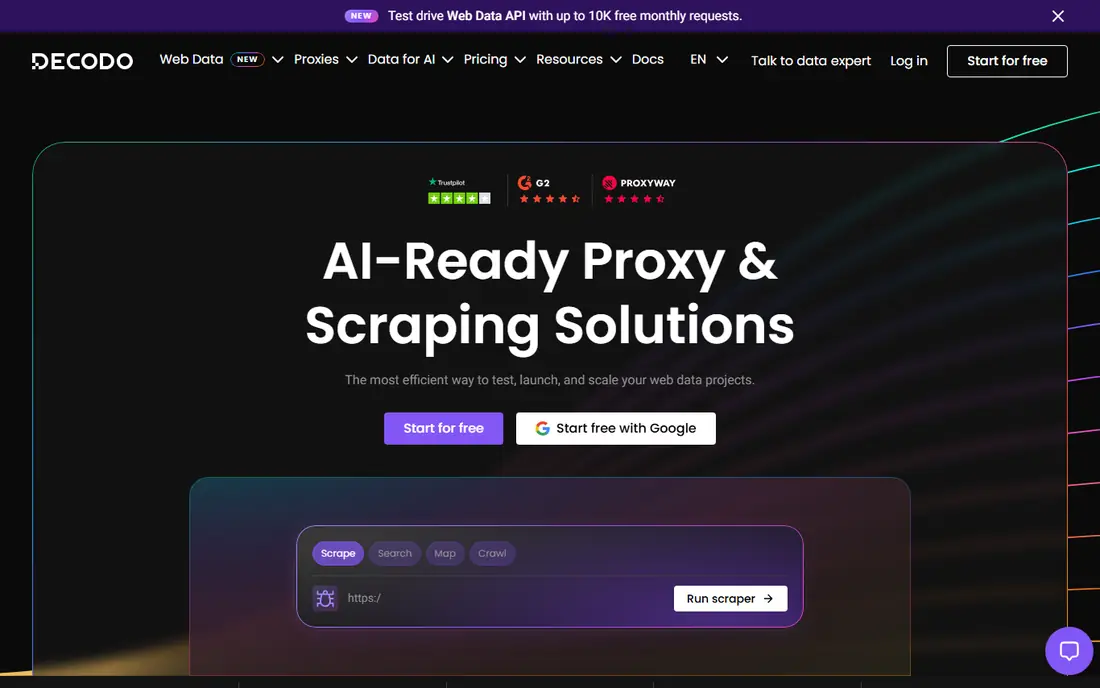
Decodo, formerly Smartproxy, is our pick for most buyers who want a paid proxy without an enterprise sales process. You can sign up, start a short trial, and run residential, ISP, datacenter, or mobile proxies from one account. Its residential pool is claimed at more than 115 million addresses across more than 195 locations, with state, city, ZIP, and ASN targeting on many plans.
Pricing is clear and easy to model. Pay-as-you-go residential traffic is listed at 4 dollars per gigabyte, and monthly plans lower the per-gigabyte rate as volume rises. That clarity helps small agencies, SEO tool builders, and researchers who need to forecast a monthly bill without negotiating a contract.
The limits show up at the top end. Decodo does not match Bright Data or Oxylabs on compliance certifications or specialized enterprise tooling, and monthly allowances generally expire. For most mid-market work, that trade is invisible in practice. For a regulated enterprise rollout, check the compliance pages first.
- Simple self-serve signup
- Pay-as-you-go residential pricing
- Wide country coverage
- Smaller pool than the enterprise leaders
- Less compliance depth for regulated buyers
SOAX suits teams that need a specific place, carrier, or device type rather than a generic pool. Its mobile proxies and residential options support city-level and ASN targeting, which helps with ad verification, local search checks, and location-sensitive testing. The dashboard also gives clear session controls, so you can hold a stable address or rotate as the job requires.
Plan structure is flexible, with different pools and credit options, but that flexibility means you should read the fine print. Entry pricing is higher than budget providers, and some credits have expiry windows. Model your monthly use before you pick a tier, and test the exact locations you need during the low-cost trial.
For broad, low-cost scraping, cheaper options win on price alone. For precise targeting work where a wrong location ruins the test, SOAX earns its place. Its support and documentation are geared to that kind of practical, location-first use.
- Granular location and carrier targeting
- Mobile and residential options
- Flexible plan structure
- Entry plans cost more than budget rivals
- Traffic terms vary by plan and need careful reading
IPRoyal is a good fit when sessions need to last. Its residential proxies support long sticky sessions, which helps with account work, form flows, and multi-step research that breaks when an address changes mid-task. It also sells datacenter, static residential, and mobile proxies, so one account can cover several job types.
The pricing story needs care. Entry pay-as-you-go traffic is listed at 7 dollars per gigabyte, which looks expensive next to budget rivals. Rates fall sharply at higher volumes, and unused pay-as-you-go traffic does not expire, which softens the cost for slow, irregular projects. If you buy in bulk and use it over months, the effective price is far better than the headline.
There is no standard free trial, so start with the smallest purchase and test your targets before committing. For teams that need steady addresses and do not want traffic to vanish at month end, IPRoyal is a practical, if not cheap, choice.
- Traffic that does not expire on pay-as-you-go plans
- Sticky sessions up to days
- Many proxy types
- Entry per-gigabyte rate is high
- Volume rates are much lower, so small buyers pay more
Webshare is the best place to start if you are building or testing a proxy setup for the first time. Its free plan includes datacenter proxies, so you can check integration, authentication, and basic routing without paying. Paid plans add more proxies, bandwidth, and residential options as needs grow.
The platform is built for developers. Setup is self-serve, proxies support common protocols, and the dashboard stays simple. That simplicity is a strength for prototypes, internal tools, and small scripts, and a limit for teams that want managed scraping tools or account support.
Free and shared proxies will not suit every target, and residential pricing is not the cheapest in this list. Use Webshare to prove the workflow, then move to a residential-heavy provider if your targets block datacenter addresses. For learning and early builds, it is hard to beat a free start.
- Free plan with datacenter proxies
- Low entry cost
- Simple self-serve setup
- Residential traffic costs more than budget rivals
- Free proxies are shared and limited
Rayobyte, formerly Blazing SEO, is a strong pick for US-focused work that runs mainly on datacenter proxies. Its dedicated datacenter plans offer unlimited bandwidth within fair-use terms, which suits always-on tools, monitoring, and internal services that would be expensive on per-gigabyte billing. It also sells residential and ISP proxies for targets that need a residential address.
The company operates its own network, which helps with control and consistency, and its US coverage is a clear strength. Volume discounts bring residential rates down a lot at large scale, so heavy users should price a monthly plan rather than judging the entry rate alone.
The catch is fit. If your work needs residential addresses in many countries, other providers offer wider pools. If your work is US-heavy and datacenter-friendly, Rayobyte gives a stable, cost-effective base, with residential options when a job needs them.
- Own network and US strength
- Datacenter plans with unlimited bandwidth
- Residential options at scale
- Minimum order on some datacenter plans
- Residential entry rate is mid-range
DataImpulse is the budget pick in this list, and it earns that spot with a simple promise. Residential traffic is listed at 1 dollar per gigabyte on pay-as-you-go, with no subscription required, and unused traffic does not expire. That model suits irregular projects, small research jobs, and developers who want to top up only when they need it.
Its pool is claimed at tens of millions of addresses, with HTTP, HTTPS, and SOCKS5 support and sticky session options. For straightforward scraping and data collection, that covers the basics well. The dashboard is functional rather than polished, and managed unblocking tools are thinner than at Bright Data or Oxylabs.
The honest limit is depth. Large teams that need service agreements, dedicated support, and advanced scraping APIs will outgrow DataImpulse. For cost-sensitive buyers who can handle their own code and retries, it delivers residential access at a fraction of enterprise pricing.
- Low flat pay-as-you-go rate
- Traffic that never expires
- Sticky sessions
- Smaller toolset than enterprise providers
- Support and documentation are leaner
How we picked these
We compared official pricing pages, product documentation, and public reviews for providers that are active in October 2026 and sell to US buyers. We favored providers with clear pricing, several proxy types, documented coverage, and a trial or low entry purchase, and we left out free proxy lists and providers we could not verify. Prices below are starting points only, since per-gigabyte rates, plan minimums, and fair-use terms change with volume and proxy type. We did not claim hands-on testing we did not do. Our comparison rests on vendor pages, pricing, and published benchmarks, so recheck the pricing page for your exact plan before you buy.
What to check before you pay
Start with the job, not the headline rate. A datacenter proxy is cheap and fast, but many sites block datacenter addresses quickly. A residential proxy looks more like a home connection and costs more per gigabyte. A mobile proxy is usually the most expensive and the hardest to block, and it suits account-sensitive or mobile-specific checks. Pick the cheapest type that actually works on your target, and test it before you scale.
Match the billing model to your pattern
Pay-as-you-go suits irregular work, because you pay only for traffic you use and, with some providers, unused credit lasts. Monthly plans suit steady work, because the per-gigabyte rate falls as volume rises. Watch for expiry rules, minimum orders, and fair-use caps on per-IP plans, since those terms change the real cost more than the headline rate does.
Test location, sessions, and speed
Run the same requests through each shortlisted provider on your real targets, in the countries and cities you need. Check success rates, response times, and whether sticky sessions hold for multi-step flows. A provider that looks cheap on paper can cost more in retries if its addresses are blocked often on your specific sites.
Stay within the rules
Use proxies only for lawful work and respect the terms of the sites you visit, robots guidance, and privacy law. Do not use proxies to bypass account bans, harvest personal data without a lawful basis, or hide abusive traffic. If a provider asks for identity verification, that is a normal compliance step for paid business proxies, not a reason to pick an unverified alternative.
Frequently asked questions
What is the best paid proxy service for most people?
Decodo is a sensible default for most small and mid-size buyers, because it pairs simple signup with clear pay-as-you-go pricing and wide coverage. Larger teams with compliance needs should shortlist Bright Data or Oxylabs. Budget buyers who scrape irregularly should look at DataImpulse first.
What is the best paid proxy software for beginners?
Webshare is the easiest starting point, thanks to its free datacenter plan and simple setup. Decodo is the next step when you need residential addresses, since its trial and pay-as-you-go model keep the first test cheap. Start small, test your targets, and only then move to a monthly plan.
How much do paid proxy services cost?
Costs vary widely by type and volume. Budget residential traffic can start near 1 dollar per gigabyte, mid-market options sit near 4 dollars per gigabyte, and enterprise entry rates are higher before volume discounts. Datacenter proxies are often priced per IP per month instead, so compare the total monthly bill at your real volume, not just the headline rate.
Are paid proxies better than free proxies?
Yes, for serious work. Paid providers offer faster, more stable addresses, customer support, and clearer sourcing and abuse policies. Free proxy lists are often slow, unreliable, and risky, since you do not know who runs the server or what it logs. For anything beyond a quick test, a paid plan is worth the cost.
Do I need residential, datacenter, or mobile proxies?
Use datacenter proxies for fast, low-risk internal work and targets that accept them. Use residential proxies for public sites that block datacenter traffic or need a home-like address. Use mobile proxies for mobile-specific checks or hard targets, and expect to pay more. Test each type on your target before you commit to a large plan.
Sources
See where you really rank - block by block
ProMapRanker scans Google Maps across a grid of your service area. Simple monthly plans from $19, white-label on every plan.
Start freeKeep reading
 zscaler alternatives
Best Zscaler Alternatives in 2026
Looking for zscaler alternatives? We compare 9 SASE and zero trust platforms on architecture, data protection, pricing, and fit for your network and team.
Read → zapier alternatives free
Best Zapier Alternatives Free in 2026
Nine automation tools for zapier alternatives free in 2026, all with genuinely free tiers, plus free plan limits, starting prices and upgrade paths explained.
Read → which platform is best for online reputation
Which Platform Is Best for Online Reputation in 2026
Wondering which platform is best for online reputation? We compare 8 review, listing, and response tools for small and multi-location businesses and agencies.
Read →