 ProMapRanker
Best Operational Technology Software in 2026

Key takeaways
- The best operational technology software starts with visibility, since you cannot protect or manage controllers, sensors and HMIs you cannot see.
- Claroty, Dragos and Nozomi Networks lead OT security, while Ignition and AVEVA lead plant operations and control.
- OT tools must understand industrial protocols such as Modbus, EtherNet/IP and PROFINET, which is why IT security tools alone are a poor fit.
- All OT security vendors on this list price by quote, so budget for a proof of concept on your own network traffic before you sign.
Quick comparison
| Pick | Great for | Pricing starts at | Free tier | |
|---|---|---|---|---|
 Claroty | Broad OT security coverage | See website | No | Visit |
 Dragos | OT threat intelligence | See website | No | Visit |
 Nozomi Networks | Multi-site OT visibility | See website | No | Visit |
 Tenable OT Security | Teams already using Tenable | See website | No | Visit |
 Armis | Asset visibility across IT and OT | See website | No | Visit |
 Palo Alto Networks OT Security | Palo Alto firewall shops | See website | No | Visit |
 Fortinet OT Security | Firewall-based OT segmentation | See website | No | Visit |
 Ignition | Plant control and visualisation | See website | Free trial | Visit |
 AVEVA | Large plant operations suites | See website | No | Visit |
The best operational technology software
Operational technology is the software and hardware that runs physical processes: factory lines, water plants, power grids and building systems. This list covers two halves of that world. The first seven tools protect and watch OT networks, and the last two run plant operations, control and visualisation. Pick the half that matches your job, then compare within it.

Claroty covers the widest OT ground on this list. It discovers cyber-physical assets passively from network traffic, adds active queries and project file analysis where that is safe, and watches for threats using research from its Team82 group. It also supports compliance work for standards such as IEC 62443 and NERC CIP, which matters for regulated utilities and manufacturers.
The honest limit is enforcement. Claroty detects and recommends, while blocking and segmentation usually happen through your existing firewalls and switches. Pricing is quoted by site and asset count. Claroty is our pick for organisations that want broad OT visibility across IT and OT together, especially where healthcare or industrial devices sit on the same programme.
- Passive asset discovery plus active query options
- Threat detection fed by Team82 research
- Compliance support for IEC 62443 and NERC CIP
- Quote-based pricing
- Enforcement depends on third-party firewalls and switches, not built-in blocking
Dragos is the threat intelligence pick. Its platform tracks industrial threat groups and attack techniques in detail, and its team brings incident response experience built for control systems rather than office IT. For a utility or manufacturer that worries about targeted attacks on controllers, that depth is the reason to choose Dragos over a general security tool.
The trade-off is scope. Dragos focuses on detection and investigation, so segmentation and blocking still need your network gear. Deployment uses on-prem sensors with cloud analytics, which needs planning in a plant that cannot stop. Dragos fits critical infrastructure operators and large manufacturers with a real OT security team. Smaller sites may find it more platform than they can staff.
- Deep ICS-specific threat intelligence
- OT-first asset inventory
- Incident response expertise for industrial incidents
- Quote-based pricing
- Detection-focused, with no native enforcement
- On-prem sensors add deployment planning
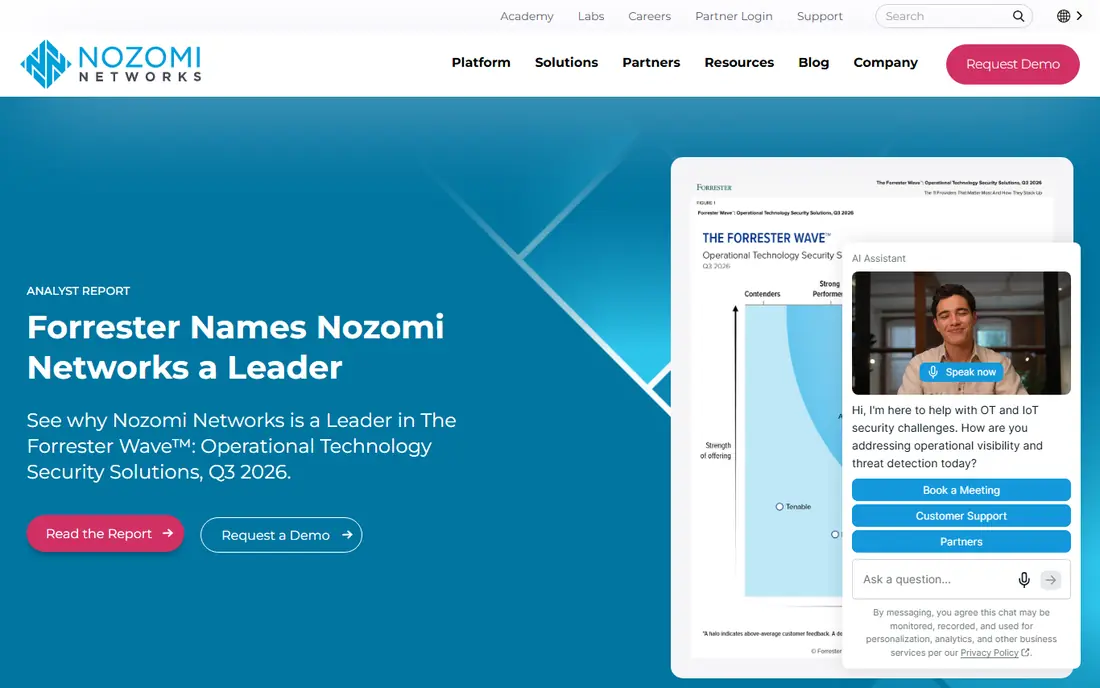
Nozomi Networks suits organisations with many distributed sites. Its Guardian sensors watch OT traffic continuously, classify assets and flag anomalies, while the Vantage cloud console manages many sites from one place. It also offers air-gapped on-prem deployment for sites that cannot send data to the cloud, which is a real requirement in some critical infrastructure settings.
The limit matches its rivals: detection and visibility first, enforcement through integration. Pricing is quoted. Nozomi is a strong pick for multi-site operators that need consistent visibility across plants, substations or water sites, and it was named a leader in a 2026 Forrester OT security review. Single-site teams should compare it with Claroty on price and protocol coverage.
- Continuous asset classification at large scale
- Anomaly detection in OT traffic
- SaaS or air-gapped on-prem deployment
- Quote-based pricing
- Enforcement works through integrations rather than built-in blocking
Tenable OT Security, formerly Tenable.ot, brings OT asset discovery, vulnerability context and risk scoring into the Tenable platform many IT teams already use. That shared console is the draw: security leaders can see IT and OT risk in one place, prioritise by exposure, and reuse existing Tenable workflows and reporting instead of learning a separate system.
The check is protocol depth. OT-first vendors built for control systems may cover more industrial protocols or offer deeper OT threat content for a given plant type. Test Tenable against your actual device mix before committing. Tenable OT Security fits organisations that already standardise on Tenable and want OT visibility inside that programme, rather than a standalone OT purchase.
- OT asset discovery and risk scoring
- Fits teams that already run Tenable for IT vulnerability management
- Central reporting
- Quote-based pricing
- OT depth is narrower than OT-first vendors for some protocol-specific cases
Armis covers the asset problem at its widest. It discovers and profiles IT, OT, IoT and medical devices, scores their risk, and gives security teams a single inventory across environments that usually sit in separate tools. For organisations where the OT problem is really an asset problem, meaning unknown devices on the network, that breadth is valuable.
The trade-off is specialisation. Armis is an asset and risk platform first, so teams that need the deepest ICS threat intelligence should pair it with, or choose, an OT-first vendor. Pricing is quoted. Armis fits enterprises and health systems with mixed device estates that need one inventory and one risk view across IT and OT.
- Very broad asset discovery across IT, OT, IoT and medical devices
- Risk scoring
- Cloud-based console
- Quote-based pricing
- OT-specific threat content is less deep than Dragos for targeted industrial attacks
Palo Alto Networks OT Security makes most sense where Palo Alto firewalls already guard the network. Its OT tools profile assets, inspect OT traffic and spot protocol anomalies, and the firewalls then enforce segmentation between OT zones. That detection plus enforcement in one vendor is an advantage over detection-only platforms, provided the firewall estate is already in place.
The catch is the starting point. Sites without Palo Alto gear face a bigger project, and OT protocol coverage should still be tested against the plant device mix. Pricing is quoted. For a Palo Alto shop, this is a natural OT extension. For a multi-vendor network, an OT-first platform plus existing firewalls may be simpler.
- OT-aware asset profiling and traffic inspection
- Firewall-enforced segmentation
- Central management through Panorama
- Quote-based pricing
- Brownfield sites without Palo Alto gear face a larger rollout
Fortinet OT Security pairs FortiGate firewalls with OT-aware inspection, virtual patching for legacy systems that cannot be patched, and FortiSwitch microsegmentation down to port level. That combination suits plants with old controllers that will never receive a vendor patch, since the network can shield them instead of changing the device.
Hardware install is the practical cost. Appliances need planned windows in a plant that runs day and night, and OT protocol coverage should be tested on your traffic. Pricing is quoted. Fortinet fits Fortinet shops and plants with legacy devices that need network-level protection. Detection-only buyers should compare it with Claroty and Nozomi on visibility depth.
- OT-aware intrusion prevention and virtual patching
- FortiSwitch microsegmentation
- Strong for Fortinet firewall estates
- Quote-based pricing
- Hardware appliance install needs planning in plants that run around the clock
Ignition by Inductive Automation is the operations pick on this list. It is a SCADA and industrial application platform for HMI visualisation, alarming, historisation and MES-style work, licensed per server with unlimited clients rather than per seat. That model keeps costs predictable as you add screens and users across a plant, and its integrator community is large.
The honest cost is build effort. Ignition is a platform, not a ready-made app, so large projects need skilled integrators or in-house engineers. Pricing is quoted for full deployments, with trial options available. Ignition suits plants and system integrators that want one flexible platform for control, visualisation and data, rather than a fixed single-purpose tool.
- Unlimited licensing model by server, not per client
- Strong SCADA, HMI and historian tools
- Large integrator community
- Quote-based pricing for full deployments
- Needs integrator or in-house skill for large projects
AVEVA covers plant operations at enterprise scale, from HMI and SCADA through asset performance management, engineering and operations data. Process industries such as chemicals, food, energy and water use it to run plants, track performance and manage assets over long lifecycles, with cloud and on-prem deployment options.
Breadth is also the cost. Selecting and rolling out an AVEVA suite is a programme, not a purchase, and pricing is enterprise and quoted. AVEVA fits large operators that want a single vendor across engineering and operations. Smaller plants will usually get faster value from Ignition or a focused SCADA tool, and should only consider AVEVA when the enterprise scope is real.
- Broad operations suite from HMI and SCADA to asset performance and engineering
- Strong in process industries
- Cloud and on-prem options
- Quote-based enterprise pricing
- Suite breadth means longer selection and rollout
How we picked these
We compared official product pages, analyst coverage and public documentation for each vendor, and checked pricing behaviour where vendors do not publish their own. We kept only software that is live in October 2026 and that truly serves operational technology, meaning OT network security, OT asset visibility, or plant control and operations. We left out general IT security tools with no OT protocol support, since they cannot read the traffic they are meant to protect.
We also split the list honestly. OT security and plant operations are different purchases with different buyers, and ranking them on one scale would mislead both. That is why the first seven entries are security and visibility tools and the last two are operations platforms, with the split stated up front.
What to check before you buy
Start with your device inventory and your protocols. List your controllers, HMIs, sensors and historians, note which protocols they speak, and ask each vendor to prove coverage on that list, not on a generic protocol sheet. Then run a proof of concept on a copy of your traffic or in a lab network first. Never run active scanning or intrusive tests against a live control network without vendor and operations approval, since probing a legacy controller can halt a process. That safety rule matters more than any feature claim.
Next, plan the response side. Detection without a response plan is only an alert feed, so confirm who triages OT alerts, how segmentation changes are approved, and how incidents are handled when operations staff and security staff disagree. Ask about support hours, update cadence and data handling for cloud consoles, especially for air-gapped sites. Finally, get the total cost in writing: sensors, licences by site or asset, managed services and implementation, at your current site count and at your planned count.
Questions to ask in the sales call
Ask how passive discovery handles encrypted or serial traffic in your plant. Ask how alerts are tuned to avoid flooding operators during normal process changes. Ask what happens when the platform loses connection to a site, and how historical data is kept. Ask for references from plants in your industry with a similar device mix, since OT fit is specific to the plant, not generic.
Frequently asked questions
What is the best operational technology software for OT security?
Claroty, Dragos and Nozomi Networks are the leading OT-first picks, with Claroty for breadth, Dragos for threat intelligence and Nozomi for multi-site scale. The best choice depends on your device mix, site count and whether you need enforcement through firewalls or detection alone. Run a proof of concept on your own traffic before choosing.
Can IT security tools protect OT networks?
Only partly, and often poorly. IT tools that cannot decode industrial protocols see IP traffic around a device without understanding what the device is doing, so they miss process-level attacks and can misread normal control traffic. OT tools exist because Modbus, EtherNet/IP, PROFINET and similar protocols need protocol-aware detection. Use IT tools for office networks and OT tools for control networks.
How much does OT security software cost?
All vendors on this list price by quote, based on site count, monitored assets and modules. Enterprise buyers commonly report sizeable annual contracts, with large multi-site rollouts costing far more, but exact figures depend on scope. Ask for a quote at your current site and asset counts, plus the cost of adding sites later.
Is OT security software a safety system?
No. OT security tools watch networks and flag risks, but they do not replace safety instrumented systems, process safety procedures or change control. Keep safety and security programmes separate, test changes in a lab first, and never let a security rollout override a safety requirement. If a change could affect a live process, operations approval comes first.
What is the difference between OT and SCADA software?
OT is the broad field covering the hardware and software that run physical processes, while SCADA is one type of OT software for supervising and controlling those processes. Ignition and AVEVA are SCADA and operations platforms, while Claroty, Dragos and Nozomi are security platforms that watch OT networks. Many plants need both kinds of software.
Sources
See where you really rank - block by block
ProMapRanker scans Google Maps across a grid of your service area. Simple monthly plans from $19, white-label on every plan.
Start freeKeep reading
 zscaler alternatives
Best Zscaler Alternatives in 2026
Looking for zscaler alternatives? We compare 9 SASE and zero trust platforms on architecture, data protection, pricing, and fit for your network and team.
Read → zapier alternatives free
Best Zapier Alternatives Free in 2026
Nine automation tools for zapier alternatives free in 2026, all with genuinely free tiers, plus free plan limits, starting prices and upgrade paths explained.
Read → which platform is best for online reputation
Which Platform Is Best for Online Reputation in 2026
Wondering which platform is best for online reputation? We compare 8 review, listing, and response tools for small and multi-location businesses and agencies.
Read →