 ProMapRanker
Best Service Dog Training Organisations in 2026


Service, hearing, and facility dogs · Pricing starts at: See website
Key takeaways
- There is no official online service dog certification or registry in the US, and a vest or certificate bought online does not make a dog a service dog.
- A service dog is defined by trained tasks that help a person with a disability, not by breed, vest, or paperwork alone.
- Legitimate training organisations place dogs after an application, assessment, and team training, often with long waits.
- This article is general information only, not legal advice, and local rules can differ, so check official guidance for your situation.
Quick comparison
| Pick | Great for | Pricing starts at | Free tier | |
|---|---|---|---|---|
| Canine Companions | Service, hearing, and facility dogs | See website | Yes | Visit |
 NEADS | Service dogs for adults and children | See website | No | Visit |
 Guide Dogs for the Blind | Guide dogs for vision loss | See website | Yes | Visit |
 Paws With A Cause | Custom-trained assistance dogs | See website | Yes | Visit |
 4 Paws for Ability | Children and veterans | See website | No | Visit |
 Dogs for Better Lives | Autism and hearing dogs | See website | Yes | Visit |
 Guiding Eyes for the Blind | Guide dogs and partner placements | See website | Yes | Visit |
 Assistance Dogs International | Finding accredited member groups | See website | No | Visit |
The best service dog training organisations
Read this first: there is no official online service dog certification or registry in the US. A website that sells a certificate, a vest, or a registry entry does not certify a service dog, and buying one does not give a pet service dog status. A service dog is defined by trained tasks that assist a person with a disability, such as guiding, alerting to sounds, retrieving items, or interrupting a harmful behavior. Breed alone does not qualify a dog, and a vest alone does not prove training. The organisations below train and place real assistance dogs, and this article is general information only, not legal advice.
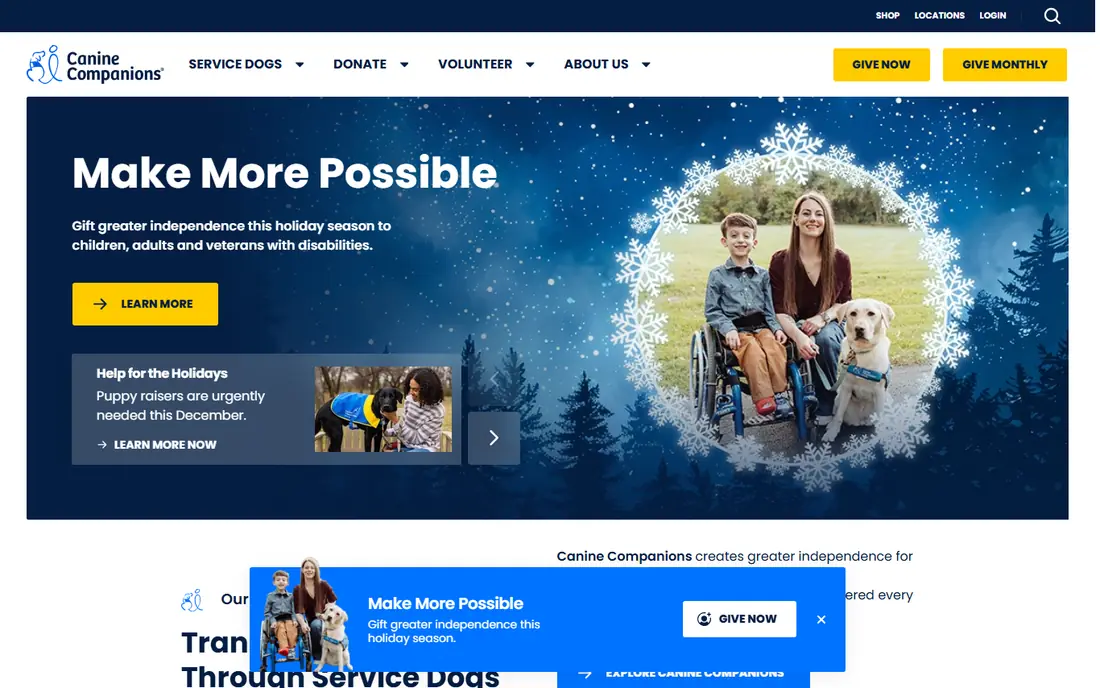
Canine Companions is one of the largest and longest-running assistance dog organisations in the US. It breeds and trains Labrador Retrievers, Golden Retrievers, and crosses, then matches dogs to adults and children with disabilities, adults who are deaf or hard of hearing, and veterans. Recipients attend team training to learn handling, care, and task work with their matched dog.
The honest limit is time. Demand far exceeds supply, so an application, assessment, and wait can take years. Travel to a training center is also part of the process. For a person who qualifies and can wait, Canine Companions offers a well-established, nonprofit route with no charge for the dog itself.
- Large nonprofit with several training centers
- Service dogs, hearing dogs, and facility dogs placed
- Dogs provided at no charge to recipients in its published model
- Long waits are common due to demand
- Applicants must attend team training and cover travel costs in its model
NEADS, based in Massachusetts, places service dogs with adults and children who have physical disabilities, as well as people with hearing loss, children with autism, and veterans. The organisation matches dogs to task needs, such as mobility help, sound alerts, and daily living tasks, rather than matching by breed or appearance.
The cost model needs clear reading. Published descriptions state that every client must raise at least $8,000, with a quarterly fundraising goal, which is far less than the full training cost but still a real commitment. NEADS suits a person in its service area who can manage fundraising and a longer process.
- Service dogs for physical disabilities, hearing loss, autism, and veterans
- Established nonprofit with a clear application route
- Dogs trained for specific tasks
- Clients must raise at least $8,000 toward costs in published descriptions
- Service area is centered in the Northeast
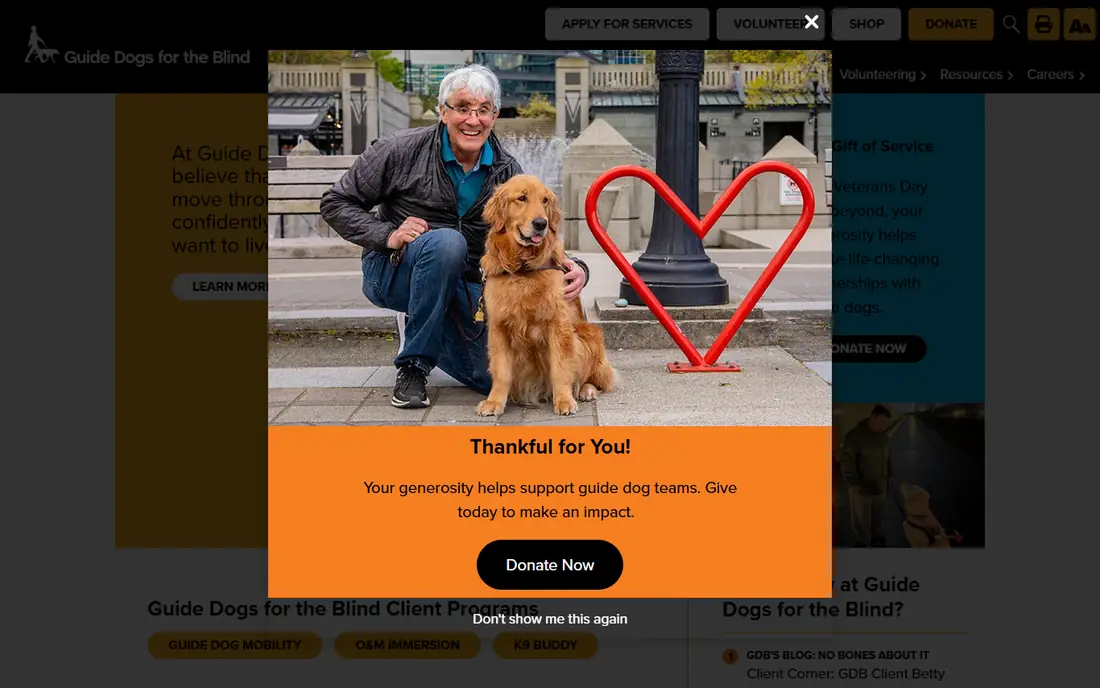
Guide Dogs for the Blind trains guide dogs for people who are blind or have low vision, helping them travel safely and independently. The program includes training for the person and the dog as a team, covering routes, traffic, and daily travel. Dogs are provided at no charge to recipients in its published model, funded by donations.
The limit is eligibility. Guide dog programs require a level of vision loss and the ability to travel independently with a cane, among other criteria. A person who needs a different kind of service task should look at a general service dog organisation instead. For vision loss, this is one of the clearest nonprofit routes.
- Guide dogs provided at no charge to recipients in its published model
- Orientation and mobility training included
- Long history in guide dog work
- Applicants must meet vision and mobility criteria
- Guide work is specific to vision loss, not general service tasks
Paws With A Cause custom-trains dogs for a wide range of tasks, from mobility and hearing work to seizure response and autism assistance. It breeds Golden Retrievers, Labrador Retrievers, Papillons, and Standard Poodles, choosing the dog by task fit rather than by a single breed rule. Clients do not pay to receive their dogs in its published model, though the full training cost is high and covered by donations.
The application window is the catch. Published FAQs state that the application request form is open from January through March each year, with a small processing fee. A person who misses that window must wait for the next cycle, and service area limits may apply. Plan the application year ahead.
- Custom training for mobility, hearing, seizure response, autism, and medical alert work
- Dogs provided at no charge to clients in its published FAQs
- Breeds chosen for task fit
- Application request window is limited to January through March in its published FAQs
- Long waits and a defined service area apply
4 Paws for Ability focuses on children and veterans, and it states that it serves people who were turned down by other organisations for being too young, too disabled, or not disabled enough. Its dogs cover mobility, autism, seizure response, diabetic alert, and other tasks, matched through an application, medical forms, and a virtual interview.
The cost model is shared fundraising. Published FAQs put the full training cost near $40,000, with the organisation raising about half and families completing a fee for service for the other half. That is a major commitment, and families should ask for the exact figure for their case before signing a contract.
- Serves children and veterans, including people turned down elsewhere
- Wide task range from mobility to medical alert
- Clear client process with interviews
- Shared fundraising model means families raise part of the cost
- A $50 application fee applies in its published process
Dogs for Better Lives places autism assistance dogs and hearing dogs, with a focus on children and families. Autism dogs help a child stay safe, support social interaction, and assist with daily routines, while hearing dogs alert to sounds such as doorbells and alarms. Dogs are provided at no charge to recipients in its published model.
Eligibility limits matter here. Published descriptions list age ranges for children and a set of available states for autism placements, so a family outside those states or age ranges may need another organisation. Check the current state list and age rules before applying, since they change over time.
- Autism assistance and hearing dogs provided at no charge in its published model
- Serves children and families in listed states
- Professional training and matching
- Age and state limits apply for autism placements in published descriptions
- Waits can be long
Guiding Eyes for the Blind trains guide dogs for people with vision loss, with a headquarters and training school in Yorktown Heights, New York. It also works with partner organisations such as NEADS and Dogs for Better Lives, placing dogs that suit service roles other than guide work. That partner route widens the reach of its breeding and training program.
For a person seeking a general service dog, the direct route may be through a partner rather than Guiding Eyes itself. That is not a flaw, but it means the application path needs checking. For vision loss, Guiding Eyes is a direct and well-established choice.
- Guide dogs for people with vision loss
- Dogs not suited to guide work may go to partner service organisations
- Adoption route for career-change dogs
- Guide dog eligibility is strict
- Service dog placements happen through partners rather than direct application in some cases
Assistance Dogs International
Great for: Finding accredited member groups
Assistance Dogs International is not a dog placement service, and that distinction is useful. It is a coalition of nonprofit organisations that raise, train, and place assistance dogs, with a member search tool that lets a person find accredited groups by region and dog type. Using that tool helps a buyer avoid sellers that promise instant certification.
The limit is that a search result is only a starting point. Each member organisation has its own application, criteria, and waitlist, and accreditation does not shorten a wait. Use Assistance Dogs International to build a shortlist, then contact each group directly and ask about tasks, costs, and timelines.
- Coalition of nonprofit assistance dog organisations
- Member search tool to find accredited groups by area
- Accreditation standards for member programs
- It does not place dogs directly
- Accreditation alone does not guarantee a short wait or a match
How we picked these
We compared official organisation pages, published FAQs, and public program descriptions, keeping only legitimate training organisations and resources. We excluded vest sellers, certificate sellers, and online registries, since those do not certify a service dog. All organisations listed were live in October 2026, and we noted where a dog is provided at no charge and where fundraising applies.
What to check before choosing a trainer or organisation
A service dog is a long-term partnership, and the wrong match can harm both the person and the dog. A careful check now prevents a costly mistake later.
Ask about tasks, not paperwork
Ask which tasks the dog is trained to perform, how those tasks were taught, and how the team is tested. A legitimate program can describe tasks in plain terms and show how training is assessed. A seller that talks mainly about certificates, vests, or registry entries is not offering training.
Check accreditation, costs, and waits in writing
Ask whether the organisation is accredited or a candidate for accreditation, what costs or fundraising apply, and how long the wait is likely to be. Get those answers in writing before signing a contract or paying a fee.
Plan for the dog's whole life
A service dog needs vet care, food, exercise, and ongoing training, plus a retirement plan when work ends. Ask about follow-up support, what happens if a match fails, and who owns the dog during and after its working life.
Frequently asked questions
Is there an official online service dog certification in the US?
No. There is no official online certification or registry in the US, and a certificate or vest bought online does not make a dog a service dog. A service dog is defined by trained tasks for a person with a disability.
Can I register my dog online to make it a service dog?
No. Online registries sell paperwork, not training or legal status. A dog becomes a service dog through task training for a disability, not through a registry entry.
Does breed alone qualify a dog as a service dog?
No. Breed alone does not qualify a dog. Temperament, health, and trained tasks matter, and many programs choose dogs by task fit and temperament rather than by breed alone.
How long does it take to get a service dog from a nonprofit?
It often takes years, due to breeding, raising, training, and matching, plus team training for the recipient. Ask each organisation for its current wait and application window before planning around a date.
What should I do if a website promises instant certification?
Treat it as a warning sign. Legitimate programs assess, train, and match over months or years, and they do not sell instant status. Check Assistance Dogs International for accredited member groups instead.
Sources
- https://canine.org
- https://neads.org
- https://www.guidedogs.com
- https://pawswithacause.org/frequently-asked-questions/
- https://www.4pawsforability.org/faq/
- https://dogsforbetterlives.org
- https://www.guidingeyes.org
- https://assistancedogsinternational.org/member-search
- https://www.nj.gov/disabilities/healthcare-medical-assistance/service-animals.shtml
See where you really rank - block by block
ProMapRanker scans Google Maps across a grid of your service area. Simple monthly plans from $19, white-label on every plan.
Start freeKeep reading
 worlds best local seo company
8 Worlds Best Local SEO Companies for Map Pack Growth in 2026
Compare the worlds best local seo company options for Google Business Profile work, citations, reviews, and multi-location rankings and reporting in 2026.
Read → world's best web hosting company
World's Best Web Hosting Company in 2026
Searching for the world's best web hosting company? We compared 10 hosts on price, renewal rates, speed, and support to help you choose well today in 2026.
Read → who's got the best nanny tax services
Who's Got the Best Nanny Tax Services in 2026
We answer who's got the best nanny tax services, comparing full filing, back taxes, software, and pricing so families can handle nanny taxes correctly.
Read →