 ProMapRanker
Best Online Broker Trading Platform in 2026

Key takeaways
- Fidelity, Schwab, and Interactive Brokers suit investors who want one account for stocks, ETFs, retirement, and research.
- Webull, Robinhood, and Firstrade suit cost-focused traders who want commission-free stock and ETF trades.
- tastytrade suits options traders, with $1 per contract to open and no charge to close.
- E*TRADE suits investors who want a strong active-trading platform alongside a full-service broker.
- This is not financial advice. Trading carries risk, including the risk of losing money, and fees, margin rates, and rules change, so confirm them on the broker site before opening an account.
Quick comparison
| Pick | Great for | Pricing starts at | Free tier | |
|---|---|---|---|---|
 Fidelity | One broker for everything | Free | Yes | Visit |
 Charles Schwab | Research and active trading | Free | Yes | Visit |
 Interactive Brokers | Active and international traders | Free | Yes | Visit |
 Webull | Low-cost technical trading | Free | Yes | Visit |
 Robinhood | Mobile-first beginners | Free | Yes | Visit |
 tastytrade | Options traders | Free | Yes | Visit |
 E*TRADE | Active traders at a full-service broker | Free | Yes | Visit |
 Firstrade | Zero-cost options trading | Free | Yes | Visit |
 Vanguard | Long-term low-cost investors | Free | Yes | Visit |
The best online brokers and trading platforms
We compared brokers on stock and ETF commissions, options fees, platforms, research, and account features. Starting price here means the cost to open and place a standard stock or ETF trade, which is $0 commission at every broker below, before regulatory fees, options contract fees, and margin interest where those apply.
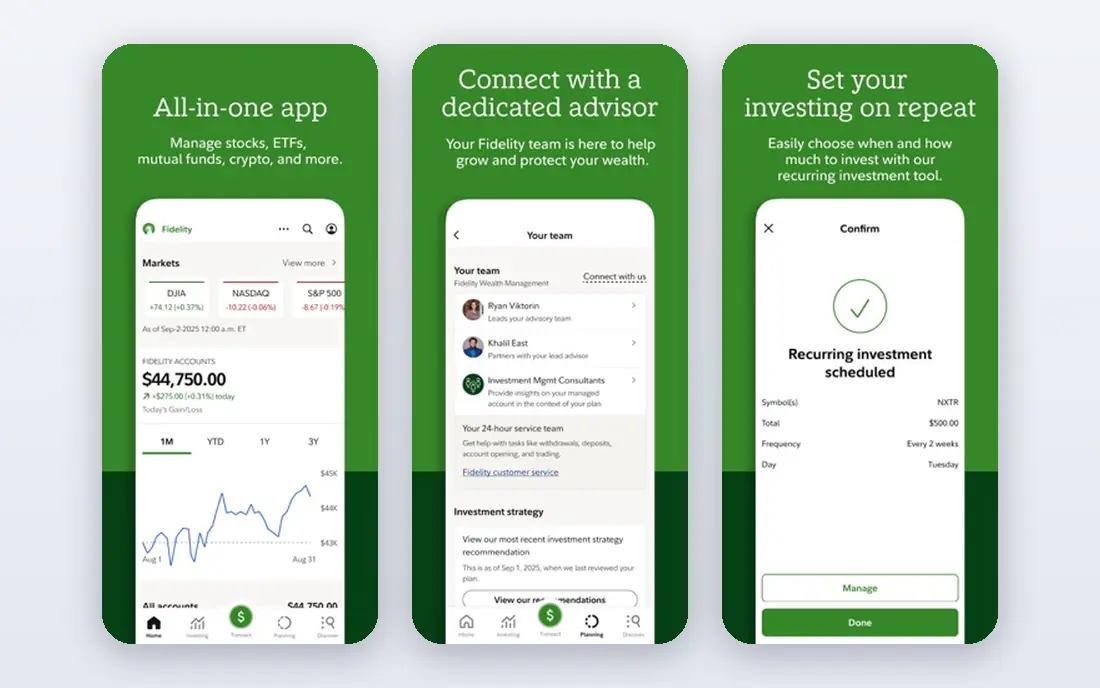
Fidelity is our pick for most investors who want one broker for taxable investing, retirement accounts, and research. Stock and ETF trades carry $0 commission, options cost $0.65 per contract, and fractional share trading helps smaller investors build diversified positions. Research, planning tools, and customer service are consistently strong, which matters for investors who check in monthly rather than trading daily.
The catch is active trading. Fidelity Trader+ is capable, but dedicated day traders may prefer the charting and customization of thinkorswim or Trader Workstation. Margin rates also sit above some low-cost rivals. For long-term investors and steady traders who want breadth without complexity, Fidelity is hard to beat.
- $0 stock and ETF commissions
- Strong research and retirement tools
- Fractional shares
- Active-trading platform is less specialized than thinkorswim
- Margin rates are higher than some rivals
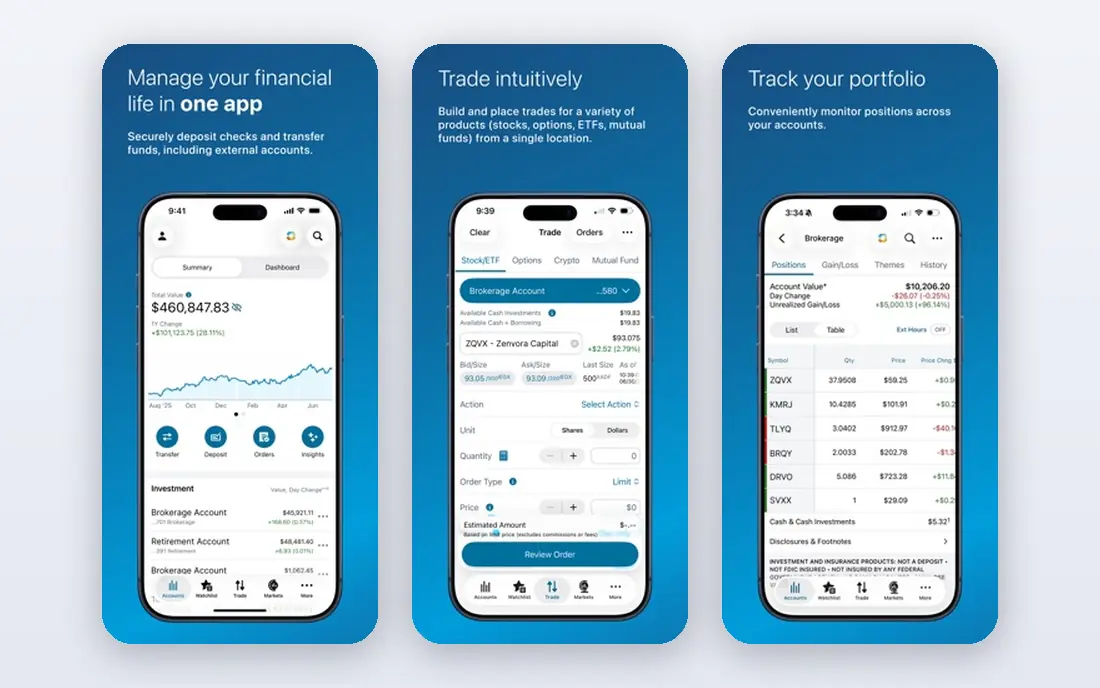
Schwab combines a full-service broker with thinkorswim, the powerful trading platform that came with TD Ameritrade, which gives active traders advanced charting, screening, and options tools in desktop, web, and mobile forms. Stock and ETF trades carry $0 commission, and research and education cover beginners through advanced traders. Banking and retirement accounts can sit alongside brokerage accounts.
Options cost $0.65 per contract, which is standard for large brokers but more than Firstrade or tastytrade for frequent options traders. Schwab base margin rates are also high compared with Interactive Brokers. For investors who want strong tools and research in one place, Schwab is a leading all-round choice.
- $0 stock and ETF commissions
- Thinkorswim platform
- Deep research and education
- Options cost $0.65 per contract
- Base margin rate is high

Interactive Brokers suits active and international traders who need deep market access and low costs. The Lite plan offers $0 stock and ETF commissions, while Pro offers tiered pricing with options from $0.65 per contract down to lower tiers at volume. Trader Workstation, IBKR Desktop, and mobile apps cover professional trading, and margin rates are among the lowest in this list.
The platform is the main barrier. Trader Workstation is powerful but dense, and beginners may find setup and order types confusing at first. For traders who already understand order routing, margin, and global markets, Interactive Brokers offers reach and pricing that few rivals match. For a first brokerage account, Fidelity or Schwab will feel calmer.
- Very low margin rates
- Global market access
- Professional Trader Workstation platform
- Platform learning curve is steep
- Interface can overwhelm beginners
Webull appeals to self-directed traders who want strong charts, technical indicators, and a clean mobile and desktop experience at $0 stock and ETF commission. Options carry $0 commission on most contracts, with certain index options at $0.50, and regulatory fees still apply. Paper trading helps new traders learn order types without risking real money, though paper results do not guarantee real results.
Research and long-term planning tools are thinner than at Fidelity or Schwab, and Webull is less suited to investors who want advice or deep retirement planning in the same account. For cost-focused traders who chart their own ideas and want a fast, modern platform, Webull is a strong pick.
- $0 stock and ETF commissions
- Strong charts and technical tools
- Low-cost market data options
- Research depth trails Fidelity and Schwab
- Margin rates vary by balance
Robinhood suits beginners who want to start investing from a phone with a simple interface and $0 stock and ETF commissions. Fractional shares let small investors buy into expensive stocks, and the app covers stocks, ETFs, options, and crypto in one place, with retirement accounts also available. The learning curve is low, which helps first-time investors place their first trades with confidence.
The limits are research depth and advanced trading tools, which trail Schwab, Fidelity, and Interactive Brokers. Options traders and active traders who need advanced charting will outgrow it. For a beginner who wants a simple, low-cost start and plans to learn as they go, Robinhood remains a practical first account, provided the investor understands trading risk.
- $0 stock and ETF commissions
- Simple mobile app
- Fractional shares and crypto access
- Research and advanced tools are limited
- Customer support history draws criticism
tastytrade was built for options and futures traders, and its pricing shows it. Stock and ETF trades carry $0 commission, options cost $1 per contract to open and nothing to close, capped at $10 per leg, and futures tools are built into the same desktop, web, and mobile platforms. Options analytics, profit and loss visualization, and education are stronger than at generalist brokers.
The trade-off is breadth. tastytrade does not offer mutual funds or fractional shares, and long-term investors who want a full retirement and planning suite will find Fidelity or Schwab more complete. For options traders who open and close contracts often, the free-to-close model can save real money over a year.
- $1 per contract to open, free to close, capped at $10 per leg
- Options-focused platform
- Strong options education
- Less suited to long-term buy-and-hold investors
- No mutual funds or fractional shares
ETRADE, part of Morgan Stanley, pairs $0 stock and ETF commissions with the Power ETRADE platform for active traders, alongside a simpler web and mobile experience for longer-term investors. Research, screening, and education are solid, and banking connections suit investors who want cash management near their brokerage account. Options cost $0.65 per contract, in line with large rivals.
Futures access is more limited than at Interactive Brokers or tastytrade, and options costs are higher than at Firstrade or tastytrade for frequent traders. For investors who want an active-trading platform inside a full-service broker, with research and support to match, E*TRADE is a strong middle ground between a simple app and a professional desk.
- $0 stock and ETF commissions
- Power E*TRADE platform
- Strong research and banking links
- Options cost $0.65 per contract
- Futures access is limited in places
Firstrade stands out for options traders because it charges $0 per contract on options, with no per-leg fee and no volume tier, alongside $0 commissions on stocks, ETFs, and mutual funds. There are no account minimums for cash accounts, and bilingual support is a real benefit for Chinese-American investors. For an active options trader, the saving versus $0.65 per contract at large brokers adds up quickly.
The platform and research tools are basic compared with Schwab or Fidelity, and there is no futures trading. Investors who want advanced charting, deep research, or futures will need another broker or a second account. For cost-first stock and options trading with a simple platform, Firstrade is hard to beat on price alone.
- $0 per-contract options commissions
- $0 stock, ETF, and mutual fund trades
- No account minimums
- Platform and research are basic
- No futures trading
Vanguard suits long-term investors who want low-cost index funds and ETFs, simple retirement accounts, and a broker that does not push frequent trading. Stock and ETF trades carry $0 commission, Vanguard funds carry famously low expense ratios, and the account experience is built around holding, rebalancing, and retirement planning rather than daily trading.
Active traders will find the platform basic, with fewer charting and options tools than Schwab, Webull, or Interactive Brokers. Vanguard is not the pick for day trading or complex options strategies. For an investor building wealth slowly through index funds and retirement accounts, it remains one of the most trusted low-cost choices.
- $0 stock and ETF commissions
- Low-cost index funds and ETFs
- Strong retirement focus
- Trading platform is basic
- Less suited to active or options traders
How we picked these
We compared official pricing pages, platform features, and public reviews for US online brokers in active use in October 2026. We kept only regulated brokers with $0 stock and ETF commissions, covered general investing, active trading, options, and long-term index investing, and we noted options fees, margin rates, and platform limits where they change the value for a specific trader type.
How to choose an online broker
Start with how you will actually invest. A long-term index investor needs low fund costs and good retirement tools, an active trader needs fast charts and order tools, and an options trader needs low per-contract fees and strong options analytics. A broker that is perfect for one style can be a poor fit for another, even when headline commissions look the same.
Next, check the full cost picture. Compare options contract fees, margin interest, account fees, and any fees for market data, wires, or paper statements. Confirm whether your account is protected by SIPC coverage for securities, and understand that SIPC does not protect against market losses. Read the broker fee schedule before funding, because rates and rules change.
Finally, test the platform with a small amount or paper trading where offered, and check research, education, and support quality. A platform that feels confusing under calm conditions will feel worse during a volatile market day. The best broker is the one whose costs, tools, and support match your investing style, and that you understand well enough to use with care.
Frequently asked questions
What is the best online broker for beginners?
Fidelity and Schwab are strong beginner picks, because both offer $0 stock and ETF trades, deep education, and full retirement accounts. Robinhood suits beginners who want the simplest mobile start, while Vanguard suits beginners focused on long-term index investing.
What are the best online brokers and trading platforms for options?
tastytrade suits frequent options traders with $1 to open and free to close, capped at $10 per leg, while Firstrade charges $0 per contract. Schwab, Fidelity, and E*TRADE charge $0.65 per contract and suit options traders who also want full research and retirement tools.
How much does it cost to open a brokerage account?
Most brokers in this list have no account minimum for a standard cash account and charge $0 commission on stock and ETF trades. Options contract fees, regulatory fees, margin interest, and fund expense ratios still apply, so check the full fee schedule.
Is trading through an online broker safe?
Regulated US brokers hold customer securities separately and offer SIPC protection up to set limits for missing securities, but SIPC does not protect against market losses. Trading itself carries risk, and margin or options trading can lose money quickly, so only invest money you can afford to lose.
Do I need a lot of money to start investing?
No. Fractional shares at Fidelity, Schwab, Robinhood, and Webull let investors start with small amounts, and most brokers here have no minimum for a cash account. Starting small and investing regularly is a sensible path for most beginners, and this article is not financial advice.
Sources
See where you really rank - block by block
ProMapRanker scans Google Maps across a grid of your service area. Simple monthly plans from $19, white-label on every plan.
Start freeKeep reading
 zscaler alternatives
Best Zscaler Alternatives in 2026
Looking for zscaler alternatives? We compare 9 SASE and zero trust platforms on architecture, data protection, pricing, and fit for your network and team.
Read → zapier alternatives free
Best Zapier Alternatives Free in 2026
Nine automation tools for zapier alternatives free in 2026, all with genuinely free tiers, plus free plan limits, starting prices and upgrade paths explained.
Read → which platform is best for online reputation
Which Platform Is Best for Online Reputation in 2026
Wondering which platform is best for online reputation? We compare 8 review, listing, and response tools for small and multi-location businesses and agencies.
Read →