 ProMapRanker
OKR Software for Startups


Startups that want OKRs with engagement surveys and manager coaching · Pricing starts at: From $4/user/month (annual)
Key takeaways
- 15Five sits first on this list: startups that want OKRs with engagement surveys and manager coaching.
- Weekdone fits small startups that want straightforward OKRs with weekly status reporting.
- Weekdone is the only tool of the 6 with a free plan.
- 15Five has the lowest monthly starting price in this list: $4/user/month.
Direct answer
15Five leads the list, best for startups that want OKRs with engagement surveys and manager coaching. If your case is different, Perdoo suits strategy-first startups that want goals tied to a real strategy map and Tability suits startups that want low-cost OKRs with AI-assisted check-ins. The other 3 tools in the list cover narrower or pricier cases.
Quick comparison
| Pick | Great for | Pricing starts at | Free tier | |
|---|---|---|---|---|
| 15Five | Startups that want OKRs with engagement surveys and manager coaching | From $4/user/month (annual) | No | Visit |
 Perdoo | Strategy-first startups that want goals tied to a real strategy map | See website | Not stated | Visit |
 Tability | Startups that want low-cost OKRs with AI-assisted check-ins | $6/user/month | Free trial (14 days) | Visit |
 Lattice | Startups that want OKRs inside a full people product | See website | No | Visit |
 Profit.co | Startups that want OKRs, performance and projects in one system | See website | Not stated | Visit |
 Weekdone | Small startups that want straightforward OKRs with weekly status reporting | See website | Yes | Visit |
The 6 tools in detail
Short on time? The summary and table above give the quick view of 6 OKR software for startups, and the profiles that follow give the detail behind each entry.
15Five
Great for: Startups that want OKRs with engagement surveys and manager coaching
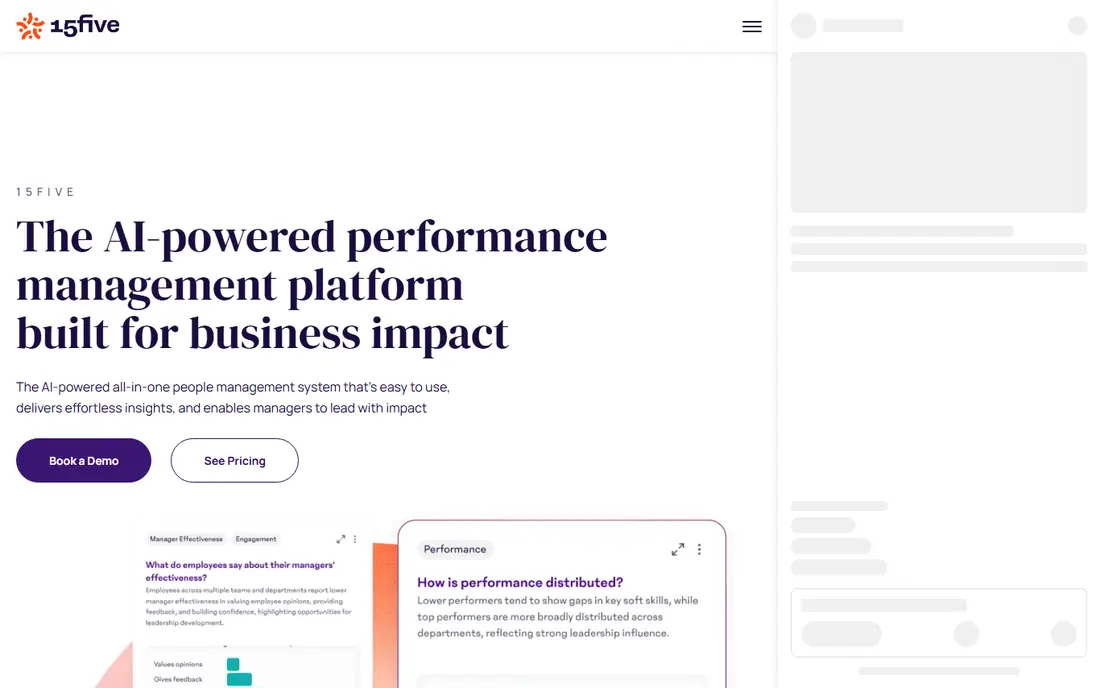
Pick 15Five if this describes you: startups that want OKRs with engagement surveys and manager coaching. The published pricing is a plus for startups budgeting carefully.
Points against: No free plan.
The Perform plan ($11/user/month annually) bundles OKRs, reviews and check-ins. The Engage plan ($4) spans surveys and analytics; the Total Platform plan ($16) bundles everything plus manager training. The starting price for 15Five: From $4/user/month. 15Five has no permanent free option.
What works well: Perform from $11; Total Platform from $16 per user/month.
- 1:1s and feedback
- OKRs inside a continuous performance product with reviews
- The OKR module is part of a broader platform
Perdoo
Great for: Strategy-first startups that want goals tied to a real strategy map
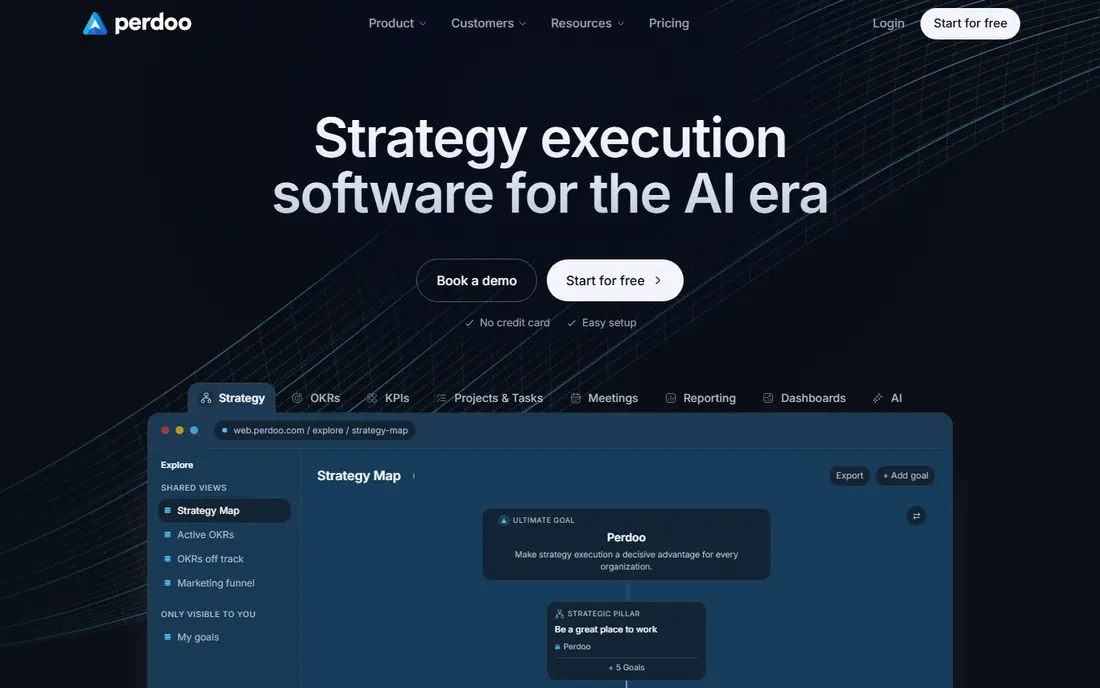
Perdoo is built with strategy-first startups that want goals tied to a real strategy map in mind. Perdoo treats OKRs as the execution layer of strategy: a strategy map displays how everything links, objectives and key results sit under it, progress is pulled from your apps, and status reports produce themselves.
Downsides: Pricing and free-tier terms are not published on the homepage.
For everyday use, for startups with a clear strategy they want the entire team executing against, Perdoo is purpose-built. Perdoo does not show a starting price in this comparison, so check the vendor site for current pricing. Trial and free access: Not stated.
- Auto-generated status reports from app integrations
- Key results and KPIs
- The strategy-first framing fits structured teams more than chaotic ones

Tability is designed for startups that want low-cost OKRs with AI-assisted check-ins. Free read-only seats mean the entire company sees the strategy without everyone needing a premium seat.
More specifically, for a cost-conscious startup that wants AI help with the reporting overhead, it is the value pick. Tability starts at: $6/user/month. On free options: Free trial (14 days).
Downsides: Smaller vendor than the enterprise players.
- Linear and Salesforce
- 14-day trial
- The AI-agent positioning is newer and less proven than classic OKR workflows
Lattice works best for startups that want OKRs inside a full people product. For a team that just wants goals tracked, a dedicated OKR tool is leaner and less expensive.
Trade-offs to know: Pricing is not published on the homepage.
What users get: Deep HRIS and productivity integrations. Lattice shows no starting price here, so confirm the cost on the vendor site. Lattice does not include a free plan.
- Solid reputation for manager-friendly UX
- Goals and OKRs alongside performance reviews, 1:1s
- Likely overkill for a team that only needs goals
Profit.co serves startups that want OKRs, performance and projects in one system. For teams that prefer specialized tools, the same breadth is the risk.
Profit.co is an all-in-one operating system: set goals, run OKRs with AI assistance, handle performance reviews and 360 feedback, track projects with Kanban/Gantt views, and pull everything into strategy dashboards with predictive forecasts. Beyond that, over 100 integrations keep data flowing without manual updates. Profit.co shows no starting price here, so confirm the cost on the vendor site. Free options: Not stated.
Downsides: The breadth can overwhelm a small team.
- Balanced Scorecard and Hoshin Kanri
- Supports OKRs
- Pricing is not published on the homepage
Weekdone
Great for: Small startups that want straightforward OKRs with weekly status reporting
Weekdone works best for small startups that want straightforward OKRs with weekly status reporting. Weekdone pairs quarterly OKRs with weekly updates: track what needs doing this week and this quarter, provide praise and feedback on plans and progress, and keep alignment visible with OKR trees, KPIs, initiatives and company-wide reports.
What to check first: Scaling past the free level needs a premium plan.
It is deliberately more straightforward than the strategy suites below, which is a feature for teams that want OKRs running this week, not next quarter. No starting price is listed for Weekdone here; confirm pricing on the vendor site. You can start on Weekdone without paying.
- KPIs and pulse surveys included
- Visual OKR hierarchy trees
- Pricing for bigger teams is not published on the homepage
What went into this list
We compared the tools on published pricing, free plan or trial availability, feature coverage for OKR software for startups, and the limits each vendor documents. Plan names, prices and limits change often. Treat the figures here as a starting point and verify them with the vendor. The order reflects how well each tool fits the most common buying scenario for OKR software for startups, then price clarity, then free plan access. It is a starting point, not a verdict.
Questions to settle before buying
- Ask Perdoo, Lattice, Profit.co and Weekdone for a written quote, since no starting price is shown.
- Look at the free plan from Weekdone closely: its caps decide whether it is usable for real work.
- Use real work to test the free trial from Tability, rather than a demo project.
- Read the limits listed for 15Five first: no free plan.
- Confirm minimum seats and billing terms with Perdoo before you commit to an annual plan.
- Confirm that Profit.co connects to the apps your team already uses, on the plan you would actually buy.
Frequently asked questions
Do OKR tools integrate with Slack, Jira and Google Workspace?
Most do. Check the specific integrations page for your stack before committing, since auto-updating key results from real data is the feature that makes the tool worth paying for.
Do these tools publish their prices?
Not all of them. Perdoo, Lattice, Profit.co and Weekdone publish no starting price, so expect a quote request for those. The rest, 15Five included, show a starting price, though seats and billing terms still change the final cost.
Can I try these tools before paying?
Often, yes. Weekdone has a free plan and Tability offers a free trial. Use your own data and a real task during the test, and check what the free tier or trial limits before you rely on it.
Which options for OKR software for startups have a free plan?
Weekdone is the only tool in this list with a free plan. Free plans usually cap users, projects or features, so check the limits on the vendor page. One other tool offers a trial instead.
What is the difference between OKRs and KPIs?
KPIs (Key Performance Indicators) are continuing health metrics you monitor continuously (revenue, churn, uptime). Most tools here manage both: OKRs for what you are trying to change this quarter, KPIs for what you must keep healthy.
How long does it take to roll out OKR software?
An entry-level rollout takes a day: invite the team, set company objectives, have everyone draft key results. The first full cycle takes a quarter, which is the real test: check-ins have to happen weekly, and someone must own the process.
Sources
See where you really rank - block by block
ProMapRanker scans Google Maps across a grid of your service area. Simple monthly plans from $19, white-label on every plan.
Start freeKeep reading
 zscaler alternatives
Best Zscaler Alternatives in 2026
Looking for zscaler alternatives? We compare 9 SASE and zero trust platforms on architecture, data protection, pricing, and fit for your network and team.
Read → zapier alternatives free
Best Zapier Alternatives Free in 2026
Nine automation tools for zapier alternatives free in 2026, all with genuinely free tiers, plus free plan limits, starting prices and upgrade paths explained.
Read → which platform is best for online reputation
Which Platform Is Best for Online Reputation in 2026
Wondering which platform is best for online reputation? We compare 8 review, listing, and response tools for small and multi-location businesses and agencies.
Read →