 ProMapRanker
Best OKR Software for Startup Teams in 2026

Key takeaways
- Weekdone and Profit.co are the best free starting points for tiny startup teams, with free plans for up to three and five users respectively.
- Perdoo suits startups that want clear strategy maps and public OKRs at a low per user price.
- Tability and Mooncamp suit growing startups that want a dedicated OKR tool without enterprise weight.
- Lattice and 15Five suit startups that want OKRs inside a wider performance platform with reviews and feedback.
- The best OKR software for startups is the one the team updates weekly, not the one with the longest feature list.
Quick comparison
| Pick | Great for | Pricing starts at | Free tier | |
|---|---|---|---|---|
 Weekdone | Weekly OKR check ins | Free | Yes | Visit |
 Profit.co | Free OKRs plus tasks | Free | Yes | Visit |
 Perdoo | Strategy maps and alignment | See website | Yes | Visit |
 Tability | Dedicated OKR tracking | $6 per user per month | Free trial | Visit |
 Mooncamp | Modern OKR design | See website | Free trial | Visit |
 Lattice | OKRs plus performance | See website | No | Visit |
 15Five | OKRs plus reviews | $11 per user per month | Free trial | Visit |
 ClickUp | Goals inside project work | $7 per user per month | Yes | Visit |
 Synergita | Startup OKRs with HR tools | See website | Yes | Visit |
The best OKR software for startup teams
OKRs, short for objectives and key results, help a startup turn a big goal into measurable steps that a small team can track each week. The tools below range from free, simple trackers to platforms that combine OKRs with performance reviews. For a startup, simplicity and weekly habit matter more than advanced reporting.

Weekdone is our pick for most early startups because it builds a weekly habit. The team sets company, team, and individual OKRs, then updates progress in a short weekly check in. That rhythm keeps goals visible without long meetings, and the OKR tree shows how a team goal connects to a company goal.
The free plan covers up to three users, which suits a founding team. Larger teams move to paid plans priced by headcount, so check the calculator on the vendor site for your team size. If your startup grows past a dozen teams, a more scalable platform may fit better, but for the first years, Weekdone keeps OKRs simple.
- Free for up to three users
- Weekly check in rhythm
- Clear OKR tree
- Paid pricing varies by team size
- Less depth for complex multi team structures
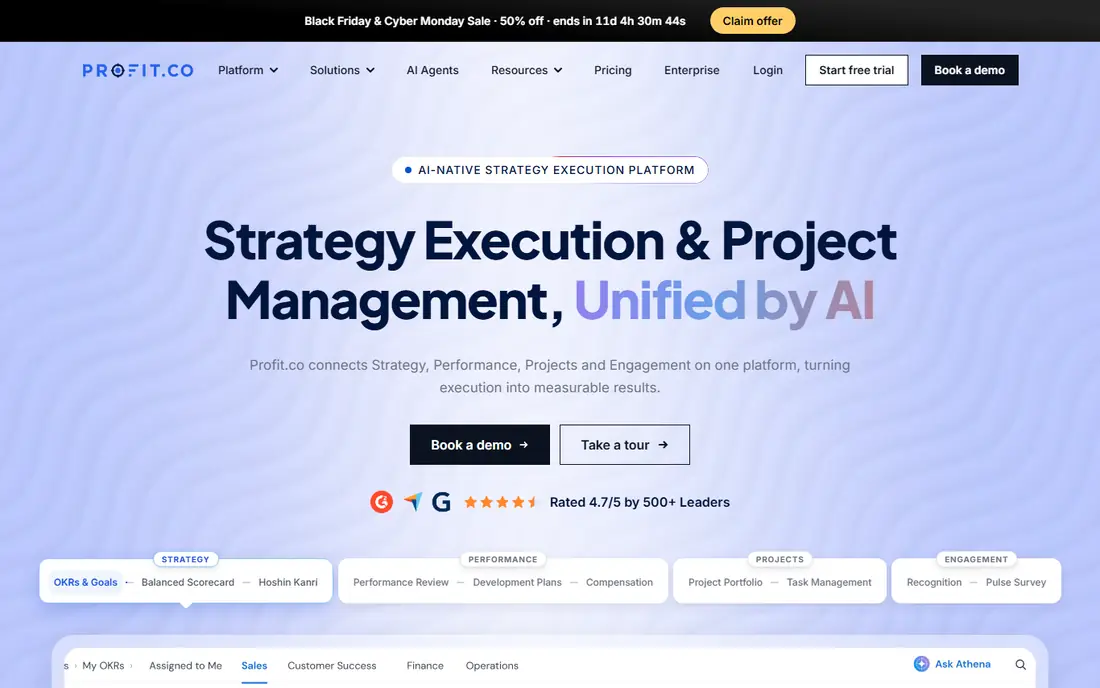
Profit.co gives a founding team of up to five users a real OKR tool for free. Templates help a new team write better objectives, tasks link directly to key results, and dashboards show progress for investor updates or board meetings. That mix suits startups that want OKRs tied to daily work, not kept in a separate doc.
The interface packs in many features, so a tiny team may need a short onboarding session to use it well. Paid tiers add reporting and integrations, and pricing has varied in vendor listings, so confirm the current paid rate on the vendor site. For a free start with room to grow, Profit.co is hard to beat.
- Free for up to five users
- OKR templates
- Tasks linked to key results
- Interface can feel busy for tiny teams
- Advanced features need paid tiers

Perdoo suits startups that want everyone to see how goals connect. Strategy maps show how a company objective breaks into team objectives and key results, and public OKRs make progress visible across the whole company. That transparency helps a remote startup stay aligned without constant status meetings.
Collaboration tools are thinner than in ClickUp or Lattice, since Perdoo focuses on goals rather than project work or reviews. Paid plans are priced in euros in vendor listings, so check the converted cost for your region. For a startup that values alignment above all else, Perdoo is a strong, low cost pick.
- Free for up to five users
- Strategy maps
- Public OKRs for transparency
- Fewer collaboration tools than all in one platforms
- Paid pricing in euros
Tability is a dedicated OKR tool that does one job well. It tracks objectives, key results, and check ins in a clean interface, with reporting that helps a founder see which teams are on track and which need help. Read only seats let advisors or investors view progress without a full paid seat.
There is no free plan, only a trial, so the $6 per user per month basic price is the real entry point. That is still low for a dedicated tool, and it suits a startup that has outgrown a spreadsheet but does not want a full performance platform. If you need tasks and docs in the same tool, ClickUp may fit better.
- Clear OKR focus
- Good reporting
- Read only seats for stakeholders
- No free plan
- Less project management depth than ClickUp
Mooncamp offers a modern take on OKR software, with a clean design and flexible structures for company, team, and individual goals. It suits a growing startup that wants a tool the whole team will actually open, rather than a system that feels like admin work. Check ins and progress views are clear, and the setup is faster than enterprise platforms.
Paid plans in vendor listings start in euros with a minimum seat count, so a very tiny team should check the current terms. For a startup of ten to fifty people, Mooncamp balances simplicity and structure well, and it scales better than a free tool built for three users.
- Modern interface
- Flexible OKR structure
- Good for growing startups
- Minimum seat count on paid plans
- Pricing in euros in some listings
Lattice suits a startup that wants OKRs inside a wider people platform. Goals sit next to performance reviews, feedback, and one to one meetings, so a manager can connect a goal discussion to a review without switching tools. That mix helps as a startup adds its first people processes.
The cost is higher than a dedicated OKR tool, and some plans carry a minimum annual spend in vendor listings. If OKRs are your only need, Weekdone, Profit.co, or Tability will cost less. If you already plan to run reviews in Lattice, adding goals there keeps everything in one place.
- Goals plus reviews, feedback, and one to ones
- Strong reporting
- Good for people teams
- Higher cost than dedicated OKR tools
- Minimum spend can apply on some plans
15Five combines OKRs with weekly check ins, engagement surveys, and performance reviews. The weekly check in rhythm fits startup life well, since it keeps goals and blockers visible without a heavy reporting process. Managers get a clear view of progress and morale in one place.
OKRs sit in the Perform plan at $11 per user per month in vendor listings, not in the cheaper Engage plan, so check the tier before you buy. For a startup that wants OKRs plus people tools, 15Five is a solid choice. For OKRs alone, a dedicated tool costs less.
- OKRs in the Perform plan
- Weekly check ins
- Engagement and review tools
- OKRs are not in the cheapest plan
- Cost adds up for a large team
ClickUp suits a startup that already runs project work in ClickUp and wants goals in the same place. Goals start on the Unlimited plan at $7 per user per month on annual billing, where you can link tasks to targets and track progress on dashboards. That link between daily tasks and company goals helps a small team see why each task matters.
The free plan does not include Goals, and the full ClickUp interface can feel busy if you only need OKRs. If your team already uses ClickUp for work, adding Goals is a natural step. If you do not use ClickUp, a dedicated OKR tool will feel simpler.
- Goals on the Unlimited plan
- Tasks, docs, and dashboards in one tool
- Free plan to start
- Goals are not in the free plan
- Interface can feel busy for a tiny team
Synergita suits startups that want OKRs alongside HR and performance tools. The free tier covers small teams, templates help new managers write better goals, and paid plans add integrations with tools such as Jira and Slack. That breadth helps a startup that is adding its first HR processes at the same time as OKRs.
Paid pricing varies by region and plan, so confirm the current rate on the vendor site for your team size. The broader HR focus means the tool does more than OKRs, which can feel like extra weight for a team that only needs goal tracking. For a startup that wants both, Synergita is a low cost way to start.
- Free tier for small teams
- OKR templates
- HR and performance features
- Paid pricing varies by region
- Interface is broader than a pure OKR tool
How we picked these
We compared official feature pages, pricing pages, and public documentation for OKR tools that are sold and working in October 2026. We kept tools that support company, team, and individual OKRs with progress tracking, and we left out pure spreadsheets and general goal apps with no OKR structure. Where a vendor does not publish a clear price, we wrote See website rather than repeating a third party figure as a vendor price.
What to check before you pay
Start with team size and habit. A team of three needs a free tool and a weekly check in, not a platform built for fifty teams. A team of thirty needs clear ownership, reporting, and integrations with Slack or a project tool. Test the check in flow with your real goals for two weeks before you commit to a paid plan.
Next, check what happens as you grow. Free user limits, minimum seat counts, and per user pricing can change the cost fast when you hire. A tool that is free for five users and $9 per user after that still costs little at ten users, but a tool with a high minimum spend can surprise a small startup. Price the team you expect in twelve months, not only the team you have today.
Finally, keep OKRs simple. Limit each team to a few objectives per quarter, write key results that can be measured, and review progress weekly. A tool cannot fix vague goals. The best software for a startup is the one that makes a short weekly update easy enough that the team actually does it.
Frequently asked questions
What is the best OKR software for startups?
Weekdone and Profit.co are the best free starting points for tiny teams, while Tability and Perdoo suit growing startups that want a dedicated tool. Lattice and 15Five suit startups that want OKRs plus performance reviews. Pick by team size and whether you need reviews in the same tool.
What are the best OKR software for startups that are free?
Weekdone is free for up to three users, and Profit.co and Perdoo are free for up to five users in vendor listings. ClickUp and Synergita also offer free plans, but Goals in ClickUp need a paid tier. Check current free limits on each vendor site before you sign up.
What is the top OKR software for startups with remote teams?
Perdoo suits remote teams that need visible strategy maps and public OKRs. Weekdone suits remote teams that need a short weekly check in rhythm. Both keep goals visible without extra meetings, which matters when a team works across time zones.
How many OKRs should a startup set?
Most startups do well with three to five company objectives per quarter, each with three to five measurable key results. Teams should set fewer objectives than they think they need, since a long list spreads focus thin. Review progress weekly and drop or revise a key result that no longer fits the quarter.
Can I run OKRs in a spreadsheet instead of software?
Yes, for a very small team and one quarter, a spreadsheet can work. Software adds value when check ins, reminders, alignment views, and reporting take too much manual work. Move to a dedicated tool when updates slip, when goals get lost in docs, or when the team grows past about ten people.
Sources
See where you really rank - block by block
ProMapRanker scans Google Maps across a grid of your service area. Simple monthly plans from $19, white-label on every plan.
Start freeKeep reading
 zscaler alternatives
Best Zscaler Alternatives in 2026
Looking for zscaler alternatives? We compare 9 SASE and zero trust platforms on architecture, data protection, pricing, and fit for your network and team.
Read → zapier alternatives free
Best Zapier Alternatives Free in 2026
Nine automation tools for zapier alternatives free in 2026, all with genuinely free tiers, plus free plan limits, starting prices and upgrade paths explained.
Read → which platform is best for online reputation
Which Platform Is Best for Online Reputation in 2026
Wondering which platform is best for online reputation? We compare 8 review, listing, and response tools for small and multi-location businesses and agencies.
Read →