 ProMapRanker
Best NPS Survey Tools in 2026

Key takeaways
- SurveyMonkey and Typeform suit most small and mid-size teams, with self-serve pricing and familiar survey building.
- Retently, AskNicely and CustomerGauge suit teams that need dedicated NPS workflows, segmentation and closed-loop follow-up.
- Qualtrics suits large enterprises that need NPS inside a wider customer experience program with governed workflows.
- Response limits and overage charges often matter more than the headline monthly price, so check them before subscribing.
- Delighted, formerly a leading dedicated NPS tool, shut down on 30 June 2026, so former users need a live alternative from this list.
Quick comparison
| Pick | Great for | Pricing starts at | Free tier | |
|---|---|---|---|---|
 SurveyMonkey | General NPS surveys | $39 per month | Yes | Visit |
 Typeform | Conversational NPS surveys | See website | Yes | Visit |
 Retently | Dedicated NPS programs | See website | No | Visit |
 Qualtrics | Enterprise CX programs | See website | Yes | Visit |
 SurveySparrow | Conversational CX surveys | See website | Yes | Visit |
 AskNicely | Multi-location service teams | See website | No | Visit |
 Zonka Feedback | Omnichannel feedback | See website | No | Visit |
 Survicate | In-app and website NPS | See website | No | Visit |
 CustomerGauge | B2B account-level NPS | See website | No | Visit |
The best NPS survey tools
Net Promoter Score, or NPS, asks customers how likely they are to recommend you on a 0 to 10 scale, then groups them as promoters, passives and detractors. These tools collect that score by email, web, in-app or SMS, analyse the follow-up comments, and help teams follow up with detractors. The best NPS survey tool for you depends on your team size, channels, integrations and whether you need NPS alone or a wider feedback program.
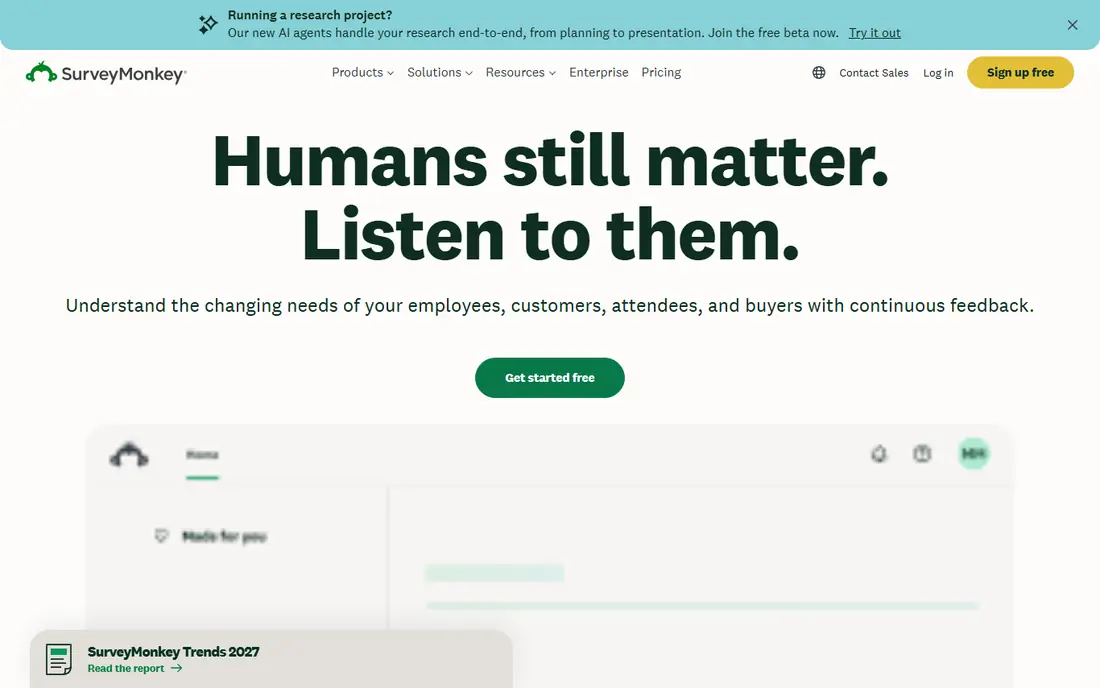
SurveyMonkey is the safest general choice for NPS because most teams already know it. NPS question types, templates and reporting views are built in, AI-assisted survey creation speeds up drafting, and integrations cover common CRMs and collaboration tools. For a team that runs NPS alongside employee, market research or event surveys, keeping everything in one platform simplifies reporting and training.
The limit is survey style. SurveyMonkey uses link-based surveys, so respondents click through to a survey page rather than rating inside the email itself, which can lower completion compared with in-email tools. Response limits also matter: paid individual plans start at around $39 per month billed annually for the Advantage plan, with overage charges per extra response beyond the plan limit. Check your expected monthly response volume against the plan before subscribing.
- Familiar survey builder with NPS templates
- Strong analysis and benchmarking
- Many integrations
- Link-based surveys rather than in-email rating
- Overage charges apply beyond plan response limits
Typeform suits teams that care most about completion rates and respondent experience. Its conversational format shows one question at a time, which feels less like a form and more like a short chat, and branding, logic and follow-up questions are easy to set up. For customer-facing NPS surveys where a polished experience matters, that design can lift responses compared with a dense grid survey.
Analysis is the trade-off. Typeform covers NPS collection well, but dedicated NPS tools offer deeper segmentation, closed-loop workflows and trend reporting out of the box. Pricing is self-serve, with a free plan limited to a small number of responses per month and paid plans rising with response volume. Start with the free plan to test completion on a small audience, then upgrade if response limits become the constraint.
- One-question-at-a-time conversational design
- Strong branding and logic
- Free plan for small tests
- Response limits on lower plans
- NPS analysis is lighter than dedicated NPS platforms
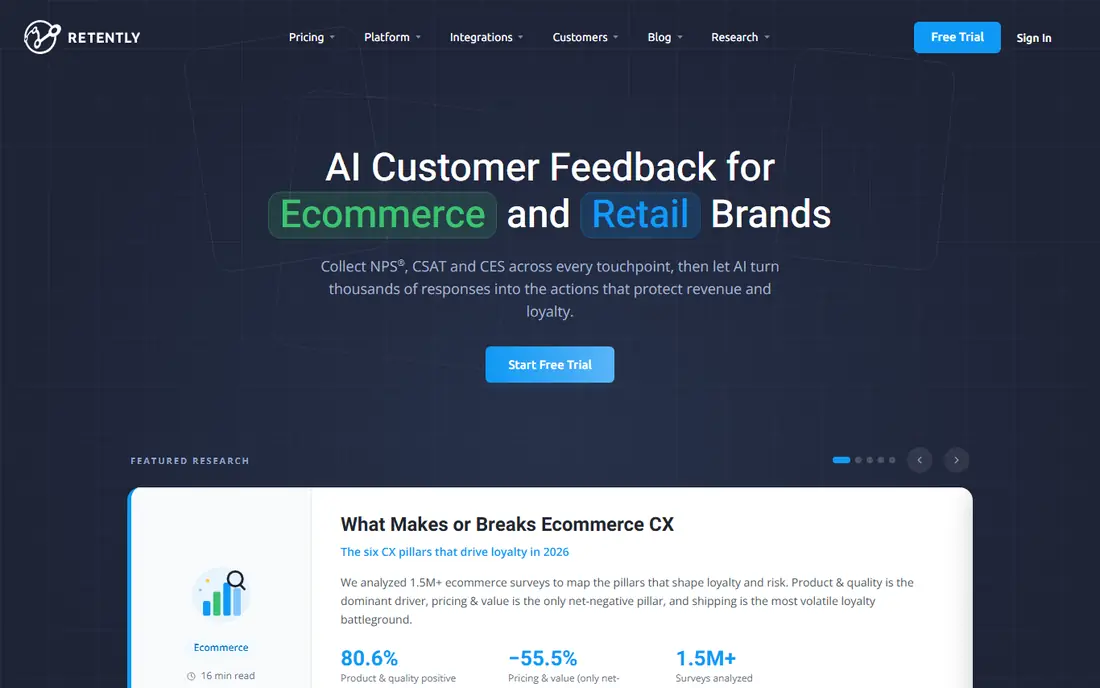
Retently is built for teams that run NPS as an ongoing program rather than an occasional survey. It sends NPS, customer satisfaction and customer effort surveys across email, web, SMS and in-app channels, segments responses by customer attributes, and automates follow-up workflows for detractors and promoters. E-commerce integrations, including Shopify, make it a natural fit for online stores that want feedback tied to orders and customers.
There is no permanent free plan, only a trial, and lower plans cap surveys and seats, so growing teams should check the plan that matches their monthly survey volume. Published starting prices vary by plan type, so confirm the current figure on the Retently pricing page for your use case. If you want a dedicated NPS tool with automation and you have outgrown a general survey platform, Retently is a strong next step.
- NPS, CSAT and CES in one dedicated platform
- Omnichannel delivery by email, web, SMS and in-app
- Automation and segmentation
- No permanent free plan
- Survey and seat caps on lower plans
- Pricing rises with volume
Qualtrics is the enterprise choice when NPS is one part of a wider customer experience program. It combines NPS with journey analytics, text analysis, contact centre feedback and closed-loop action workflows, with role-based access and audit controls that large organisations require. For a CX team that must govern surveys across regions, brands and business units, that control matters as much as the survey itself.
Complexity and price are the drawbacks. Full Qualtrics programs are quote-based, and the platform assumes a CX team with time to configure it properly. A small team that only needs a monthly NPS survey will find SurveyMonkey or Typeform faster and cheaper. Choose Qualtrics when NPS must connect to enterprise systems, governance and journey data, not when you just need a score.
- Full customer experience platform with NPS, journey analytics and closed-loop workflows
- Strong governance and integrations
- Quote-based pricing for full programs
- More complex than a small team needs for NPS alone
SurveySparrow combines conversational survey design with CX workflow features that general form tools lack. It offers NPS, CSAT and CES surveys, AI-assisted question creation, recurring scheduling and built-in ticketing, so a detractor response can become a follow-up task without leaving the platform. Distribution covers email, web link, SMS, WhatsApp, QR codes and offline collection, which suits field and service teams as well as online businesses.
Pricing starts lower than SurveyMonkey on published plans, with a free tier for small tests, but response limits on lower plans mean you should match the plan to your monthly volume. SurveySparrow suits a mid-size team that wants conversational surveys plus follow-up ticketing, without paying enterprise prices for a full CX suite.
- Conversational surveys with AI question help
- NPS, CSAT and CES support
- Ticketing for closed-loop follow-up
- Lower plans limit responses
- Some advanced features sit on higher tiers
AskNicely is built for service businesses with many locations, teams or frontline staff. It reports NPS by location, team and individual, adds coaching and huddle tools for managers, and collects feedback by email, SMS, web and kiosk. That structure helps a franchise, dealership group or field service company see which locations need help and coach them, rather than just tracking a company-wide score.
Pricing is quote-based, with plans typically starting from a set response volume, so small single-site teams may find self-serve tools cheaper. AskNicely suits organisations where NPS must drive frontline coaching and location accountability. If you run one site and just need a score, a simpler tool will serve you better.
- Location and team-level NPS reporting
- Coaching tools for frontline teams
- Kiosk and SMS delivery
- Quote-based pricing
- Best value for multi-location businesses rather than single-site teams
Zonka Feedback covers the full set of NPS channels in one platform, from email and SMS to in-app, website and on-site kiosk surveys, with AI analysis that groups open-text comments into themes and sentiment. Role-based dashboards let different teams see only their locations or segments, which helps larger organisations share feedback without exposing every response to everyone.
The platform is broader than a simple NPS tool, so smaller teams may find the setup heavier than Typeform or SurveyMonkey. Pricing is plan-based and varies by features and volume, so request a quote matched to your channels and response count. Zonka suits teams that collect feedback in several places, including physical locations, and want AI theme analysis without an enterprise CX contract.
- Email, SMS, in-app, web and kiosk surveys
- AI sentiment and theme analysis
- Role-based dashboards
- No permanent free plan on most listings
- Feature depth varies by plan tier
Survicate is the pick for product and marketing teams that want NPS inside the product or website, not only by email. Behavioural targeting lets you trigger a survey after a specific action, such as completing onboarding or using a feature, and a two-way HubSpot sync ties responses to contacts and deals. AI text analysis helps teams read open comments at scale without manual tagging.
Email-only teams may not need Survicate's targeting depth, and in-app features sit on higher tiers, so check the plan that includes your channels. For SaaS and e-commerce teams that want feedback at the moment of use, Survicate's in-product approach often beats a link sent days later, when the experience is already forgotten.
- Behavioural targeting for in-app and website surveys
- HubSpot two-way sync
- AI text analysis
- In-app features depend on plan tier
- Pricing rises with survey volume and features
CustomerGauge is designed for B2B companies where the account, not the individual contact, is the unit that matters. It rolls individual NPS responses up to account scores, links feedback to revenue and retention data, and integrates with Salesforce and HubSpot so account managers can act on at-risk accounts. That account view is the main reason a B2B firm would choose it over a general survey tool.
Pricing is quote-based and the platform assumes a B2B sales and success workflow, so consumer brands and small teams will find it heavier and pricier than needed. If your business sells to companies with multiple contacts per account, and you need to know which accounts are at risk, CustomerGauge is the most focused option on this list.
- Account-level NPS reporting for B2B
- Revenue-linked reporting
- Salesforce and HubSpot integrations
- Quote-based pricing
- Overkill for consumer teams that need only a simple score
How we picked these
We compared NPS tools on survey channels, NPS-specific reporting, segmentation, closed-loop follow-up, integrations, response limits and pricing, using vendor product and pricing pages and public reviews. We included general survey platforms, dedicated NPS tools and enterprise CX platforms so teams of different sizes can find a fit. We excluded Delighted because Qualtrics shut it down on 30 June 2026, and we used See website for prices that are quote-based or that vary by plan and volume, rather than publishing a figure we could not verify.
How to run an NPS program that actually helps
Start with a clear question and a follow-up. The 0 to 10 score alone tells you little, so always ask why the customer gave that score, and keep that follow-up short and open. Send surveys at a consistent moment, such as after onboarding, after a support interaction or on a regular quarterly cycle, so trends are comparable rather than driven by timing changes.
Next, close the loop. Assign detractor follow-ups to a named owner with a deadline, thank promoters and invite them to share a review or referral where appropriate, and review passive feedback for themes that could move customers into the promoter group. A score that no one acts on will quickly feel like noise to both customers and staff.
Finally, watch response bias. NPS surveys with very low response rates often overrepresent unhappy or very happy customers, so track response rate alongside the score, avoid surveying the same customers too often, and compare segments such as new versus long-term customers before drawing conclusions. Use NPS as one signal among others, including retention, repeat purchase and support volume, not as a single verdict on your business.
Frequently asked questions
What is the best NPS survey tool?
SurveyMonkey is the best general NPS survey tool for most teams, thanks to familiar building, NPS templates and strong analysis. Typeform is better if survey experience and completion matter most, while Retently is better for a dedicated NPS program with automation. Qualtrics suits large enterprises that need NPS inside a wider CX program.
What is the best NPS survey software for small businesses?
Typeform and SurveyMonkey suit small businesses best, since both offer free plans and self-serve paid plans without a sales process. SurveySparrow is another good small business option, with conversational surveys and follow-up ticketing at a lower starting price than enterprise tools. Start free, test completion on a small audience, and upgrade only when response limits bind.
What happened to Delighted?
Qualtrics shut Delighted down on 30 June 2026, with data deleted after that date and no extensions offered. Former Delighted users need a live alternative, and the closest replacements depend on what they valued: SurveyMonkey or Typeform for simple surveys, Retently for a dedicated NPS program, or Qualtrics itself for an enterprise CX program. Export any historical data before a shutdown deadline in future migrations.
How is NPS calculated?
Respondents rate likelihood to recommend on a 0 to 10 scale. Those scoring 9 or 10 are promoters, 7 or 8 are passives, and 0 to 6 are detractors. NPS is the percentage of promoters minus the percentage of detractors, giving a score from minus 100 to plus 100. Passives count in the total but do not move the score directly, which is why follow-up comments matter for understanding them.
Should I survey NPS by email, in-app or SMS?
It depends on where your customers engage. Email suits most B2B and account-based programs, in-app surveys suit SaaS products where users are already logged in, and SMS suits service businesses with mobile customers. Many teams use more than one channel, but avoid surveying the same customer on every channel at once, and keep frequency low enough that surveys do not become a nuisance.
Sources
See where you really rank - block by block
ProMapRanker scans Google Maps across a grid of your service area. Simple monthly plans from $19, white-label on every plan.
Start freeKeep reading
 zscaler alternatives
Best Zscaler Alternatives in 2026
Looking for zscaler alternatives? We compare 9 SASE and zero trust platforms on architecture, data protection, pricing, and fit for your network and team.
Read → zapier alternatives free
Best Zapier Alternatives Free in 2026
Nine automation tools for zapier alternatives free in 2026, all with genuinely free tiers, plus free plan limits, starting prices and upgrade paths explained.
Read → which platform is best for online reputation
Which Platform Is Best for Online Reputation in 2026
Wondering which platform is best for online reputation? We compare 8 review, listing, and response tools for small and multi-location businesses and agencies.
Read →