 ProMapRanker
Best Notification Infrastructure for Mobile Apps in 2026


Free Android and iOS delivery · Pricing starts at: Free
Key takeaways
- Firebase Cloud Messaging is the free delivery layer for Android, and Apple Push Notification service plays the same role for iOS, so every paid tool here builds on those systems.
- OneSignal is the best self-serve start for small teams, with a free tier and paid plans from $19 per month.
- Pusher Beams suits teams that want a simple push API, while Braze and Airship fit larger brands with cross-channel programs.
- Compare billing units before you choose, since some tools charge per user, others per message, and others per subscriber.
Quick comparison
| Pick | Great for | Pricing starts at | Free tier | |
|---|---|---|---|---|
| Firebase Cloud Messaging | Free Android and iOS delivery | Free | Yes | Visit |
 OneSignal | Self-serve mobile push | $19 per month | Yes | Visit |
 Pusher Beams | Simple push API | $29 per month | Yes | Visit |
 Braze | Enterprise lifecycle messaging | See website | No | Visit |
 Airship | Enterprise mobile brands | See website | No | Visit |
 CleverTap | Analytics plus engagement | $85 per month | Free trial | Visit |
 Courier | Cross-channel notification API | See website | Yes | Visit |
 Pushwoosh | Simple per-user push pricing | See website | Free trial | Visit |
 Amazon SNS | Cloud-native push delivery | Free | Yes | Visit |
The best notification infrastructure for mobile apps
This list covers genuine push and notification platforms and SDKs for mobile apps, not generic chat apps. Every push on iPhone travels through Apple Push Notification service, and every push on Android travels through Firebase Cloud Messaging, so the paid tools here add dashboards, segments, scheduling, and analytics on top of that free delivery layer.

Firebase Cloud Messaging, known as FCM, is the free transport that Android push relies on, and it also delivers to iOS apps through Apple Push Notification service. Google lists Cloud Messaging as no-cost on Firebase plans, and there is no per-message fee for delivery itself. For a team with developers, that makes FCM the cheapest possible foundation.
The catch is that FCM is a delivery service, not a marketing tool. There is no drag-and-drop journey builder, no rich segmentation dashboard, and no campaign analytics of the kind OneSignal or Braze provide. If your team can build targeting and sending logic in code, FCM is excellent. If you want a dashboard your product team can use without code, pair FCM with a tool below or choose one of them outright.
- No-cost delivery for push messages
- SDKs for Android, iOS, Flutter and Unity
- Backed by Google infrastructure
- No built-in marketing dashboard or journeys
- Targeting and automation must be built in code
- Reporting is basic compared with paid tools
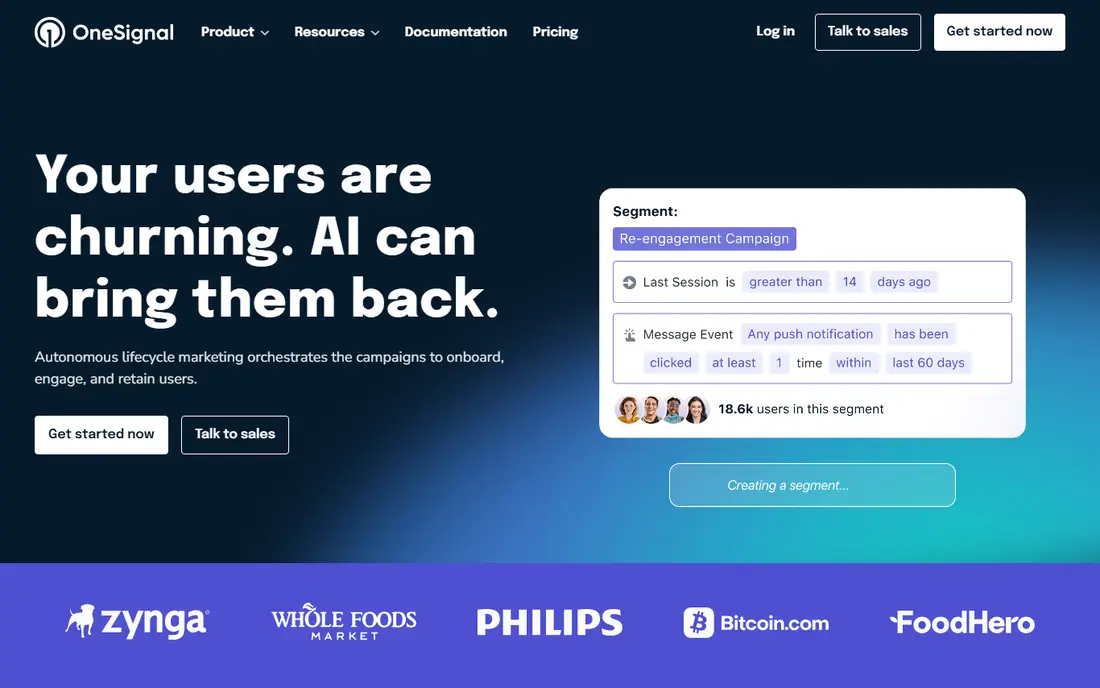
OneSignal is our pick for most small and mid-size app teams because it is easy to start and hard to outgrow quickly. The free tier covers unlimited mobile push up to 1,000 monthly active users, and the Growth plan starts at $19 per month plus a per-user charge for mobile push. SDKs cover iOS, Android, Flutter, React Native, Expo, Unity, and more, so most app stacks are covered.
The honest weakness is billing growth. Because mobile push is billed per monthly active user, a fast-growing app will see its bill rise even if send volume stays flat. Still, for a team that wants segments, scheduling, in-app messages, and journeys without building them, OneSignal gives the best balance of price and features here.
- Free tier with unlimited mobile push up to 1,000 monthly active users
- Wide SDK coverage
- Segments, journeys and A/B testing
- Paid cost grows per monthly active user
- Some advanced features need higher plans
- Pricing model takes care to compare fairly
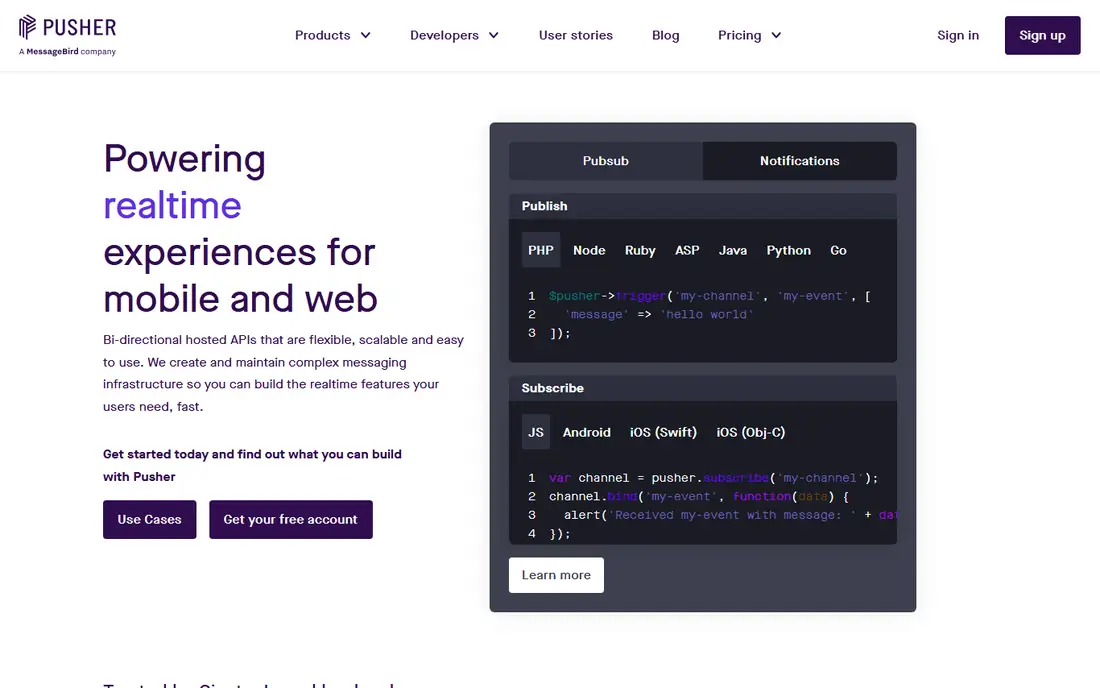
Pusher Beams suits developers who want to send push notifications from code without adopting a full marketing suite. Its API is straightforward, its free tier covers up to 1,000 subscribers, and paid plans start at $29 per month for a larger subscriber tier. For transactional alerts such as order updates or account events, that simplicity is a strength.
The limit is scope. Beams does not try to be a lifecycle platform, so teams that want journeys, email, SMS, and in-app messages in one place will need another tool. If your need is reliable push delivery through a clean API, Beams is a focused and fairly priced choice.
- Simple API for transactional push
- Free tier up to 1,000 subscribers
- Predictable per-subscriber pricing on paid plans
- Focused on push only, not full lifecycle marketing
- Fewer built-in campaign tools than OneSignal or Braze
- Dashboard is leaner
Braze is the enterprise pick for brands that run large, cross-channel lifecycle programs. It combines push with email, SMS, in-app messages, and web messaging, with segmentation and journey tools designed for teams that send at scale. Large consumer brands use it to coordinate campaigns across channels from one platform.
The drawbacks are cost and complexity. Pricing is by quote, with no free plan, and enterprise contracts can run to tens of thousands of dollars a year. A small app team will find Braze heavy and costly. A large brand that needs coordinated lifecycle messaging across channels will find it hard to replace.
- Cross-channel journeys across push, email, SMS and in-app
- Strong segmentation and personalization
- Built for large brands
- No public price, sales quote only
- No free plan
- More platform than a small app needs
Airship serves a similar enterprise audience to Braze, with a focus on mobile brands that need push, in-app messages, email, SMS, and mobile wallet passes together. Its segmentation and journey tools suit teams with large audiences and complex campaigns, and it is often chosen by regulated or high-volume brands.
Like Braze, Airship does not publish a price and offers no free plan, so small teams should not start here. Implementation also takes longer than a self-serve tool. For a large mobile brand that needs one platform across channels and a vendor that can support enterprise requirements, Airship is a credible option.
- Push, email, SMS, wallet and web messaging in one platform
- Predictive segmentation and AI journeys
- Strong for regulated and large brands
- No public price, sales quote only
- No free plan
- Implementation and onboarding take time
CleverTap appeals to consumer apps that want analytics and engagement in one suite, rather than a push-only tool. It covers push, email, SMS, in-app messages, and WhatsApp, with analytics that help teams see how campaigns affect retention. Its core plan starts at $85 per month, with a 30-day trial for evaluation.
The catch is that there is no free plan, and pricing scales with monthly active users, so costs rise with growth. Teams that only need push may find the suite larger than necessary. Teams that want to link push campaigns to user behavior and retention in one place will get more value from it.
- Combines analytics with push, email and in-app messaging
- Strong Android delivery features
- Core plan from $85 per month
- No free plan, only a 30-day trial
- Pricing scales per monthly active user
- Suite can feel large for push-only needs
Courier is built for developers who send notifications across many channels and do not want to wire each provider separately. One API can route to push, email, SMS, in-app messages, Slack, and Teams, and teams can switch the underlying provider without changing their own code. Its free tier covers 10,000 messages per month, which suits early-stage apps.
The weakness is per-message pricing beyond the free tier, which can add up quickly for high-volume apps. Courier is also more of a developer API than a marketer's campaign suite. If your team values one clean notification API across channels, Courier is a strong pick. If you want rich journey design, Braze or OneSignal may fit better.
- One API across push, email, SMS, in-app and chat tools
- Free tier of 10,000 messages per month
- Lets teams switch providers without rewriting code
- Per-message pricing can grow fast at high volume
- Dashboard is developer-focused
- Marketing journey features are leaner than Braze
Pushwoosh is a straightforward push platform for teams that want clear per-user pricing and a simple setup. It offers SDKs for the main mobile stacks, segments for targeting, and scheduled sends for campaigns. Teams that found OneSignal's pricing hard to model may prefer Pushwoosh's approach.
The limit is that there is no free push plan, only a trial, and its ecosystem is smaller than OneSignal's. Advanced features also sit on higher tiers. For a mid-size app that wants a simple push tool without a full marketing suite, Pushwoosh is worth a trial.
- SDKs for iOS, Android, Flutter and React Native
- Segments and scheduled sends
- Per-user pricing that is easy to model
- No free push plan, only a trial
- Smaller ecosystem than OneSignal
- Some advanced features need higher tiers
Amazon Simple Notification Service, known as SNS, is the cloud-native option for teams already running on AWS. Its free tier covers 1 million push notifications per month, and beyond that the per-message cost is very low. For a backend team that already uses AWS services, SNS fits naturally into existing infrastructure.
The catch is that SNS is infrastructure, not a campaign tool. There is no marketer dashboard, no journey builder, and no segmentation UI of the kind OneSignal provides. Your team builds those pieces. If you have AWS skills and want low-cost delivery, SNS is excellent. If you want a dashboard, start with OneSignal or Pusher Beams instead.
- Free tier of 1 million push notifications per month
- Fits AWS-native backends
- Reliable delivery at very low per-message cost beyond the free tier
- Developer tool, not a marketing dashboard
- Setup needs AWS knowledge
- Campaign features must be built by your team
How we picked these
We compared vendor pricing pages, SDK documentation, and platform comparisons published in 2026, and we kept only platforms with a genuine push SDK or API for mobile apps. We excluded generic messaging apps, email-only tools, and app builders that merely include push as a side feature. Prices reflect published starting points where vendors list them, and we wrote See website where pricing is by quote or varies by volume, rather than guessing a figure.
Choosing by billing unit, not only by headline price
The biggest mistake when comparing push tools is to compare headline prices without checking the billing unit. OneSignal and CleverTap charge mainly per monthly active user, Courier charges per message, Pusher Beams charges per subscriber, and FCM and SNS charge nothing for delivery itself. A tool that looks cheap for a small app can become costly as users grow, while a per-message tool rewards apps that send rarely.
Start by estimating your monthly active users, your subscriber count, and your sends per user per month. Then price each shortlisted tool on that same example, not on its marketing page. Also check permission habits: ask for push permission at a sensible moment, explain what notifications will cover, and give users a clear way to change settings. Good infrastructure will not save a notification strategy that annoys people.
Frequently asked questions
What is the cheapest notification infrastructure for a small app?
Firebase Cloud Messaging is free for delivery, and OneSignal's free tier covers unlimited mobile push up to 1,000 monthly active users. For a small app with developers, FCM alone costs nothing, while OneSignal adds a dashboard at no cost up to that user limit.
Do I need a paid tool if I use Firebase Cloud Messaging?
Not necessarily. FCM handles delivery for free, but it does not provide a marketing dashboard, journeys, or rich segmentation. Paid tools add those features, so choose a paid tool only if your team needs them and cannot build them in code.
How does push work on iPhone and Android?
Every push on iPhone travels through Apple Push Notification service, and every push on Android travels through Firebase Cloud Messaging. Paid platforms send through those systems and add targeting, scheduling, and analytics on top.
What is the difference between OneSignal and Braze?
OneSignal is a self-serve tool with a free tier and published starting prices, suited to small and mid-size teams. Braze is an enterprise platform with quote-only pricing, built for large brands running cross-channel lifecycle programs.
Should I choose per-user or per-message pricing?
Per-user pricing suits apps that send often, since the cost stays flat as sends rise. Per-message pricing suits apps that send rarely, since you pay only for what you send. Model both on your real user and send numbers before you decide.
Can I switch push providers later?
Yes, but switching is easier if you keep provider details behind your own API layer or use a routing tool such as Courier. Plan the switch early, since users must stay subscribed through Apple and Google systems during the change.
Sources
See where you really rank - block by block
ProMapRanker scans Google Maps across a grid of your service area. Simple monthly plans from $19, white-label on every plan.
Start freeKeep reading
 zyte alternatives
Best Zyte Alternatives in 2026
These zyte alternatives cover managed scraping APIs, proxy networks and no code tools for lawful collection from your own or consented sources only in 2026.
Read → zerto alternatives
Best Zerto Alternatives in 2026
Compare the best zerto alternatives for disaster recovery and replication, with recovery targets, cloud options and honest trade-offs for teams in 2026.
Read → zerofox alternatives
Best ZeroFox Alternatives in 2026
We compared 9 zerofox alternatives for brand protection, phishing takedowns, dark web monitoring, and social impersonation, with clear coverage notes.
Read →