 ProMapRanker
Best Nonprofit Software in 2026

Key takeaways
- Bloomerang and Neon CRM are the strongest all-round donor systems for small to mid-size nonprofits, with different strengths in retention and membership.
- Givebutter and Zeffy let small nonprofits start with no software cost, funded by optional donor tips rather than a subscription.
- Little Green Light and DonorSnap are the lowest-cost paid donor databases for teams leaving spreadsheets.
- Salesforce Nonprofit Cloud and Blackbaud Raiser's Edge NXT suit larger organizations with staff to configure and manage them.
- Price scales with contacts or records on most platforms, so count your database before you compare monthly figures.
Quick comparison
| Pick | Great for | Pricing starts at | Free tier | |
|---|---|---|---|---|
 Bloomerang | Donor retention | $125 per month | No | Visit |
 Neon CRM | Membership organizations | $99 per month | No | Visit |
 DonorPerfect | Fundraising automation | See website | No | Visit |
 Little Green Light | Small budgets | $45 per month | Free trial | Visit |
 Givebutter | Free fundraising and CRM | Free | Yes | Visit |
 Zeffy | Zero-fee donations | Free | Yes | Visit |
 Salesforce Nonprofit Cloud | Large complex nonprofits | $60 per user per month | Yes | Visit |
 Blackbaud Raiser's Edge NXT | Large fundraising teams | See website | No | Visit |
 DonorSnap | Affordable donor database | $50 per month | Free trial | Visit |
The best nonprofit software
Nonprofit software covers donor records, fundraising pages, events, membership, and reporting, and the right platform depends on team size and how you raise money. This list mixes donor CRMs, free fundraising tools, and enterprise platforms, so a small charity and a large organization can both find a fit. We compared official pricing pages and feature pages to build it.
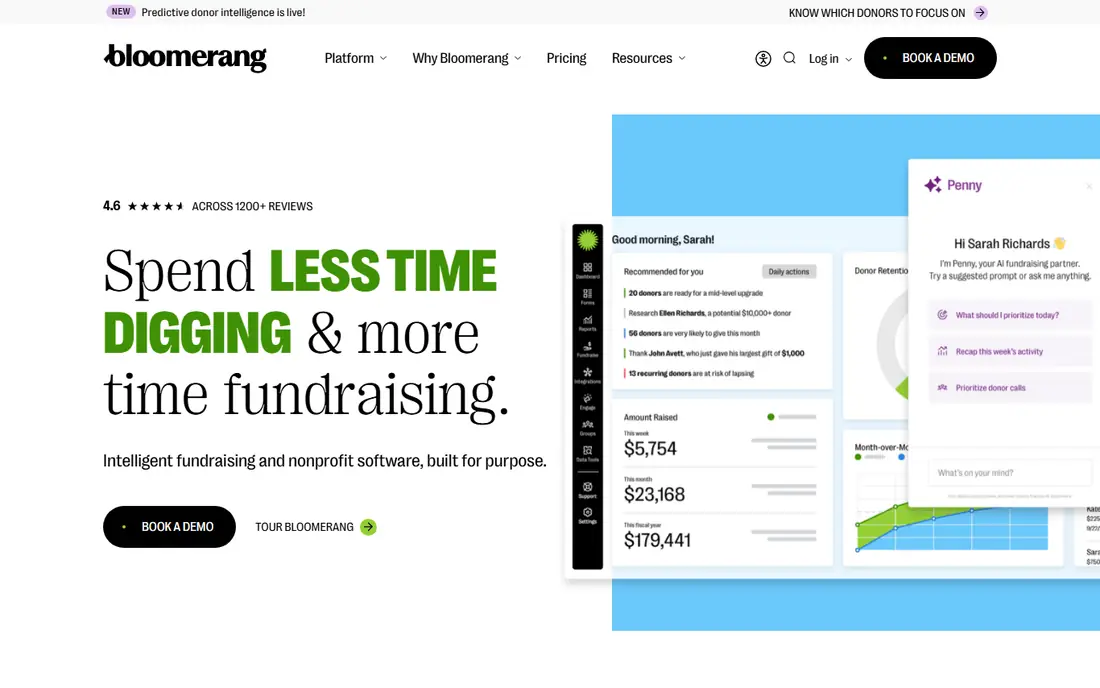
Bloomerang is built around a simple idea: keeping donors matters as much as finding new ones. The CRM plan starts at $125 per month when billed annually, and it centers on donor timelines, engagement scoring, and a retention dashboard that shows which donors are slipping away. Segmentation and reporting help small development teams run targeted appeals without a data analyst.
The price is the main barrier for very small teams, and some fundraising features sit in add-on products rather than the base CRM. Contact-count pricing also means a growing list raises the bill over time. If retention is your biggest problem, Bloomerang is our first pick. If budget is tighter, Little Green Light or Givebutter will cover the basics for less or for free.
- Retention dashboard and engagement scoring
- Constituent timelines and segmentation
- Unlimited users on plans
- Higher starting price than budget rivals
- Some fundraising tools are add-ons
- Pricing rises with contact count
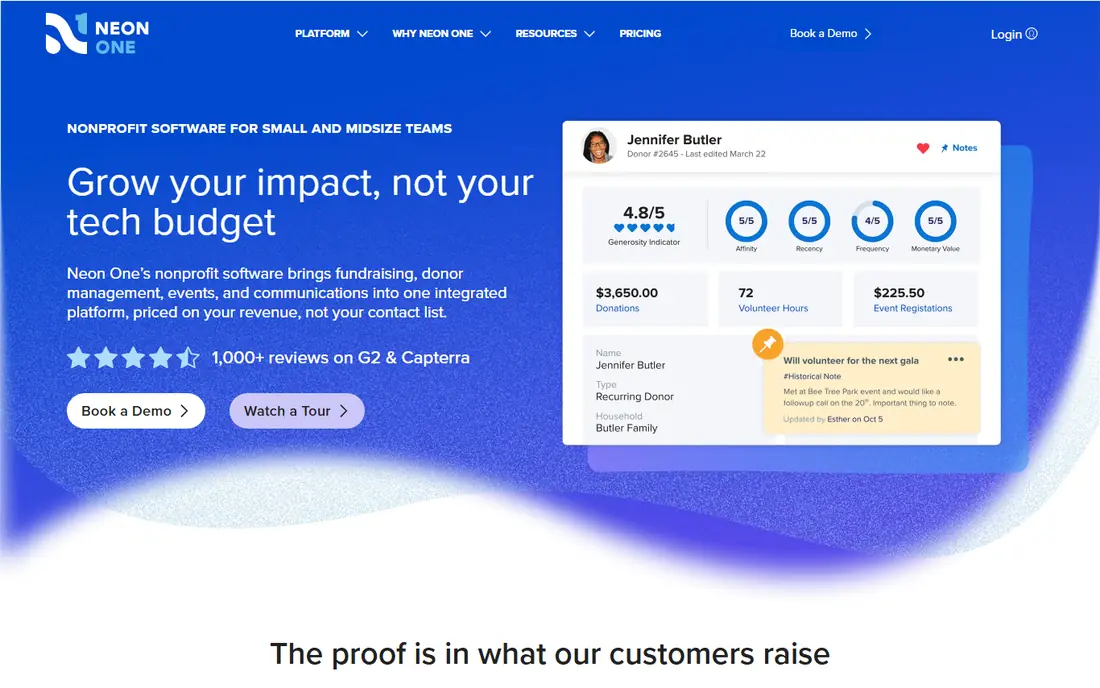
Neon CRM, from Neon One, starts at $99 per month on the Essentials plan and suits organizations that juggle members, donors, events, and volunteers at once. Membership management, donation forms, event registration, and email tools sit in one database, so a member who donates and attends an event shows up as one person, not three records. Workflow automation helps small teams handle renewals and follow-ups without manual tracking.
Reporting is powerful but can feel complex until you learn it, and onboarding support may add a fee depending on the package. New admins should budget time to set up forms and workflows properly. Pick Neon CRM if membership is central to your model. Pick Bloomerang if donor retention alone is the priority.
- Membership, events, and donations in one system
- Unlimited records on plans
- Strong workflow automation
- Reporting can feel complex at first
- Onboarding fees may apply
- Learning curve for new admins
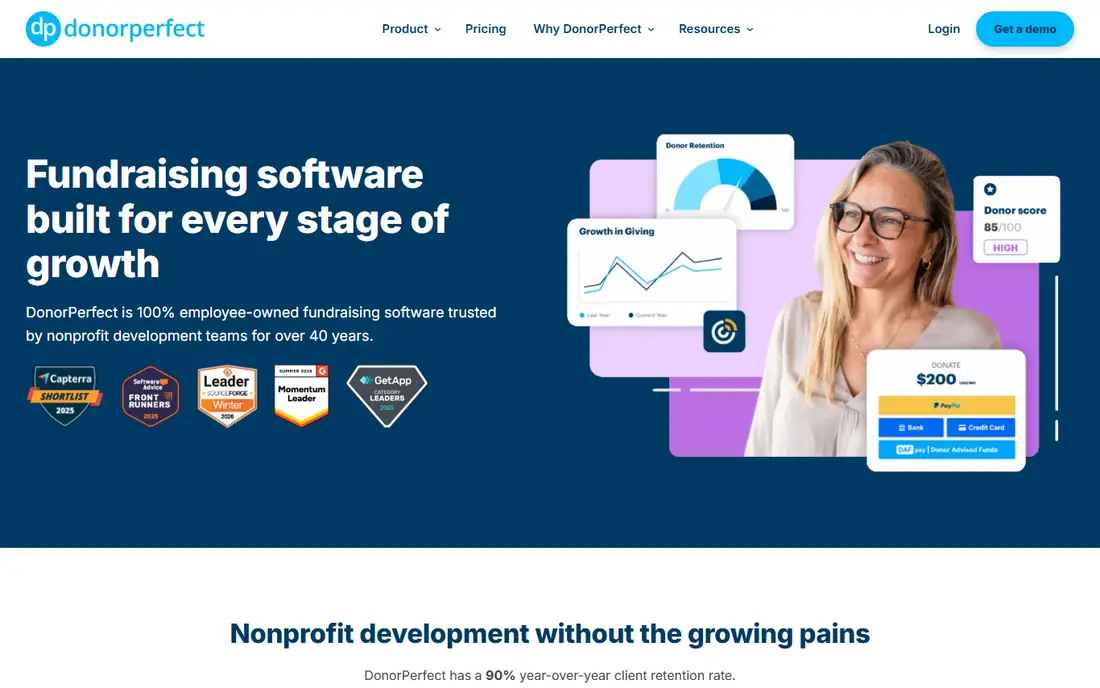
DonorPerfect is a long-running donor management system for mid-size nonprofits with multi-channel fundraising. It offers donation tracking, custom reports, automated thank-you workflows, and a Donor Journey Builder for moves management. Organizations that run direct mail, online giving, events, and grants from one database will find depth here that budget tools lack.
Pricing is quote based and scales with database size, so we list it as See website, and you should start the sales conversation early if you need it. The interface also feels dated compared with newer rivals, and building complex reports takes practice. Choose DonorPerfect when you need proven depth and automation. Choose Neon CRM or Bloomerang when you want a more modern interface at a published price.
- Long-established donor system
- Strong reporting and custom reports
- Donor journey and automation tools
- Pricing is quote based
- Interface feels dated in places
- Report building can be complex for new users
Little Green Light is the budget paid pick for nonprofits leaving spreadsheets. It starts at $45 per month for up to 2,500 records, with unlimited users, gift tracking, goal tracking, customizable reports, and built-in donation forms through Stripe or PayPal. For a small charity that needs one true donor record and clear reports, it covers the essentials without enterprise cost.
Support is email only on basic plans, and automation and marketing features are thinner than in Bloomerang or Neon CRM. The interface is functional rather than flashy, which matters little once your data is clean. If $45 per month is your ceiling for a paid database, Little Green Light is the best value here. If you need zero cost, Givebutter or Zeffy come first.
- Low starting price for a real donor database
- Unlimited users
- Built-in donation forms and goal tracking
- Email-only support on basic plans
- Fewer advanced automation features
- Interface is functional rather than polished
Givebutter lets small nonprofits start fundraising with no software subscription. You can build donation pages, run campaigns and events, and track donors in a basic CRM, with the platform funded by optional tips donors can add at checkout. That model makes it a strong first step for a new charity, a school group, or a one-off appeal.
The free tier is not a full donor CRM. Reporting and automation are lighter than in Bloomerang or DonorPerfect, and some advanced features sit on paid plans. Donors also see a tip prompt, which some organizations prefer to turn off or explain. Pick Givebutter when free matters most and you need campaigns running this week. Move to a paid CRM when donor reporting becomes the bottleneck.
- Free fundraising pages, events, and basic CRM
- Funded by optional donor tips
- Easy to launch a campaign quickly
- Platform fee applies on some paid features
- Basic CRM is thinner than a dedicated donor system
- Tip prompt appears to donors
Zeffy goes further than Givebutter on fees: it charges no platform fee and no transaction fee on donations, funding itself through optional donor contributions. Small nonprofits get donation forms, peer-to-peer fundraising, event ticketing, raffles, and a basic CRM without a monthly bill. For a charity where every dollar of a donation matters, that fee model is a real difference.
The trade is depth. The CRM is basic next to Bloomerang or Neon CRM, and integrations are fewer, so larger teams with complex reporting will outgrow it. Donors also see a contribution prompt, which you should explain on your page. If zero fees and simple fundraising are the priority, Zeffy is the best free pick here. If donor analytics drive your strategy, pay for a dedicated CRM.
- No platform or transaction fees on donations
- Fundraising, events, and basic CRM included
- Simple setup for small teams
- CRM features are basic
- Funded by donor tips, so donor experience includes a tip prompt
- Fewer integrations than paid CRMs
Salesforce Nonprofit Cloud suits large nonprofits with complex programs, many staff, and data spread across fundraising, programs, and grants. It offers deep customization, a huge integration library, and program management tools that smaller CRMs do not attempt. Eligible nonprofits can receive free licenses through Salesforce Power of Us program, which helps with license cost, though the published starting price is $60 per user per month.
Implementation is the real cost. Configuration, data migration, and training need technical staff or a consultant, and total project cost can run far above the license figure. Small teams should not pick Salesforce for simplicity. Large organizations with IT capacity, or with a partner to implement it, get a platform that can grow with them for years.
- Deep customization and scale
- Large integration ecosystem
- Eligible nonprofits can get free licenses through the Power of Us program
- Needs technical staff or consultants to configure well
- Total cost includes implementation, not just licenses
- Learning curve is steep
Blackbaud Raiser's Edge NXT is the enterprise fundraising system many large nonprofits and universities already use. It covers donor records, prospect research, annual fund workflows, suggested gift amounts, and campaign tracking, with integrations to many third-party tools. For a development office with several fundraisers and complex campaigns, that depth matters.
Pricing is quote based, so we list it as See website, and you should budget for implementation and training as well as licenses. The system also rewards technical experience, and users report yearly price increases as a concern. Pick Raiser's Edge NXT when your fundraising operation is large and complex. Pick Bloomerang or Neon CRM when a smaller team needs a system it can run on its own.
- Deep fundraising and prospect tools
- Wide integration library
- Built for large development teams and campaigns
- Pricing is quote based
- Needs technical experience to use well
- Yearly price changes are a known concern for users
DonorSnap is a focused, affordable donor database for small nonprofits. It starts at $50 per month for up to 1,000 contacts, with unlimited users, customizable donation pages, donor follow-up tools, and add-on event and auction tools. That scope suits a small charity that needs clean donor records and simple fundraising without paying for features it will not use.
The feature set is smaller than Bloomerang or Neon CRM, and the price rises as your contact count grows. Automation is also lighter, so teams that need complex journeys should look elsewhere. If you want a simple, low-cost donor system with a free trial to test it, DonorSnap is a solid pick beside Little Green Light.
- Low price for up to 1,000 contacts
- Unlimited users
- Built-in donation forms and event tools
- Smaller feature set than larger CRMs
- Scales in price as contacts grow
- Fewer advanced automation options
How we picked these
We compared official pricing pages, feature pages, and plan structures, and we favored platforms that are actively maintained and used by US nonprofits in October 2026. We included free, budget, mid-range, and enterprise options, because a one-person charity and a large development office do not need the same system. Where pricing is quote based, we listed See website rather than repeating a third-party estimate as a vendor price.
What to check before you buy
Count your contacts first, because most paid plans price by records or contacts, and a list that looks small on a spreadsheet may cost more than you expect. Next, list the jobs the software must do: donation forms, membership, events, email, grants, and accounting are different jobs, and no single tool here does all of them equally well. Some teams pair a donor CRM with a separate accounting tool, and that is normal.
Then run a trial with your real data. Import a sample of donors, build a donation form, send a test appeal, and run the reports your board actually asks for. Check payment processing fees separately, because those sit on top of subscription prices on most platforms. Finally, ask who will administer the system week to week, because a powerful tool nobody maintains will fail faster than a simple tool your team actually uses.
Frequently asked questions
What is the best software for nonprofits?
Bloomerang is the best all-round donor CRM for small to mid-size nonprofits, and Neon CRM is best for membership organizations. Givebutter and Zeffy are best for small teams that need free fundraising. Large organizations should look at Salesforce Nonprofit Cloud or Blackbaud Raiser's Edge NXT, with implementation help.
What is the top nonprofit software for small nonprofits?
Little Green Light at $45 per month and DonorSnap at $50 per month are the best low-cost paid donor databases. Givebutter and Zeffy cost nothing for core fundraising and suit teams that cannot yet pay a subscription. Start free if budget is tight, then move to a paid CRM when reporting needs grow.
Is there free nonprofit software?
Yes. Givebutter and Zeffy offer free fundraising and basic CRM, funded by optional donor tips. Salesforce offers free licenses to eligible nonprofits through its Power of Us program, though implementation still costs time or money. Free tiers cover campaigns and basic donor records, not deep analytics.
How much does nonprofit software cost?
Free options cost nothing for core use, budget donor databases start at $45 to $50 per month, mid-range CRMs start at $99 to $125 per month, and enterprise platforms are quote based with implementation costs on top. Payment processing fees are usually separate, so check those before you compare totals.
Should a nonprofit use a CRM or a spreadsheet?
A spreadsheet works for a very small donor list, but it breaks when you add events, membership, email, and repeat gifts. A CRM keeps one record per person, tracks gifts over time, and produces board reports without manual merging. Move to a CRM when duplicate records, missed follow-ups, or slow reporting start costing donations.
Sources
See where you really rank - block by block
ProMapRanker scans Google Maps across a grid of your service area. Simple monthly plans from $19, white-label on every plan.
Start freeKeep reading
 zoho inventory alternatives
6 Alternatives to Zoho Inventory, Compared on Price and Fit
Zoho Inventory alternatives: 6 tools compared on price, free plans and fit. Katana leads the list for manufacturers. Fit and flaws are laid out for each entry.
Read → zoho crm alternatives
Best Zoho CRM Alternatives (2026)
Need Zoho CRM alternatives? We compare 7 tools on cost, free access and who each suits. Every pick gets a straight assessment. Built for quick decisions.
Read → zelle alternatives
Best Zelle Alternatives in 2026
Compare the best Zelle alternatives for sending money to friends, paying sellers and moving funds abroad, with honest notes on fees, speed and safety in 2026.
Read →