 ProMapRanker
Best Newsletter Platforms (2026)


Small companies and nonprofits wanting premium features at low prices · Pricing starts at: Free plan (250 subscribers); Comfort from $12/month
Direct answer
Our first pick is MailerLite, best for small companies and nonprofits wanting premium features at low prices. Alternatives: Kit for creators who will eventually sell products and need automation, and Beehiiv for creators building a media business, not just a newsletter. The remaining 3 options are covered below with prices and limits.
Key takeaways
- MailerLite is the opening pick, best for small firms and nonprofits wanting premium features at low prices.
- Check the limits for Buttondown before you commit: design and template choices are sparse.
- Free plans are common here: 6 of 6 tools have one, including MailerLite, Kit, Beehiiv and Buttondown.
- For small companies needing email plus landing pages and entry-level CRM, Mailchimp is worth a look.
Quick comparison
| Pick | Great for | Pricing starts at | Free tier | |
|---|---|---|---|---|
| MailerLite | Small companies and nonprofits wanting premium features at low prices | Free plan (250 subscribers); Comfort from $12/month | Yes | Visit |
 Kit | Creators who will eventually sell products and need automation | Free Newsletter plan (10,000 subscribers); Creator $39/month ($33/month annual at 1K subs) | Yes | Visit |
 Beehiiv | Creators building a media business, not just a newsletter | Free plan (2,500 subscribers); Lite from $59/month ($49/month annual) | Yes | Visit |
 Buttondown | Technical writers wanting email as an API | Free (first 100 subscribers); premium from $9/month (up to 1,000 subscribers) | Yes | Visit |
 Substack | Writers wanting to publish and monetize without building a website | $0 to start; 10% platform fee on premium subscriptions plus Stripe processing | Yes | Visit |
 Mailchimp | Small firms needing email plus landing pages and entry-level CRM | Free plan (250 contacts); Essentials from $13/month (500 contacts) | Yes | Visit |
Our 6 newsletter platforms
ProMapRanker put together this guide to newsletter platforms for readers who want a clear shortlist without reading every vendor page. It compares 6 tools on starting price, free plans, who each one suits and where each one falls short.
MailerLite
Great for: Small companies and nonprofits wanting premium features at low prices
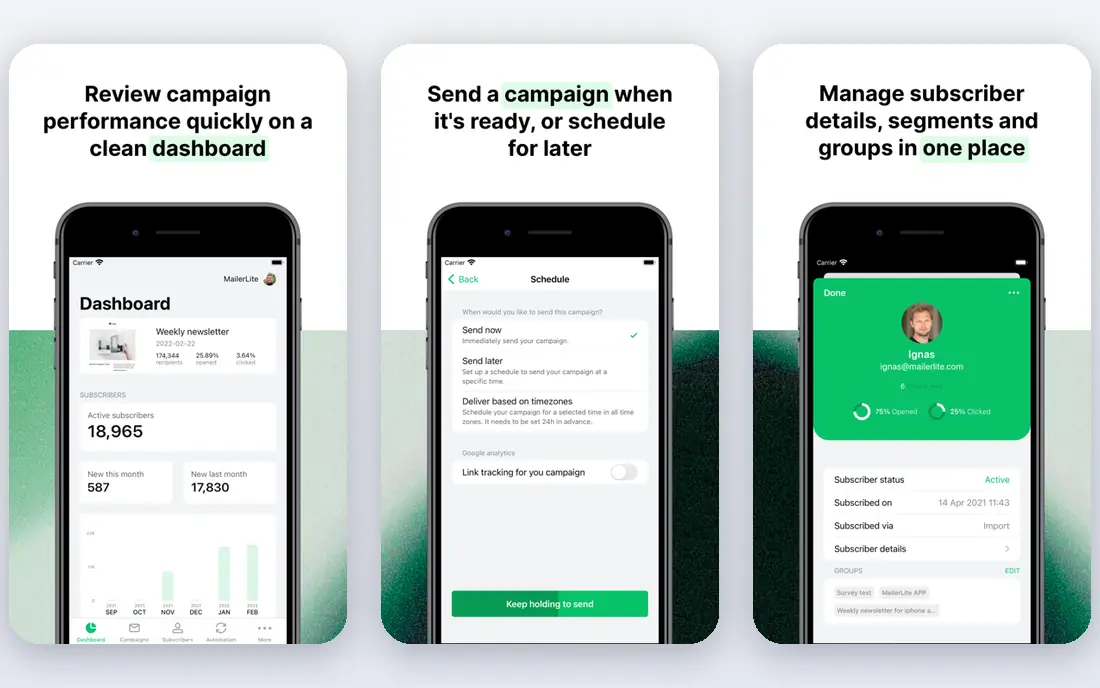
Think of MailerLite for small firms and nonprofits wanting premium features at low prices. The manual account review before your first send can delay launch by a day or two, so plan around it.
At $12 a month for the Comfort level, the price is hard to argue with for what you get. Entry price for MailerLite: Free plan. You can start on MailerLite without paying.
The main drawbacks: Approval process for new accounts can delay sending.
- Very good value on premium levels
- 30% nonprofit discount
- Automation depth trails Kit
Kit is built with creators who will eventually sell products and need automation in mind. Kit (formerly ConvertKit) hands away the most ample free newsletter level here: 10,000 subscribers at $0. If your plan is newsletter first, products later, Kit's free level plus automation is the natural home.
As for the details, setup contains guided migration help. As for the details, the subscriber-centric model with visual automations and tagging fits creators who segment audiences and sell products, with commerce features built in instead of bolted on. Price to start with Kit: Free Newsletter plan. Free access exists with Kit.
Watch-outs: Costs scale steeply with subscriber count.
- Commerce features built in
- Ample free level for pure newsletters
- Templates are more straightforward than Mailchimp or Flodesk
Beehiiv is aimed squarely at creators building a media business, not just a newsletter. Beehiiv is infrastructure for a media business: newsletters plus an ad network, premium boosts, referral programs and analytics, with zero product fee on subscriptions. For a creator whose newsletter is the business, Beehiiv's monetization stack justifies the flat fee.
What to check first: Website builder is entry-level.
For a casual writer, it is more than needed. More specifically, 2026 brought raises up to 52 percent on some levels, so confirm current prices instead of trusting old guides. For everyday use, the free level includes 2,500 subscribers with unlimited sends, which is a real audience before you pay. The website builder is entry-level. Beehiiv starts at: Free plan. You can start on Beehiiv without paying.
- Capable analytics and referral program
- Zero product fee on premium subscriptions
- Price increases in 2026 made higher levels notably more costly
Choose Buttondown for technical writers wanting email as an API with a clean interface. The free level spans 100 subscribers.
As for the details, the writing interface stays out of the way, pricing scales linearly with subscribers from $9, and the API deals with everything else. Worth adding: if you want power and polish, look elsewhere; if you want email that behaves like infrastructure, Buttondown is it. On cost, Buttondown starts like this: Free. A free plan is available with Buttondown.
Limits to weigh: Analytics are entry-level compared with Beehiiv.
- Straightforward subscriber-based pricing
- Markdown-native writing
- Design and template choices are sparse
Substack
Great for: Writers wanting to publish and monetize without building a website
For writers wanting to publish and monetize without building a website, Substack is a natural candidate. The discovery network means readers find you inside Substack, which is distribution most newsletters never get elsewhere.
The 10 percent fee is the entire story. In daily use, Substack's pitch is radical simplicity: write, publish, turn on premium subscriptions, done. Substack pricing: $0 to start. A free plan is available with Substack.
Where Substack stands out: Zero upfront cost and no subscription levels.
Watch-outs: 10% cut is steep at scale.
- Simplest path to premium subscriptions
- Built-in discovery network brings readers
- Restricted design and branding control
Mailchimp
Great for: Small firms needing email plus landing pages and entry-level CRM
Where Mailchimp fits: small companies needing email plus landing pages and entry-level CRM. For a small business that needs newsletters plus landing pages and light CRM in one account, the breadth is the appeal.
Contact-based billing is the trap. The free plan is small at 250 contacts. Mailchimp pricing: Free plan. Mailchimp offers a free plan.
Points against: Charges for unsubscribed contacts too.
- Most mature template and design library
- Ample feature set on premium levels
- Pricing escalates rapidly with list size
Our selection method
We compared the tools on published pricing, free plan or trial availability, feature coverage for newsletter platforms, and the limits each vendor documents. Plan names, prices and limits change often. Treat the figures here as a starting point and verify them with the vendor. The order reflects how well each tool fits the most common buying scenario for newsletter platforms, then price clarity, then free plan access. It is a starting point, not a verdict.
What to check before you buy
- Check the current price for MailerLite, Mailchimp and the rest on each vendor page, since seats and billing terms change the total.
- Look at free plan limits closely: MailerLite, Kit, Beehiiv and others have one, and the caps decide whether it is usable for real work.
- Read the limits listed for MailerLite first: approval process for new accounts can delay sending.
- Read the plan comparison for Kit carefully; key features often start on a higher tier.
- Compare total cost, not headline price: for Mailchimp, add extra seats, add-ons and any usage-based charges.
Frequently asked questions
Which options for newsletter platforms have a free plan?
On this list, 6 of 6 tools include a free plan, among them MailerLite, Kit, Beehiiv and Buttondown. Caps on seats, usage or features are common, so test the free plan against your real workload.
Is MailerLite the right pick for everyone comparing newsletter platforms?
No single tool suits every team. MailerLite comes first because it fits small businesses and nonprofits wanting premium features at low prices, while Kit suits creators who will eventually sell products and need automation and Beehiiv suits creators building a media business, not just a newsletter. Match the tool to your own size, budget and workflow before deciding.
Can I migrate my newsletter to another system?
The risk is deliverability during the switch: warm up the new sending domain, keep the old list engaged, and expect a small unsubscribe bump. Plan the migration; do not fear it.
Which newsletter system is a good match for beginners?
For most readers this guide would start with MailerLite, built for small firms and nonprofits wanting premium features at low prices. Kit is the alternative for creators who will eventually sell products and need automation, and Beehiiv for creators building a media business, not just a newsletter. The right answer depends on budget and workflow.
Do these tools publish their prices?
Yes. Every tool from MailerLite to Mailchimp shows a starting price, though seats, add-ons and billing terms still change the final cost.
Can I try these options before paying?
Often, yes. MailerLite, Kit, Beehiiv and others have a free plan. Use your own data and a real task during the test, and check what the free tier or trial limits before you rely on it.
Sources
See where you really rank - block by block
ProMapRanker scans Google Maps across a grid of your service area. Simple monthly plans from $19, white-label on every plan.
Start freeKeep reading
 zoho inventory alternatives
6 Alternatives to Zoho Inventory, Compared on Price and Fit
Zoho Inventory alternatives: 6 tools compared on price, free plans and fit. Katana leads the list for manufacturers. Fit and flaws are laid out for each entry.
Read → zoho crm alternatives
Best Zoho CRM Alternatives (2026)
Need Zoho CRM alternatives? We compare 7 tools on cost, free access and who each suits. Every pick gets a straight assessment. Built for quick decisions.
Read → zelle alternatives
Best Zelle Alternatives in 2026
Compare the best Zelle alternatives for sending money to friends, paying sellers and moving funds abroad, with honest notes on fees, speed and safety in 2026.
Read →