 ProMapRanker
Best MTD Software in 2026


Sole traders and growing firms · Pricing starts at: See website
Key takeaways
- MTD means Making Tax Digital, the UK system where VAT and income tax records are kept digitally and sent to HMRC through compatible software.
- From April 2026, MTD for Income Tax applies to sole traders and landlords with qualifying income over 50,000 pounds, with a lower threshold planned for 2027.
- Check MTD for VAT and MTD for Income Tax separately, since a tool approved for one is not always approved for the other.
- Sole traders often do well on QuickBooks, FreeAgent, or Xero, while spreadsheet users may only need bridging software.
Quick comparison
| Pick | Great for | Pricing starts at | Free tier | |
|---|---|---|---|---|
| QuickBooks Online | Sole traders and growing firms | See website | Free trial | Visit |
 Xero | Growing firms and accountants | See website | Free trial | Visit |
 FreeAgent | Freelancers and contractors | See website | Free trial | Visit |
 Sage Accounting | Established firms and payroll | See website | Free trial | Visit |
 Zoho Books | Low-cost bookkeeping | Free | Yes | Visit |
 KashFlow | UK-focused small firms | See website | Free trial | Visit |
 Clear Books | Simple UK bookkeeping | See website | Free trial | Visit |
 QuickFile | Free core bookkeeping | Free | Yes | Visit |
 Pandle | Simple sole trader bookkeeping | See website | Free trial | Visit |
The best MTD software
This article covers UK Making Tax Digital software only. Every tool below is presented as MTD-compatible for VAT, income tax, or both, and you should confirm the exact HMRC approval for your tax type on the vendor site before you file.

QuickBooks is a strong default for UK small firms facing MTD. It keeps digital records, links to bank feeds, and submits VAT and income tax updates to HMRC through its MTD features. The sole trader plan keeps costs lower for one-person firms, while larger plans add payroll and project tools.
The main drawback is tier creep. Features that look standard in marketing often sit on higher plans, so the monthly cost can climb as the firm grows. Still, for a sole trader or small limited company that wants one tool for records and filing, it is hard to beat for ease of use.
- Clear MTD filing path
- Bank feeds and receipt capture
- Dedicated sole trader plan
- Prices rise with tiers
- Some advanced features need higher plans
Xero suits firms that work closely with an accountant. The accountant can view the same records, post adjustments, and help with MTD submissions without a pile of exported files. Its integration list is wide, so invoicing, stock, and payment tools can connect to the same books.
For a very small sole trader, Xero may be more than needed, and the price can feel high next to a free core tool. It earns its place when the firm has staff, stock, or an accountant who already uses Xero day to day.
- Strong accountant collaboration
- Wide app integrations
- MTD for VAT and income tax support
- Can feel pricey for a sole trader
- Payroll is a separate add-on in some plans
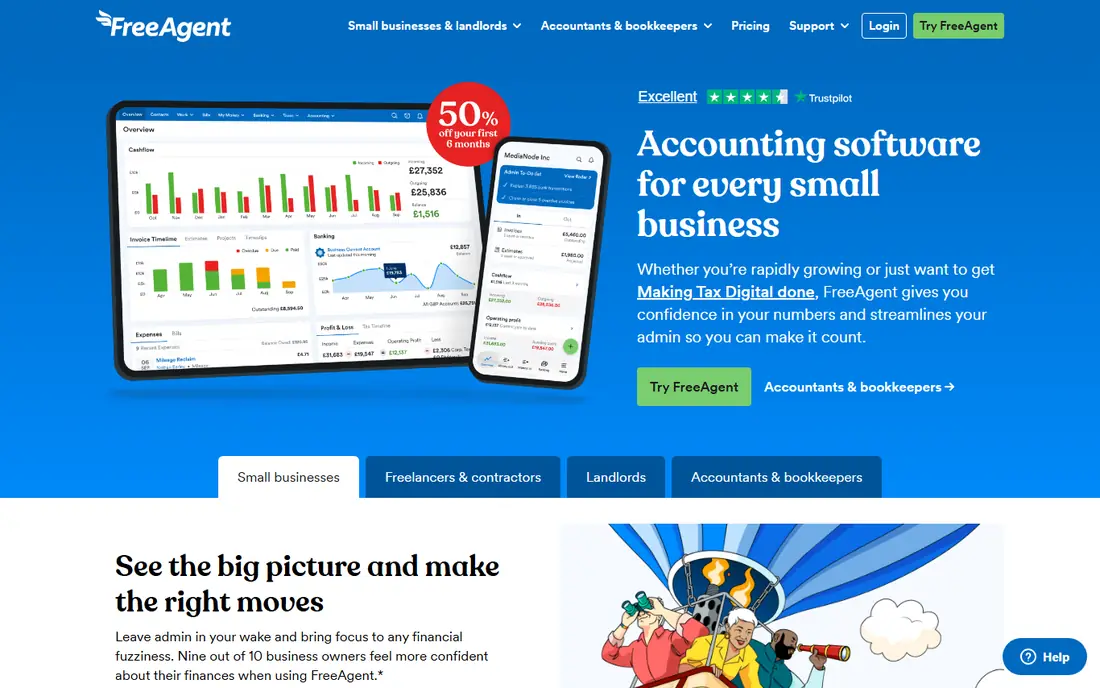
FreeAgent was built around UK freelancers, contractors, and small limited companies. It shows tax timelines, handles MTD submissions, and keeps invoicing, expenses, and bank feeds in one place. Many users like how plainly it explains what is due and when.
Larger firms with stock, multiple entities, or complex payroll may outgrow it. It is also worth checking current bank-partner offers, since free access through some UK banks has changed over time. For a freelancer, it remains one of the simplest MTD paths.
- Built for UK freelancers
- MTD filing included
- Clear tax timelines
- Less suited to complex stock or multi-entity firms
- Some bank offers change
Sage is a familiar name in UK accounting, and its cloud product covers MTD filing alongside invoicing, bank feeds, and reporting. Firms that already use Sage payroll or desktop products may find the move smoother than switching to a new vendor. Support for UK tax rules is a clear strength.
New users sometimes find the interface busy, with many menus and options. The entry plan covers core bookkeeping, but firms that need payroll or deeper reporting should price the higher tier before deciding.
- Long UK accounting history
- MTD support
- Payroll and stock options
- Interface can feel busy
- Best value often needs a higher tier
Zoho Books appeals to cost-conscious firms because its free plan covers core invoicing and bookkeeping for smaller volumes. It supports MTD for VAT, and its paid plans add automation, multi-user access, and deeper reporting. Teams already using other Zoho apps get an extra benefit from shared contacts and data.
UK users should confirm MTD for Income Tax status for their own filing type before relying on it for quarterly income tax updates. The distinction between VAT approval and income tax approval matters, and vendor pages state the current position.
- Free plan for smaller firms
- MTD for VAT support
- Good invoicing tools
- UK MTD for income tax coverage needs checking
- Support is mainly online
KashFlow is a UK-built tool with a clear focus on MTD and small firm bookkeeping. Its VAT workflow is straightforward, and it handles invoicing, expenses, and bank feeds without a steep learning curve. Small firms that want a UK-first product often prefer it to a global tool.
The integration list is narrower than Xero or QuickBooks, so firms with specialist stock or payment tools should check compatibility first. The interface is functional rather than modern, but for routine MTD filing that rarely matters.
- UK-built and MTD-focused
- Simple VAT workflow
- Payroll add-on available
- Fewer third-party integrations than Xero
- Interface looks dated to some users
Clear Books keeps bookkeeping simple for UK small firms and limited companies. It covers invoicing, expenses, bank reconciliation, and MTD submissions, with pricing tiers that scale by features rather than by a long list of add-ons. Firms that want a plain, UK-focused tool often like its direct approach.
Its app ecosystem is smaller than the big global platforms, so a firm that relies on many connected tools should check the list first. Advanced reporting also sits on higher tiers, which can matter for firms with complex analysis needs.
- UK MTD support
- Clear pricing tiers
- Good for small limited companies
- Smaller app ecosystem
- Advanced reporting is limited on entry plans
QuickFile is the best starting point for a tiny firm that wants MTD for VAT without a monthly fee. The core product is free, with paid extras for larger volumes and added features. It handles invoicing, receipts, bank feeds, and VAT submissions, which covers the basics for many micro firms.
Users who need MTD for Income Tax should confirm the current approval status on the QuickFile site, since VAT and income tax approvals are separate. Support is mainly online, so firms that want phone help may prefer a paid platform.
- Core bookkeeping is free
- MTD for VAT support
- Useful for tiny firms
- MTD for income tax needs checking
- Support is mainly online and community-based
Pandle suits sole traders and micro firms that want bookkeeping without accounting jargon. The interface is plain, the setup is quick, and MTD filing is built in for the tax types it supports. It is a good fit for a trader who mainly needs invoicing, expenses, and quarterly updates.
Larger firms, firms with stock, and firms with complex payroll will likely outgrow it. The integration list is also shorter than Xero or QuickBooks, so check any must-have connections before switching.
- Simple interface for non-accountants
- UK MTD support
- Low learning curve
- Limited for larger firms
- Fewer integrations than the big platforms
How we picked these
We compared official vendor pages and HMRC-related guidance for tools described as MTD-compatible in October 2026. We favoured tools with a clear UK tax focus, current MTD statements, and a real filing path rather than a general accounting claim. We left out general spreadsheets on their own, since a spreadsheet alone does not submit to HMRC without bridging software. Prices shown as See website mean the vendor price depends on plan and offers, so check the vendor page before you buy.
What to check before you choose
Start by naming your tax type. MTD for VAT applies to VAT-registered firms, while MTD for Income Tax applies to sole traders and landlords above the qualifying income threshold. A tool can be approved for one and not the other, so confirm both on the vendor site and on the HMRC software list for your filing. This step matters more than any feature list.
Records, bank feeds, and quarterly updates
Choose a tool that fits how you actually keep records. If you invoice from your phone and photograph receipts, bank feeds and mobile capture matter. If you keep records in a spreadsheet, bridging software or a tool with a clean import path may suit you better. Also check how quarterly updates work in practice, including what your accountant can see and what reminders the tool sends before a deadline.
Cost and accountant fit
Price the plan you will actually use for a full year, including payroll, extra users, and any filing extras. Then check whether your accountant already uses the tool, since a shared platform can cut back-and-forth at filing time. A cheaper tool that your accountant cannot easily access may cost more in fees than a slightly pricier tool they already know.
Frequently asked questions
What is the best MTD software for a sole trader?
QuickBooks, FreeAgent, and Xero are the most common picks, with QuickFile and Pandle as lower-cost options. The best choice depends on your income, whether you need MTD for VAT or income tax, and whether you work with an accountant. Check the MTD approval for your exact tax type first.
What is top MTD software for a limited company?
Xero, QuickBooks, and Sage Accounting are strong picks for limited companies, since they handle payroll, reporting, and accountant collaboration. FreeAgent and Clear Books also suit smaller limited companies. Larger firms should check multi-user access and reporting tiers.
Can I use a spreadsheet for Making Tax Digital?
A spreadsheet alone cannot submit to HMRC. You need MTD-compatible bridging software that links the spreadsheet to HMRC and keeps digital links between records. Many small firms find full bookkeeping software simpler than bridging, but bridging suits firms that want to keep spreadsheet records.
Is MTD for Income Tax the same as MTD for VAT?
No. They are separate MTD systems with separate software approvals and filing rhythms. MTD for VAT covers VAT returns, while MTD for Income Tax covers quarterly updates and a final declaration for self-employment and property income. Confirm approval for each type you must file.
Do I need MTD software if my income is below the threshold?
You may not be required to use it yet, but digital records still help with accuracy and tax planning. Thresholds are set to fall over time, so starting early can make the later switch smoother. Check the current HMRC rules for your income level before you decide.
Sources
See where you really rank - block by block
ProMapRanker scans Google Maps across a grid of your service area. Simple monthly plans from $19, white-label on every plan.
Start freeKeep reading
 zscaler alternatives
Best Zscaler Alternatives in 2026
Looking for zscaler alternatives? We compare 9 SASE and zero trust platforms on architecture, data protection, pricing, and fit for your network and team.
Read → zapier alternatives free
Best Zapier Alternatives Free in 2026
Nine automation tools for zapier alternatives free in 2026, all with genuinely free tiers, plus free plan limits, starting prices and upgrade paths explained.
Read → which platform is best for online reputation
Which Platform Is Best for Online Reputation in 2026
Wondering which platform is best for online reputation? We compare 8 review, listing, and response tools for small and multi-location businesses and agencies.
Read →